Table of Contents
- The Dawn of August 4, 1914: London on the Brink of War
- Shadows Over Europe: The Tumultuous Pre-War Years
- The Complex Web of Alliances and Tensions
- Britain’s Reluctant Drift Toward Conflict
- The Ultimatum and German Invasion of Belgium
- The Moment of Decision: Britain’s Declaration of War
- The Streets of London: Public Reaction and Atmosphere
- The Political Chessboard: Key Figures and Debates in Parliament
- Mobilizing an Empire: The Challenge Ahead
- The Royal Family and National Identity in Times of Crisis
- Press and Propaganda: Shaping Public Opinion for War
- The Global Stakes: Britain’s Empire and the World Stage
- Voices from the Front: Early Warnings and Soldier Sentiments
- The First Ripples of War: Economic and Social Impacts
- Women and the War Effort: An Emerging Role
- Cultural Reflections: Art, Literature, and the Spirit of 1914
- Misconceptions and Hopes: The War Everyone Thought Would Be Quick
- Britain’s War Aims: Beyond Defending Belgium
- The Aftershock: How August 4 Set the Century’s Course
- Historians’ Perspectives: Revisiting the Declaration a Century Later
- Conclusion: The Human Face of Britain’s Entry into the Great War
- FAQs: Unpacking Britain’s Declaration of War on Germany
- External Resource
- Internal Link
The Dawn of August 4, 1914: London on the Brink of War
The first light of August 4, 1914, crept over London like a hesitant whisper. Yet beneath the grey morning skies, tension crackled through the city’s arteries. Horse-drawn carts clattered alongside trams, shopkeepers prepared their storefronts, and the usual bustle of the capital masked a profound uncertainty. As the day advanced, the air grew heavy with anticipation—would Britain join a conflict rapidly consuming the continent?
In the corridors of power, decisions of monumental consequence were being forged. The British public awoke unaware that their lives, their futures, and the very fabric of their society were about to be irrevocably altered. War, previously a distant rumble on the continent, was now crossing the channel with the force of a tidal wave. By nightfall, the United Kingdom would be a nation at war, bound to a struggle that would shape the 20th century and beyond.
Shadows Over Europe: The Tumultuous Pre-War Years
To truly understand Britain’s declaration of war, one must look beyond that August morning to the tangled shadows stretching back decades. Europe in the early 20th century was a continent on edge — a volatile mix of nationalism, imperial rivalry, and military goodwill that few dared confront directly.
The long peace after the Napoleonic Wars yielded to a restless scramble for colonies and influence. Germany, unified only in 1871, emerged as a powerful challenger to Britain’s imperial dominance. France hungered to regain Alsace-Lorraine, lost in that war. Meanwhile, Russia sought to assert its own ambitions in the Balkans.
Amid this powder keg, nationalism swelled like a storm surge. Ethnic groups sought recognition or independence, especially in the Balkans—the “powder keg of Europe.” Austria-Hungary and the Ottoman Empire, waning powers, struggled to maintain control, while alliances were signed and secret pacts inked in the shadows.
Britain watched cautiously, between a desire to preserve balance and a deep, often ambivalent, attachment to maintaining peace. The country’s policy was one of “splendid isolation,” wary of entangling alliances but always vigilant to protect its global interests.
The Complex Web of Alliances and Tensions
Europe's diplomatic landscape was a labyrinth of commitments and rivalries, pulling nations inexorably toward inevitable conflict. The Triple Entente—comprising Britain, France, and Russia—stood opposed to the Triple Alliance of Germany, Austria-Hungary, and Italy.
At the heart of these alignments were promises of mutual defense, which meant that a conflict between two powers could quickly balloon into a continental or even global war. When Archduke Franz Ferdinand of Austria-Hungary was assassinated in Sarajevo in June 1914 by a Serbian nationalist, the spark lit the fuse on a highly unstable powder keg.
Britain's position was ambivalent. While not formally bound to act militarily in defense of France or Russia, the British government understood that German domination of Europe would threaten the balance of power—and its own imperial security.
Britain’s Reluctant Drift Toward Conflict
Britain did not seek war. In fact, leading up to August 1914, political leaders and diplomats pursued every effort to maintain peace. The Foreign Secretary, Sir Edward Grey, famously remarked just before Britain entered the war: “The lamps are going out all over Europe; we shall not see them lit again in our lifetime.”
Yet, the pressure was immense. Germany’s ultimatum to Belgium — demanding free passage for their armies — put Britain in a dire choice. The 1839 Treaty of London, signed by Britain and other powers, guaranteed Belgium’s neutrality. Violating this treaty would be a blow to British honor and legal obligation.
It was more than legalism. The thought of Germany dominating the North Sea and threatening the British Isles was alarming. The Royal Navy, Britain’s pride and the guardian of its empire, faced potential obsolescence if Germany could control the seas.
So, despite deep divisions and popular antipathy to war, the government edged closer to the precipice.
The Ultimatum and German Invasion of Belgium
On August 2, 1914, Germany delivered an ultimatum to Belgium, demanding unimpeded passage for their armies en route to France. Belgium, steadfast in its neutrality, refused. At dawn on August 4, German troops crossed the border.
For Britain, this was a red line. The violation of a small, neutral country’s sovereignty was an affront not only legally but morally. King George V and Prime Minister Herbert Asquith faced their gravest crisis—would Britain stand aside as German forces marched through Belgium, or would it act to uphold international law and balance?
The Moment of Decision: Britain’s Declaration of War
That August 4 afternoon, the British Cabinet assembled in a somber mood. Emotions ranged from indignation to foreboding. After hours of tense deliberations, Britain's decision was made: a declaration of war against Germany.
At 11:15 am, Sir Edward Grey announced to the House of Commons, “The Government, representing the united feeling of the nation, have decided to resent this violation of Belgium neutrality… and therefore have declared war on Germany.”
This pronouncement was both a call to arms and a binding commitment—a moment frozen in history when Britain resolved to enter the maelstrom engulfing Europe.
The Streets of London: Public Reaction and Atmosphere
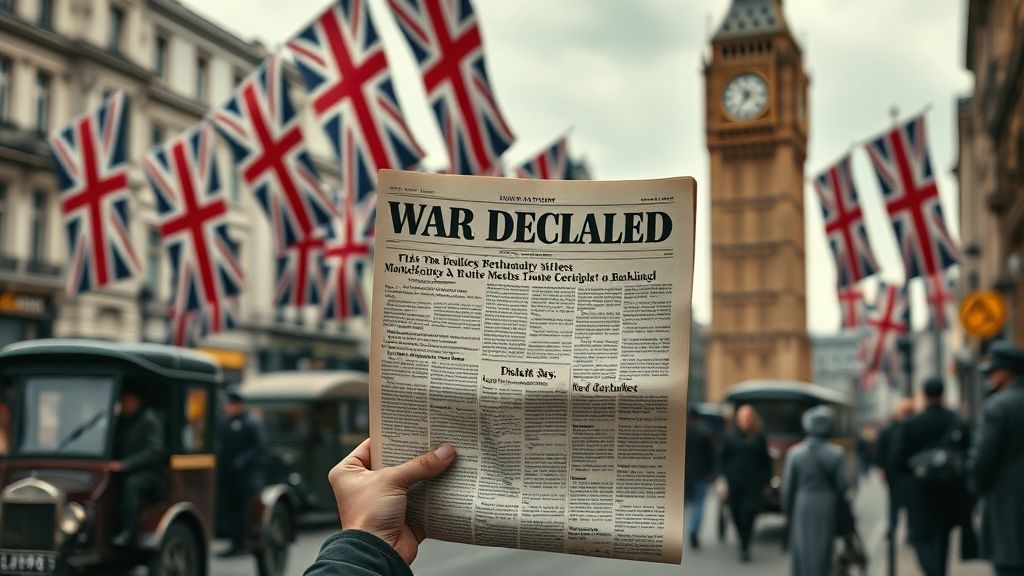
Outside the halls of power, Londoners responded with a mixture of shock, pride, and anxiety. Newspapers hawked sensational headlines; crowds gathered outside the War Office, murmuring in uncertainty.
Patriotic fervor soon blossomed. Men lined up to enlist, their faces flush with a mixture of excitement and dread. Volunteers came in waves, spurred by a sense of duty to King and country.
Yet beneath the surface was a complex blend of emotions. Mothers clung to their sons; clergy preached for peace amid prayers for victory. The city hummed nervously—aware that the coming years would test every fiber of the nation’s resolve.
The Political Chessboard: Key Figures and Debates in Parliament
The declaration brought to the fore Britain’s political heavyweights. Herbert Asquith, the Liberal Prime Minister, balanced liberal ideals with the hard necessity of war. Winston Churchill, then First Lord of the Admiralty, championed naval supremacy and an assertive war stance.
Opposition parties, though critical, largely rallied to national unity. Yet debates simmered over conscription, military preparedness, and the best path forward.
Sir Edward Grey’s diplomacy had sought peace until the last moment, but now his words directed the war effort. His famous statement, “The lamps are going out…” resonated with a nation bracing for darkness.
Mobilizing an Empire: The Challenge Ahead
Britain’s declaration of war was not merely a national act but the awakening of an empire. Men and materials from Canada to India, Australia to South Africa stood poised for the conflict’s unfolding.
Logistics became paramount. The Royal Navy enforced a blockade threatening Germany’s supplies. Recruitment drives swelled; the British Expeditionary Force prepared to deploy to the Western Front, where newly industrialized warfare awaited.
Britain faced the monumental task of turning a relatively small standing army into a force capable of waging modern, mechanized war across continents.
The Royal Family and National Identity in Times of Crisis
King George V, though a German-speaking descendant of the House of Hanover, was a symbol of British unity. The monarchy’s role in bolstering morale and national identity grew as war progressed.
The royal family’s public appearances carried weight, reinforcing bonds between the crown and subjects. Symbols like the red poppy would later emerge, but even early on, rituals and ceremonies sought to frame sacrifice and service as noble.
Press and Propaganda: Shaping Public Opinion for War
Newspapers, pamphlets, and posters played critical roles in keeping public opinion galvanized. The government quickly moved to censor unfavorable reports but encouraged stirring narratives of heroism and justice.
Propaganda portrayed the German enemy as a brutal “Hun,” fostering a fierce narrative that would fuel recruitment and patriotism but also sow deep enmities.
The media was a battlefield as much as the trenches would become—shaping perceptions that mattered for unity and endurance.
The Global Stakes: Britain’s Empire and the World Stage
Britain was no isolated island: the empire’s vastness meant that war stretched from the Caribbean to the Indian Ocean. Colonies contributed troops, resources, and strategic bases.
The conflict threatened to redraw maps worldwide. Control of sea lanes, colonies, and trade routes became entangled with military objectives, making the war truly global.
Voices from the Front: Early Warnings and Soldier Sentiments
Within weeks of Britain’s declaration, the first troops landed in France and Belgium. Letters and reports sent back home revealed a mixture of confidence and sobering reality.
Soldiers described the intensity of modern war—graphic, mechanized, different from anything previously imagined. Yet a steadfast resolve permeated their words: England was at war, and they were ready to shoulder the burden.
The First Ripples of War: Economic and Social Impacts
War transformed British society. Industries shifted production; food shortages and rationing began to seep into daily life.
Unemployment initially dropped as factories churned for the war effort, but inflation and social change stirred unrest. The idyllic Edwardian way of life gave way to a society braced for sacrifice.
Women and the War Effort: An Emerging Role
As men went to the front, women’s roles shifted dramatically. They stepped into factories, offices, and agricultural work, sustaining the home front.
The war began to fracture traditional gender roles, fueling future social movements and altering Britain’s social fabric.
Cultural Reflections: Art, Literature, and the Spirit of 1914
Artists and writers responded to the outbreak of war with a complex blend of patriotism and later, disillusionment.
The immediate period saw poems celebrating courage and sacrifice, but as the bloodshed dragged on, literature and art bore witness to the grim realities, capturing the fractured spirit of a generation.
Misconceptions and Hopes: The War Everyone Thought Would Be Quick
One of the most poignant ironies is the expectation that the war would last only months, “over by Christmas.”
The early optimism masked the brutal stalemate and attrition to come. August 4, 1914, was thus not just the start of war but the end of any naive hopes for a swift resolution.
Britain’s War Aims: Beyond Defending Belgium
While Belgium’s defense provided the immediate casus belli, British war aims extended further: curbing German ambitions, preserving the empire, and maintaining Europe’s balance of power.
This declaration signaled Britain’s entry into a conflict that demanded not only military might but strategic vision and endurance.
The Aftershock: How August 4 Set the Century’s Course
The declaration of war resonated far beyond 1914. It launched the United Kingdom into a conflict that would reshape borders, politics, and societies.
The Great War sowed the seeds of future conflicts but also led to profound changes—in democracy, international relations, and in the consciousness of nations.
Historians’ Perspectives: Revisiting the Declaration a Century Later
Modern scholarship continues to debate Britain’s entry into war—was it a moral necessity, an imperial strategy, or an unavoidable tragedy?
With access to archives and broader perspectives, historians paint a nuanced picture of a nation caught between idealism and realpolitik, courage and fear.
Conclusion
The declaration of war by the United Kingdom on Germany on August 4, 1914, was a watershed moment—a point at which centuries of history, passion, and ideology coalesced into a single historic decision. It was a day when a nation bound itself to a path of sacrifice, endurance, and transformation.
Yet beyond political maneuvering and strategic calculations, it is the human dimension that lingers most poignantly. The hopes and fears of Londoners watching the lamps go out, of soldiers setting off into the unknown, and of families bracing for a future darkened by war remind us that history is lived, not just recorded.
This day was the beginning of a profound journey—one that forever altered Britain and the world, challenging every assumption about war, peace, and humanity itself.
FAQs
Q1: Why did Britain declare war on Germany in 1914?
Britain declared war largely due to Germany’s invasion of neutral Belgium, violating the 1839 Treaty of London, combined with fears over German military dominance threatening British interests and the balance of power in Europe.
Q2: Who were the key British figures involved in the decision?
Prime Minister Herbert Asquith, Foreign Secretary Sir Edward Grey, and First Lord of the Admiralty Winston Churchill were pivotal in the political and military deliberations leading to Britain’s entry into the war.
Q3: How did the British public react to the declaration of war?
The public displayed a mix of shock, patriotism, and anxiety. Initial waves of volunteer enlistment were driven by national pride and duty, though underlying fears and grief were also pervasive.
Q4: What role did the British Empire play following the declaration of war?
Britain’s empire contributed significant manpower, resources, and strategic value, making World War I a truly global conflict. Dominion forces fought alongside British troops on multiple fronts.
Q5: How did Britain’s declaration of war impact the economy and society in 1914?
The economy shifted to war production, unemployment dropped initially, but shortages and inflation began affecting daily life. Social roles, especially for women, began to change as the war effort expanded.
Q6: Was Britain obligated to defend Belgium?
Yes, under the 1839 Treaty of London, Britain had guaranteed Belgium’s neutrality. Germany’s violation was both a legal and moral justification for Britain’s declaration of war.
Q7: How is Britain’s entry into World War I viewed by historians today?
Historians debate between viewing it as a necessary defense of international law and balance, an imperial calculation, or a tragic inevitability. Most agree it was a complex decision shaped by multiple factors.
Q8: What was the significance of August 4, 1914, beyond Britain?
This date marked Britain’s entry into the Great War, transforming a regional conflict into a global one and setting in motion events that would shape the geopolitical landscape of the 20th century.