Table of Contents
- The Dawn of July 1, 1916: A Quiet Before the Storm
- Europe on Edge: The Prelude to the Somme
- The Great War in 1916: Stalemate and Strategy
- Planning the Offensive: The British and French Commanders’ Gamble
- The Role of Technology and Artillery in Shaping the Battle
- The Morning of the First Day: Soldiers’ Hopes and Horrors
- The Cry of War: The Initial Assault Unfolds
- The First Hours: Chaos, Heroism, and Catastrophe
- The Toll on the British Army: Casualties and Crushing Reality
- French Involvement and Their Struggles on the Right Flank
- German Defenses: Fortified Lines and the Depth of Resistance
- Soldiers’ Voices: Letters, Diaries, and the Human Experience
- Media Narratives and Public Reactions in Britain and France
- The Battle’s Progress Beyond Day One: Weeks of Grinding Attrition
- Strategic Repercussions: Did the Somme Change the War?
- Innovations in Warfare: What Somme Taught Military Minds
- The Psychological Impact on Armies and Civilians
- Remembering the Somme: Memorials, Literature, and Legacy
- Myths and Misconceptions: Separating Fact from Fiction
- The Battle of the Somme in Global Memory and Historiography
July 1, 1916, dawned over Albert, a modest town nestled in the rolling fields of northern France. As a pale pink light gilded the horizon, there was, paradoxically, an eerie calm that cloaked the trenches. The soldiers—the young men from Britain and their French allies—waited, breaths held and hearts pounding, for the signal that would fracture the quiet with a roar unlike any before. This was the beginning of the Battle of the Somme, a moment destined to become one of the most brutal, defining engagements of the First World War. It was a day that would witness unprecedented devastation, heroism, and tragedy—a day where over 20,000 British soldiers lost their lives before the sun set.
The opening salvo of the Somme did not come from a distant past or a distant land. It emerged amidst the muddy, blood-soaked trenches of Europe’s Western Front, a killing field that had by 1916 become synonymous with war’s senseless stalemate. The battle was conceived not merely as a clash of armies, but as a desperate bid by the Allied powers to break the impasse and shatter the formidable German lines that had stalled progress for nearly two years. And so, with a gigantic artillery barrage designed to pulverize German defenses, British and French troops began an assault that would stretch across several months, transforming the quiet fields near the River Somme into a vast, scarred landscape of human sacrifice.
But the Battle of the Somme was more than just a military operation. It was a crucible that revealed the brutal realities of industrialized warfare, exposed the limitations of strategy clashing with technological innovation, and imprinted itself deeply upon the collective consciousness of nations and generations to come. As we journey back through those fateful days, it is impossible not to confront the human stories etched into the mud and blood – stories of courage and despair, ambition and failure, hope and grief. This is the story of the Battle of the Somme’s beginning: a story that demands not only to be remembered but to be understood in all its complex and tragic grandeur.
The inescapable tension across Europe in mid-1916 had been simmering for nearly two years since the outbreak of World War I in 1914. The war had draped itself like a dark cloud over the continent, each nation plunged into a desperate, grinding conflict that defied expectation and shattered illusions of swift victory. Originally, many had imagined the war would be short, perhaps decided within months, but by 1916, the Western Front had solidified into a gruesome stalemate. Trenches stretched like scars across the land from the North Sea to the Swiss border, and life for the infantrymen was a brutal routine of mud, cold, fear, and death.
The origins of the Battle of the Somme lay in a grim strategic calculus. The French army, under enormous strain after the Battle of Verdun—arguably the longest and most ferocious battle at that point—was desperately in need of relief. Verdun had become a symbol of French national tenacity but also a blood-soaked quagmire. Britain, newly determined to assert its offensive capabilities, pledged to open a second front on the Somme, a quiet sector at the time, to force the Germans to divert forces and alleviate the pressure on Verdun. This strategic choice, jointly devised by the British commander General Sir Douglas Haig and French General Ferdinand Foch, sought to break the deadlock by sheer weight of numbers and firepower.
However, beneath this strategic rationale lurked profound disagreements and uncertainties. Haig, often criticized by historians for his rigidity and perceived unrealistic expectations, believed in the power of artillery to destroy enemy defenses and thus make infantry advances possible. His faith in the “creeping barrage” and massive bombardment was to shape the initial assault. The reality would prove far more complicated. German forces, seasoned and deeply entrenched, had fortified their positions with underground bunkers, barbed wire, machine guns, and a depth of defense that many in Allied command underestimated.
Technology had evolved since the outbreak of war, adding layers of complexity to the battlefield. The Somme was to become a testing ground for new weapons: tanks made their debut weeks later during the battle, artillery techniques became more precise and devastating, and airplanes began to play reconnaissance and support roles. Yet, these innovations arrived alongside the grim industrialization of killing, where massed infantry attacks met with withering machine-gun fire, leading to staggering casualties.
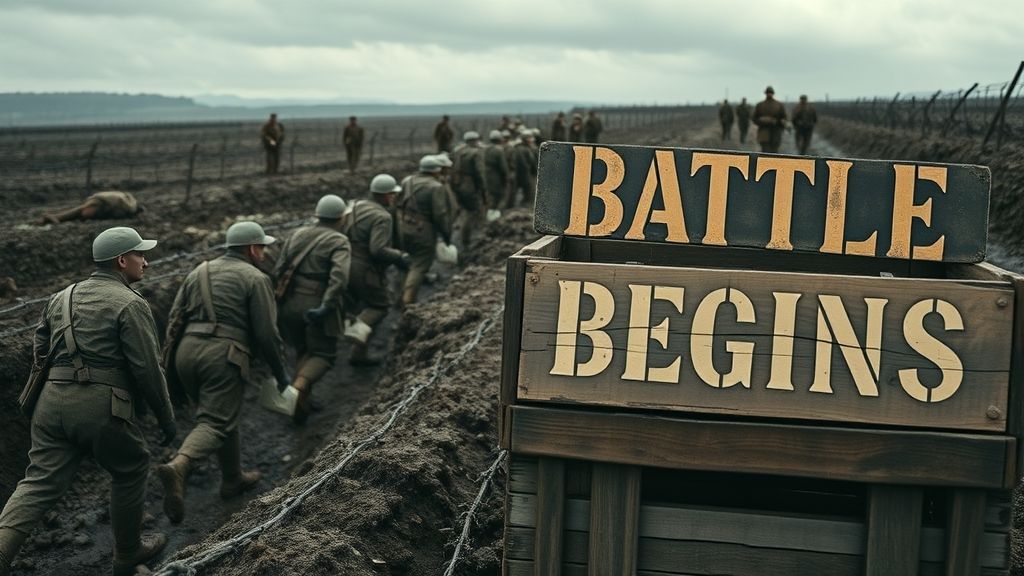
In the early hours of July 1, 1916, an assault force of over 100,000 British troops lay in their trenches, hearts pounding in synchrony with the artillery pounding German lines. Many men mused about the brief peace before the storm, writing letters to loved ones, exchanging jokes as a shield against fear, or silently preparing themselves for what might be their last moments. “We stood up to go over the top," one soldier later recounted. "The whistle blew, and the earth around us seemed to explode.”
At precisely 7:30 a.m., the long-anticipated artillery barrage lifted—a moment when millions of shells had targeted German defenses for seven continuous days. The attack began. Thousands of men rose and stepped over the parapets, moving forward in tightly choreographed waves. Yet what awaited many was a nightmare of uncut wire, hidden machine gun nests, and deadly terrain. Instead of swift gains, British troops met with relentless resistance and devastating fire.
The cost was immediate and staggering. On the very first day of the Somme, the British Army suffered nearly 60,000 casualties, including more than 19,000 killed—the bloodiest day in British military history. Amidst the carnage emerged acts of extraordinary bravery: men like the “Pals Battalions,” groups of friends who had enlisted together and endured the horrors side by side. Yet the sorrow was palpable, and the battlefield's mud was soon soaked with the blood of a generation.
The French forces, meanwhile, faced their own brutal challenges on the southern flank. Their attack, though less costly on July 1, was essential for pinning German troops and facilitating the broader allied offensive. The German defenders, commanded by General Fritz von Below among others, displayed a resilience that would extend the battle into months of grinding attrition.
Humanizing the battle beyond numbers involves delving into the letters, diaries, and memories left behind by those who lived it. One British officer wrote to his family before the assault: “If this letter reaches you, think of me as proud as any man can be to have fought for King and country today.” These voices—rife with hope, fear, love, and despair—create a tapestry that captures the essence of the Somme experience.
Back home, the media reported with cautious optimism, often downplaying the human cost in a bid to maintain morale. Yet families waiting for news often received telegrams filled with grim brevity. The Battle of the Somme quickly became a symbol in British and French public consciousness of both heroic sacrifice and tragic futility.
The weeks and months following the first day on the Somme saw a war of attrition unfold, with both sides enduring continuous shelling, counterattacks, and minor territorial gains measured in yards rather than miles. The offensive ultimately claimed over one million casualties, making it one of the bloodiest battles ever fought. Yet its strategic impact remains debated: did the Somme break the stalemate or merely deepen it?
In military terms, the battle catalyzed shifts too significant to ignore. The introduction of tanks, refined artillery tactics, and the increasing role of air power all foreshadowed the future face of warfare. At the same time, the psychological scars etched by the Somme left a generation forever marked by grief and disillusionment, shaping literature, politics, and military thought for decades.
Memory and commemoration of the Battle of the Somme have created a powerful legacy. From the Thiepval Memorial to countless books, poems, and museum exhibitions, the Somme stands as a stark monument to the costs of war and the resilience of human spirit. Yet myths around the battle’s leadership and purpose persist, reminding us how history is often as much about interpretation as facts.
Ultimately, the Battle of the Somme is woven into the global narrative of the First World War — a testament to horror, courage, and the complex dance of human conflict. Its echoes continue to resonate, challenging us to remember not only the scale of loss but the lives behind the lines.
Conclusion
The beginning of the Battle of the Somme on July 1, 1916, was a moment charged with hope, dread, and immense human cost. It represented the dark face of industrialized warfare, where strategy collided with the unyielding realities of entrenched, machine-infested battlefields. Yet beyond the staggering numbers and grim tactics, it was a human story—of young men stepping into the unknown, of families carved by loss, and of nations grappling with the price of conflict.
This battle did not end the war, nor did it offer clear victories. Instead, it exposed the limits of military theory faced with evolving technology and the indomitable resilience of men entrenched in earth and mud. Its legacy endures in memorials, in stories passed from generation to generation, and in the somber collective memory of humanity’s struggles.
The Battle of the Somme reminds us that history is lived experience—complex, painful, yet essential for understanding who we are and the costs of the dreams we chase. It challenges us to mourn the past honestly and to strive for a future where the lessons of such sacrifice are never forgotten.
FAQs
Q1: What was the main objective of the Battle of the Somme?
A1: The primary goal was to break the deadlock on the Western Front by launching a massive offensive against German positions, relieving pressure on the French at Verdun, and forcing Germany to divide its forces.
Q2: Why was the first day of the Somme particularly deadly for the British?
A2: The British suffered high casualties due to underestimated German defenses, uncut barbed wire, machine gun nests, and the failure of the artillery bombardment to destroy enemy positions fully.
Q3: Which new military technologies were introduced during the Battle of the Somme?
A3: The battle saw the first significant use of tanks, improved artillery tactics including the creeping barrage, and expanded roles for aircraft in reconnaissance and support.
Q4: How did the French contribute to the battle?
A4: The French launched coordinated attacks primarily on the southern flank, which were designed to engage German forces and support the broader offensive, although their casualties on July 1 were lower.
Q5: What were the psychological effects of the battle on soldiers and civilians?
A5: The immense loss and brutal conditions led to widespread trauma among soldiers (then often referred to as “shell shock”) and deep grief among civilians, influencing post-war culture and perceptions of war.
Q6: How is the Battle of the Somme remembered today?
A6: It is commemorated through memorials like the Thiepval Memorial, literature, films, and public ceremonies, symbolizing both sacrifice and the horrors of industrial warfare.
Q7: Did the Battle of the Somme achieve its strategic aims?
A7: Opinions vary; while the battle failed to deliver a decisive breakthrough, it did relieve Verdun and strained German resources, influencing the broader trajectory of the war.
Q8: What myths exist about the Battle of the Somme?
A8: Myths include oversimplified critiques of British leadership as reckless and pointless slaughter; while leadership mistakes occurred, the situation was complex, shaped by emerging tactics and harsh realities.