Table of Contents
- The Dawn of a New Chapter: America’s Declaration of War, April 6, 1917
- The World at War: Europe’s Devastation and Diverging Alliances
- America’s Isolationist Roots: The Reluctance to Enter the European Conflict
- The Underlying Forces: Economic Interests and Ideological Sympathies
- The Submarine Menace: German U-Boat Warfare and the Turning Tide
- The Sinking of the Lusitania: A Nation Shocked, Morality Shaken
- The Zimmermann Telegram: Intrigue and the Breaking Point
- President Woodrow Wilson’s Calculated Decision: From Neutrality to Engagement
- Congressional Debate: Voices of Isolation and Intervention
- April 6, 1917: The Fateful Vote and the Speech That Changed History
- Mobilizing a Nation: From Peace to War Economy
- The Propaganda Machine: Rallying the American People
- The Doughboys Prepare: Training the American Expeditionary Forces
- The Psychological Shift: American Identity in Wartime
- The Global Impact: How US Entry Redrew World Maps
- The Human Cost: Soldiers, Civilians, and the Toll of War
- The Treaty of Versailles and America’s Role in Peace-making
- Reflections in Retrospect: Lessons and Legacies of 1917
- War Memories and Commemorations: Keeping History Alive
- The United States’ Emergence as a World Power: A New Global Order
The Dawn of a New Chapter: America’s Declaration of War, April 6, 1917
On a gray spring day in Washington, D.C., the halls of Congress filled with a palpable tension, an air thick with uncertainty and resolve. Outside, cherry blossoms fluttered gently in the cool breeze—a delicate contrast to the storm brewing within the United States government. It was April 6, 1917, a date forever etched into the American consciousness. On this day, the United States officially declared war on Germany, ending nearly three years of official neutrality and thrusting the young nation into the epic tragedy of World War I.
Inside the Chamber, President Woodrow Wilson’s voice rang clear, solemn yet resolute: "The world must be made safe for democracy." The declaration was not just a political act—it was an emotional turning point, a rupture that altered the course of American and global history. Citizens across the country felt the tremors of this commitment, as families sent their sons, factories shifted gears, and newspapers splashed headlines that meant the world was now at war—not just over seas, but at America's doorstep.
But this declaration did not arrive out of a sudden impulse. It was the culmination of years of escalating tensions, political maneuvering, and profound shifts within the international order.
The World at War: Europe’s Devastation and Diverging Alliances
By 1917, Europe had been engulfed in a brutal conflict for nearly three years. The continent was a sprawling battlefield, drenched in blood and scarred by relentless artillery fire. The Central Powers, led by Imperial Germany and Austria-Hungary, battled fiercely against the Entente Powers, which counted Britain, France, and Russia among their ranks.
This complex web of alliances had evolved from deep historical tensions—imperial ambitions, nationalist fervor, and an arms race that made war increasingly inevitable. What had begun as a regional conflict after the assassination of Archduke Franz Ferdinand in June 1914 spiraled into a total war involving nations across the world.
The United States watched warily from its Atlantic shores, sympathetic to allies culturally and economically, but fiercely protective of its own isolationist traditions.
America’s Isolationist Roots: The Reluctance to Enter the European Conflict
The American public and policymakers were deeply divided in opinion regarding the conflict across the Atlantic. The prevailing sentiment adhered to a long-standing tradition of isolationism, championed by the late President George Washington and recent legislators who believed that America should avoid entanglements with foreign powers.
Many Americans felt that the war was a distant European quarrel, offering no clear benefit or threat to the United States. The “melting pot” nation was also home to countless immigrants with divided loyalties—German, Irish, and others who harbored strong opinions about who should win and lose.
President Wilson himself had campaigned for re-election in 1916 under the slogan “He kept us out of war,” a testament to his initial commitment to peace.
The Underlying Forces: Economic Interests and Ideological Sympathies
Yet, beneath this public reluctance flowed powerful currents pulling America closer to involvement. The U.S. economy had become intertwined with the Allies through trade and loans. Britain and France depended on American industries for weapons, food, and supplies, tying American prosperity to their survival.
Moreover, many Americans identified ideologically with the Allied cause. The democratic ideals of Britain and France contrasted with the autocratic ambitions of the German Kaiser, feeding a moral imperative to support the fight for liberty and justice.
Still, politics remained a delicate balance between profit and principle, neutrality and intervention.
The Submarine Menace: German U-Boat Warfare and the Turning Tide
One of the most significant provocations that undermined America’s neutrality was Germany’s aggressive use of unrestricted submarine warfare. The German Navy unleashed U-boats that targeted military and civilian vessels alike, attempting to blockade Britain and starve it into submission.
Ships flying neutral flags were not spared if suspected of aiding the Allies. This ruthless strategy threatened American lives and commerce—crossing a red line for many in the U.S.
The sinking of the British liner Lusitania in 1915, with 128 Americans aboard, stunned the nation and ignited fierce debate but did not immediately cause war.
The Sinking of the Lusitania: A Nation Shocked, Morality Shaken
May 7, 1915—on a foggy day off the coast of Ireland, the Lusitania, a luxury ocean liner, was torpedoed by a German U-boat. Within minutes, the great ship sank, plunging over a thousand passengers into turbulent waters. Among the dead were 128 Americans whose deaths sent ripples of outrage through the United States.
President Wilson condemned the attack as "deliberately done" but still sought to preserve neutrality. The debate raged: Was this an act of war or tragic collateral damage in a distant conflict? Public opinion swayed between shock, grief, and calls for caution.
Yet, the Lusitania tragedy marked a turning point—a cruel awakening to the war’s harsh realities.
The Zimmermann Telegram: Intrigue and the Breaking Point
February 1917 delivered a dramatic revelation that pushed the United States closer to war. British intelligence intercepted a secret message from German Foreign Minister Arthur Zimmermann to Mexico, proposing a military alliance against the United States. Germany promised to help Mexico regain lost territories in Texas, New Mexico, and Arizona if it joined the fight.
When British operatives revealed the telegram to American newspapers, the story electrified public opinion. The threat was no longer abstract—it was a direct challenge to American sovereignty and security.
President Woodrow Wilson’s Calculated Decision: From Neutrality to Engagement
Faced with German provocations and Allied entreaties, President Wilson grappled with the fate of his nation. His decision was not taken lightly. In his war address to Congress, he framed the conflict as a crusade to protect democracy itself.
Wilson declared: “The world must be made safe for democracy.” This phrase echoed with a vision beyond mere military engagement—it envisioned a moral duty and a new role for America on the world stage.
Wilson’s advocacy helped sway reluctant lawmakers and citizens to embrace intervention as necessary and just.
Congressional Debate: Voices of Isolation and Intervention
Congressional halls became a battleground as voices clashed over the question of war. Isolationists warned of the dangers of foreign entanglements that could drag the country into endless conflict. Interventionists, bolstered by Wilson and Allied influence, argued for decisive action to defend American lives and ideals.
After impassioned debate, the Senate voted 82 to 6, and the House followed with 373 to 50. The legislative body had spoken. The United States would enter the carnage of World War I.
April 6, 1917: The Fateful Vote and the Speech That Changed History
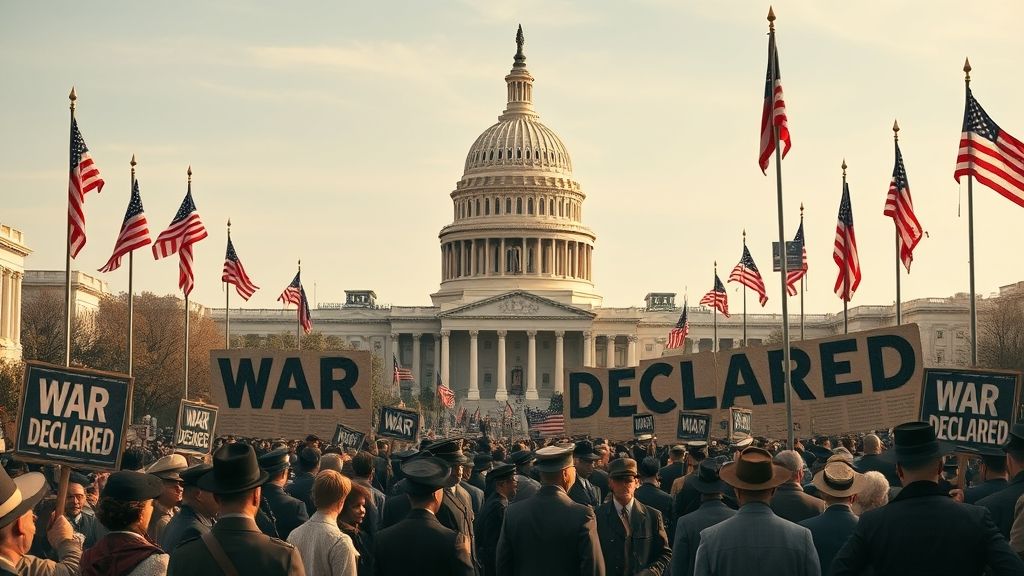
On this momentous day, following Wilson’s eloquent appeal, Congress formally declared war on Germany. The declaration united the country’s political leaders, albeit with lingering opposition.
Wilson’s words resonated not only within Washington but across a nation on the cusp of transformation. Newspapers chronicled the event in soaring language. Crowds outside the Capitol erupted in cheers, sensing the weight and promise of what lay ahead.
But this was not a celebration of violence—it was the solemn acceptance of duty.
Mobilizing a Nation: From Peace to War Economy
With war declared, the United States embarked on an unprecedented mobilization. Factories converted from consumer goods to munitions. Farmers increased production to feed troops overseas. Millions registered for the draft as the Selective Service Act took effect.
The government created new agencies to manage resources, distribute materials, and regulate industry. This war effort reshaped the American economy, expanding federal power and industrial capacity.
It was a dizzying transformation that lifted a once insular country into the throes of global conflict.
The Propaganda Machine: Rallying the American People
To sustain support for the war, the government launched effective propaganda campaigns. The Committee on Public Information, directed by George Creel, used posters, films, speeches, and newspapers to promote patriotism and demonize the enemy.
“Join or Die,” “Enlist Now,” and other slogans filled public spaces as artists and writers contributed to a narrative that inspired sacrifice and unity. Yet, dissent was sometimes silenced, and civil liberties curtailed in the name of national security.
Still, morale and enthusiasm for the war effort grew as men marched off to battle.
The Doughboys Prepare: Training the American Expeditionary Forces
American troops, soon nicknamed “Doughboys,” faced the daunting task of transforming from civilians to soldiers. Training camps sprung up across the country, where recruits learned marksmanship, trench warfare, and military discipline.
Under the command of General John J. Pershing, the American Expeditionary Forces prepared for deployment to Europe. Their presence would prove crucial in bolstering tiring Allied troops and turning the tide of battle.
Youthful, inexperienced, but eager, the Doughboys carried the hopes of a nation into foreign trenches.
The Psychological Shift: American Identity in Wartime
War did not merely change military strategies—it reshaped American identity. Patriotism gained new meaning; national unity was stressed over internal divisions.
Women took on new roles in factories and nursing, minorities pressed for recognition and rights, and debates over freedom and security intensified. The war served as a crucible, testing America’s values and social fabric.
It was a time of hope and contradiction, courage and sacrifice.
The Global Impact: How US Entry Redrew World Maps
America’s entry into the war accelerated the defeat of the Central Powers. Fresh troops and resources tipped the balance as 1918 began.
Beyond the battlefield, the war redrew borders, toppled empires, and paved the way for new nations. It laid the groundwork—albeit imperfect—for an international order aimed at peace through diplomacy and collective security.
The United States would emerge not as an isolated giant but as a key player on the global chessboard.
The Human Cost: Soldiers, Civilians, and the Toll of War
The glory of victory came at a steep price. Over 116,000 American soldiers lost their lives, thousands more wounded physically and scarred psychologically.
Civilian populations across Europe suffered famine, displacement, and widespread trauma. The influenza pandemic of 1918, which traveled with soldiers worldwide, compounded the suffering.
The war’s legacy is not just in maps or treaties, but in the countless personal stories of loss and resilience.
The Treaty of Versailles and America’s Role in Peace-making
At the war’s end, President Wilson championed a vision for a just peace embodied in his Fourteen Points and the League of Nations. His ideals inspired hope but met resistance, especially within a reluctant Senate fearful of new entanglements.
Though the Treaty of Versailles redrew boundaries and imposed harsh penalties on Germany, the United States ultimately rejected full membership in the League, a sign that isolationism lingered despite the war’s transformative impact.
Reflections in Retrospect: Lessons and Legacies of 1917
Looking back, America’s declaration of war in 1917 was a pivotal moment—a crucible that forced a young nation to confront its role in a fractured world.
The experience shaped its military, politics, and identity. It taught the costs of war, the power of ideals, and the complexity of global leadership.
Historians continue to debate motivations and consequences, but no one doubts the profound impact of that fateful decision.
War Memories and Commemorations: Keeping History Alive
Throughout the 20th century and beyond, the memory of America’s entry into World War I has been preserved in memorials, literature, and public ceremonies.
Veterans’ organizations, museums, and schools have kept alive the stories of sacrifice and courage. The 100th anniversary saw renewed interest, prompting reflection on peace and the human cost of conflict.
Remembering 1917 is essential to understanding America's journey and responsibilities.
The United States’ Emergence as a World Power: A New Global Order
Ultimately, April 6, 1917, marked more than just a war declaration; it heralded America’s emergence as a global power. Its military might, economic strength, and diplomatic influence would shape international affairs throughout the 20th century.
From reluctant neutral to decisive leader, the United States stepped onto a stage that demanded engagement and vision—a role still defining the nation today.
Conclusion
America’s declaration of war against Germany in 1917 was a moment drenched in gravitas—an inflection point where ideals, realities, and ambitions collided. It was a leap from isolation to engagement, from observer to actor on a tumultuous international stage. The decision carried immense consequences: lives irrevocably changed, a nation transformed, and a new chapter in global history inscribed.
Yet beyond the politics and battles lies a human story—of leaders who wrestled with conscience, of citizens who faced uncertain futures, of soldiers who carried the burden of war across the ocean. To remember April 6, 1917, is to grasp the complexity of courage, the price of peace, and the enduring hope for a world safe for democracy.
FAQs
Q1: What were the main reasons the United States declared war on Germany in 1917?
A1: The key reasons included Germany’s unrestricted submarine warfare, notably attacks on neutral ships carrying Americans; the revelation of the Zimmermann Telegram proposing a German-Mexican alliance against the U.S.; economic ties to the Allies; and President Wilson’s vision of making the world safe for democracy.
Q2: Why did the United States remain neutral for the first three years of World War I?
A2: American isolationist traditions, public opinion favoring neutrality, and the desire to avoid costly foreign entanglements kept the U.S. out of the conflict initially. There was also a divide among immigrant communities and political figures on which side, if any, to support.
Q3: How did the sinking of the Lusitania affect American public opinion?
A3: The sinking of the Lusitania in 1915, which killed 128 Americans, shocked the public and generated outrage against Germany. Though it did not immediately trigger war, it shifted opinion substantially towards intervention over time.
Q4: What impact did the Zimmermann Telegram have on U.S. decision-making?
A4: The Zimmermann Telegram was a serious provocation that revealed Germany’s intent to incite Mexico against the U.S. It galvanized public and political support for war, as it posed a direct threat to American security.
Q5: What role did Congress play in the declaration of war?
A5: Congress debated vigorously but ultimately voted overwhelmingly in favor of war after President Wilson’s address. This legal authorization formalized America’s entry into World War I.
Q6: How did the U.S. mobilize its military and economy for the war effort?
A6: The government implemented the draft via the Selective Service Act, converted industries for munitions production, increased agricultural output, and established agencies to manage resources and information. Propaganda campaigns helped rally public support.
Q7: What were the human costs of U.S. participation in World War I?
A7: More than 116,000 American soldiers died, with many thousands wounded. Civilians worldwide endured hardships, including famine and disease. The 1918 influenza pandemic further exacerbated suffering.
Q8: How did America’s entry into World War I influence its role on the world stage?
A8: The war marked America’s emergence as a global power, demonstrating its military might and diplomatic influence. While it withdrew somewhat from the League of Nations, the U.S. remained engaged in shaping the postwar world.