Table of Contents
- The Sunset of an Empire: Europe on the Brink, Winter 1917-1918
- The Bolshevik Revolution: A New Power Grips Russia
- War and Weariness: Russia’s Devastation by 1918
- The Long Road to Brest-Litovsk: Negotiations Begin
- Who Sat at the Table? The Key Figures of the Treaty
- The Central Powers’ Demands: Ruthless and Unyielding
- Lenin’s Gamble: Peace at Any Cost?
- The German Advance: Pressure Mounts Beyond Diplomacy
- Signing in the Shadow of Occupation: March 3, 1918
- The Terms of Defeat: Territorial Losses and Political Consequences
- Reactions Across Russia: Outrage and Resignation
- Europe’s New Map: Shattered Borders and New Nations
- The Treaty’s Global Impact: Changing the Great War’s Trajectory
- The Struggle within Bolshevik Ranks: Unity or Division?
- The Treaty’s Ghosts: Seeds of Future Conflicts
- Remembering Brest-Litovsk: Historical Debates and Memory
- Conclusion: A Fragile Peace Marked by Turmoil
- FAQs: Key Questions About the Treaty of Brest-Litovsk
- External Resource: Wikipedia Link
- Internal Link: Visit History Sphere
The Sunset of an Empire: Europe on the Brink, Winter 1917-1918
The bitter cold of the Eastern European winter of 1917 was more than just a test of endurance—it was the tipping point of an empire gasping under the weight of endless war. Amid the frostbitten streets and snow-covered plains of Western Russia, the once mighty Tsarist realm was unraveling, consumed by hunger, exhaustion, and the growing fires of revolution. The grand narrative of World War I, defined by brutal stalemates and millions of casualties, was about to be dramatically reshaped—not on the bloody Western Front—but on the icy negotiation table of Brest-Litovsk.
The Bolshevik Revolution: A New Power Grips Russia
Months earlier, in the unrest of Petrograd’s streets, the world witnessed the seismic upheaval of the Bolshevik Revolution. Led by the enigmatic Vladimir Lenin, the Bolsheviks seized power promising “peace, land, and bread.” The war-weary masses, desperate for change, rallied behind voices that championed an immediate end to the bloodshed. Yet, the reality confronting this new regime was daunting—Russia was still locked in the brutal conflict of the Great War, its armies battered, its people hungry, and its fate uncertain.
War and Weariness: Russia’s Devastation by 1918
By early 1918, Russia’s military and civilization were fractured. Over two years of fighting had left millions dead or wounded. Railways and factories were crippled, the countryside scarred, and food supplies perilously low. The Provisional Government, which had attempted to keep Russia in the war after February 1917, fell to the Bolsheviks’ promise of peace. Yet delivering on this promise meant confronting the humiliations of defeat—the harsh realities of surrendering vast swathes of territory and influence.
The Long Road to Brest-Litovsk: Negotiations Begin
The opening gambit began in December 1917 as the Bolsheviks entered negotiations with the Central Powers—Germany, Austria-Hungary, Bulgaria, and the Ottoman Empire—at Brest-Litovsk, a small town on the edge of Belarus. The talks were tense from the start. For Russia’s new leaders, peace was a lifeline; for the Central Powers, exacting a punishing victory was the goal. As diplomats pondered and generals poised, the vast expanse of Eastern Europe became the prize—and the pawn—in an unfolding political drama.
Who Sat at the Table? The Key Figures of the Treaty
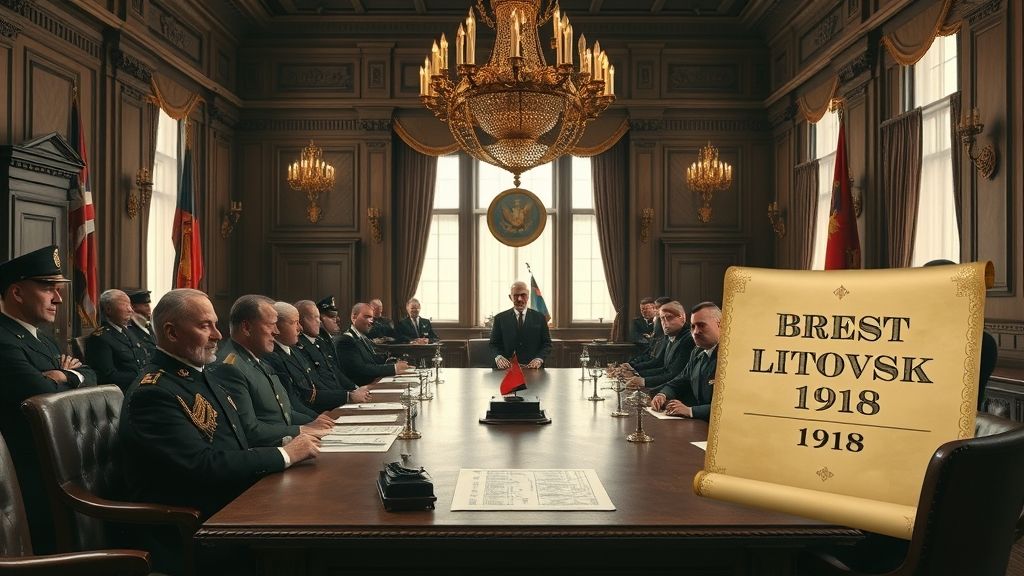
The negotiating table at Brest-Litovsk was a theatre of intense personalities. On the Russian side stood Leon Trotsky, the brilliant but stubborn Commissar for Foreign Affairs, who combined ideological zeal with strategic calculation. Opposite him was Count Richard von Kühlmann, the German Foreign Secretary, wielding the weight of military success and nationalist ambition. More shadowed but no less critical were representatives of Austria-Hungary, Bulgaria, and the Ottoman Empire, each with their own stakes and agendas. Together, these figures shaped a treaty that would reverberate for decades.
The Central Powers’ Demands: Ruthless and Unyielding
The Central Powers approached the negotiations from a position of strength. The German High Command saw the talks not as diplomacy but as a way to force Russia out of the war forever—and to extract maximum concessions. Demands included the loss of Poland, the Baltic States (Estonia, Latvia, Lithuania), parts of Belarus and Ukraine, and economic privileges that stripped Russia of its industrial and agricultural wealth. It was a treaty that sought to erase Russia’s status as a great power, at least for the time being.
Lenin’s Gamble: Peace at Any Cost?
Back in Moscow, Lenin faced a torturous choice. Trotsky’s initial “neither peace nor war” strategy attempted to stall, hoping to turn world opinion and foment revolution in Germany. Yet, the German army’s relentless advance into Russian territory made this impossible. Lenin, guided by hard realism and ideological conviction, pushed for signing the treaty to preserve the revolutionary government. His famous words echoed: “You cannot make an omelette without breaking eggs.” To Lenin, peace—even a humiliating peace—was necessary survival.
The German Advance: Pressure Mounts Beyond Diplomacy
By February 1918, the situation on the ground became grim. German troops crossed into Ukraine and Belarus, overrunning towns and communications. The Red Army was still nascent, disorganized, and ill-prepared for sustained defense. This reality made the diplomatic stalemate untenable—signing the treaty was less a choice and more a grim necessity. Brest-Litovsk was no mere place of negotiation; it was a liminal ground where the fate of millions was decided under the shadow of tanks and artillery.
Signing in the Shadow of Occupation: March 3, 1918
On a bitter cold morning, March 3, 1918, the Treaty of Brest-Litovsk was signed. The ceremony was subdued, almost somber. The ink on the parchment sealed a humiliating peace for Russia but a critical reprieve for the Bolsheviks. Vast territories were ceded; millions of people and resources passed to enemy hands. It was a peace that split a nation, but one that allowed the Bolsheviks to focus inward—to consolidate power, fight civil war, and nurture the embryonic Soviet state.
The Terms of Defeat: Territorial Losses and Political Consequences
The treaty was staggering in scope. Russia renounced claims to Finland, Poland, Lithuania, Latvia, Estonia, and Ukraine—amounting to more than a million square kilometers and a third of its population. Industrious regions, rich in coal and agriculture, were lost. The political ramifications were profound: the treaty shattered centuries of Russian imperial identity and realigned power in Eastern Europe, heralding new, fragile national experiments while sapping Russia’s global standing.
Reactions Across Russia: Outrage and Resignation
Within Russia, reactions were polarized. Many Bolsheviks, including Trotsky, distrusted the treaty, viewing it as a betrayal of proletarian internationalism. Some soldiers and citizens saw it as capitulation and humiliation. Yet, the harsh realities of survival muted opposition. Meanwhile, anti-Bolshevik factions seized upon the treaty as evidence of the revolution’s betrayal of Russia’s honor, fueling the fires of the civil war that would plunge Russia into further decades of bloodshed.
Europe’s New Map: Shattered Borders and New Nations
One of the treaty's profound consequences was the redraw of Eastern Europe. The map was an intricate mosaic of new tiny states and contested sovereignties. Poland re-emerged; Ukraine attempted independence albeit fragile; the Baltic states planted the seeds of nationhood. The collapse of imperial borders sowed both hope and conflict. The Treaty of Brest-Litovsk thus stands as a crucial juncture from which modern Eastern Europe emerged, though scars of its rupture remain visible even today.
The Treaty’s Global Impact: Changing the Great War’s Trajectory
Internationally, the treaty sent shockwaves. The Central Powers could transfer troops to the Western Front, intensifying battles in France and Belgium. But ironically, the treaty’s harsh terms galvanized Allied resolve to fight on. The United States, not yet involved in Eastern Europe but brother-in-arms in the wider war, perceived the treaty as a dangerous precedent, emboldening nationalism and territorial dismemberment. The repercussions echoed beyond 1918, shaping interwar diplomacy and future conflicts.
The Struggle within Bolshevik Ranks: Unity or Division?
The treaty exposed deep fault lines within the Bolshevik leadership. Trotsky’s diplomatic tactics, often called “neither war nor peace,” conflicted with Lenin’s pragmatism. Many feared signing such a treaty would irreparably weaken the revolution. Nonetheless, Lenin’s priorities—to save the nascent regime—won out. This episode reveals the tensions between ideology and realpolitik, a dilemma threading through Soviet policy in decades to come.
The Treaty’s Ghosts: Seeds of Future Conflicts
While the Treaty of Brest-Litovsk ended Russia’s direct involvement in WWI, it planted seeds of new conflicts. The cession of territories would ignite struggles for independence, border disputes, and civil wars. It fractured Russian society and embittered nationalist groups. Moreover, many historians argue that the harsh terms contributed to the rise of extremist ideologies in Germany and Eastern Europe, further destabilizing a continent already reeling from total war.
Remembering Brest-Litovsk: Historical Debates and Memory
The legacy of Brest-Litovsk remains contested. For Soviet historians, it was often portrayed as a bitter but necessary sacrifice for revolution. In Western traditions, it has been seen as a moment of betrayal or tragic necessity. The treaty’s name evokes different emotions—shame, pragmatism, or strategic brilliance—depending on perspective. Yet, its significance as a pivotal moment in twentieth-century history is undeniable, marking the intersection of war, revolution, and diplomacy.
Conclusion: A Fragile Peace Marked by Turmoil
The Treaty of Brest-Litovsk stands as a haunting testament to the costs of revolution and war. It was not a triumphant peace but a reluctant truce with catastrophe, a grim contract signed under duress. Yet it also granted the Bolsheviks the breathing room to survive, to transform Russia profoundly, and to leave an indelible mark on global history. Brest-Litovsk was more than a treaty—it was a crossroad of empires and ideologies, a fleeting moment when the old world collapsed, and a new, uncertain era dawned.
FAQs
Q1: Why did Russia agree to such harsh terms in the Treaty of Brest-Litovsk?
A1: Russia was war-weary, with its military exhausted and its new Bolshevik government struggling to consolidate power. Facing the threat of German invasion and internal chaos, Lenin prioritized peace over territorial integrity, accepting harsh terms to preserve the revolution.
Q2: Who were the main negotiators of the treaty?
A2: The chief Russian negotiator was Leon Trotsky, while Germany was represented by Count Richard von Kühlmann. Representatives from Austria-Hungary, Bulgaria, and the Ottoman Empire also took part.
Q3: What territories did Russia lose under the treaty?
A3: Russia ceded Finland, Poland, the Baltic states (Estonia, Latvia, Lithuania), parts of Belarus and Ukraine, vast regions important for industry and agriculture.
Q4: How did the treaty affect the wider course of World War I?
A4: It allowed Germany to shift troops from the Eastern to Western Fronts, intensifying battles there. However, it also galvanized Allied determination and complicated postwar negotiations.
Q5: How did Russian society react to the treaty?
A5: Reactions varied from outrage and feelings of betrayal to pragmatic acceptance, reflecting the fractured nature of Russian society during civil strife.
Q6: Did the treaty have a lasting impact on Eastern Europe?
A6: Yes, it dramatically altered borders and national identities, setting the stage for future conflicts and independent states emerging after the war.
Q7: What internal conflicts did the treaty cause within the Bolshevik Party?
A7: It exposed ideological divisions between those wanting to hold out against German demands and Lenin’s faction advocating immediate peace at any cost.
Q8: How is the Treaty of Brest-Litovsk remembered today?
A8: It remains a complex historical moment—viewed as both a betrayal and a necessary survival strategy—symbolizing the immense dilemmas faced by revolutionary Russia.