Table of Contents
- The Guns Fall Silent: A Morning Like No Other
- Europe Woven in War: The Preludes to 1918
- Fraught Diplomacy: The Road Toward an Armistice
- The Setting: Compiègne Forest, A Quiet Witness
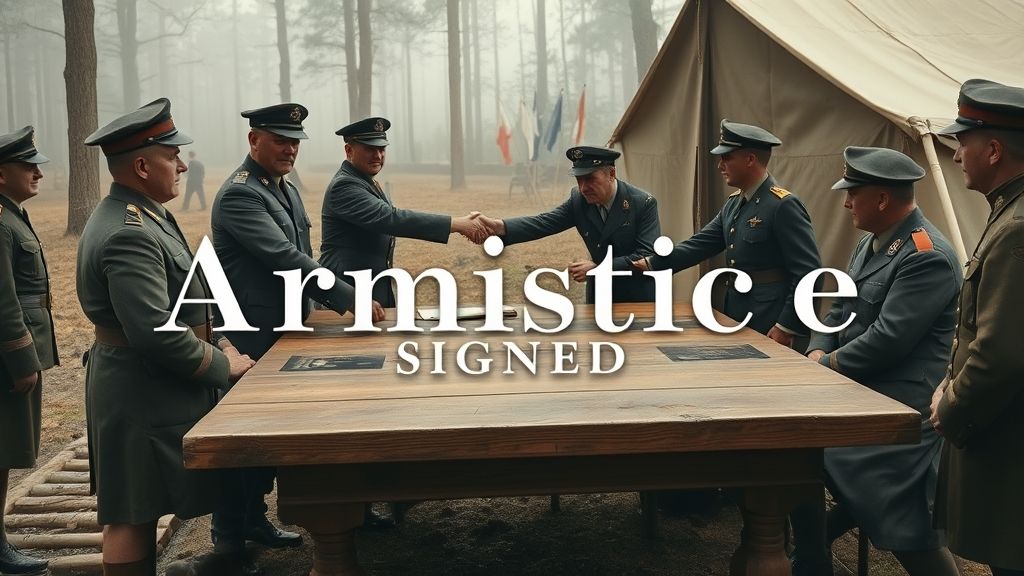
- The Delegations Assemble: Faces Behind the Table
- The Terms That Ended a World at War
- The Emotional Weight of November 11th, 1918
- Across Battlefields: Reactions from Trenches to Capitals
- The Shadow of Defeat and the Silence of Victory
- The Paris Peace Conference Looms: Seeds of Future Conflict
- France’s Symbolic Triumph and Lingering Pains
- Germany’s Weary Capitulation: Between Pride and Despair
- Global Repercussions: The End of Empires and the Birth of New Orders
- November 11th in Memory: Rituals, Remembrances, and Myths
- The Armistice’s Legacy in Modern Europe and Beyond
- Lessons Carved in Wood and Steel: War’s Final Toll
- Historiography: How Views of the Armistice Evolved
- Voices from the Day: Memoirs, Diaries, and Testimonies
- Reflections on Peace and the Fragility of Ceasefires
- The Compiègne Armistice Today: A Living History
- Conclusion: Remembering the Moment When War Stood Still
- FAQs: Unearthing the Details of the 1918 Armistice
- External Resource
- Internal Link
1. The Guns Fall Silent: A Morning Like No Other
On November 11th, 1918, as the eleventh hour approached, a hush spread over the scarred landscapes of Europe unlike anything the war-weary continent had known in four brutal years. At the exact moment when the cold steel of rifles surrendered their echoes, and artillery ceased their thunderous cries, an invisible thread of fragile peace stitched together once-irreconcilable nations. The Armistice of Compiègne, signed hours earlier in a musty railway carriage nestled deep within the Compiègne Forest in northern France, was the alchemy that turned bullets to silence.
Across craters and shattered villages, on muddy fields dotted with the fallen, men listened intently, breath held, hearts pounding—not only because the carnage was ceasing, but because the world itself seemed to pause, trembling on the cusp of an uncertain dawn. Some whispered prayers, others wept quietly, and a few dared a hopeful smile. This day was not a victory parade; it was the cessation of the unimaginable, a fragile ceasefire that fashioned hope amidst ruin. Yet beneath this fragile calm lay a complex web of emotions: relief, sorrow, exhaustion, and a foreboding suspicion that peace might prove as elusive as the ceasefire was temporary.
2. Europe Woven in War: The Preludes to 1918
World War I was never meant to last as long or devastate as ruthlessly as it did. What began in the summer of 1914 as a localized crisis—a tangled mesh of alliances, nationalism, and imperial ambitions—quickly flared into a global conflagration. From the first gunshot fired in Sarajevo to the last artillery barrage on the Western Front, Europe was consumed by a mechanized nightmare.
By 1918, the continent was a patchwork of exhausted armies, ruined economies, and fractured societies. The Central Powers—led by Germany, Austria-Hungary, and the Ottoman Empire—had hoped for rapid triumph but were instead ground down by attrition and the entry of new forces, most notably the United States in 1917. The Allied Powers, despite staggering losses, clung stubbornly to their cause.
The year 1918 was crucial. A series of offensives tested the endurance of all. The German Spring Offensive initially made alarming gains, threatening to break the stalemate, but it was ultimately blunted by the weary but progressively reinforced Allied forces. By late summer, the momentum shifted decisively. A counteroffensive, bolstered by American troops and fresh weaponry, shoved the Central Powers back, exposing the fragility beneath their war effort.
3. Fraught Diplomacy: The Road Toward an Armistice
Despite the grinding battles, war is settled first and foremost at the negotiating table—or so the broken leaders hoped. By autumn 1918, the diplomatic landscape became a battlefield of its own. Germany, increasingly isolated and crippled by internal strife, knew the futility of prolonged fighting. The empire’s social fabric was unraveling; food shortages sparked unrest, and the prospect of revolutionary upheaval loomed.
The Allies, led politically by France’s Georges Clemenceau, Britain’s David Lloyd George, and the United States’ Woodrow Wilson, each brought different visions to the peace process. Wilson’s famous Fourteen Points emphasized self-determination and a “peace without victory,” while Clemenceau demanded strict punishment for Germany.
Messages crossed enemy lines, emissaries exchanged cautious signals. On October 4th, the German Chancellor Prince Max of Baden reached out, asking Presidents Wilson and Poincaré for an armistice based on the Fourteen Points. Wilson responded with conditions that Germany could barely swallow.
Internal instability pushed German leaders to act swiftly. By November, the emperor abdicated, revolution spread in Germany, and a new government appeared eager for peace.
4. The Setting: Compiègne Forest, A Quiet Witness
The place chosen for the armistice signing was imbued with symbolism and practicality. A secluded railway carriage in the Compiègne Forest, about 60 kilometers north of Paris, offered a neutral, secluded spot away from prying eyes and fragile nerves.
The carriage itself—a modest wooden structure—was transformed into a makeshift negotiation table. Heavy clouds hovered low, the forest loomed somberly, and the chill November air hinted at the gravity of what was unfolding. It was in this quiet enclave that war’s monsters momentarily stepped into the human realm of dialogue.
5. The Delegations Assemble: Faces Behind the Table
On the Allied side, Marshal Ferdinand Foch, Supreme Allied Commander, stood as the inexorable face of victory and terms. His austere demeanor masked a profound understanding of the stakes involved. Accompanying him were generals and politicians, each carrying the hopes and wrath of millions.
The German delegation was led by Matthias Erzberger, a civilian politician—and later vilified in his country for his role—alongside military officers. Their expressions revealed a mixture of fatigue, resignation, and veiled desperation. Erzberger reportedly pleaded for leniency, aware that Germany’s fate hung by a thread.
The assembly in that forest carriage was a collision of worlds: victors and vanquished, idealists and pragmatists, men who had borne the great burden of war and those who were now ending it.
6. The Terms That Ended a World at War
The armistice terms were delivered by Foch with unmistakable firmness. They included the immediate cessation of hostilities, the evacuation of occupied territories by Germany, the surrender of vast amounts of military equipment, and crucially, Allied occupation of the Rhineland. Communication lines and railway control shifted swiftly to maintain strategic advantage.
Though called an “armistice,” what was signed was more akin to a surrender under stringent conditions—fatally humiliating for the Germans, many viewed it as a diktat.
The agreement was brief—only seven pages—but its implications monumental. It was designed not to end the war definitively, but to stop the fighting while a lasting peace treaty was negotiated, which would come with the Versailles Treaty in 1919.
7. The Emotional Weight of November 11th, 1918
When the armistice was announced, disbelief was mingled with jubilation. Crowds poured into streets, church bells rang out, and strangers embraced, united by the release from an unimaginable nightmare.
Yet alongside celebration was deep mourning: millions of dead, countless maimed, and overburdened communities facing daunting reconstruction. Some soldiers, hearing the news in trenches, found tears in the mud; others remained skeptical, remembering previous false dawns.
The hours that followed were a kaleidoscope of human emotions—ecstasy, grief, hope, and exhaustion.
8. Across Battlefields: Reactions from Trenches to Capitals
On the Western Front, soldiers cautiously dropped weapons and shared rations with former enemies in moments of fragile camaraderie. In London, Paris, Washington, euphoria was tempered by somber reflection. German cities braced for upheaval as revolution spread.
Yet the end of the war’s fighting did not end suffering overnight. Food shortages, displaced peoples, and the Spanish flu pandemic added layers of despair.
9. The Shadow of Defeat and the Silence of Victory
For the Allies, victory was costly and mixed. The war had destroyed empires and redrawn maps, but it also sowed resentment, especially in Germany, where the armistice was remembered as a “stab in the back”—a myth that would poison future politics.
Victory was heavy with responsibility. Clemenceau called it “the war to end all wars,” yet few suspected the fragile ceasefire was only the end of an act, not the grand finale.
10. The Paris Peace Conference Looms: Seeds of Future Conflict
The armistice was a pause, not a peace. The subsequent Paris Peace Conference would pour old enmities and new ideals into a treaty that attempted to reconcile justice with power.
Wilson’s vision was compromised by nationalist desires and revengeful claims. The Treaty of Versailles, signed in 1919, was hailed as the new world’s foundation but also condemned for its harshness, planting the seeds of future war.
11. France’s Symbolic Triumph and Lingering Pains
France, ground zero of Western Front carnage, saw the armistice as both relief and vindication. The scars of battlefields littered its landscape; its people carried unbearable losses.
The choice of Compiègne was symbolic—a reclaiming of French soil and dignity. Yet the war’s toll lingered in economic difficulty and political instability.
12. Germany’s Weary Capitulation: Between Pride and Despair
For Germany, the armistice marked not just defeat, but a profound identity crisis. The abdication of Kaiser Wilhelm II and establishment of the Weimar Republic did little to heal national wounds.
Many Germans regarded the armistice as a betrayal by civilian “November criminals,” fueling political extremism. Erzberger himself was assassinated in 1921, target of nationalist rage.
13. Global Repercussions: The End of Empires and the Birth of New Orders
The armistice rippled far beyond Europe. The Austro-Hungarian and Ottoman empires collapsed, new nations rose from their ashes, and colonial ambitions scrambled to fill the void.
The global order shifted, setting the United States on a new world stage while societies coped with the trauma of mechanized warfare.
14. November 11th in Memory: Rituals, Remembrances, and Myths
November 11th quickly became a symbol of remembrance, honoring those lost and commemorating the fragile gift of peace. Monuments like the Tomb of the Unknown Soldier in Paris and London were erected.
Yet memory proved complex, often entwining fact with myth, and remembrance with political narratives.
15. The Armistice’s Legacy in Modern Europe and Beyond
The ceasefire signed in that forest carriage inadvertently shaped the century ahead. Its harsh terms inculcated bitterness in Germany that contributed to the rise of Nazism and a second, even grimmer conflict.
The principle of armistice itself remains a lesson on the necessity—and fragility—of peace agreements.
16. Lessons Carved in Wood and Steel: War’s Final Toll
The notorious armistice not only ended a war but also revealed humanity’s capacity for destruction and its yearning for reconciliation. Statues, memorials, and hundreds of books continue to recount its meaning.
It vividly reminds us that peace must be negotiated with honesty, justice, and compassion, lest history repeat its mistakes.
17. Historiography: How Views of the Armistice Evolved
Historians have debated the armistice’s terms, causes, and consequences for decades. Early accounts often reflected national biases, but contemporary scholarship offers nuanced views on the political dilemmas and human costs.
Recent works emphasize the human stories behind the political headlines, revealing the toll on individual lives.
18. Voices from the Day: Memoirs, Diaries, and Testimonies
Soldiers’ letters, diaries of commanders, and politicians’ memoirs give vivid, personal textures to the event. One British officer recalled “the strange silence that followed—like the world held its breath.”
Similarly, German accounts conveyed bitter relief mingled with shame and confusion.
19. Reflections on Peace and the Fragility of Ceasefires
The Armistice of Compiègne endures as a profound meditation on peace’s fragility. Ceasefires halt violence but do not resolve deeper conflicts.
Understanding this moment helps us appreciate the arduous path from ceasefire to lasting peace, a lesson painfully learned by generations since.
20. The Compiègne Armistice Today: A Living History
Today, the railway carriage that hosted the signing lives in the Glade of the Armistice museum, visited by tens of thousands annually. It stands as a solemn relic and a call to vigilance against the resurgence of conflict.
Elsewhere, commemorations and education keep alive the memory of that critical November day.
21. Conclusion: Remembering the Moment When War Stood Still
The Armistice of Compiègne on November 11th, 1918, was more than a political act; it was a human moment, charged with relief, grief, and profound uncertainty. It ended hostilities but also marked the beginning of a complex quest for peace.
Its story compels us to remember war’s terrible costs and to cherish every fragile moment when peace prevails.
FAQs
Q1: What exactly was signed at Compiègne on November 11th, 1918?
A1: The Armistice of Compiègne was a ceasefire agreement that ended fighting on the Western Front during World War I. It was not a peace treaty but a suspension of hostilities pending formal negotiations.
Q2: Why was the armistice signed in a railway carriage in the Compiègne Forest?
A2: The remote setting provided secrecy, neutrality, and a secure environment away from large cities. The railway carriage was a convenient, symbolic location representing mobility and the path to peace.
Q3: Who were the main figures involved in the signing?
A3: On the Allied side, Marshal Ferdinand Foch led the negotiation, while Matthias Erzberger and German generals represented Germany.
Q4: What were the immediate consequences of the armistice?
A4: Hostilities ceased, German troops began withdrawal, and the groundwork was laid for the Treaty of Versailles. However, political instability and economic hardship persisted.
Q5: How is November 11th commemorated today?
A5: Known as Armistice Day or Remembrance Day, it is marked by ceremonies honoring fallen soldiers, moments of silence, and educational events worldwide.
Q6: Did the armistice guarantee lasting peace?
A6: Unfortunately, no. While it ended WWI’s fighting, unresolved issues and punitive terms contributed indirectly to the outbreak of World War II.
Q7: How did German society react to the armistice?
A7: Reactions ranged from relief to outrage. Many Germans felt betrayed by their leaders, fueling political turmoil that destabilized the Weimar Republic.
Q8: What is the historical significance of the Compiègne signing today?
A8: It symbolizes the costly end to a devastating war and the complexities of peacemaking—lessons that continue to resonate in international relations.