Table of Contents
- The Dawn of International Cooperation: Setting the Stage for the League
- Aftermath of the Great War: A World Bent on Peace
- Drafting the Covenant: Visionaries, Skeptics, and Diplomats
- The League of Nations Covenant: A Blueprint for Peace
- January 10, 1920: A Historic Day in Geneva
- The Assembly in Session: The League's First Steps
- Key Principles and Innovations within the Covenant
- The Power and Limits of Collective Security
- Early Challenges: Manchuria, Upper Silesia, and the Abyssinian Crisis
- The Role of the United States: An Unfulfilled Promise
- Member States’ Dynamics: Cooperation and Conflict
- The Secretariat and Institutions: Creating a Global Bureaucracy
- The Covenant’s Impact on International Law and Diplomacy
- Cultural and Political Ripples Across the Globe
- The League’s Legacy and the Road Toward the United Nations
- Reflections on the Covenant’s Failures and Enduring Lessons
- How the Covenant Shaped Modern Peacekeeping
- Voices from the Time: Speeches, Anecdotes, and Memoirs
- The Significance of Geneva: A City Transformed by Diplomacy
- Conclusion: Hope, Fragility, and the Pursuit of Peace
- FAQs: Understanding the League of Nations Covenant
- External Resource
- Internal Link
On a crisp Swiss morning, January 10, 1920 dawned with more than the serene snow over Geneva’s lake; it heralded an unprecedented global commitment. At that precise moment, the League of Nations Covenant entered into force—a manifesto of hope borne from the ashes of the Great War. The air was thick with a cocktail of cautious optimism and the solemn awareness of recent horrors. Delegates who had spent months crafting this idealistic framework for peace awaited the world’s verdict, each aware that a fragile new order hinged on the principles they had painstakingly agreed upon.
The League Covenant was not merely a document; it was a promise, a tentative bridge spanning the chasm of distrust that war had carved between nations. Yet, as the clock struck and the Covenant took legal effect, many wondered: could these lofty words truly rewrite the brutal language of conflict? Would the League succeed in knitting together fractured alliances into a durable peace?
This article takes you through the extraordinary story of the League of Nations Covenant—from its visionary inception and turbulent ratification to its sobering challenges and lasting influence on international relations. Step by step, it reveals how the world’s first global peacekeeping attempt unfolded, shaped by idealism, geopolitical realities, and human aspirations.
The Dawn of International Cooperation: Setting the Stage for the League
The early 20th century was a world on edge. The industrial revolution had rapidly transformed societies, while nationalism and imperial ambitions sharpened rivalries. The assassination of Archduke Franz Ferdinand in 1914 unleashed the war that would claim millions of lives and reshape borders dramatically. As guns silenced in 1918, the scale of devastation was staggering. Europe lay in ruins, its political and economic structures shattered. The human cost was incomprehensible—countless families mourned, entire generations scarred.
Amid this profound grief arose a yearning—an imperative—to ensure “never again.” Leaders, intellectuals, and the public alike demanded mechanisms to prevent future conflicts. President Woodrow Wilson of the United States emerged as a fervent advocate of a new international order centered on dialogue, justice, and collective security. His Fourteen Points, presented in January 1918, emphasized open diplomacy, self-determination, and most notably, the creation of a League of Nations to safeguard peace.
Yet, this dream was contested. Old empires struggled to westernize war and peace; victors sought reparations and dominion over vanquished foes. Balancing these tensions required delicate diplomacy as the world was poised between tradition and a hopeful future.
Aftermath of the Great War: A World Bent on Peace
The Treaty of Versailles (1919) formally ended World War I. It imposed harsh penalties on Germany but also included the Covenant of the League of Nations as Part I of the Treaty—integral yet separate. The Covenant was an innovative attempt to institutionalize international cooperation. It professed a commitment to resolving disputes through arbitration and collective action.
However, the treaty’s punitive nature toward Germany sowed seeds of resentment that would later destabilize Europe. Simultaneously, many countries wrestled with internal upheavals, economic crises, and the challenge of redefining sovereignty. The League Covenant thus entered a volatile political landscape, ambitious but vulnerable.
Drafting the Covenant: Visionaries, Skeptics, and Diplomats
Behind closed doors in the grand halls of the Paris Peace Conference, international delegates labored over the Covenant’s wording. John Foster Dulles of the United States, Léon Bourgeois of France, Jan Smuts of South Africa, and others emerged as key architects. They grappled with varied visions: some sought a supranational authority, others preferred a loose alliance of sovereign nations.
Debates were intense over enforcement mechanisms—would member states commit to military intervention? How to include or exclude aggressive powers? How to reconcile colonial interests with promises of self-determination? These discussions reflected the era’s complexity, as the world attempted to reconcile ideals with harsh realities.
The League of Nations Covenant: A Blueprint for Peace
The Covenant was revolutionary in its scope. It established the League’s principal organs—the Assembly, the Council, and the Permanent Secretariat. It embraced principles of collective security, dispute resolution through arbitration, disarmament promotion, and mandates for former colonies. The idea was clear: aggression against any member was aggression against all.
Article 10 was particularly significant: it called for the mutual protection of territorial integrity. This pledge suggested a collective responsibility unlike anything before in modern diplomacy. Yet, vagueness in enforcement and exemptions remained. The architecture was elegant but untested.
January 10, 1920: A Historic Day in Geneva
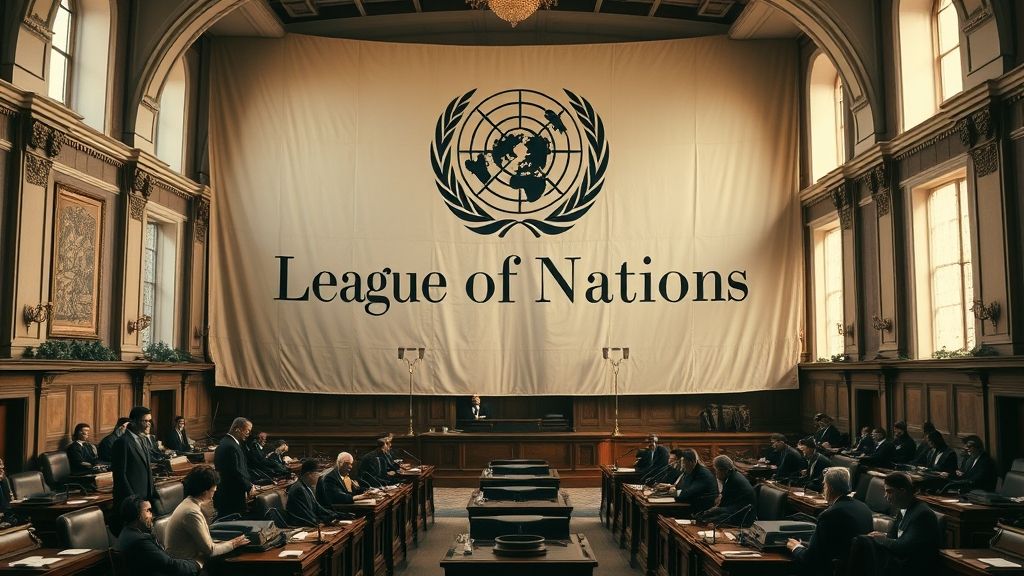
Geneva, known for its picturesque lake and alpine backdrop, assumed an unexpected global role on this day. The Covenant formally entered into force, signaling the inauguration of the League of Nations. Delegations from signatory nations converged on the Palais des Nations, an edifice soon to symbolize international dialogue.
The mood was buoyant but cautious. Delegates, journalists, and ordinary citizens gathered to witness a milestone—a new hope that diplomacy might triumph over the chaos of war. The clock ticking towards midnight seemed to carry the weight of future peace.
The Assembly in Session: The League's First Steps
The League’s inaugural Assembly convened shortly after the Covenant took effect, steered by President Sir Eric Drummond. Representatives introduced modest but important agenda items: humanitarian aid, health, refugees, and disarmament.
While debates were civil and hopeful, fractures quickly appeared. The absence of the United States—the very nation that championed the League—cast a shadow, as the Senate refused ratification of the Treaty of Versailles. This absenteeism was a critical blow to the League’s authority and effectiveness.
Key Principles and Innovations within the Covenant
The Covenant introduced several groundbreaking elements. It sought peaceful dispute settlement through negotiation, mediation, and arbitration before sanction or force could be considered. It abolished secret treaties, promoting transparency. It introduced mandates to manage former colonies under international supervision, attempting to reconcile imperial realities with emerging self-rule ideologies.
The League also pioneered special agencies addressing humanitarian concerns: the International Labor Organization, the Health Organization, and the Refugees Committee. These efforts demonstrated the Covenant’s broader vision beyond mere conflict mediation.
The Power and Limits of Collective Security
The foundation of the League’s promise was collective security—the idea that an attack on one member state would trigger the unified response of all. This concept was radical, aiming to deter aggression through solidarity.
Yet the mechanism was neither automatic nor forceful. Decisions required consensus. No permanent military force existed, leaving enforcement dependent on member states' voluntary cooperation. This structural weakness would later undermine the League’s credibility when tested by crises.
Early Challenges: Manchuria, Upper Silesia, and the Abyssinian Crisis
The League was soon confronted with serious tests. In 1921-1922, disputes over Upper Silesia and the Åland Islands required delicate arbitration to prevent escalation. The League succeeded in peacefully administering these cases, bolstering early confidence.
However, the Japanese invasion of Manchuria in 1931 revealed the League’s impotence. Japan flouted the Covenant’s principles with little effective reaction. Similarly, Italy’s invasion of Abyssinia (Ethiopia) in 1935 exposed the League's failure to uphold collective security, as economic sanctions proved ineffective and major powers refrained from military action.
These failures critically eroded faith in the League.
The Role of the United States: An Unfulfilled Promise
Though President Wilson was the Covenant’s foremost architect, the United States Senate rejected American membership. This moment marked a profound irony: the nation promoting the League from afar refused to join, citing concerns over entangling commitments and national sovereignty.
The U.S. absence deprived the League of vital political, economic, and military weight. Member states struggled to enforce resolutions or project authority without American backing. The League became a European-dominated forum, less global and less potent.
Member States’ Dynamics: Cooperation and Conflict
The League was a mosaic of 42 original members, gradually increasing. These ranged widely in power, interests, and geopolitical goals. Conflicts often arose between great powers and smaller nations, between colonial powers and emerging independence movements, and within competing alliances.
The League had to balance these between cooperation and rivalry. This dynamic dictated much of its operational challenges: can a body dominated by imperial powers fairly address indigenous aspirations? Could conflicting national interests override commitments to peace?
The Secretariat and Institutions: Creating a Global Bureaucracy
To function, the League established a Secretariat, a pioneering supranational bureaucracy that coordinated its functions. Drawn from diverse nationalities, these civil servants worked on diplomacy, reporting, and administration.
The League’s specialized agencies grew complex—addressing labor rights, health crises, trafficking, and refugees. These institutions showed how the Covenant inspired beyond politics, fostering early multilateral governance.
The Covenant’s Impact on International Law and Diplomacy
The League’s Covenant pioneered principles that shaped modern international law. It popularized arbitration, dispute settlement forums, and the concept of international responsibility for peace. Non-recognition of territorial gains by force became a normative principle.
The Covenant directly influenced later treaties and the foundation of the United Nations charter after World War II. It laid the conceptual groundwork for modern multilateralism.
Cultural and Political Ripples Across the Globe
Though centered on Europe, the League’s reach extended worldwide. The mandate system reshaped colonial governance in Africa, the Middle East, and Asia. New ideas about minority rights, labor standards, and humanitarian aid permeated national policies.
Simultaneously, the League influenced cultural understandings of sovereignty and international cooperation which continue to resonate today.
The League’s Legacy and the Road Toward the United Nations
Despite its eventual failure to prevent another global war, the League was a monumental experiment. It demonstrated both the potential and pitfalls of multinational governance.
After World War II, its flaws informed the architects of the United Nations, who sought stronger enforcement, broader participation, and deeper institutional integration. The League’s spirit—if not its structure—endures in contemporary global governance.
Reflections on the Covenant’s Failures and Enduring Lessons
Few international initiatives are as instructive as the League Covenant. Its failure owed much to political realities: nationalist rivalries, the absence of key powers, and the tension between sovereignty and collective responsibility.
Yet its ambitions and framework remain a testament to humanity’s enduring hope for peace. It teaches that international cooperation requires both idealism and pragmatism.
How the Covenant Shaped Modern Peacekeeping
The League laid the groundwork for peacekeeping practices—sending commissions to observe conflicts, mediating disputes, and addressing humanitarian crises. It demonstrated early forms of international intervention short of war.
While imperfect, these precedents influenced post-1945 peacekeeping and conflict resolution efforts.
Voices from the Time: Speeches, Anecdotes, and Memoirs
In his 1920 opening speech, League Secretary-General Sir Eric Drummond declared, "We have to remember that the League is not a panacea; it is an instrument fashioned by human hands—with all imperfections—but a beacon for humanity’s quest for peace."
Memoirs vary from hopeful idealism to bitter disappointment, reflecting the complexity of this diplomatic endeavor. Anecdotes of tense debates and fragile alliances illustrate the human dimension behind the Covenant’s dry articles.
The Significance of Geneva: A City Transformed by Diplomacy
Geneva evolved from a quiet Swiss city to a global diplomatic hub because of the League. The construction of the Palais des Nations symbolized new hopes for international governance. This legacy endures as Geneva remains home to numerous UN agencies and international organizations.
Conclusion: Hope, Fragility, and the Pursuit of Peace
The League of Nations Covenant entering into force was an epochal moment—a courageous, though ultimately fragile, leap toward collective security and international cooperation. Born from the horrors of World War I, it embodied humanity’s longing for peace and justice, yet struggled under the weight of distrust, conflicting national interests, and insufficient power.
Its legacy is paradoxical: a pioneering vision that failed spectacularly in its primary mission, but whose ideas and structures seeded future efforts toward global governance. The Covenant reminds us that peace demands vigilance, commitment, and above all, the courage to imagine a better world.
As we look back, the lessons of 1920 resonate deeply in today’s complex international landscape. The League’s story is a human story—of hope, failure, resilience, and the unending strive for harmony among nations.
FAQs
Why was the League of Nations Covenant created?
It was designed to prevent another catastrophic war by establishing a system of collective security, arbitration, and international cooperation after World War I.
What were the key principles of the Covenant?
Collective security, peaceful resolution of disputes, disarmament encouragement, and mandates for former colonies were among its core tenets.
Why didn’t the United States join the League?
Despite President Wilson’s support, the U.S. Senate rejected membership due to concerns over national sovereignty and involuntary military commitments.
What were the major challenges the League faced?
The League struggled with enforcement, notably during Japan’s invasion of Manchuria and Italy’s attack on Abyssinia, highlighting its limited power.
How did the League influence future international organizations?
It provided a structural and conceptual precedent for the United Nations, influencing peacekeeping, diplomacy, and international law.
Was the Covenant successful in preventing conflicts?
It achieved success in resolving certain territorial disputes peacefully but failed to prevent major conflicts leading up to World War II.
What is the legacy of the League’s covenant today?
Its vision of collective security and multilateral diplomacy continues to inform global governance and the quest for international peace.
How did Geneva become central to international diplomacy?
As home to the League and later UN agencies, Geneva transformed into a vibrant center for diplomacy, humanitarian work, and international law.