Table of Contents
- The Storm Before the Calm: Ireland’s Turbulent Road to 1921
- Rising Tensions: The War of Independence Unfolds
- The British Government’s Dilemma: Balancing Empire and Rebellion
- The Quest for Peace: Initiation of Anglo-Irish Negotiations
- Portraits of Peacemakers: The Key Figures Around the Table
- December 6th, 1921: The Day That Changed Ireland Forever
- The Terms of the Treaty: Freedom Wrapped in Compromise
- Jubilation and Outrage: Initial Reactions on Both Sides
- The Treaty’s Controversy: Sinn Féin Divided
- Arthur Griffith and Michael Collins: Voices of the Treaty
- Éamon de Valera’s Opposition: The Seeds of Civil War
- The Treaty Debates: A Battle of Ideals and Realities
- The Shadow of War: From Political Discord to Armed Conflict
- The Treaty’s International Impact and Recognition
- Economic Consequences: A Nation’s Struggle to Rebuild
- Cultural Reflections: How the Treaty Shaped Irish Identity
- Voices from the People: Stories of Hope and Despair
- The Legacy of the Anglo-Irish Treaty: A Nation Divided, A Nation Forged
- Remembering the Treaty in Modern Ireland
- Conclusion: The Complex Birth of the Irish Free State
- FAQs: Untangling the Anglo-Irish Treaty
- External Resource
- Internal Link
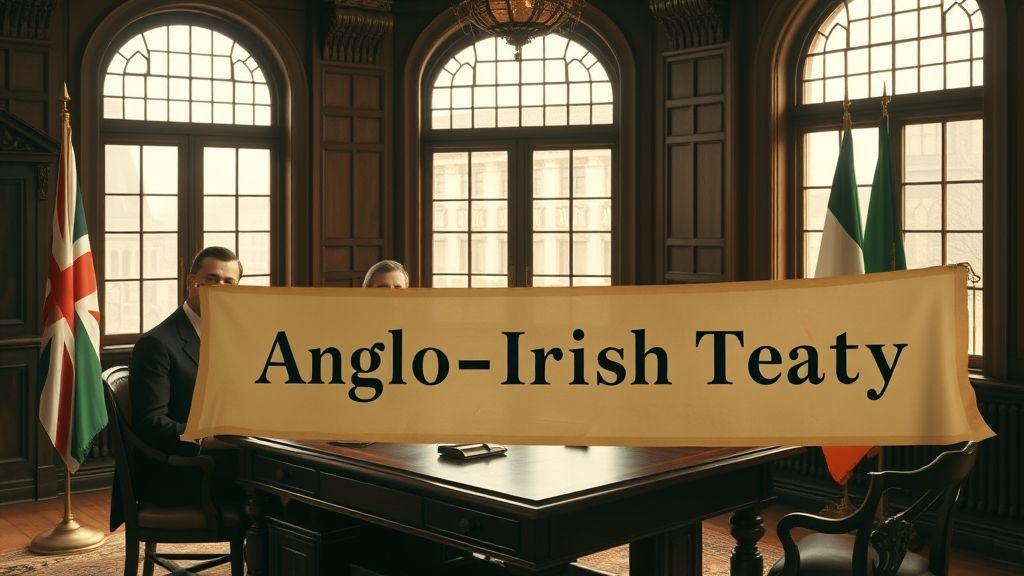
On a cold December day in 1921, the air in London was thick with somber anticipation and cautious hope. Beneath the austere roof of the Westminster Palace, representatives of two worlds sat down at the negotiating table—one bearing the scars of centuries-old colonial dominion, the other the weariness of a relentless fight for self-determination. The ink about to flow onto the Anglo-Irish Treaty was more than a mere signature; it was the fragile thread from which a new Irish future would dangle, poised precariously between peace and further upheaval.
The Storm Before the Calm: Ireland’s Turbulent Road to 1921
Ireland’s early 20th century was a landscape etched with blood and hope. The Home Rule movement had struggled for decades to achieve political autonomy, only to be repeatedly frustrated by British parliamentarian resistance and deep sectarian divides within the island itself. The eruption of the Easter Rising in 1916, though poorly executed and brutally suppressed, rekindled the flame of republicanism, imprinting the spirit of revolt on a new generation. As the Great War dragged on, so too did Ireland’s restless heart beat louder for freedom.
The shattering aftermath saw Sinn Féin’s electoral landslide in 1918, an overwhelming mandate for independence that the British government refused to recognize. The Irish Republic was declared, and with it, radical factions took up arms, plunging the island into the bitter guerrilla warfare known as the Irish War of Independence. By 1921, the economic, human, and political toll was unbearable on both sides.
Rising Tensions: The War of Independence Unfolds
In the dense Irish countryside and the narrow backstreets of Dublin, the Irish Republican Army (IRA) waged a relentless campaign against British forces and the notorious Black and Tans—a paramilitary police force infamous for its harsh reprisals. From bloody ambushes to assassination plots, the cycle of violence deepened, with civilian populations caught in the terrible crossfire.
The British government, commanding an empire that was fraying at the edges, struggled to maintain control. Public opinion in Britain began to waver as reports of brutal reprisals filtered through—atrocities that fueled condemnation at home and abroad. The situation became untenable: peace was imperative, but the terms were uncertain.
The British Government’s Dilemma: Balancing Empire and Rebellion
Faced with mounting pressure, Prime Minister David Lloyd George’s government began to reconsider the hard line. The cost—military, political, and moral—had become unsustainable. Yet, any concession to Irish demands risked eroding the imperial prestige of Britain, stirring unrest in other parts of the empire.
The internal tensions within Lloyd George’s cabinet reflected a broader dilemma: how to stem the tide of Irish nationalism without fracturing the empire irreparably. Back-channel diplomacy and preliminary contacts paved the way for formal talks—but with expectations guarded and the political stakes sky-high.
The Quest for Peace: Initiation of Anglo-Irish Negotiations
In July 1921, an uneasy truce was declared, halting hostilities to permit political dialogue. The venue was set: London, the heart of the empire. Both sides understood the gravity of the moment—what began as a military conflict was about to be shaped into a political accord, one that would either birth peace or ignite further conflict.
Negotiations were slow, fraught with mutual suspicion and conflicting demands. The Irish delegation sought unequivocal independence, while the British insisted on preserving the Crown's sovereignty and the unity of the United Kingdom. Through hours of tense dialogue, delicate compromises were painstakingly crafted.
Portraits of Peacemakers: The Key Figures Around the Table
The Irish delegation was led by Arthur Griffith and Michael Collins, two remarkably different figures united by a shared goal yet divided in style. Griffith, the veteran politico who favored compromise, stood out as a voice of pragmatism. Collins, the young and charismatic intelligence officer, was more hawkish but understood the necessity of strategic concessions.
Across the table stood British negotiators like David Lloyd George, Winston Churchill, and Austen Chamberlain—statesmen seasoned by war and empire. Behind their stiff exterior, many bore fatigue from the relentless conflict and the hopes of preserving Britain’s global stature.
December 6th, 1921: The Day That Changed Ireland Forever
The signing ceremony was somber. Held in London’s Downing Street, the treaty was finalized after gruelling weeks of negotiation. The cold winter’s day seemed to echo the chill in the room—a mixture of relief, uncertainty, and trepidation enveloped the signatories.
As quills scratched paper, the fate of millions hung in balance. The treaty granted Ireland dominion status within the British Empire—a status akin to that of Canada or Australia—offering self-government but falling short of full republic status. Yet, the concessions required to reach agreement would soon sow deep fissures.
The Terms of the Treaty: Freedom Wrapped in Compromise
The treaty’s clauses were both a breakthrough and a compromise so fraught that it would divide Ireland for years. Key provisions included:
- Establishment of the Irish Free State as a self-governing dominion under the Crown
- Oath of allegiance to the British monarch by members of the Irish parliament
- Partition of Ireland, with Northern Ireland opting to remain part of the UK
- British retention of certain military ports and rights
While granting considerable autonomy, the treaty fell short of full sovereignty, leaving ambiguities and resentments simmering beneath its surface.
Jubilation and Outrage: Initial Reactions on Both Sides
The Irish public greeted the treaty with elation and despair in equal measure. Some viewed it as a pragmatic step—an end to war and a new birth of freedom. Others saw betrayal: an acceptance of British overlordship and the legitimization of partition.
In Britain, relief was palpable. The empire had navigated a dangerous shoal without collapsing, but questions lingered about the stability of Ireland and the cost of imperial hubris. The treaty was hailed as a triumph of diplomacy, but the peace it promised proved fragile.
The Treaty’s Controversy: Sinn Féin Divided
Within Sinn Féin, the party that had championed full independence, the treaty cracked the movement apart. A narrow majority approved the agreement, led by Griffith and Collins. Yet a significant faction, led by de Valera, vehemently opposed it—refusing the oath and condemning any acceptance of partition.
These divisions were not merely political but deeply personal, shaking old friendships and alliances. The schism set the stage for bitter debate and, ultimately, violence.
Arthur Griffith and Michael Collins: Voices of the Treaty
Arthur Griffith, with his calm reasoning and moderate vision, saw the treaty as a stepping stone toward full independence. Michael Collins, whose role in intelligence and guerrilla tactics had made him a folk hero, spoke candidly of the harsh realities that had forced compromises. "Those who cannot make a compromise cannot make a nation," he famously remarked, highlighting the pragmatism behind his support.
Both understood that the treaty was imperfect—yet they believed it was the best possible outcome amid impossible choices.
Éamon de Valera’s Opposition: The Seeds of Civil War
On the other side stood Éamon de Valera, towering figure and former president of the Irish Republic, who rejected the treaty outright. De Valera argued that swearing allegiance to the Crown was an affront to Irish sovereignty and that accepting partition condemned millions of Irish people to unionist rule.
His impassioned speeches electrified his followers, whose opposition crystallized into a political and, later, armed resistance that would rend the Irish nation violently apart.
The Treaty Debates: A Battle of Ideals and Realities
The Dáil Éireann debates of early 1922 were intense, with speeches swirling between idealism and realpolitik. Arguments were fought not just over technicalities, but over the soul of an emerging nation. Confidence battles and emotional pleas illustrated the chasm dividing those who saw the treaty as pragmatic progress and those who saw it as surrender.
The divide was not just political but existential—could peace come without full independence? Could Ireland be truly free under the shadow of the British Crown? These questions haunted every word.
The Shadow of War: From Political Discord to Armed Conflict
By mid-1922, the fragile truce shattered. Anti-Treaty forces rejected the authority of the new Free State government, taking up arms in what would become the Irish Civil War. Brother fought brother; comrades became enemies. The conflict was brutal and deeply scarring, lasting nearly two years and leaving a legacy of bitterness that echoed for generations.
The Treaty’s International Impact and Recognition
Despite domestic turmoil, the Anglo-Irish Treaty represented a crucial moment in the shrinking British Empire. It established dominion status as a potential model for other colonies seeking self-government. Politically, it signaled the beginning of the empire’s inevitable transformation into a Commonwealth of Nations.
Internationally, Irish independence was increasingly acknowledged, and Ireland gained a seat at the League of Nations, marking its emergence on the world stage.
Economic Consequences: A Nation’s Struggle to Rebuild
The treaty’s aftermath saw an Ireland grappling to create stable institutions while reconstructing an economy battered by years of conflict. Partition complicated market development and trade routes. Yet, investments in infrastructure, agriculture, and industry slowly took root.
Economic challenges were exacerbated by civil war and uncertainty, underscoring that political peace was only the first step in a longer journey toward prosperity.
Cultural Reflections: How the Treaty Shaped Irish Identity
The treaty debate and its fallout not only shaped politics but deeply influenced Irish cultural expression. Literature, music, and theatre reflected a nation wrestling with its fractured identity—pride tangled with pain, hope shadowed by loss.
Poets like W.B. Yeats and playwrights like Sean O’Casey grappled with themes of betrayal and reconciliation, capturing for posterity the heartbeat of a divided people.
Voices from the People: Stories of Hope and Despair
Beyond political elites, the treaty and its consequences were felt in villages and cities across Ireland. Families torn apart by opposing allegiances, communities shattered yet resilient—these human stories reveal the emotional cost often hidden behind history’s grand narratives.
Personal letters, oral testimonies, and folk memories sustain these voices, giving depth to the abstract facts.
The Legacy of the Anglo-Irish Treaty: A Nation Divided, A Nation Forged
The treaty remains one of the most contested chapters in Irish history. It founded the Irish Free State, eventually the Republic of Ireland, but also enshrined partition and set off a civil war whose scars persisted for decades. Controversy surrounding the treaty shaped Irish politics, creating rifts still echoed by political discourse today.
Yet, against all odds, it also marked the dawn of Irish sovereignty and the beginning of a new national story.
Remembering the Treaty in Modern Ireland
Ireland today remembers the Anglo-Irish Treaty with a complex mixture of solemnity and reflection. Commemorations and historical inquiries seek to understand its significance without romanticizing or demonizing the actors involved. As Ireland continues to evolve, the treaty stands as a reminder of the difficult choices nations face on the path to freedom.
Conclusion
The Anglo-Irish Treaty of December 6, 1921, was neither simple nor universally accepted. It was a pact born of war-weariness and political necessity—a mirror reflecting the contradictions and complexities of a country yearning for self-rule yet shackled by history. The treaty did not bring immediate peace nor full independence, but it carved a path forward, forged in compromise and conflict.
This day marked a profound chapter in the story of Ireland and of empires struggling to redefine themselves in the 20th century. It reminds us that national freedom is rarely the product of purity or simplicity, but of imperfect human decisions made amid hardship and hope.
FAQs
Q1: What led to the signing of the Anglo-Irish Treaty in 1921?
The treaty was the result of years of violent uprising known as the Irish War of Independence, which made continued British control untenable. Exhaustion on both sides and the desire to avoid further bloodshed precipitated negotiations.
Q2: Who were the main Irish negotiators of the treaty?
Arthur Griffith and Michael Collins led the Irish delegation, representing Sinn Féin's pro-treaty faction, while anti-treaty figures like Éamon de Valera opposed the terms.
Q3: Why was the treaty controversial in Ireland?
Because it required Irish leaders to accept dominion status under the British Crown and the partition of the island, both seen as betrayals by many Irish nationalists.
Q4: What were the immediate political consequences after the treaty signing?
The treaty deeply split Sinn Féin and the Irish nationalist movement, leading to violent civil war between pro- and anti-treaty forces from 1922 to 1923.
Q5: Did the Anglo-Irish Treaty grant full independence to Ireland?
No. It created the Irish Free State as a self-governing dominion within the British Empire, not a fully independent republic.
Q6: How did the treaty affect Northern Ireland?
Northern Ireland remained part of the United Kingdom, reinforcing partition and complicating Irish national unity.
Q7: What is the treaty’s legacy in modern Ireland?
It is seen as both a foundational moment for Irish sovereignty and a source of deep division, shaping political and cultural identity.
Q8: How does the treaty fit within the broader decline of the British Empire?
The treaty set a precedent for colonial negotiation and dominion status that influenced other independence movements, marking the beginning of empire dissolution.