Table of Contents
- The Dawn of a New Era: October 28, 1922
- Italy in Turmoil: The Post-War Landscape
- Seeds of Discontent: Political Polarization and Social Upheaval
- Benito Mussolini: From Socialist to Fascist Leader
- The Birth of Fascism and the Blackshirts' Rise
- The Weakness of Liberal Italy and the King’s Predicament
- The March on Rome: A Calculated Show of Force
- Mussolini’s Strategy: Political Theater and Realpolitik
- The Role of the Italian Army and Police
- Public Reaction: Fear, Fascination, and Hopes for Order
- The Government’s Collapse and the King’s Fateful Decision
- The Appointment of Mussolini as Prime Minister
- Mussolini’s Speech in Rome: The Dawn of Fascist Rule
- Early Fascist Policies: Consolidation of Power
- International Reactions: Europe and the World Respond
- The March on Rome’s Legacy: Authoritarianism in Italy
- Cultural and Social Changes Under Mussolini
- The Road to Totalitarianism: From March to Dictatorship
- Myths and Realities: The March on Rome in Collective Memory
- Lessons from 1922: Democracy’s Fragility and Vigilance
- Conclusion: The Turning Point That Shaped the 20th Century
- FAQs About the March on Rome
- External Resource
- Internal Link
1. The Dawn of a New Era: October 28, 1922
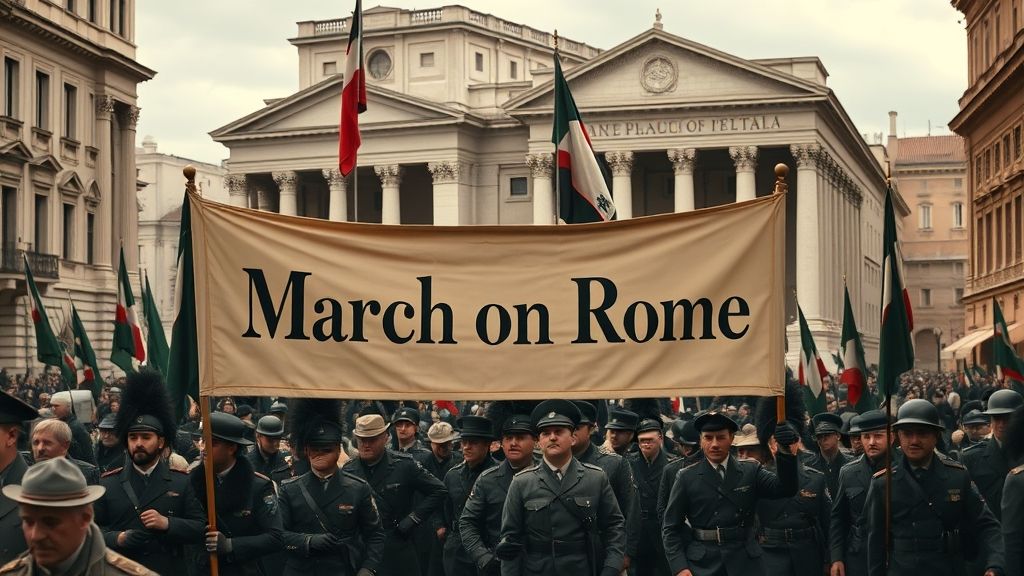
On a crisp autumn day, the air in Rome was filled with a simmering sense of anticipation and unease, as thousands of men clad in black shirts—a mixture of war veterans, nationalists, and disillusioned youths—marched toward the heart of Italy’s ancient capital. The cobblestones echoed beneath their boots, a rhythmic drumbeat that translated into a resounding declaration: the old order was about to be overturned.
This was not merely a protest; it was a calculated march of power. The streets thrummed with tension, citizens glanced anxiously from their windows, soldiers lined their posts, and the halls of government whispered their last prayers. This was the March on Rome, a moment when history balanced on a razor’s edge. What followed would ripple across Europe and the world, marking the birth of fascism as a dominant force.
2. Italy in Turmoil: The Post-War Landscape
The end of World War I in 1918 left Italy wounded—not only physically, but deeply fractured socially, politically, and economically. While on paper Italy was a victorious power, the terms of the Treaty of Saint-Germain and the Treaty of London only partially satisfied its territorial ambitions, earning the war the bitter nickname “mutilated victory.” Veterans returned to a country swollen with dissatisfaction: inflation soared, unemployment skyrocketed, and rural and industrial unrest boiled over.
Politically, Italy was a shaky parliamentary democracy, ill-equipped to manage the competing demands of burgeoning socialist movements on one side and nationalist, right-wing factions on the other. The ruling liberal elites appeared ineffectual, bogged down by infighting and an inability to address the country’s spiraling crises. The parliamentary system was paralyzed, and the fear of revolution haunted the Italian upper classes.
3. Seeds of Discontent: Political Polarization and Social Upheaval
Between 1919 and 1922, Italy became a battleground of ideologies. Socialists and anarchists organized strikes, land occupations, and factory takeovers. The so-called Biennio Rosso (Red Biennium) saw radical left-wing activism threaten the established order. Meanwhile, landowners, the bourgeoisie, and conservative elements feared not only communism but the complete collapse of societal frameworks.
This polarization created fertile ground for new political movements promising restoration of order, national pride, and strength. One such movement was fascism, a potent blend of ultra-nationalism, populism, and militarism. The stage was set for an upheaval that would shatter the fragile Italian democracy.
4. Benito Mussolini: From Socialist to Fascist Leader
Benito Mussolini’s trajectory illuminates the volatile complexity of the era. Once a fervent socialist and editor of Avanti!, Mussolini’s ideological shift towards nationalism and authoritarianism mirrored the disillusionment of many Italians. His break with socialism in 1914 over Italy’s entry into the war marked the beginning of a new political path.
In 1919, Mussolini founded the Fasci di Combattimento, an organization that gathered war veterans and right-wing militants under the banner of national rejuvenation. His charisma, oratorical skill, and ruthless strategy quickly transformed him from a fringe agitator to a formidable political actor.
5. The Birth of Fascism and the Blackshirts' Rise
Fascism emerged not only as a political ideology but as a paramilitary force. The Squadristi, known as Blackshirts because of their uniforms, operated with violent tactics to suppress socialist strikes and intimidate political opponents. Their actions blurred the line between political activism and outright violence, contributing significantly to the destabilization of the Italian left.
This organized militancy captured the imagination of many Italians tired of chaos, offering a promise of decisive action and national revival. Fascist squads spread across cities and countryside alike, often operating with tacit or explicit support from local authorities.
6. The Weakness of Liberal Italy and the King’s Predicament
Italy’s parliamentary system in 1922 was mired in factionalism and indecision. Prime Ministers came and went in rapid succession, each unable to contain the country’s spiraling tensions. King Victor Emmanuel III faced a monumental dilemma: whether to uphold constitutional norms or to intervene in the face of growing disorder.
The king’s reluctance to crack down on Mussolini’s ambitions stemmed from fears of civil war, socialist revolution, and the inability of the existing government to maintain order. The monarchy’s cautious ambiguity created a vacuum into which fascism eagerly stepped.
7. The March on Rome: A Calculated Show of Force
The March on Rome was not a spontaneous uprising but a deliberately planned event, meant to intimidate and force the hand of the government. On October 27, 1922, thousands of Fascist Blackshirts mobilized from various parts of Italy, converging towards the capital.
While some historical accounts exaggerate the military threat they posed, the spectacle was designed to project power. Vast columns of uniformed men, equipped with weapons and a rigid discipline, advanced in a psychological campaign of fear and spectacle—an assault on the senses as much as on the political order.
8. Mussolini’s Strategy: Political Theater and Realpolitik
Mussolini masterfully combined political rhetoric with the threat of violence to undermine the liberal government. He demanded the resignation of Prime Minister Luigi Facta and proposed himself as the leader who could restore order and national prestige.
Behind the scenes, Mussolini negotiated with conservative elites, business leaders, and the monarchy. His willingness to use force was balanced by promises of stability and respect for property, courting powerful institutions wary of socialist upheaval.
9. The Role of the Italian Army and Police
Unlike the Fascists, the Italian Royal Army and police forces hesitated when the March began. While government forces prepared to repel the incursion, orders from high command reflected political uncertainty and division. Some units refused to engage Fascist columns, signaling the army’s unwillingness to defend the fragile liberal regime fully.
King Victor Emmanuel III’s refusal to authorize martial law essentially opened the gates for Mussolini’s victory. This critical malaise underscored the state’s institutional collapse.
10. Public Reaction: Fear, Fascination, and Hopes for Order
The Italian populace watched with a mixture of apprehension and curiosity. For some, Mussolini’s march represented a dangerous threat to democracy; for others, it was a beacon of hope amid chaos. Newspapers portrayed the event variably, from sensationalist warnings of impending dictatorship to supportive narratives emphasizing national rebirth.
The middle class, industrialists, and landowners often saw in Mussolini a defense against the socialist threat. The urban poor were more divided, some frightened, others captivated by the promise of order.
11. The Government’s Collapse and the King’s Fateful Decision
Faced with the marchers’ bold advance and the government's paralysis, Prime Minister Luigi Facta twice requested King Victor Emmanuel III to sanction martial law. The king hesitated, weighing the risks of civil conflict and revolution. Ultimately, on October 29, he refused to sign the decree, effectively sealing the government’s fate.
Facta resigned, and the king invited Mussolini to form a new government. The liberal order had bowed to the fascist challenge without a shot fired in the streets of Rome.
12. The Appointment of Mussolini as Prime Minister
On October 31, 1922, Mussolini entered Rome in triumph. His appointment as Prime Minister marked the first time a fascist had taken power in a western democracy. He immediately began consolidating control, skillfully navigating parliamentary majorities and co-opting conservative elements.
Mussolini’s rise was as much about his political savvy as it was about the failures of his opponents—a grim reminder that power often fills the void left by weakness.
13. Mussolini’s Speech in Rome: The Dawn of Fascist Rule
From the steps of Palazzo Venezia, Mussolini addressed a crowd charged with expectation and dread. His speech ingeniously mixed nationalist fervor, authoritarian resolve, and promises of reconstruction. He declared that Italy would be “reborn,” under a regime that would restore strength, discipline, and order.
These words would echo through the years as the facade of democracy crumbled beneath the iron fist of fascism.
14. Early Fascist Policies: Consolidation of Power
Following his appointment, Mussolini swiftly moved to dismantle democratic institutions. Laws curtailing press freedom, suppressing opposition parties, and expanding the powers of the executive branch laid the groundwork for dictatorship.
The leggi fascistissime (Fascist laws) passed in subsequent years destroyed the pluralism that had defined Italy’s political life, replacing it with a one-party state wrapped in the garb of nationalist revival.
15. International Reactions: Europe and the World Respond
Europe watched with a mix of alarm and ambivalence. Many conservatives feared the spread of socialism and communism and cautiously welcomed Mussolini’s crackdown on the left. Democratic states struggled to grasp the full implications of fascism’s rise, often underestimating its brutality.
The March on Rome became a precedent for authoritarian movements elsewhere, signaling that democracies could be subverted by charismatic leaders wielding violence and political theatre.
16. The March on Rome’s Legacy: Authoritarianism in Italy
The legacy of the March is complex. It marked the end of liberal democracy in Italy and the beginning of two decades of fascist rule, culminating in the disastrous alliance with Nazi Germany and World War II.
It remains a stark example of how fragile democratic institutions can be overwhelmed by extremist politics and calculated coercion.
17. Cultural and Social Changes Under Mussolini
Fascism’s ascendance reshaped all facets of Italian life. The regime promoted a cult of personality around Mussolini, utilized propaganda extensively, and controlled education and culture to mold public opinion.
While infrastructure improved and national pride surged, these came at the cost of political freedoms and the persecution of dissent.
18. The Road to Totalitarianism: From March to Dictatorship
Although the March on Rome was a single dramatic moment, the transition from parliamentary democracy to totalitarian state unfolded gradually. Mussolini’s iron grip tightened through violence, legal manipulations, and the creation of a secret police.
The March was the opening act, but the fascist regime’s true nature revealed itself through repression and ruthless control over society.
19. Myths and Realities: The March on Rome in Collective Memory
Over time, the March on Rome has been mythologized both by fascist propaganda and critics alike. Fascists portrayed it as a popular uprising; scholars stress the elite complicity and state weakness that enabled it.
Understanding this event requires dissecting the narratives and confronting uncomfortable truths about democracy’s vulnerabilities.
20. Lessons from 1922: Democracy’s Fragility and Vigilance
The March on Rome serves as a dire warning: democratic institutions, if left weak and divided, can be toppled by radical movements offering order at the price of liberty. It challenges modern societies to remain vigilant against polarization and extremist tactics.
The event forces reflection on leadership, responsibility, and the price of political complacency.
21. Conclusion: The Turning Point That Shaped the 20th Century
October 28, 1922, was not merely a date on the calendar but a fulcrum in history. Through spectacle, violence, and political maneuvering, a new chapter opened for Italy and the world—a chapter that would test the resilience of democracy against the tides of dictatorship.
The March on Rome reminds us of the enduring human drama where power, fear, hope, and ambition converge to shape destinies.
Conclusion
The March on Rome stands as a vivid testament to a pivotal moment when Italy, and indeed Europe, teetered on the brink of transformation. Against the backdrop of postwar chaos and political paralysis, a movement rooted in charisma and force seized the reins of power. Mussolini’s triumph was born of both momentous social unrest and the failures of existing institutions, revealing how swiftly democracy’s foundations can erode when confronted by determined, ruthless ambition.
But beyond the political machinations, the story is deeply human: of men yearning for stability amidst chaos, of a nation grappling with its identity, and of the paradoxes that arise when power promises salvation at the price of freedom. The specter of the March on Rome endures as a somber reflection on the fragility of democracy, the dangers of extremism, and the enduring need for vigilance in safeguarding our political values.
FAQs About the March on Rome
Q1: What triggered the March on Rome in 1922?
A1: The March was triggered by widespread political and social unrest in post-WWI Italy, combined with the rise of Mussolini’s fascist movement promising order amid chaos. The government’s paralysis and fear of socialist revolution created an opening for fascist militancy to challenge the liberal state.
Q2: Who was Benito Mussolini, and how did he rise to power?
A2: Mussolini was originally a socialist journalist who broke away to form the fascist movement. Through charismatic leadership, paramilitary violence, and strategic alliances with conservatives and the monarchy, he positioned himself as Italy’s savior from socialism and disorder.
Q3: What role did King Victor Emmanuel III play in the March on Rome?
A3: The King played a decisive role by refusing to authorize martial law against the fascist marchers, which allowed Mussolini to take power. His choice reflected fears of civil war and socialist revolution but effectively undermined Italy’s democracy.
Q4: How did the Italian military respond to the March?
A4: The military was divided and hesitant. Some units considered resisting, but ultimately the lack of strong government orders and political ambiguity led many soldiers not to confront the fascists, facilitating Mussolini’s ascent.
Q5: What were the immediate consequences of the March on Rome?
A5: Mussolini was appointed Prime Minister and quickly began dismantling democratic structures, establishing a one-party dictatorship that suppressed opposition and altered Italy’s political and social landscape.
Q6: How is the March on Rome remembered today?
A6: It remains a controversial symbol—seen by some as a bold political upheaval, by others as the collapse of democracy enabling fascism’s rise. Historians emphasize the complex interplay of social forces and political failures behind the event.
Q7: What lessons does the March on Rome offer contemporary democracies?
A7: It illustrates how fragile democracies are when divided and vulnerable to extremist narratives, highlighting the importance of political accountability, institutional strength, and societal vigilance against authoritarianism.