Table of Contents
- The Dawn of Post-War Europe: A Continent on the Brink
- The Seeds of Locarno: War’s Lingering Shadows and Hopes for Peace
- The Key Players: Architects of a New European Order
- Locarno, Switzerland: A Quiet Town Takes Center Stage
- October 16, 1925: The Day the Treaties Were Initialed
- The Treaties Unveiled: A Pact of Security and Reassurance
- The Rhineland Guarantee: Securing Borders and Avoiding Renewed Conflict
- Germany’s Return to the International Fold
- Britain and France: Balancing Power and Diplomacy
- Italy’s Role and Aspirations at Locarno
- Reactions Across Europe: From Optimism to Skepticism
- The Treaties' Diplomatic Impact: A Breath of Fresh Air or Illusion?
- The League of Nations and Locarno: Overlapping Aspirations
- The Aftermath: From Initial Joy to Growing Doubts
- Locarno’s Place in the Road to World War II
- Personalities Behind the Treaties: Stories of Statesmen and Negotiators
- How Locarno Influenced the Concept of Collective Security
- Economic and Cultural Reverberations in a Fragile Europe
- Lessons from Locarno: Diplomacy in Times of Uncertainty
- The Legacy of the Locarno Treaties in 20th Century International Relations
- Conclusion: Hopes, Realities, and the Fragile Thread of Peace
- FAQs: Understanding the Locarno Treaties’ Complex Legacy
- External Resource: Locarno Treaties on Wikipedia
- Internal Link: Visit History Sphere
The Dawn of Post-War Europe: A Continent on the Brink
It was October 16, 1925. The sleepy town of Locarno, nestled in the serene Swiss Alps, suddenly became the stage for a grand act of international diplomacy. Amid the crisp autumn air and under the gaze of imposing mountain peaks, Europe’s major powers gathered to sign a series of treaties that promised, at least on paper, to usher in a new era of peace and security following the devastation of the First World War.
Yet, beyond the carefully constructed smiles and diplomatic phrases, the air was thick with both hope and apprehension. Five years after the Treaty of Versailles, Europe remained a tinderbox of unresolved tensions and national resentments, their echoes threatening to ignite another conflict. Locarno represented more than just a series of legal documents — it was a symbol of a fragile truce, a desperate attempt to draw lines that might contain the horrors of the past.
The moment was charged with a potent mix of optimism and unease: could these treaties truly bind the wounds of a fractured continent, or were they merely an elegant illusion masking deeper, indelible fractures?
The Seeds of Locarno: War’s Lingering Shadows and Hopes for Peace
The Great War had shattered the European order. Empires collapsed, new nations emerged, borders were redrawn with arbitrary lines, and millions of lives had been lost or changed forever. The Treaty of Versailles in 1919, meant to secure peace, left a bitter taste for many—especially for Germany, which viewed the treaty as a humiliating diktat. Its territorial losses, military restrictions, and reparations created fertile ground for nationalism and resentment.
In the years following the war, France sought security against any future German aggression, often at odds with a Britain tired of entanglements, and a Germany struggling with political instability and economic hardship. The Rhineland, a demilitarized zone along Germany’s western border with France and Belgium, was a key point of contention. Securing this border was essential for France, whose memory of invasions remained raw.
At the same time, the League of Nations—founded to prevent another catastrophe—struggled to enforce its mandate amid competing national interests and a lack of American participation. It was clear that new diplomatic efforts were needed to stabilize the continent.
In this precarious atmosphere, the idea of reaching a comprehensive security pact before the borders of Europe became a beacon for many. The complexity of post-war diplomacy was daunting, but the desire for peace pushed statesmen into the mountain town of Locarno, Switzerland.
The Key Players: Architects of a New European Order
The story of the Locarno Treaties is, above all, about people. The negotiations were led by a cast of formidable diplomats and politicians, each carrying their own national burdens and personal convictions.
On the British side, Austen Chamberlain, the Foreign Secretary, a seasoned politician and Nobel Peace Prize laureate, personified a blend of cautious optimism and realpolitik. France was represented by Aristide Briand, a masterful orator and idealist who deeply believed in reconciliation and cooperation. Germany, newly admitted into the diplomatic community and eager to regain prestige, counted on Gustav Stresemann, whose pragmatic approach sought to rebuild Germany’s standing while also limiting the harshest effects of Versailles. Italy, under Benito Mussolini’s regime, also participated with its own ambitions on the European stage.
These statesmen, hailing from battered nations yet inspired by visions of stability, convened in Locarno to craft treaties that would transform the balance of power—and perhaps the fate of Europe.
Locarno, Switzerland: A Quiet Town Takes Center Stage
Locarno was an unlikely setting for what would become one of the most significant diplomatic breakthroughs of the interwar period. This modest Swiss town, lounging peacefully by Lake Maggiore with its cobbled streets and medieval castles, was far from the capitals of power and intrigue.
Switzerland’s neutrality and reputation for discretion made it the ideal backdrop for sensitive negotiations. The choice underscored the desire for impartiality and solemnity—a kind of diplomatic sanctuary where common ground might be found between old rivals.
The atmosphere in Locarno was charged with a peculiar blend of solemnity and cautious celebration. Delegates worked intensely through discussions, punctuated only by brief respites to enjoy the crisp mountain air or the calming waters of the lake. But even here, away from the clamors of capital cities, the stakes were enormous.
October 16, 1925: The Day the Treaties Were Initialed
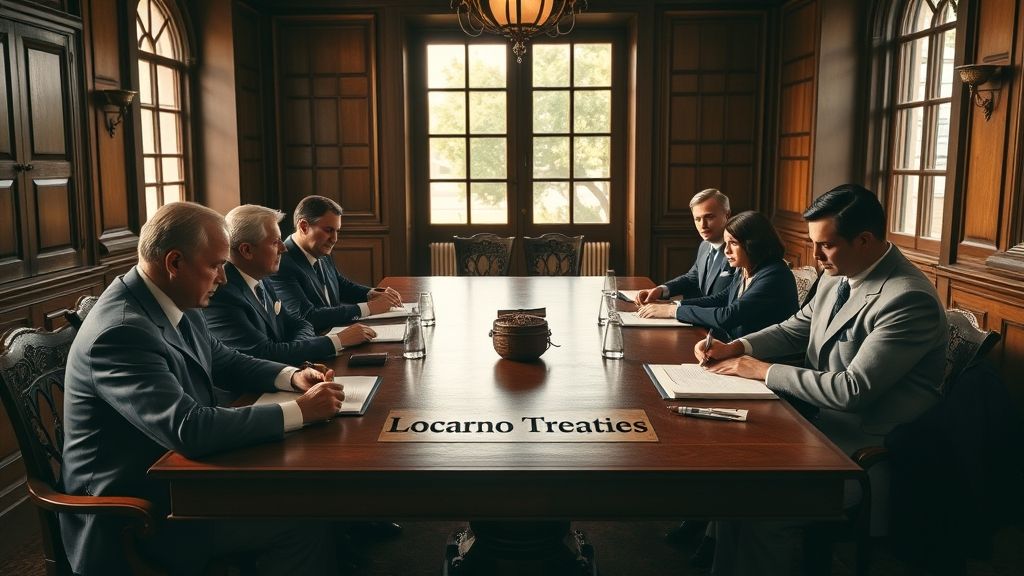
On October 16, the culmination of weeks of delicate negotiation was reached. The Locarno Treaties were initialed, a technical step before formal ratification, but one heavy with promise.
These treaties consisted of a web of agreements between Germany, France, Belgium, Great Britain, and Italy. Most notably, Germany, France, and Belgium mutually guaranteed their post-Versailles borders, particularly the western border along the Rhineland. Britain and Italy acted as guarantors, promising to come to the defense of any signatory attacked in violation of these agreements.
The significance was immense: Germany had accepted its western borders, France and Belgium guaranteed security, and Britain and Italy committed to collective enforcement. The era of confrontation and suspicion seemed to be giving way to dialogue and legal guarantees—a historic pivot.
The Treaties Unveiled: A Pact of Security and Reassurance
The Locarno Treaties comprised several interlocking agreements. The centerpiece was the Rhineland Pact, in which Germany, France, and Belgium promised to respect their existing frontiers. Germany formally accepted the borders outlined by the Treaty of Versailles, particularly with France and Belgium.
Additional agreements covered arbitration clauses: signatories agreed to submit disputes peacefully to arbitration, reducing the risk of war through legal processes. Britain and Italy pledged to uphold these treaties and intervene militarily in case of an unprovoked attack.
Meanwhile, Germany and Poland, and Germany and Czechoslovakia, signed separate treaties, albeit less robust and lacking the same guarantees for borders in the east. Germany’s eastern borders remained more contentious, a gap that would later prove significant.
Through these accords, Locarno articulated a vision of collective security, mutual recognition, and legal arbitration—a new chapter in European diplomacy.
The Rhineland Guarantee: Securing Borders and Avoiding Renewed Conflict
Central to the Locarno Treaties was the guarantee attached to the Rhineland border. The demilitarized zone created by Versailles was critical to French security, serving as a buffer against future invasions.
By having Germany formally accept the western borders and by committing Britain and Italy to enforce them, Locarno aimed to provide an ironclad shield against unilateral aggression.
For France, this was a reassurance after years of insecurity and fears of a German resurgence. For Germany, it was a political victory wrapped in diplomatic language—a tacit recognition of its place within Europe, moving from pariah to partner.
Yet the Rhineland guarantee also sowed the first seeds of future crisis: the eastern borders, where much ethnic and territorial dispute persisted, were deliberately left unguaranteed.
Germany’s Return to the International Fold
Perhaps the most dramatic narrative spun by the Locarno Treaties was Germany’s reintegration into the international community. After years of diplomatic isolation and economic punishment, Germany’s acceptance and participation signaled a thawing in relations.
Gustav Stresemann, the German Foreign Minister, leveraged Locarno as a platform to rehabilitate Germany’s image. His willingness to accept the western borders was seen domestically as controversial but pragmatic—sowing unity at home was a delicate task.
Locarno paved the way for Germany’s admission to the League of Nations in 1926, a symbolic nod to renewed trust. It was a moment of hope: perhaps Germany could embrace a role as a responsible partner in peace rather than a threat.
Britain and France: Balancing Power and Diplomacy
Britain's role at Locarno was nuanced. War-weary and reluctant to maintain large standing armies or engage in costly alliances, Britain sought a solution that would stabilize Europe without overcommitment. Acting as a guarantor, Britain aimed to deter German aggression while avoiding entanglements in continental conflicts.
France, for whom security was paramount, saw in Locarno both affirmation and limitation. The treaties secured its western flank but left it uneasy about the eastern frontier and the capability to throw British support in a conflict.
This delicate dance between British retrenchment and French demands defined much of the post-war diplomacy, revealing underlying tensions that diplomacy would never fully erase.
Italy’s Role and Aspirations at Locarno
Italy’s participation added an additional layer of complexity. Under Mussolini, Italy sought to assert itself as a great power. By becoming a guarantor of Locarno, Italy aimed to enhance its international standing.
Yet Italy’s ambitions also sowed seeds for future discord. Its later aggressive policies in the Mediterranean and Africa contrasted sharply with the image of a peace guarantor established in 1925.
Nevertheless, at Locarno, Italy’s consent helped legitimize the treaties and presented a united European front.
Reactions Across Europe: From Optimism to Skepticism
Across Europe, the Locarno Treaties were initially greeted with enthusiasm. Newspapers celebrated the dawn of “the Spirit of Locarno,” a hopeful phrase suggesting that a new era of cooperation and peace was underway.
Yet not all shared this optimism. Many Germans on the political right condemned the acceptance of Versailles’ borders. Eastern European nations—especially Poland and Czechoslovakia—felt uneasy about the lack of guarantees for their borders, fearing future German revisionism.
Some analysts and diplomats cautioned that Locarno treated only half the problem—the west—while ignoring the volatile east. The optimism was fragile, a hopeful veneer over complex realities.
The Treaties' Diplomatic Impact: A Breath of Fresh Air or Illusion?
Internationally, Locarno reshaped alliances and diplomacy. It marked a step away from isolationism and distrust, encouraging dialogue and frameworks for security.
By institutionalizing arbitration and collective guarantees, Locarno inspired new norms in international relations. Its influence reverberated into diplomatic practices and emboldened the League of Nations’ efforts.
However, beneath this fresh air lay unresolved tensions: the uneven security guarantees, ideological clashes, and economic instability remained potent threats beneath Locarno’s reassuring surface.
The League of Nations and Locarno: Overlapping Aspirations
Locarno and the League of Nations represented parallel efforts toward peace in the interwar period. While the League promoted collective security and disarmament, it lacked forceful means and struggled with member divisions.
Locarno complemented the League by providing bilateral and multilateral guarantees. Germany’s subsequent admission into the League marked a symbolic unification of efforts.
Still, both institutions lacked capacity to suppress emerging threats decisively, foreshadowing the difficulties that lay ahead.
The Aftermath: From Initial Joy to Growing Doubts
In the following years, the initial joy of Locarno began to wane. Economic crises, rising nationalist fervor, and political upheavals in Germany challenged the treaty’s foundations.
The fragile equilibrium cracked. The eastern frontiers remained disputed. Germany’s subsequent remilitarization of the Rhineland in 1936 boldly violated the treaty’s guarantees, revealing the limits of Locarno’s power.
For many, Locarno became a bittersweet symbol—not of lasting peace, but of missed opportunities and the complexities of diplomacy in troubled times.
Locarno’s Place in the Road to World War II
In hindsight, Locarno was a crucial waypost on the path to the Second World War. It demonstrated both the possibilities and limitations of diplomatic agreements in the interwar turmoil.
While it delayed open conflict and fostered a temporary détente, underlying animosities and geopolitical ambitions remained unaddressed.
The failure to secure comprehensive security across Europe, especially in the east, and the inability to enforce treaties strictly contributed to the eventual unraveling of peace.
Personalities Behind the Treaties: Stories of Statesmen and Negotiators
The Locarno Treaties were shaped profoundly by personalities—men who negotiated not only treaties but also hopes for their nations.
Austen Chamberlain’s steadfast pragmatism, Aristide Briand’s poetic idealism, Gustav Stresemann’s statesmanship, and Mussolini’s ambition all intertwined to produce a pact that was as complex as the men themselves.
Their writings, speeches, and diplomatic maneuverings provide invaluable insight into the human dimension of international relations during one of history’s most tumultuous periods.
How Locarno Influenced the Concept of Collective Security
One of Locarno’s lasting contributions was the reinforcement of collective security principles—the idea that peace could be maintained through mutual guarantees and joint action.
The treaties set precedents for multilateral enforcement, arbitration, and international cooperation, influencing future diplomatic frameworks such as the United Nations.
Despite its limitations, Locarno helped seed concepts essential to modern international law and diplomacy.
Economic and Cultural Reverberations in a Fragile Europe
Locarno’s impact extended beyond politics. The promise of stability encouraged investment and cultural exchanges.
Cross-border trade and cooperation saw tentative growth. Artists, intellectuals, and professionals trafficked more freely, enlivening a Europe still healing from trauma.
These softer forms of rapprochement complemented political efforts, enriching the continent’s fragile tapestry of peace.
Lessons from Locarno: Diplomacy in Times of Uncertainty
The story of Locarno teaches us about the delicate nature of diplomacy—its triumphs, frailties, and the ever-present tension between ideals and practical realities.
It reminds us that treaties are more than paper; they are expressions of trust, power balances, and the messy human desire for peace.
Locarno stands as a testament to both the potential and limits of diplomacy to shape history.
The Legacy of the Locarno Treaties in 20th Century International Relations
Ultimately, the Locarno Treaties occupy a complex place in history. They symbolized hope, reconciliation, and a shared desire to avoid war.
Yet, their shortcomings and eventual unraveling reveal the fragility of interwar peace and the persistent challenges in building lasting security.
Locarno’s legacy lives on as a pivotal moment in international relations, influencing diplomacy, law, and the pursuit of peace throughout the turbulent 20th century.
Conclusion
As the ink dried on the documents in the tranquil Swiss town, the world held its breath. Locarno was more than a collection of treaties; it was a fragile promise, a testament to humanity’s yearnings for peace in a world still haunted by war.
Its story is neither one of triumph nor failure, but of the complex interplay of hope, fear, ambition, and resilience. It teaches us that diplomacy is an art of balancing visions and realities, that the road to peace is fraught with setbacks, and that every effort counts—no matter how delicate.
Locarno’s ghosts linger in history, reminding future generations that peace, once so painstakingly negotiated, must be nurtured, valued, and protected against both overt and silent threats.
FAQs
1. What were the Locarno Treaties, and why were they significant?
The Locarno Treaties were a series of agreements initialed in October 1925 aimed at securing post-war borders and promoting peace in Western Europe. They were significant as they marked Germany’s diplomatic rehabilitation and established mutual guarantees to prevent conflict.
2. Who were the main negotiators of the Locarno Treaties?
Key figures included British Foreign Secretary Austen Chamberlain, French Foreign Minister Aristide Briand, and German Foreign Minister Gustav Stresemann, whose efforts underpinned the treaties.
3. How did the treaties address Germany’s western borders?
Germany accepted its borders with France and Belgium, particularly the demilitarized Rhineland, which was guaranteed by Britain and Italy, aiming to prevent unilateral aggression.
4. Why were the eastern borders excluded from similar guarantees?
Due to political complexities and differing national interests, the eastern borders involving Poland and Czechoslovakia were not included in the same security guarantees, leaving them vulnerable.
5. What impact did Locarno have on Germany’s international standing?
The treaties facilitated Germany’s admission into the League of Nations and represented a step toward reintegration, improving Germany’s diplomatic legitimacy.
6. Did the Locarno Treaties prevent future conflicts?
While they delayed direct confrontation and offered hope for peace, the treaties ultimately failed to prevent further conflict, especially with Germany’s later remilitarization of the Rhineland and rising tensions in the 1930s.
7. How did other European countries react to the treaties?
Western nations generally welcomed Locarno, but Eastern European countries expressed concern over the lack of protections for their borders and feared German revisionism.
8. What lessons can modern diplomats learn from Locarno?
Locarno underscores the importance of inclusive security agreements, the limits of treaties without enforcement, and the vital role of trust and cooperation in maintaining peace.