Table of Contents
- The Dawn of a New Era: Guangzhou, Summer 1926
- China’s Fragmented Landscape: Warlords and Warlordism
- The Legacy of the 1911 Revolution and the Rise of Nationalism
- The Northern Expedition: Vision and Strategy
- Sun Yat-sen’s Last Gambit and the Kuomintang Reorganization
- The Alliance with the Communists: Unlikely Comrades
- The Role of the Soviet Union: Aid and Influence
- The Mobilization at Guangzhou: Preparing for War
- The March Begins: Early Successes and Difficulties
- The Capture of Key Cities: Momentum in the South
- The Warlord Response: Fragmentation and Resistance
- The Army and Its Leaders: Chiang Kai-shek’s Ascendancy
- The Role of Propaganda and Popular Support
- Political Intrigues within the Kuomintang
- The Northern Expedition and the Peasantry: Social Dimensions
- International Reactions and Diplomatic Balancing
- Military Tactics and the Changing Nature of Chinese Warfare
- The Fall of Wuhan: Turning Point in the Campaign
- The Expedition’s End: Reunification or New Divisions?
- Consequences for China’s National Identity and Future
- The Northern Expedition’s Place in World History
- Legacy in Popular Memory and Chinese Historiography
- Conclusion: The Quest for Unity Amidst Chaos
- FAQs about the Northern Expedition
- External Resources
- Internal Link
1. The Dawn of a New Era: Guangzhou, Summer 1926
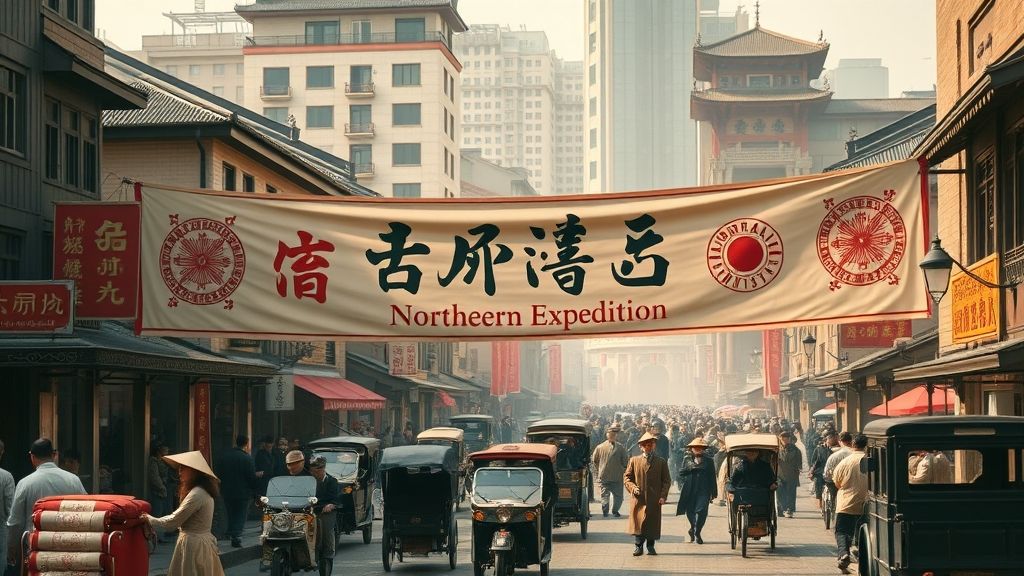
Guangzhou, in the sweltering heat of July 1926, was a city on the cusp of transformation. The mingled scent of sweat, gunpowder, and revolution hung thick in the humid air, as troops gathered along the docks and narrow, rutted streets. A palpable sense of urgency gripped the city; after years of political chaos and fractured authority, something momentous was about to unfold. The Northern Expedition, a bold military campaign launched by the Kuomintang (KMT), promised to reshape the shattered map of China. This was not merely a march of soldiers—it was a surge of collective hope, a desperate bid to unify a nation sundered by division and warlordism.
2. China’s Fragmented Landscape: Warlords and Warlordism
To understand the significance of the Northern Expedition, one must first grasp the fractured American-style patchwork China had become following the collapse of the Qing Dynasty in 1911. The fragile republic that replaced the imperial order soon disintegrated into competing warlord factions, each carving out territories in a ceaseless scramble for power. Central authority was a faint illusion in vast swathes of the country. Cities like Beijing, Shanghai, and Canton (Guangzhou) often changed hands not through elections or diplomacy, but bullet and blade.
The warlords themselves were as diverse as China’s landscapes—military commanders, opportunistic politicians, local strongmen. They ruled through personal loyalty and force, often indifferent to the masses they governed. This era of warlordism inflicted profound suffering on civilians: famine, dislocation, corruption, and persistent violence rendered everyday life precarious for millions.
3. The Legacy of the 1911 Revolution and the Rise of Nationalism
The Northern Expedition did not emerge from a vacuum. It was the continuation of ideals born during the 1911 Xinhai Revolution, which ended over two millennia of imperial rule. Sun Yat-sen, the revolutionary leader who inspired that upheaval, envisioned a modern, unified China founded on nationalism, democracy, and social welfare. However, his vision remained largely unrealized at his death in 1925.
By 1926, the urgency to stabilize and modernize China was widely felt. A rising tide of nationalism, fueled by intellectual ferment and social discontent, sought to end the dominance of warlords, foreign imperialist influences, and internal factionalism. The Kuomintang positioned itself as the harbinger of this new China, though it had its own internal contradictions and ambitions.
4. The Northern Expedition: Vision and Strategy
The Northern Expedition was conceived as a sweeping military and political campaign with two goals: to defeat the warlords controlling northern and central China and to bring the nation under Kuomintang control. The strategy was not just brute force but also political mobilization. The KMT planned to combine military conquest with unification efforts, appealing to war-weary officials, businessmen, and peasants alike.
At its core, this was an expedition that aimed to march northward from the southern strongholds—Guangzhou, and eventually Wuhan—taking victories city by city. The anticipation built not only in military circles but also among civilians, many of whom saw the campaign as a long-awaited attempt to restore stability and rebuild national pride.
5. Sun Yat-sen’s Last Gambit and the Kuomintang Reorganization
Sun Yat-sen’s death in March 1925 left a leadership vacuum, but his ideological foundations for the Nationalist Party endured. Modern leadership transitioned toward Chiang Kai-shek, a military officer who had trained in Japan and cultivated ties with the powerful Guangdong military circles.
Under Chiang’s influence, the Kuomintang underwent rigorous reorganization. The party aimed to streamline its military command, improve discipline, and forge alliances to expand its forces. In particular, efforts were made to integrate disparate armed groups under the centralized command, elevating the National Revolutionary Army (NRA) as a symbol of unified national spirit.
6. The Alliance with the Communists: Unlikely Comrades
Perhaps one of the most intriguing dimensions of the Northern Expedition was the First United Front—the cooperation between the Kuomintang and the fledgling Chinese Communist Party (CCP). Despite ideological differences, both parties recognized an overlapped goal in defeating the warlords and ending imperialist interference.
This complex relationship was marked by pragmatic collaboration. Communists joined the KMT ranks; they helped organize peasants and workers to support the military campaign both logistically and politically. Yet, this uneasy alliance was a powder keg waiting to explode, destined to fracture brutally in the coming years.
7. The Role of the Soviet Union: Aid and Influence
The Soviet Union, seeking to spread revolutionary ideals and extend its geopolitical clout, furnished support to the Kuomintang with advisors, weapons, and funding. Moscow’s influence was palpable in military training and political propaganda. Soviet agents like Mikhail Borodin worked closely with party leaders, guiding the KMT’s reorganization and framing the Northern Expedition as an anti-imperialist crusade.
This alliance was both an asset and a source of tension. While the Soviet Union bolstered the nationalist cause against warlords and foreign powers, its close ties to the Chinese Communists deepened suspicion among the KMT’s right wing.
8. The Mobilization at Guangzhou: Preparing for War
Guangzhou served as the nerve center for the Northern Expedition’s launch. The city buzzed with activity: soldiers drilled in courtyards, armories buzzed with production, and political meetings stirred fervent debate. The atmosphere was a blend of excitement, fear, and determination—men and women, young and old, placed their hopes on this campaign to break the cycle of chaos.
Chiang Kai-shek strode through the ranks, a figure both inspiring and enigmatic, consolidating his position as the campaign’s military leader. The people who lined the streets—shopkeepers, students, laborers—saw in this campaign a chance for renewal, a glimmer of order after decades of upheaval.
9. The March Begins: Early Successes and Difficulties
On the morning of July 9, 1926, the Northern Expedition officially commenced. Thousands of troops, banners held high, marched away from Guangzhou under a blazing sun. The initial phases met considerable success. Warlord forces, often demoralized and fragmented, fell back before the disciplined NRA, which employed a combination of conventional tactics and guerilla-like mobility.
Yet the expedition was not a simple march. Difficult terrain, harsh summer heat, logistical challenges, and occasional clashes among allied factions shaped the first weeks. Each victory was hard-earned, and every city taken exacted its toll on morale and resources.
10. The Capture of Key Cities: Momentum in the South
In rapid succession, strategic cities in southern China—such as Changsha and Nanchang—came under Nationalist control. These victories were not merely military but symbolic. They convinced many wavering warlords and bureaucrats that the Kuomintang was the wave of the future.
The capture of these urban centers allowed the KMT to set up administrative mechanisms, rallying local populations through promises of land reform, improved governance, and an end to predatory taxation. Underneath the gunfire and marching boots, a political revolution was unfolding.
11. The Warlord Response: Fragmentation and Resistance
Not all warlords crumbled at the Northern Expedition’s approach. Some mounted fierce resistance, determined to safeguard their fiefdoms and privileges. The fragmentation of warlord alliances meant shifting loyalties, betrayals, and skirmishes behind the front lines.
Prominent figures like Wu Peifu and Zhang Zuolin orchestrated counterattacks and formed temporary coalitions. Their responses highlighted the complexity of China’s political landscape, where regional identities, personal ambitions, and foreign ties all competed for supremacy.
12. The Army and Its Leaders: Chiang Kai-shek’s Ascendancy
Chiang Kai-shek emerged from the campaign as more than a general; he became the embodiment of Nationalist hopes. His leadership style—strategic, often ruthless—solidified his control over the army and the party.
Chiang’s balancing act was delicate: he needed to maintain unity within the KMT, manage relations with the Communists for the time being, and navigate the volatile politics of the Chinese elite. His growing influence during the Northern Expedition set the stage for his eventual rise as China’s paramount leader.
13. The Role of Propaganda and Popular Support
Victory on the battlefield was matched by battles for hearts and minds. The Kuomintang mastered propaganda techniques, using newspapers, posters, and public speeches to paint their cause as the salvation of China.
Popular support was essential. The NRA soldiers often relied on local populations for food and shelter, creating bonds through promises of reform and national pride. Yet, the campaign also sowed discontent where requisitions or violence occurred, reminding observers that revolutions are never bloodless.
14. Political Intrigues within the Kuomintang
Inside the Nationalist Party, factions jostled for influence. Radicals pushed for social reforms and closer ties with the Communists; conservatives favored limited change and more traditional power structures. These ideological struggles played out in party congresses and secret meetings, occasionally spilling into open conflicts.
Sun Yat-sen’s vision was under constant reinterpretation, and the Northern Expedition became a test of whether the KMT could survive its internal divisions while facing formidable external foes.
15. The Northern Expedition and the Peasantry: Social Dimensions
While the emphasis often falls on generals and politicians, the peasantry was the silent majority behind the campaign. Many peasants saw the expedition as an opportunity to overturn exploitative local landlords and warlord taxes.
Communist cadres working alongside the KMT mobilized peasant associations, organizing grassroots support that went beyond mere sympathy. Yet, rural China was complex, and responses varied widely; in some regions, peasants embraced the revolution, while in others, fear or loyalty to local powers delayed change.
16. International Reactions and Diplomatic Balancing
The Northern Expedition did not unfold in isolation. Foreign powers—Japan, Britain, France, and the United States—watched cautiously. Many held concessions or interests in China and feared instability that might threaten their position.
Some foreign governments covertly supported certain warlords; others hesitated to recognize the KMT as China’s legitimate government. The campaign thus became a diplomatic tightrope, influencing early 20th-century geopolitics in East Asia.
17. Military Tactics and the Changing Nature of Chinese Warfare
The Northern Expedition marked a shift from traditional clan-based skirmishes to more organized, modern warfare in China. The NRA drew from Soviet doctrines, combined with previous Chinese military traditions.
New tactics combined mobile infantry, early mechanization, and political officers embedded within units to boost morale and enforce discipline. The campaign’s successes and setbacks offered lessons that would resonate in later conflicts, particularly the Chinese Civil War.
18. The Fall of Wuhan: Turning Point in the Campaign
The capture of Wuhan in late 1926 symbolized the expedition’s peak. Wuhan’s fall opened northern China to the Nationalists and struck a severe blow to warlord power. It also showcased the increasing political sophistication of the KMT: city governments were restructured to reflect Nationalist ideals and lay administrative foundations.
Yet this victory also exposed fractures within the KMT, particularly over relations with the Communists, foreshadowing an impending rupture.
19. The Expedition’s End: Reunification or New Divisions?
By 1928, the Northern Expedition had nominally ended with the capture of Beijing, signaling an end to warlord fragmented rule. However, the victory was bittersweet. The KMT’s alliance with the Communists collapsed soon after, sparking civil war that would scar China for decades.
While the expedition achieved formal reunification, underlying tensions—political, social, ideological—remained unresolved. The fragile peace was more a ceasefire than a lasting settlement.
20. Consequences for China’s National Identity and Future
The Northern Expedition reshaped China’s sense of itself. It symbolized a break from centuries of feudal and fragmented rule, a tentative step toward modern nationhood. The campaign inspired nationalist fervor, but also exposed the contradictions between ideology and realpolitik.
In the broader sweep of Chinese history, it was a moment of hope and tragedy, a prelude to the titanic struggles that would occupy the nation in the 20th century.
21. The Northern Expedition’s Place in World History
Globally, the Northern Expedition was emblematic of post-World War I shifts—colonial dismantling, ideological ferment, and the struggle for self-determination. It attracted international attention as a rare example of a successful nationalist campaign in Asia.
The expedition also influenced other revolutionary movements and contributed to the shaping of Cold War-era divisions decades later, especially with the rise of Communist China.
22. Legacy in Popular Memory and Chinese Historiography
How the Northern Expedition is remembered varies widely. In the People's Republic of China, it is often celebrated as a heroic step toward liberation, albeit with criticism of the Kuomintang’s failures. In Taiwan and among KMT sympathizers, it is revered as the founding act of modern Chinese nationalism.
Scholars continue to debate its causes, outcomes, and the complex legacy of cooperation and conflict between Nationalists and Communists.
23. Conclusion: The Quest for Unity Amidst Chaos
The Northern Expedition stands as a monumental chapter in China’s journey through the 20th century—a stirring saga of ambition, courage, and the perennial pursuit of unity in a land too often torn apart. From the streets of Guangzhou to the gates of Beijing, soldiers and civilians alike wove a narrative of resilience and vision. Yet, beneath triumph lay unresolved struggles, contradictions that doomed lasting peace but forged the crucible from which modern China ultimately emerged.
Conclusion
The Northern Expedition was more than a military campaign; it was an epic narrative of hope battling chaos amid one of the most tumultuous eras in Chinese history. The soldiers who marched northward carried with them the weight of a nation fractured and a people yearning for unity. Their successes heralded the promise of a strong, modern China but also revealed the deep fissures—political, social, and ideological—that would erupt into decades of conflict.
Looking back from the vantage of history, the expedition embodies the complexity of revolution: the collision between idealism and pragmatism, unity and division, old and new. It reminds us that the path to national rebirth is rarely linear or peaceful, but forged in struggle, sacrifice, and unwavering vision. In this light, the Northern Expedition is a timeless story—a testament to human resilience and the enduring quest for collective identity.
FAQs about the Northern Expedition
Q1: What was the primary goal of the Northern Expedition?
The main goal was to end warlord rule in China and unify the country under the Kuomintang government, establishing a central authority capable of modern governance.
Q2: Why did the Kuomintang ally with the Chinese Communist Party during the expedition?
Despite ideological differences, they shared a mutual interest in defeating the warlords and foreign imperialism. This United Front was largely pragmatic but short-lived.
Q3: Who was Chiang Kai-shek, and what role did he play?
Chiang was the military leader of the National Revolutionary Army during the expedition. His leadership solidified his power within the Kuomintang and marked the beginning of his rise to national prominence.
Q4: How did the Soviet Union influence the Northern Expedition?
The USSR provided military advisors, training, equipment, and political guidance, hoping to spread communist influence and support anti-imperialist struggles in China.
Q5: What were some of the social impacts of the Northern Expedition?
The campaign mobilized peasants and workers, igniting social reforms and political consciousness, but it also led to hardships due to warfare and requisitions.
Q6: Did the Northern Expedition succeed in unifying China?
It succeeded in defeating many warlords and recapturing territories, but political unity was fragile and soon unraveled as the Kuomintang and CCP split, leading to civil war.
Q7: How is the Northern Expedition remembered today?
It is viewed as a foundational moment in modern Chinese history with varying interpretations—heroic unification, a prelude to civil strife, or a complex revolutionary moment.
Q8: What global significance did the Northern Expedition have?
It symbolized anti-imperialist nationalist movements worldwide, influenced Cold War dynamics, and highlighted revolutionary currents in early 20th-century Asia.