Table of Contents
- The Dawn of October 3, 1935: A Tremor in the Horn of Africa
- Italy’s Imperial Ambitions: The Road to Invasion
- Ethiopia in the 1930s: A Sovereign Nation Besieged
- Mussolini’s Vision: Reviving the Roman Empire in Africa
- The International Climate: A League of Nations in Turmoil
- The First Shots at Adigrat: The Opening Salvo
- Ethiopian Resistance: Emperor Haile Selassie’s Call for Unity
- Modern Warfare Meets Tradition: Disparities in Arms and Strategy
- The Brutality of the Invasion: Chemical Weapons and Aerial Bombardment
- Civilians in the Crossfire: Human Stories of Agony and Heroism
- The Propaganda War: Italy’s Media Machine vs. Ethiopian Reality
- The Global Reaction: Silence, Sympathy, and Strategic Interests
- The Shifting Frontlines: From Adigrat to Addis Ababa
- The Fall of Ethiopia and the Birth of Italian East Africa
- Haile Selassie’s Exile: Symbolism and Rallying Cry
- The Conquest’s Legacy: Colonialism’s Shadows in Africa
- Lessons for the League of Nations: Failure and Foreshadowing of WWII
- Remembering 1935: Ethiopia’s National Memory and Resistance
- The Italian Invasion’s Place in World History: A Prelude to Global Conflict
- Conclusion: Echoes of Adigrat and the Indomitable Spirit of a Nation
- FAQs: Understanding the Italian Invasion of Ethiopia
- External Resource
- Internal Link
The Dawn of October 3, 1935: A Tremor in the Horn of Africa
At dawn on October 3, 1935, the quiet highlands around Adigrat, in northern Ethiopia, were shattered by the distant roar of artillery, shattering the fragile calm that had long gripped the region. The dry air carried the first acrid scents of gunpowder and burning earth, whispering a grim prophecy to those who lived there: war had come. From the rugged plateaus to the bustling streets of Addis Ababa, the heart of Ethiopia, a nation stood on the brink of unprecedented crisis. The Italian invasion, meticulously planned and ruthlessly executed, was no mere collision of armies — it was an assault on sovereignty, on identity, and on the very essence of a people striving to protect their ancient homeland.
In those early hours, few could foresee the devastating cascade of violence and upheaval that would soon grip Ethiopia, transforming not only its landscape but also the geopolitical tides of the entire world. The invasion was not just the clash of two armies; it was the confrontation of ideologies, ambitions, and historical legacies that reverberate to this day.
Italy’s Imperial Ambitions: The Road to Invasion
To understand why Italian forces crossed the border into Ethiopia in 1935, one must retrace the tangled path of Italy’s post-World War I history. Unlike the other European powers that had carved vast empires, Italy entered the 20th century as a relatively latecomer to colonialism. The scramble for Africa had largely bypassed it, leaving Italy with modest holdings in Eritrea and Somalia.
For Benito Mussolini and his fascist regime, however, colonial expansion was a symbol of national prestige and a key pillar for creating a “New Roman Empire.” Ethiopia, one of the last independent African states, represented the final piece missing in Italy’s imperial puzzle. The failed conquest of the 1890s, especially the humiliating defeat of Italian forces at the Battle of Adwa in 1896, remained a fresh wound on national pride, enflaming dreams of revenge.
By the early 1930s, emboldened by the fascist government’s aggressive rhetoric and the growing weakness of the international order, Italy began shifting from mere posturing to actual preparations for war. The invasion was framed as both a reassertion of Italy's rightful place on the world stage and a civilizing mission to bring modernity to Ethiopia — rhetoric that masked the brutal realities to come.
Ethiopia in the 1930s: A Sovereign Nation Besieged
Ethiopia in the 1930s was a unique country in Africa—proudly sovereign, ethnically diverse, and steeped in a legend of resistance to colonial conquest. Governed by Emperor Haile Selassie, who ascended the throne in 1930, Ethiopia had embarked on a cautious path toward modernization, building schools, infrastructure, and diplomatic alliances.
But its military capabilities lagged far behind the mechanized armies of Europe. The country was still heavily reliant on traditional weapons and decentralized regional loyalties, complicating efforts to mount a coordinated defense. Nevertheless, Ethiopian society was bound together by a deep-rooted sense of independence and a history of defeating foreign invaders.
That said, internal divisions, limited resources, and geopolitical isolation meant Ethiopia faced an uphill battle—not only militarily but diplomatically—against the fascist juggernaut massing at its borders.
Mussolini’s Vision: Reviving the Roman Empire in Africa
For Benito Mussolini, the conquest of Ethiopia was more than a military campaign; it was a manifestation of his vision for fascist Italy’s grandeur. His ambitions married ancient Roman nostalgia with modern fascist ideology, emphasizing strength, discipline, and expansion.
Mussolini often cast himself as a new Augustus Caesar, destined to restore Italy’s greatness through territorial expansion. Ethiopia symbolized the "corona" jewel, the crown on this new empire, linking Italy’s imperial aspirations to the mythos of Rome and asserting dominance in the strategically vital Horn of Africa.
The propaganda machinery at work crafted an image of a heroic, civilizing mission — but behind the scenes, Mussolini’s regime showed little concern for Ethiopian lives, preparing to unleash overwhelming violence to crush any resistance.
The International Climate: A League of Nations in Turmoil
As Italian troops prepared to invade, the wider world watched with a mixture of alarm and impotence. The League of Nations, established to prevent aggression and war after the devastation of World War I, faced its most serious test in Ethiopia.
Despite Ethiopia being a member of the League, and pleas for intervention from Haile Selassie, the international community’s response was riddled with hesitation, self-interest, and political paralysis. Britain and France, two major powers with colonial interests in Africa, were reluctant to antagonize Italy and risk destabilizing their own empires or driving Italy closer to Nazi Germany.
Sanctions imposed on Italy by the League were ineffective and partial, failing to halt the buildup of Italian war matériel or disrupt its military campaign. The invasion exposed the cracks in collective security and foreshadowed the broader failures that would soon plunge the world into a far deadlier conflict.
The First Shots at Adigrat: The Opening Salvo
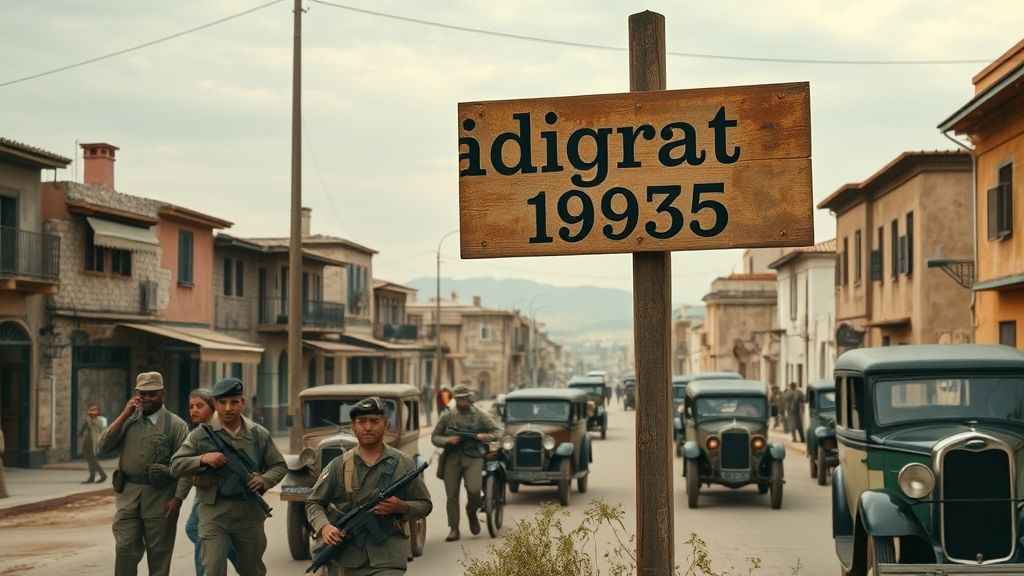
The Italian invasion’s opening act was centered at Adigrat, a strategic town near the Eritrean border and gateway to the Ethiopian interior. On October 3, 1935, Italian forces crossed into Ethiopian territory under the cover of early morning darkness, quickly deploying artillery and mechanized units.
The initial bombardments stunned Ethiopian forces unprepared for the scale and technology of the attack. Italian aircraft, tanks, and artillery overwhelmed the Ethiopian defenders, heavily reliant on outdated weapons and guerrilla tactics.
Adigrat quickly became a bloody symbol of the imbalance between the two armies. The tightly held Ethiopian defensive lines were broken, and the road to Mekele and deeper into the Ethiopian heartland was thrown open. This opening salvo was decisive, shattering the hope that Ethiopia could repel Italy with traditional means.
Ethiopian Resistance: Emperor Haile Selassie’s Call for Unity
Amid the chaos of invasion, Emperor Haile Selassie emerged as a beacon of resistance and national unity. Despite facing overwhelming odds, he sought to inspire his people through a call to arms grounded in patriotism, faith, and historical pride.
He worked tirelessly to rally regional leaders, nobles, and ordinary citizens to mount a unified front. His diplomatic appeals extended beyond Ethiopia’s borders — the 1936 League of Nations speech is still remembered as a powerful denunciation of fascist aggression and a plea for collective justice.
The Ethiopian resistance was fiercely courageous, marked by fierce battles, acts of heroism, and an unyielding belief in sovereignty. Yet, the disparity in technology and resources was painfully evident on the battlefields.
Modern Warfare Meets Tradition: Disparities in Arms and Strategy
The Italian invasion was among the first conflicts to highlight the brutal effectiveness of modern industrial warfare against traditional armies. Italy deployed tanks, airplanes, and poison gas—tools that Ethiopia lacked and could scarcely defend against.
Italian units used Blitzkrieg-inspired tactics of rapid movement, mechanized columns, and air supremacy to encircle and dismantle Ethiopian forces. Meanwhile, Ethiopian warriors relied on cavalry charges, rifles, and the terrain’s natural fortifications in desperate attempts to slow the invaders.
This clash of eras underscored the brutal reality of colonial wars in the 20th century—where technological advances translated into decisive advantage, often at horrific human cost.
The Brutality of the Invasion: Chemical Weapons and Aerial Bombardment
One of the darkest chapters of the invasion was Italy’s widespread use of chemical weapons, particularly mustard gas, which shocked the international conscience. Despite being banned under international conventions, Italy deployed these weapons extensively to terrorize and destroy both combatants and civilians.
Aerial bombardments flattened villages and terrorized populations with ruthless efficiency, leaving scars that would endure for generations. The Italian forces committed atrocities, including massacres and the systematic targeting of civilians suspected of aiding resistance.
The consequences were devastating: tens of thousands of Ethiopians died or suffered lifelong injuries, and entire communities were uprooted in the chaos.
Civilians in the Crossfire: Human Stories of Agony and Heroism
Behind each strategic victory or loss lay the heartbreaking stories of ordinary Ethiopians caught in the maelstrom. Families were torn apart, children orphaned, and elders faced unimaginable cruelty.
Yet, amidst the carnage, stories of courage and human kindness emerged. Local communities formed militias, women supported the resistance through intelligence and logistics, and religious leaders provided spiritual resilience.
Oral histories recount the bravery of those who refused to flee, choosing instead to fight or shield their neighbors—a testament to the indomitable human spirit under siege.
The Propaganda War: Italy’s Media Machine vs. Ethiopian Reality
While guns thundered on the ground, a parallel war unfolded in the realm of propaganda. Italian fascist media portrayed the invasion as a glorious campaign of liberation and modernizing progress. Headlines boasted of swift victories and the benevolent Italian mission.
In stark contrast, Ethiopian accounts and foreign journalists reported the harsh realities of war—atrocities, resistance, and the suffering of civilians. The chasm between reality and propaganda shaped international perceptions, complicating efforts to rally global support for Ethiopia.
This battle of narratives is a compelling example of how media can mold public opinion in conflicts, often obscuring inconvenient truths.
The Global Reaction: Silence, Sympathy, and Strategic Interests
The world’s reaction to the Italian invasion was a patchwork of condemnation, disinterest, and tactical calculation. Many countries expressed sympathy for Ethiopia, seeing it as a victim of unprovoked aggression.
Yet realpolitik prevailed. Britain and France, fearing diplomatic fallout, imposed half-hearted sanctions and maintained colonial ties with Italy. The United States adopted a policy of neutrality.
This global ambivalence revealed the League of Nations’ impotence and the era’s geopolitical complexities, signaling dangerous trends toward unchecked aggression.
The Shifting Frontlines: From Adigrat to Addis Ababa
Despite early Italian advances, Ethiopian resistance slowed the invaders’ progress. The Ethiopian army and guerrilla bands fought fiercely, turning the war into a grueling, attritional campaign.
The frontlines shifted as Mussolini poured more troops and resources into the campaign. Italian forces moved steadily southward, capturing key towns and cutting off supply routes.
By May 1936, Italian troops took Addis Ababa, dealing a symbolic and strategic blow. Yet resistance continued in remote regions, laying the groundwork for future uprisings.
The Fall of Ethiopia and the Birth of Italian East Africa
With the capture of Addis Ababa, Italy proclaimed the creation of Italian East Africa, merging Eritrea, Somalia, and Ethiopia into one colonial territory. Mussolini celebrated the conquest as a triumph but also faced the monumental task of pacification.
Italian administration imposed harsh policies, including repression, forced labor, and cultural assimilation attempts. This new colonial regime sowed resentment and planted the seeds for post-war liberation movements.
Haile Selassie’s Exile: Symbolism and Rallying Cry
Forced into exile, Haile Selassie did not fade into obscurity; rather, he became a global symbol of anti-fascist resistance and African sovereignty. From London, he advocated tirelessly for Ethiopian independence and the principles of international law.
His speeches inspired both Africans and the wider world to confront fascism and colonial oppression. Selassie’s exile illuminated the broader stakes of the invasion—not just Ethiopia’s freedom but the fate of global peace and justice.
The Conquest’s Legacy: Colonialism’s Shadows in Africa
The Italian invasion left deep scars on Ethiopia and the African continent. It exposed the vulnerability of African nations to renewed colonial aggression despite earlier sacrifices for sovereignty.
It also intensified debates about colonialism, race, and self-determination in the interwar period. The brutal methods of conquest and occupation provided stark lessons on imperialism’s costs.
Moreover, the war’s memory fueled nationalist movements, contributing to the wave of decolonization that would sweep Africa after World War II.
Lessons for the League of Nations: Failure and Foreshadowing of WWII
The League of Nations’ failure to prevent or stop Italy’s aggression was a bitter blow to international diplomacy. It revealed the lack of enforcement mechanisms and political will among member states.
This failure emboldened other aggressive powers, foreshadowing the unchecked expansionism that would lead to World War II. The Ethiopian crisis became a cautionary tale about the limits of idealistic institutions facing ruthless realpolitik.
Remembering 1935: Ethiopia’s National Memory and Resistance
In Ethiopia today, the invasion of 1935 remains a defining historical moment. National holidays, memorials, and cultural works commemorate the sacrifices of those who resisted.
The event is taught as a testament to Ethiopia’s resilience and an enduring symbol of African dignity and sovereignty. It continues to inspire discussions about justice, memory, and the meaning of freedom.
The Italian Invasion’s Place in World History: A Prelude to Global Conflict
Viewed through a wider lens, the Italian invasion of Ethiopia was more than a colonial skirmish; it was a precursor to the global conflagration soon to engulf the world.
It highlighted the dangers of fascism unchecked, the fragility of peace institutions, and the brutal costs of imperial conquest. The echoes of Adigrat ripple through history, reminding us how local conflicts can presage world-changing events.
Conclusion: Echoes of Adigrat and the Indomitable Spirit of a Nation
The echoes that began with the first shots fired near Adigrat in October 1935 transcend time and borders. They tell a story of ambition and oppression, but also of courage, resilience, and the unbreakable will of a people determined to defend their dignity.
The Italian invasion of Ethiopia stands as a somber chapter in world history—a reminder of the perils of unchecked aggression and the power of resistance rooted in identity and justice. As the dust settled on those blood-soaked highlands, the spirit of Ethiopia endured, inspiring generations to fight for freedom and sovereignty in the face of adversity.
FAQs: Understanding the Italian Invasion of Ethiopia
Q1: What were the main causes of the Italian invasion of Ethiopia in 1935?
A1: The invasion was driven by Italy’s desire for colonial expansion, Mussolini's fascist agenda to restore Roman imperial glory, and the longstanding desire to avenge the 1896 defeat at Adwa. Ethiopia’s sovereignty and strategic location made it a key target.
Q2: How prepared was Ethiopia militarily for the invasion?
A2: Ethiopia had a largely traditional army with limited modern weaponry and infrastructure. While brave and determined, Ethiopian forces were outmatched by Italy’s mechanized and aerial capabilities.
Q3: What role did the League of Nations play during this conflict?
A3: The League condemned the invasion and imposed sanctions on Italy, but lacked enforcement power and the political will of major powers, leading to ineffective prevention or intervention.
Q4: Who was Emperor Haile Selassie, and what was his significance during the invasion?
A4: Haile Selassie was Ethiopia’s Emperor and symbol of national resistance. He led diplomatic appeals internationally and rallied his people during the conflict, continuing his leadership from exile after defeat.
Q5: What were the consequences of the invasion for Ethiopia?
A5: Italy occupied Ethiopia, establishing Italian East Africa. The invasion caused massive loss of life, destruction, and repression but also sparked a legacy of resistance and contributed to the eventual decolonization of Africa.
Q6: How did the international community respond to the invasion?
A6: Responses were mixed; some condemned Italy, others remained neutral or complicit due to alliances and colonial interests. The failure to act decisively exposed the limits of the interwar peace system.
Q7: What was the role of chemical weapons in the invasion?
A7: Italy used banned mustard gas extensively, causing horrific casualties and suffering among Ethiopian soldiers and civilians, marking one of the early uses of chemical warfare against a non-European population.
Q8: Why is the invasion of Ethiopia considered a prelude to World War II?
A8: It revealed the inability of international bodies to contain fascist aggression, emboldening Axis powers and destabilizing global peace, foreshadowing the larger conflict to come.