Table of Contents
- The Dawn of a Dire Morning: March 13, 1938 in Vienna
- Austria on the Brink: The Precarious Political Landscape
- The Shadow of the Third Reich: Hitler’s Vision for Anschluss
- From Treaty to Tension: The Versailles Repercussions and Austrian Sovereignty
- The Rise of Austrian National Socialists: Seeds of Internal Strife
- Diplomatic Dance: International Reactions and Appeasement Policies
- The Invasion Begins: German Troops Crossing the Border
- Vienna’s Streets Flooded: Public Sentiment and Mass Gatherings
- The Proclamation of Anschluss: Symbolism and Ceremonial Acts
- Figures of the Day: Key Players and Their Roles in the Annexation
- Forced Invitations and the Illusion of Unity: The Plebiscite That Followed
- The Persecution Commences: Jewish Austrians and Political Opponents
- The World Watches in Silence: Global Political Responses
- The Anschluss’s Impact on European Stability and the Road to War
- The Incorporation of Austria: Administrative and Social Changes
- Resistance and Collaboration: Diverse Austrian Reactions
- The Anschluss in Historical Memory: Postwar Reflections and Narratives
- The Long Shadow: How 1938 Shaped Austria and Europe’s Future
- Conclusion: The Human Cost of Ambition and the Lessons of March 1938
- FAQs: Understanding the Anschluss and Its Consequences
- External Resource
- Internal Link
The Dawn of a Dire Morning: March 13, 1938 in Vienna
The chill in the air was palpable, but it was not only the fading winter that numbed the city of Vienna on March 13, 1938. As dawn broke gently over the Danube, an ominous transformation was already unfolding—one that would forever alter the imprint of this historic city and the identity of an entire nation. From the grand boulevards to the humble neighborhoods, people spoke in whispers, unsure whether to hope or fear. The German Wehrmacht was crossing the border, an uninvited yet unstoppable force, and with them an idea that had been festering in the minds of many: Anschluss—the annexation of Austria by Nazi Germany.
Vienna’s grand old buildings trembled not from the cold but from the weight of history pressing down—a history tracing back to centuries of Habsburg dominance, shattered treaties, ideological battles, and rising nationalist fervor. On this day, the Austrian flag would be replaced, and the country’s sovereignty suspended under the guise of unity and destiny. But beneath the banners and the speeches, the human stories told of betrayal, hope, complicity, and terror. This was not merely a political event; it was a profound rupture in the fabric of Central Europe.
Austria on the Brink: The Precarious Political Landscape
To understand the Anschluss proclaimed on March 13, 1938, one must grasp the fragile and tumultuous political reality that Austria had endured throughout the interwar period. The collapse of the Austro-Hungarian Empire at the end of World War I left Austria as a shrunken republic, stripped of its imperial grandeur and left grappling with an identity crisis. Its economy was fragile, politically fragmented, and vulnerable to extremist ideologies.
The First Austrian Republic, founded on the ruins of empire, was riven by opposing factions—Christian Social conservatives, Social Democrats, and a fledgling nationalist movement inspired by the growing menace of German National Socialism. Street violence, political assassinations, and polarized propaganda became daily life. The country was ruled by authoritarian leader Engelbert Dollfuss and after him Kurt Schuschnigg, who sought to maintain Austrian independence by suppressing the Nazis within Austria and balancing delicate relations with Hitler’s Germany.
Yet beneath the surface, waves of support for unification with Germany swelled—particularly among Austrian Germans who embraced Hitler’s vision of a “Greater Germany.” This internal division was exploited and amplified by German propaganda and clandestine Nazi operatives, undermining the fragile republic from within.
The Shadow of the Third Reich: Hitler’s Vision for Anschluss
Adolf Hitler’s obsession with Austria was deeply personal as much as political. Born in Braunau am Inn, Austria, Hitler viewed the Anschluss as a natural and essential step towards the reunification of all German-speaking peoples under the Third Reich’s banner. For Hitler, Austria was not truly a separate nation but an artificial construct imposed by the Treaty of Saint-Germain in 1919, a treaty that he vehemently opposed.
The year 1938 marked a decisive moment. Germany had reoccupied the Rhineland in 1936 without European resistance, emboldening the Führer. Now, with Austria politically weakened and internationally isolated, Hitler saw an opportunity to absorb Austria peacefully—or through a calculated show of force.
Behind closed doors, the German high command and Nazi officials orchestrated a plan to pressure Austria into submission. They encouraged the Austrian Nazi party to sabotage the government while threatening invasion. The idea was to present the Anschluss as a popular, almost inevitable, union rather than a military conquest—though German troops would be on hand to secure control.
From Treaty to Tension: The Versailles Repercussions and Austrian Sovereignty
The Treaty of Versailles and the Treaty of Saint-Germain reshaped Europe physically and politically, but their impact on Austria was profound and painful. Austria was designated a small, landlocked republic, forbidden from uniting with Germany under the terms of the treaties. These restrictions were intended to prevent the resurgence of a powerful Germanic state but fostered resentment and instability.
The loss of territory, including South Tyrol and other German-speaking regions, compounded Austria’s economic hardships. Hyperinflation and unemployment exacerbated social unrest, fueling extremist movements. Austrian politicians were forced to navigate between appeasing Western powers and resisting Anschluss proponents.
Despite the banning of union, the cultural and linguistic ties to Germany remained strong, perpetuating a sense of shared destiny among many Austrians. This liminal state haunted Austria’s politics during the interwar years and set the stage for the events of March 1938.
The Rise of Austrian National Socialists: Seeds of Internal Strife
The Austrian Nazi Party, though banned and persecuted under Dollfuss and Schuschnigg’s rule, grew bolder and better coordinated with their counterparts in Berlin. The internal Nazi infrastructure functioned as a shadow state, embedding spies, agitators, and saboteurs inside the country.
By early 1938, the Austrian Nazis intensified their campaign of terror and propaganda, orchestrating assassinations (including the attempt on Chancellor Dollfuss in 1934), spreading fear, and demanding capitulation. Their goal was clear: destabilize the government enough to invite German intervention.
Many ordinary Austrians were caught between fear of Nazi reprisal and hope that Anschluss might bring economic recovery and national pride. Yet others resisted fiercely, fearing the loss of their democracy and the racial hatred sown by Nazi ideology.
Diplomatic Dance: International Reactions and Appeasement Policies
The Anschluss did not unfold in a vacuum; European powers were watching, albeit with limited resolve. France and Britain, exhausted from the First World War and fearful of another conflict, leaned towards appeasement. Both countries were reluctant to confront Hitler militarily over Austria.
Italy, a former antagonist of Germany and Italy’s own fascist regime led by Mussolini, initially opposed Anschluss, wary of German dominance over Central Europe. Yet by 1938, Italy’s diplomatic stance had softened following the Rome-Berlin Axis alignment.
The League of Nations and the Western democracies condemned German aggression nominally but failed to mobilize concrete action. This hesitation emboldened Hitler, signaling that the world might acquiesce to his ambitions.
The Invasion Begins: German Troops Crossing the Border
In the early hours of March 12, 1938, German troops flowed across the Austrian border in a carefully staged but overwhelmingly unopposed move. The initial invasion lacked the violence and resistance of a traditional conquest. Instead, many Austrian soldiers were ordered to stand down, and the government soon collapsed.
This sudden military occupation was accompanied by jubilant crowds waving swastikas, chanting slogans, and greeting Hitler as a liberator. The Wehrmacht soldiers marched through towns where many locals greeted them with cheers, flowers, and singing.
Yet beneath these scenes of triumph, there were pockets of fear, confusion, and despair. Jewish families, dissidents, and many others sensed the storm gathering.
Vienna’s Streets Flooded: Public Sentiment and Mass Gatherings
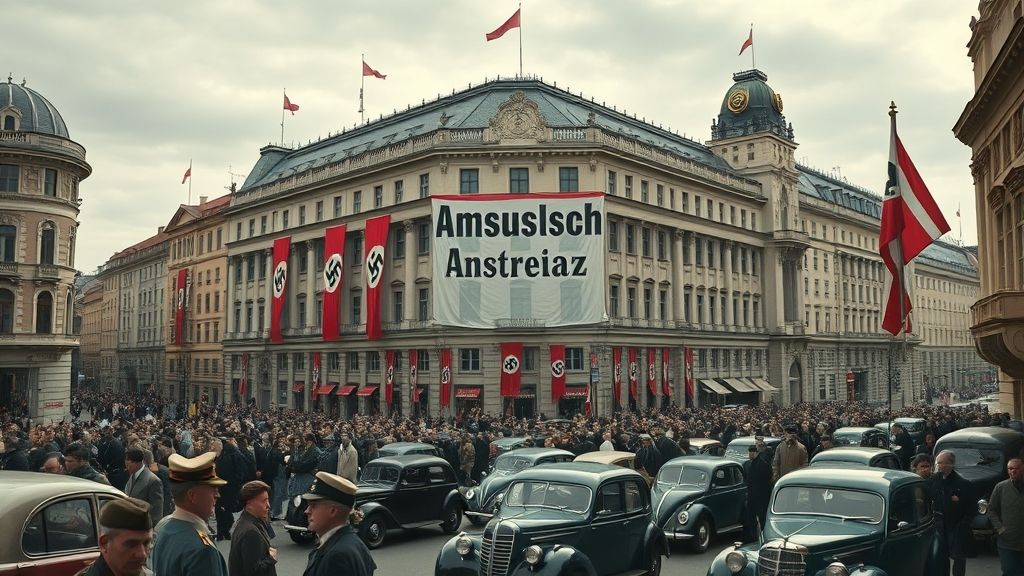
Vienna, the imperial city of art and culture, found itself awash in waves of conflicting emotions. Thousands thronged the Ringstrasse and Heldenplatz, waving flags and listening to speeches by Nazi officials. The atmosphere was electric, charged with nationalism and a sense of historical destiny.
Hitler himself arrived in Vienna on March 15 to a massive crowd. His speech at Heldenplatz was part oration, part propaganda. He hailed the Anschluss as the “fulfillment of German unity” and promised prosperity and peace.
Yet there were silenced voices amid the cheers—those who feared repression, anticipated persecution, or mourned the loss of Austrian sovereignty. Anecdotes recall a synagogue watchman watching helplessly as Nazis looted holy artifacts or whispered warnings to friends.
The Proclamation of Anschluss: Symbolism and Ceremonial Acts
The Anschluss was not only a physical annexation but a theatrical proclamation of power. On March 13, Nazi banners replaced the Austrian flag over government buildings. Public ceremonies displayed the supposed harmony between Austria and Germany.
The official announcement framed the union as a “popular will,” legitimized through staged plebiscites. Church bells rang, military bands marched, and the media presented the event as an almost sacred moment in history.
But beyond the pageantry lay a brutal reality: a nation’s autonomy extinguished and a population swept into the machinery of totalitarianism.
Figures of the Day: Key Players and Their Roles in the Annexation
Central figures emerged in the unfolding drama. Adolf Hitler, the architect and symbol of the Anschluss, orchestrated the operation with calm determination. Kurt Schuschnigg, Austria’s Chancellor, had reluctantly resigned under pressure but tried until the last moment to preserve Austria’s independence.
Arthur Seyss-Inquart played a controversial role; an Austrian Nazi sympathizer, he was appointed as Interior Minister before facilitating the German occupation. His role would later define his legacy as a collaborator responsible for Nazi crimes.
Among the wider population, ordinary men and women, soldiers, and politicians each had their stories—ranging from enthusiastic support to quiet resistance.
Forced Invitations and the Illusion of Unity: The Plebiscite That Followed
To cloak the Anschluss in legitimacy, Hitler demanded a plebiscite to confirm the union. Held in April 1938 under intense propaganda, intimidation, and electoral manipulation, it reported an implausible 99% vote in favor.
The plebiscite was less a democratic exercise and more an instrument of control, crushing dissent and manufacturing consent. The results served Berlin as justification for the annexation internationally, despite widespread skepticism.
The Persecution Commences: Jewish Austrians and Political Opponents
One of the most harrowing consequences of the Anschluss was the swift and brutal persecution of Jewish citizens and political opponents. The welcoming crowds were soon followed by Gestapo raids, arrests, and violence.
Jewish homes, businesses, and synagogues were vandalized and looted in the Kristallnacht-like pogroms. Thousands were deported or fled, fearing the rapidly spreading shadow of the Holocaust.
Austria became the first country to be completely “Aryanized” under Nazi rule, setting a tragic precedent for the rest of Europe.
The World Watches in Silence: Global Political Responses
Despite vocal condemnation from some quarters, the world largely remained passive. Britain and France, caught in domestic troubles and wary of war, maintained policies of appeasement, hoping Hitler’s appetite could be sated.
The United States issued sharp statements but kept isolationist policies. The Soviet Union denounced the move but was diplomatically isolated itself. This collective inaction was perceived by Hitler as tacit approval, allowing him to push further into Czechoslovakia months later.
The Anschluss’s Impact on European Stability and the Road to War
The annexation shattered the fragile peace in Europe. The balance of power shifted, emboldening Hitler to pursue further territorial ambitions. It exposed the weakness of international law and the failure of collective security.
For Austria, it meant disappearance from the map as an independent nation for seven years, and for Europe, it was the prelude to catastrophe. The Anschluss was not merely a territorial expansion; it was a harbinger of the Second World War.
The Incorporation of Austria: Administrative and Social Changes
Following the Anschluss, Austria was absorbed into the German Reich as Ostmark. German law and institutions were imposed overnight. The governance of Austria shifted from a republic to a Nazi administrative district.
Economic policies followed Nazi priorities, focusing on rearmament and war readiness. Austrian education, culture, and media were Nazified. Public life conformed strictly to propaganda and totalitarian control.
Resistance and Collaboration: Diverse Austrian Reactions
Though collaborationist enthusiasm was vocal, many Austrians resisted quietly or overtly. Various underground groups, socialists, communists, and some Catholic clergy opposed Nazi rule, often at great personal risk.
But there was also complicity, with some Austrians volunteering for the Wehrmacht and SS. The complex legacy of these years would fuel political and social debates in Austria for generations.
The Anschluss in Historical Memory: Postwar Reflections and Narratives
After 1945, Austria quickly positioned itself as the first victim of Nazi aggression—a narrative that shaped its postwar identity. Yet historians have since debated the extent of Austrian complicity.
Memorials, museums, and education have sought to reconcile these conflicting stories, reminding Austrians and the world of the lessons of Anschluss and its dangers.
The Long Shadow: How 1938 Shaped Austria and Europe’s Future
The Anschluss’s imprint lingered long after WWII ended. The political borders, human tragedies, and cultural ruptures define much of Central Europe’s 20th-century history. Austria’s rebirth required facing difficult truths about nationalism, collaboration, and resistance.
On a continental scale, the Anschluss symbolized the failure of diplomacy and the catastrophic costs of appeasement—a solemn warning echoing into the present.
Conclusion
The proclamation of Anschluss in Vienna on that fateful day of March 13, 1938, was more than a geopolitical maneuver; it was a complex human story writ large on the continent’s stage. It was hope mingled with fear, pride shadowed by repression, the promise of unity twisted into the machinery of oppression.
Today, as we revisit those moments, we are reminded how fragile democracy can be in the face of aggression and how the tides of history can sweep entire nations into darkness. But we also learn of the courage found in resistance and the power of memory to shine light on the darkest chapters. The Anschluss is history’s solemn lesson—never to be forgotten, never to be repeated.
FAQs
1. What was the Anschluss and why did it happen in 1938?
The Anschluss was the annexation of Austria by Nazi Germany, occurring on March 13, 1938. It happened due to a mix of Austria's political instability, Nazi ideological goals, and international appeasement, allowing Germany to absorb Austria almost without resistance.
2. Who were the main figures behind the Anschluss?
Adolf Hitler was the driving force, seeking unification of all German-speaking peoples. Austrian Chancellor Kurt Schuschnigg tried to resist but resigned under pressure. Arthur Seyss-Inquart, an Austrian Nazi, facilitated German entry.
3. How did the Austrian population react to the Anschluss?
Reactions were mixed—while some Austrians welcomed the union with enthusiasm, others were fearful or resistant, particularly minorities and political opponents of the Nazis.
4. What was the international response to the Anschluss?
The international community, especially Britain and France, largely remained passive, adhering to policies of appeasement. Italy’s position shifted from opposition to tacit support, while the US maintained isolationism.
5. What were the consequences of the Anschluss for Austrian Jews and dissenters?
There was immediate and brutal persecution of Jews and political dissidents. Synagogues were destroyed, businesses seized, and many were deported or fled. The Anschluss marked the beginning of Austria’s tragic role in the Holocaust.
6. How did the Anschluss shape Europe’s road to World War II?
It emboldened Hitler, demonstrated the ineffectiveness of diplomacy, and destabilized Europe, directly leading to further territorial demands and eventually the outbreak of war.
7. How is the Anschluss remembered in Austria today?
Austria initially portrayed itself as a victim, but modern reflections acknowledge complicity and resistance. It remains a subject of education, remembrance, and debate to learn from this dark chapter.
8. Were there Austrian resistance movements during the Nazi period?
Yes, several groups, including socialists, communists, and some religious figures, resisted Nazi rule despite severe repression and danger.