Table of Contents
- The Gathering Storm: Europe on the Brink
- Munich, September 1938: A City Holds Its Breath
- The Players Arrive: Chamberlain, Hitler, Daladier, and Mussolini
- The Sudetenland Question: History and Heartache
- Diplomatic Chess: Negotiations Behind Closed Doors
- The Promise of Peace: The Munich Agreement Unfolds
- A Moment of Triumph or Betrayal? The Immediate Reactions
- Voices from the Shadows: The Sudeten Germans and Czechs
- The Mask of Appeasement: Chamberlain’s “Peace for Our Time”
- Winston Churchill’s Dissent: The Alarm Bells Ring
- The Disintegration of Czechoslovakia: A Nation Abandoned
- Hitler’s Strategic Gains: Beyond the Agreement
- The Fallout in Europe and Beyond: A World Shaken
- The False Peace: Marching Toward War
- Memory and Legacy: Munich in the Historical Imagination
- Munich’s Lessons: Diplomacy, Aggression, and the Limits of Compromise
- Concluding Reflections: The Shadow That Loomed Over a Continent
The Gathering Storm: Europe on the Brink
In the fall of 1938, Europe was a tinderbox, quivering under the heavy weight of unresolved tensions left by the Great War. The continent was a patchwork of fragile alliances, national resentments, and economic strife. Across the newsfeeds and dinner tables, conversations buzzed with anxiety about what the next move of Adolf Hitler might be. Rumors of military posturing, territorial ambitions, and propaganda campaigns had set a somber tone.
Yet, beneath this foreboding atmosphere, there remained a thread of hope — a hope that words and agreements might still hold the power to avoid the catastrophe of another world conflict. It was against this charged backdrop that four leaders converged on the Bavarian capital, Munich, to attempt the unthinkable: to negotiate peace with a dictator determined to reshape Europe by force.
Munich, September 1938: A City Holds Its Breath
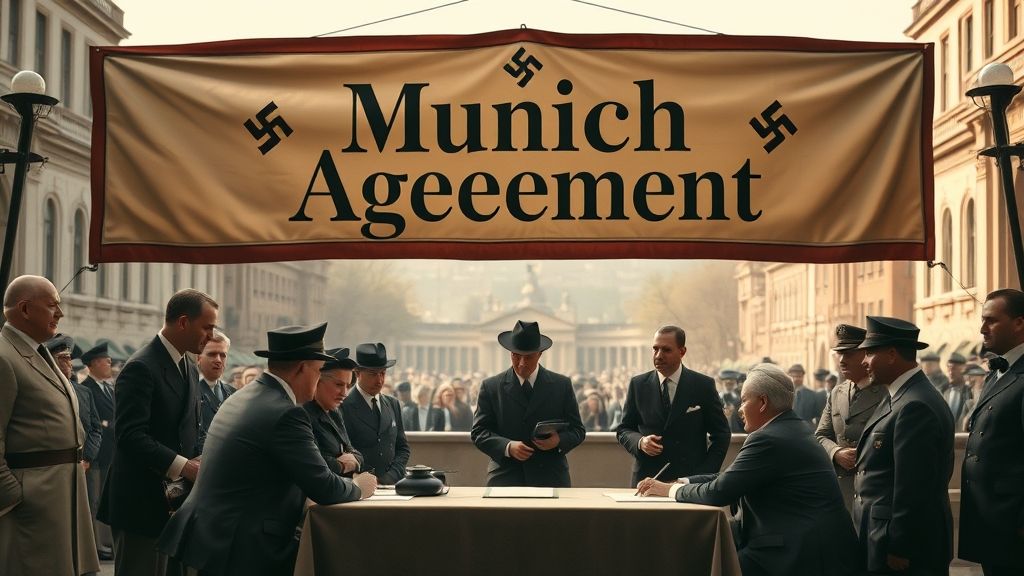
The city of Munich itself seemed caught between the present and an impending storm. The golden autumn sunlight filtered through the leaves, casting long shadows over the huddled delegations. The atmosphere was tense, a mix of anticipation and apprehension. Here, in a beautiful city that had seen previous contrasts of art and turmoil, history was about to pivot.
Citizens lined the streets, newspapers blared headlines declaring a “peace summit” with cautious optimism, and journalists scrambled for every scrap of information. The world’s eyes were fixed on this gathering, knowing that the decisions made within the austere rooms of the Führerbau and the Führer’s private villa would echo for decades.
The Players Arrive: Chamberlain, Hitler, Daladier, and Mussolini
Four leaders—each embodying distinct nations and ideologies—sat at the negotiating tables: British Prime Minister Neville Chamberlain, German Führer Adolf Hitler, French Premier Édouard Daladier, and Italian dictator Benito Mussolini. Their presence alone was a reflection of the complex power dynamics shaping Europe.
Chamberlain, wielding the mantle of British democracy, carried the heavy burden of preventing war at almost any cost. Hitler, the master of propaganda and ruthless ambition, saw the summit as an opportunity to legitimize his claims. Daladier, caught between loyalty to the Treaty of Versailles and the pressure to protect France’s borders, sought a fragile peace. Mussolini, the fascist ally, played the role of both mediator and opportunist.
Each man brought a different vision, each with their own stakes and ambitions, making the summit a perilous dance on the edge of history.
The Sudetenland Question: History and Heartache
At the heart of the Munich Agreement was the Sudetenland, a mountainous border region of Czechoslovakia inhabited predominantly by ethnic Germans. Since the aftermath of World War I and the treaties that carved Europe into new nations, the Sudeten Germans lamented their “captivity” under Czech rule. Their grievances were skillfully exploited by Hitler, who portrayed himself as their protector.
But the issue was about more than just territorial claims; it was a complex tangle of national identities, strategic defenses, and historical grievances. The Sudetenland contained vital border fortifications of Czechoslovakia as well as industrial resources — its loss posed a grave threat to the young democracy’s survival.
This ethnic and geopolitical mosaic made any solution exceedingly difficult, setting the stage for a dramatic showdown.
Diplomatic Chess: Negotiations Behind Closed Doors
The next days in Munich were marked by intense discussions, interspersed with tension-filled silences and strategic posturing. Hitler's demands were clear: the Sudetenland must be ceded to Germany without Czech consent.
The Czechoslovak government was not invited to participate — a glaring omission that framed the talks as an imposition rather than a true negotiation. Chamberlain and Daladier wrestled between appeasing Hitler and standing up to aggression, while Mussolini contributed with theatrical flair.
Behind the scenes, secret calculations governed the diplomats' moves — all hunting for an elusive peace, knowing well that pricking the fragile bubble might mean war.
The Promise of Peace: The Munich Agreement Unfolds
On September 30, 1938, the four powers finalized an accord that would change the map of Europe. The Munich Agreement handed over the Sudetenland to Germany, to be occupied within ten days. The decision was presented as a necessary sacrifice to maintain peace.
Chamberlain returned to Britain waving the agreement, famously declaring that it had secured "peace for our time." The sense of relief was palpable, yet mixed with unease among informed observers.
For many others, the agreement was a bitter pill — a betrayal wrapped in the veil of diplomacy.
A Moment of Triumph or Betrayal? The Immediate Reactions
Internationally, responses were polarized. British and French governments largely touted the agreement as a masterstroke of diplomacy that had averted disaster. Newspapers celebrated Chamberlain’s bravado, while sections of the populace breathed easier after a decade of fear.
On the other hand, Czechoslovaks felt abandoned and humiliated, their sovereignty stripped away without consent. The Sudeten Germans were jubilant, but this euphoria was overshadowed by growing fears of Nazi rule.
Winston Churchill, then a backbench MP, vocally denounced the pact as a "total and unmitigated defeat," warning that it only emboldened Hitler further.
Voices from the Shadows: The Sudeten Germans and Czechs
Beyond the capitals and diplomatic chambers, the people caught in the middle experienced seismic shifts. The Sudeten Germans, long marginalized, anticipated a return to their “homeland,” but soon discovered that Nazi control came with ruthless repression and ideological conformity.
Czech citizens faced the disintegration of their country’s defenses and the onset of political turmoil. Many fled or resisted, their hopes for a peaceful future shattered. Families were divided, communities splintered, and an atmosphere of fear and suspicion permeated daily life.
This human cost was obscured by the grand narrative of “peace” broadcasted in London and Paris.
The Mask of Appeasement: Chamberlain’s “Peace for Our Time”
Neville Chamberlain returned to Britain as a hero, clutching the signed agreement and uttering words that echoed across history. His phrase “peace for our time” was at once hopeful and, in hindsight, tragic.
Chamberlain genuinely believed that compromise and concession might prevent the horrors of another war. His policy of appeasement reflected the trauma of World War I, the public’s exhaustion, and the economic constraints Britain faced.
Yet this approach revealed the limits of diplomacy when confronted with expansionist totalitarianism—a lesson bitterly learned in the years to come.
Winston Churchill’s Dissent: The Alarm Bells Ring
Amidst the general acclaim, one voice cried out in warning. Winston Churchill saw the Munich Agreement as not peace but prelude. In speeches and writings, he condemned the surrender of Czechoslovakia as a dangerous sign that Hitler’s ambitions would only grow.
Churchill’s stance was unpopular at the time, labeled as warmongering and pessimistic, but his relentless vigilance cemented his place as a prescient moral compass.
The Disintegration of Czechoslovakia: A Nation Abandoned
The Munich Agreement effectively dismantled Czechoslovakia’s defenses and subjected it to humiliation and fragmentation. Within months, the country unraveled: Slovakia declared autonomy, and Hungary and Poland seized portions of its territory.
By March 1939, under Nazi pressure, the remainder of Bohemia and Moravia fell under German occupation, transforming the region into a protectorate. The once vibrant democracy was reduced to a puppet state, its people caught under the shadow of tyranny.
The abandonment starkly demonstrated the perilous consequences when strategic interests override principles and allies.
Hitler’s Strategic Gains: Beyond the Agreement
For Hitler, Munich was a strategic masterpiece wrapped in political legitimacy. The acquisition of the Sudetenland not only secured a critical defense line but also boosted German morale and resources.
More importantly, the agreement revealed the Western powers’ reluctance to confront his expansionist aims, encouraging further territorial ambitions. Just six months later, the invasion of Poland ushered in the official start of World War II.
Munich had, in effect, bought time for Germany to strengthen its hand, while Europe’s hopes for peace unraveled.
The Fallout in Europe and Beyond: A World Shaken
The Munich Agreement reverberated far beyond Central Europe. In Moscow, Stalin viewed the pact with suspicion, accelerating Soviet interest in alliances. Across the Atlantic, the United States watched warily, still committed to isolationism but increasingly alert to threats.
The agreement undermined faith in collective security and the League of Nations, exposing the fragile architecture of interwar diplomacy.
Countries around the globe grappled with the unsettling realization that appeasement might not secure peace but rather delay the inexorable march to conflict.
The False Peace: Marching Toward War
Despite its proclamations, the Munich Agreement was a fragile, illusory peace. It did nothing to stop Hitler’s ambitions, only emboldened them.
Within months, Hitler violated the pact, occupying the rest of Czechoslovakia and pushing invasion plans for Poland. The Anglo-French declaration of war in September 1939 marked the collapse of appeasement and the onset of a devastating global conflict.
Munich became a symbol of the dangers of compromise with tyranny, a historical lesson etched in blood.
Memory and Legacy: Munich in the Historical Imagination
Over the decades, Munich has been a haunting chapter in textbooks, films, and collective memory. It embodies the tension between diplomacy and moral clarity, the heartbreak of sacrifice, and the cost of underestimating evil.
For many, Munich is synonymous with appeasement’s failure; for others, it’s a moment of tragic necessity. It reminds us of the fragile line between peace and war, and the unforgiving judgments of history.
Munich’s Lessons: Diplomacy, Aggression, and the Limits of Compromise
The Munich Agreement forces us to reflect on the nature of diplomacy in the face of aggression. How far can compromise go before it becomes betrayal? When does caution slide into cowardice? These questions remain as relevant today as then.
The event underscores the need for vigilance, the dangers of underestimating ambitions fueled by ideology, and the importance of commitments to sovereignty and justice.
In this light, Munich stands not merely as a failed negotiation but as a profound lesson on the human and political cost of peace at any price.
Concluding Reflections: The Shadow That Loomed Over a Continent
As the sun set on September 30, 1938, the leaders of Europe parted ways with an agreement that promised peace but delivered the opposite. The echoes of those decisions would resound in the generations that followed—a reminder that diplomacy, while essential, demands courage, clarity, and an unyielding commitment to truth.
Munich was neither the end nor the beginning of conflict but a critical inflection point—one where hope met harsh reality, and the world came face to face with the terrible choices that define history.
Conclusion
The Munich Agreement of 1938 remains one of the most poignant and debated moments of the 20th century. It encapsulates the desperate desire to avoid war, the tragic concessions made in the name of peace, and the human suffering that ensued when aggression met appeasement.
Beyond the political maneuvering and international drama, it is a story of people—of leaders burdened with impossible choices, of communities uprooted and betrayed, and of a continent teetering on the edge.
Reflecting on Munich today invites us to carry forward its most crucial lesson: that peace forged by sacrifice and compromise must never come at the cost of justice and sovereignty. Only with such wisdom can the shadows of history be transformed into guides for a more humane future.
FAQs
1. Why was the Munich Agreement signed without Czechoslovakia’s participation?
The major powers—Germany, Britain, France, and Italy—sought to resolve the Sudetenland crisis quickly, believing that excluding Czechoslovakia would ease negotiations and avoid further conflict. Unfortunately, this sidelined the very nation whose territory and sovereignty were at stake.
2. What was Neville Chamberlain’s motivation behind the appeasement policy?
Chamberlain aimed to avoid another devastating war like World War I, believing that satisfying Hitler’s territorial demands in the Sudetenland would secure lasting peace. He also faced domestic pressure and recognition of Britain’s temporary military unpreparedness.
3. How did the Munich Agreement impact Czechoslovakia?
The agreement led to the loss of critical border defenses and industrial regions, weakening Czechoslovakia militarily and politically. Subsequently, the country was dismembered and eventually occupied by Nazi Germany, marking a tragic collapse of its sovereignty.
4. What role did Winston Churchill play during the Munich crisis?
At the time a backbench MP, Churchill vocally opposed the agreement, warning it would embolden Hitler and lead to war. His dissent was initially unpopular but later recognized as prescient.
5. Did the Munich Agreement prevent World War II?
No. Though it delayed the outbreak of war by less than a year, Hitler violated the agreement by occupying the rest of Czechoslovakia and invading Poland, which triggered Britain and France’s declaration of war.
6. How is the Munich Agreement viewed in historical perspective?
It is often seen as a classic example of failed appeasement—a cautionary tale about the dangers of compromising with aggressive totalitarian regimes to avoid immediate conflict at the expense of long-term peace.
7. What lessons does the Munich Agreement teach modern diplomacy?
Munich illustrates the necessity of balancing conciliation with firm resistance to aggression, emphasizing the importance of honoring alliances and protecting sovereignty to prevent emboldening dictators.
8. How did the public in Britain and France react to the agreement at the time?
The public largely celebrated the agreement as a peace-saving success, relieved by Chamberlain’s assurances. However, some political figures and informed citizens expressed concern and skepticism about its long-term efficacy.