Table of Contents
- The Night the World Shuddered: Kristallnacht, November 9, 1938
- A City on the Edge: Berlin in the Late 1930s
- Anti-Semitism in Germany: Seeds of Hatred and Persecution
- The Assassination That Sparked a Firestorm: Herschel Grynszpan and Ernst vom Rath
- Nazi Propaganda: From Incitement to Orchestration
- The Early Hours: How Kristallnacht Began in Berlin
- The Destruction Unfolds: Synagogues, Shops, and Homes in Flames
- The Sounds of Shattered Glass: Eyewitness Testimonies from Berlin Streets
- The Role of the SA, SS, and Hitler Youth in the Violence
- Police and Firefighters: Complicity and Restraint
- Arrests and Deportations: The Immediate Human Toll
- Public Reaction: Fear, Indifference, and Resistance
- International Outrage and Indifference: The World Responds
- The Economic War Against Jews: Aryanization Accelerates
- Kristallnacht’s Place in the Holocaust’s Dark Prehistory
- Psychological Impact on Berlin’s Jewish Community
- The Aftermath: Trials, Punishments, and Propaganda Spin
- Remembering Kristallnacht in Berlin Today
- The Moral Lessons: How a City Was Tested and Transformed
- Kristallnacht’s Legacy in World History
1. The Night the World Shuddered: Kristallnacht, November 9, 1938
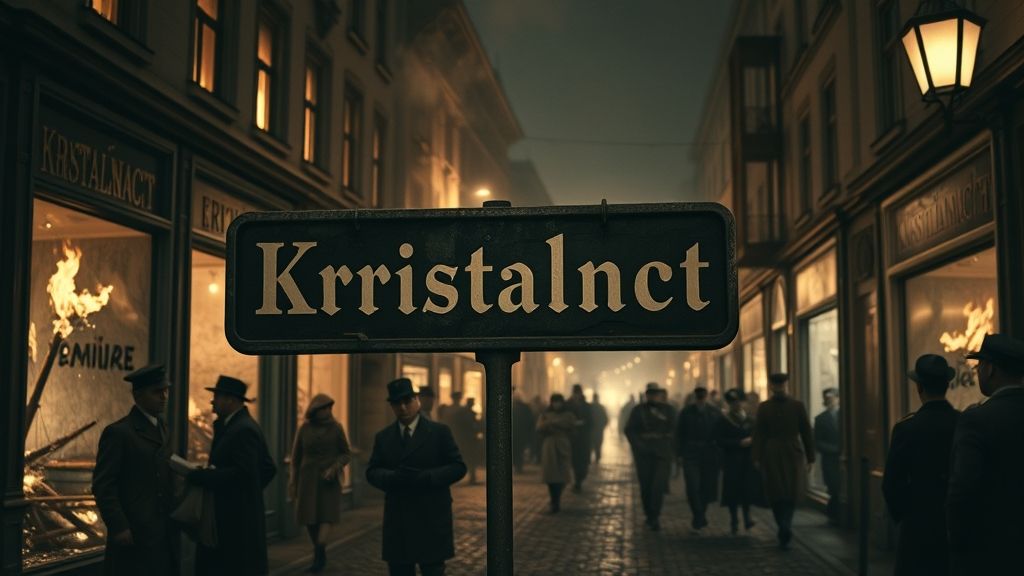
Berlin, November 9, 1938. The cold night air was pierced by the sharp crack of shattering glass. Windows splintered under the force of Nazi thugs wielding stones and crowbars, sending shards like deadly rain onto the pavements. Flames licked the stone façades of synagogues, their roaring smoke blotting out the starlit sky. Families cowered in fear behind locked doors, listening helplessly as the fury tore through their neighborhoods. Somewhere, a mother wept silently for a store set ablaze, for a life of dignity smashed to rubble. This was Kristallnacht—the Night of Broken Glass—a horrifying—and haunting—turning point from hatred to open terror.
This night in Berlin marked more than the destruction of glass. It was the shattering of the fragile veneer of “legal” discrimination, morphing into naked violence, state-directed and complicit. For the Jewish residents of Berlin, it was the moment when the nightmare became reality. For the world, it was a warning shot—the quiet before the storm of genocide.
Yet the night was not born out of nowhere. As the torchlit mobs moved through the city’s streets, their crimes bore the bitter fruit of years of escalating cruelty. To understand Kristallnacht in its full meaning requires diving into the murky currents that led Berlin to this fateful night.
2. A City on the Edge: Berlin in the Late 1930s
Berlin in 1938 was a city caught between the shadows of its chaotic past and the ever-tightening grip of Nazi ideology. Once the vibrant cultural heart of the Weimar Republic, it was now a metropolis simmering with political tension, fear, and propaganda.
Streets once teeming with intellectuals, artists, and cosmopolitan life became echo chambers for nationalist fervor and racial hatred. Jewish communities, once integral to the city’s fabric, found themselves increasingly ostracized. The Reichstag, the symbol of Germany’s parliamentary democracy, stood powerless against the flood of authoritarianism sweeping across the nation.
The economy was paradoxical—on the rise in terms of rearmament and public works, but brittle beneath the surface, particularly for those labeled “enemies of the state.” Fear clung to the air like smog, and Berliners learned to whisper, to watch shadows, and to wonder who might vanish next.
3. Anti-Semitism in Germany: Seeds of Hatred and Persecution
Anti-Semitism was woven into the ideological DNA of the Nazi regime. Rooted in centuries of European prejudice but given a deadly new direction, it escalated in intensity after Adolf Hitler’s rise to power in 1933. Jews were scapegoated for Germany’s economic woes, labeled as racially inferior, and blamed for communism’s specter—a perfect storm for state-sponsored discrimination.
Reich laws systematically stripped Jews of their rights. The Nuremberg Laws of 1935 revoked citizenship, banned intermarriage, and institutionalized racial discrimination. Jewish businesses were boycotted; cultural and social exclusion became law.
Yet for all the legal control, outright violence was often officially restricted until 1938. The Nazis maintained an uneasy balance, using intimidation and legal oppression rather than mass destruction—until Kristallnacht shattered this timeline.
4. The Assassination That Sparked a Firestorm: Herschel Grynszpan and Ernst vom Rath
The immediate trigger for Kristallnacht was the assassination of Ernst vom Rath, a German diplomat stationed in Paris. On November 7, 1938, Herschel Grynszpan, a 17-year-old Polish-Jewish refugee, arrived at the German embassy in Paris and shot vom Rath in a desperate act of protest against the humiliations suffered by his family and other Polish Jews deported from Germany.
Vom Rath died two days later, and the Nazi leadership seized upon the assassination as a pretext to unleash a coordinated wave of violence against Jews. The staged reaction fused wrath with calculated political theater.
Behind the scenes, Joseph Goebbels, Hitler’s propaganda minister, orchestrated the response with grim efficiency. The night of November 9 was to be a signal like no other—a violent puncture in the facade of German civility.
5. Nazi Propaganda: From Incitement to Orchestration
The Nazi propaganda machine moved swiftly. Newspapers and radio broadcasts whipped up anger, framing Grynszpan’s act not as an isolated tragedy but as evidence of a larger "Jewish conspiracy." Headlines castigated the Jewish community, while official instructions were relayed to the SA (Sturmabteilung) and SS units to prepare for violent reprisals.
State authorities organized the violence with chilling precision. Kristallnacht was not a spontaneous riot; it was a planned pogrom, a horrifying climax of years of hateful incitement.
Goebbels’ chilling words before the night: "That comrade costs us the German people a Kristallnacht." A euphemism for darkness and destruction that was to befall Berlin and the Reich.
6. The Early Hours: How Kristallnacht Began in Berlin
As dusk fell on November 9, 1938, an eerie quiet descended over Berlin. But behind the scenes, the city was abuzz with movement. SA officers, uniformed men from the Hitler Youth, and Gestapo agents slipped into Jewish neighborhoods armed with clubs, axes, and Molotov cocktails. Orders had been given: destroy synagogues, vandalize Jewish businesses, arrest Jewish men.
The first attacks began near Kurfürstendamm, Berlin’s prestigious avenue, where Jewish-owned shops glittered with goods suddenly destined for ruin. Within hours, synagogues such as the Oranienburger Straße synagogue were engulfed in flames, the fire fed by gasoline and hate.
Streetlights flickered, glass exploded, screams echoed through narrow alleys. The night was both chaotic and methodical—windows shattered, Torah scrolls torn and burned, families thrown into terror.
7. The Destruction Unfolds: Synagogues, Shops, and Homes in Flames
By midnight, Berlin had become a city ablaze. Nearly 50 synagogues and prayer houses were set on fire or severely damaged, their sanctuaries desecrated. More than 7,500 Jewish establishments—stores, offices, and homes—were ransacked and looted, their interiors gutted.
One notable scene unfolded at the Fasanenstrasse synagogue, where local worshippers tried desperately to save holy books and artifacts, only to be pushed back by paramilitary forces. The unmistakable crackle of flames was a grim soundtrack as flames consumed centuries of religious and cultural heritage.
Jewish homes were invaded, personal belongings destroyed. Men and women were humiliated, some beaten to the point of death. Yet in this orchestrated chaos, the face of resilience quietly emerged—neighbors offering shelter, whispers of solidarity amid terror.
8. The Sounds of Shattered Glass: Eyewitness Testimonies from Berlin Streets
“I remember the crash of windows, the shouting of men,” recalled Elisabeth Meyer, a Berlin resident who witnessed the night unfold from her apartment window. “It was horror made visible; the streets became rivers of broken glass and flames. We could hear a mother screaming for her children—my heart ached.”
Others told of the cold indifference of passersby—some drawn by morbid curiosity, while others turned away in fear. Still, pockets of courage appeared—some Berliners hid Jewish families, risking punishment.
These voices remind us that Kristallnacht was not only an event but a lived nightmare, a night etched into human memories with pain and sorrow.
9. The Role of the SA, SS, and Hitler Youth in the Violence
Kristallnacht’s machinery was powered by Nazi paramilitaries. The SA—once the party’s brawny street thugs—marched through Berlin enforcing the pogrom with brutal zeal. The SS, the regime’s elite security force, coordinated mass arrests.
The Hitler Youth, teenage boys driven by ideology and peer pressure, played their part, throwing stones, setting fires, and humiliating neighborhoods. Their participation symbolized a generational farewell to innocence, drafted into hatred.
Far from spontaneous mobs, these groups followed orders with ruthless commitment. Their violence was a dark ballet choreographed by the Nazi state.
10. Police and Firefighters: Complicity and Restraint
Police officers’ responses varied but often bordered on complicity. Most police units did not intervene, standing by as violence spread. Firefighters were ordered to prioritize saving non-Jewish buildings, allowing synagogues to burn unchecked—a tacit approval of destruction.
Yet, not all were silent. Some officers risked retribution to protect neighbors. Still, the official stance reflected a law enforcement apparatus aligned with, rather than resisting, the pogrom.
11. Arrests and Deportations: The Immediate Human Toll
Kristallnacht was not only about destruction of property; it marked a mass arrest campaign. In Berlin alone, around 30,000 Jewish men were detained and sent to concentration camps such as Sachsenhausen and Dachau.
The arrests were arbitrary and brutal, stripping men from their families without due process. Released weeks later, many suffered lasting trauma or worse.
Women, children, and the elderly were left vulnerable—subject to further persecution. Kristallnacht thus escalated from destruction to incarceration, tightening the Nazi noose.
12. Public Reaction: Fear, Indifference, and Resistance
Berliners’ reactions were complex and fraught. Fear silenced many; indifference or tacit approval prevailed among others. Some denounced the violence in private; a few brave souls aided victims.
Yet widespread resistance was rare, as the brutal efficiency of Nazi repression discouraged dissent. The chilling message was clear: speaking out invited peril.
13. International Outrage and Indifference: The World Responds
News of Kristallnacht spread quickly beyond Germany’s borders. Newspapers in Britain, the United States, and France condemned the violence. Jewish communities worldwide mourned and organized relief efforts.
However, official diplomatic responses were often restrained, limited to protests or symbolic actions. Many Western governments maintained tight immigration quotas, closing doors to desperate refugees.
Thus, while internationally recognized as atrocity, Kristallnacht also exposed the limits of global intervention in the prelude to the Holocaust.
14. The Economic War Against Jews: Aryanization Accelerates
The destruction of Jewish businesses was not random. It was part of a systemic economic campaign known as “Aryanization,” where Jewish property was forcibly seized and transferred to non-Jewish Germans.
Kristallnacht accelerated this process, bankrupting businesses and leaving owners destitute. Berlin’s vibrant Jewish economic network, once foundational, was swiftly erased.
15. Kristallnacht’s Place in the Holocaust’s Dark Prehistory
Kristallnacht is often seen as a watershed—marking the transition from discrimination to extermination. It foreshadowed the “Final Solution,” the Holocaust’s systematic murder of six million Jews.
Berlin’s shattered glass was a warning, a grim marker on the road to genocide. The event’s brutality exposed the Nazi regime’s full-hearted cruelty.
Yet, it also reminds us of the fragility of civilization and the catastrophic consequences of hatred unleashed.
16. Psychological Impact on Berlin’s Jewish Community
For Berlin’s Jews, Kristallnacht was a shattering trauma. Many who had considered Germany home felt betrayed and terrified. The destruction of sacred spaces deepened a sense of exile.
Families debated fleeing, yet barriers loomed large. Memories of Kristallnacht would haunt survivors for decades.
17. The Aftermath: Trials, Punishments, and Propaganda Spin
Following the pogrom, the Nazi regime fined the Jewish community one billion Reichsmarks for “damages.” Official statements framed Kristallnacht as a justified reprisal, masking the pogrom’s state orchestration.
Few perpetrators faced punishment; the event reinforced the culture of impunity.
18. Remembering Kristallnacht in Berlin Today
Today, memorials stand where synagogues once burned, silent witnesses to history. Berlin’s urban landscape bears traces of loss, but also resilience.
Annual commemorations honor victims, demanding “never again.” The city’s engagement with its dark past is complex but necessary.
19. The Moral Lessons: How a City Was Tested and Transformed
Kristallnacht challenges us to confront human capacity for cruelty and indifference. Berlin’s role can teach vigilance against hatred’s rise.
It underscores the imperative of protecting minorities and opposing state violence.
20. Kristallnacht’s Legacy in World History
More than a night of broken glass, Kristallnacht resonates as a symbol of warning. Its echoes inform lessons on genocide, intolerance, and collective responsibility.
Berlin in 1938 is a mirror to humanity—a call to remember, to resist, and to uphold justice.
Conclusion
Kristallnacht in Berlin was a night when the shattering of glass mirrored the fracturing of a society’s conscience. It was the moment when bricks of hatred solidified into violent action, altering forever the lives of thousands and marking a turning point in human history.
Yet within the horror lay stories of sorrow, courage, and survival—reminders that even in darkness, humanity persists. As we look back on that cold November night, we are compelled not only to remember the victims but to recognize the fragility of peace and the perils of silence.
In a world still scarred by division, Kristallnacht stands as a solemn testament: when hatred is allowed to fester unchecked, the rubble it leaves behind is never just glass.
FAQs
Q1: What was the main cause triggering Kristallnacht in Berlin?
A1: The assassination of Ernst vom Rath by Herschel Grynszpan in Paris provided the Nazi regime with a pretext to unleash Kristallnacht, though the violence was premeditated and rooted in ongoing anti-Semitic policies.
Q2: How was Kristallnacht organized and who carried out the attacks?
A2: Kristallnacht was a coordinated pogrom orchestrated by Nazi leaders, primarily carried out by the SA, SS, and Hitler Youth, with varying degrees of police compliance.
Q3: What were the immediate consequences for Berlin’s Jewish community?
A3: Thousands of Jewish businesses and synagogues were destroyed, approximately 30,000 Jewish men were arrested and sent to concentration camps, and the community was plunged into fear and uncertainty.
Q4: How did the international community respond to Kristallnacht?
A4: While many countries condemned the violence, official responses were limited and immigration barriers prevented many Jewish refugees from finding safe haven.
Q5: Why is Kristallnacht considered a turning point in Holocaust history?
A5: It marked the shift from legal persecution to overt violence and large-scale repression, foreshadowing the systemic genocide that would follow.
Q6: Are there memorials in Berlin commemorating Kristallnacht?
A6: Yes, several memorials and plaques throughout Berlin honor the victims and educate the public about the night’s atrocities.
Q7: What role did propaganda play in the events of Kristallnacht?
A7: Nazi propaganda incited hatred and justified violence, portraying Grynszpan’s assassination as a Jewish conspiracy and rallying the public to support the pogrom.
Q8: Did any Berliners resist or protest against Kristallnacht?
A8: Some individuals discretely aided victims or expressed private dissent, but widespread resistance was rare due to fear of retribution.