Table of Contents
- The Opening of the Yalta Conference: A World on Edge
- The War’s Final Chapter: The Context Before Yalta
- The Big Three: Roosevelt, Churchill, and Stalin Prepare to Meet
- Setting the Stage: Crimea as a Symbol and a Battlefield
- Arrival and Initial Impressions: Tensions Beneath Official Smiles
- Negotiating the Future: The Question of Europe’s Fate
- The Fate of Germany: Division, Demilitarization, and Reconstruction
- Poland’s Future: Borders, Governments, and Soviet Influence
- The United Nations: Birth of a Global Peacekeeper
- The Soviet Commitment to Join the War Against Japan
- Human Shadows: Discussions on War Crimes and Refugees
- Personalities at the Table: Power Dynamics and Psychological Intrigue
- The Role of Secrecy: Behind Closed Doors and Classified Agreements
- Press and Public Perception: How News of Yalta Spread
- The Political Fallout: Critics, Supporters, and Revisionists
- Yalta vs. Potsdam: The Shifting Balance of Power
- The Conference’s Legacy in Cold War Historiography
- Memory and Myth: Yalta in Popular Imagination
- Consequences for Eastern Europe: From Liberation to Iron Curtain
- The Human Cost: How Decisions Affected Millions
- Geopolitical Realignments: Seeds of the Bipolar World
- Roosevelt’s Last Days: Health, Hopes, and Historical Judgment
- Churchill’s Perspective: A Veteran’s Warning
- Stalin’s Strategic Gains: The Soviet Empire Enlarged
- The Yalta Agreements in Modern Context
1. The Opening of the Yalta Conference: A World on Edge
The dawn of February 4, 1945, broke over the Crimean peninsula with a bitter chill in the air, as if the frozen landscape itself heralded the icy negotiations to come. In the Livadia Palace, a former summer retreat of the last Russian tsar, the grand halls filled with the weight of history and the burden of expectation. Outside, the vast Black Sea stretched silently, harboring the last quarters of one world and the uncertain dawn of another.
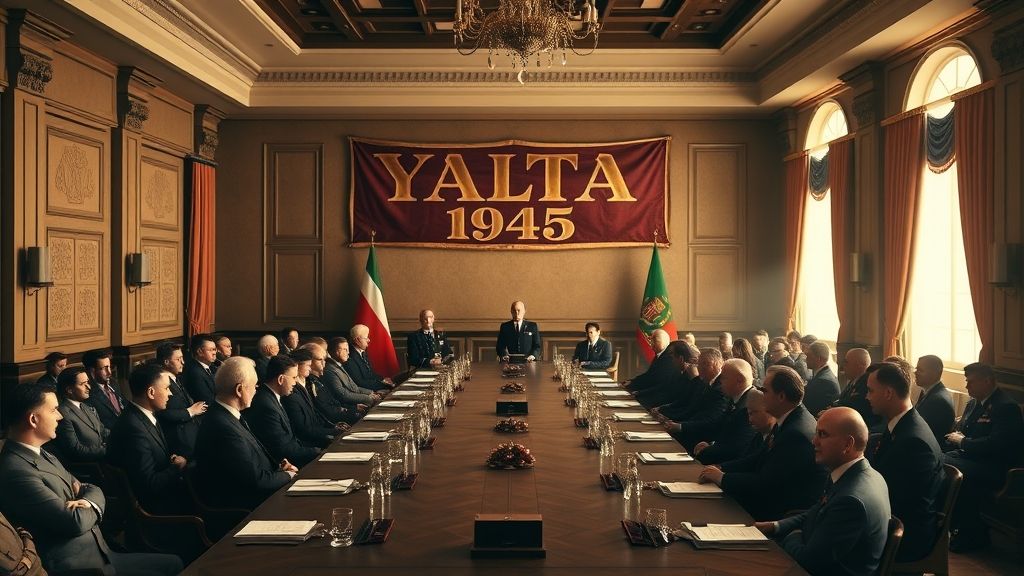
World War II was nearing its end, but peace remained a fragile concept, wrought with questions, rivalries, and unspoken fears. Three colossal figures—President Franklin D. Roosevelt of the United States, Prime Minister Winston Churchill of Great Britain, and General Secretary Joseph Stalin of the Soviet Union—were about to sit together, determining the contours of a postwar order whose consequences would ripple across decades.
The Yalta Conference wasn’t merely a diplomatic meeting. It was a crucible where victory’s price was debated, human destinies were negotiated, and the map of Europe was redrawn—in ways that would haunt humanity long after the last bullet had been fired.
2. The War’s Final Chapter: The Context Before Yalta
By early 1945, nearly six years of relentless global conflict had devastated continents. Nazi Germany was crumbling on both eastern and western fronts, yet uncertainty lingered about what the peace would look like. The Allies had pushed deep into Europe, the Soviets capturing cities on the Eastern Front as the Western Allies stormed through France into Germany.
Yet beneath the triumphant headlines lay complex tensions. The wartime alliance had been born of necessity rather than friendship; the ideological gulf between capitalist democracies and the Soviet communist regime yawned wide, threatening cracks in the coalition’s foundation. The future of liberated nations, particularly Poland, was already a subject of intense debate.
Meanwhile, Roosevelt faced deteriorating health, Churchill struggled to maintain the British Empire’s relevance, and Stalin sought security guarantees and recognition of Soviet influence across Eastern Europe. The stakes could not have been higher.
3. The Big Three: Roosevelt, Churchill, and Stalin Prepare to Meet
Each leader embarked on the journey to Crimea burdened with personal and national hopes. Roosevelt, aware this might be his last major diplomatic summit, sought to forge a vision of a new international order that would prevent future wars and protect democracy. Churchill, the indomitable wartime leader, aimed to secure British interests and preserve a balance against Soviet expansionism. Stalin, having borne the brunt of the Nazi invasion’s horrors, was determined to safeguard Soviet security through territorial gains and political influence.
Their disparate perspectives and priorities meant the meeting’s success was far from assured. They carried a mixture of pragmatism and suspicion, with secret plans and undisclosed intentions loaded in their briefcases.
4. Setting the Stage: Crimea as a Symbol and a Battlefield
The choice of Yalta, in Crimea, was no accident. This Black Sea peninsula was a place marked by imperial splendor and wartime devastation. It had witnessed the fall of czars, the upheavals of revolution, and now served as a remote, secure site away from prying eyes and frontlines.
Within the ornate, yet shadowed halls of Livadia Palace, with its grand mosaics and sweeping seaviews, the world powers would attempt to agree on the architecture of peace. The very walls seemed to echo with the ghosts of empires past and the uncertain future to come.
5. Arrival and Initial Impressions: Tensions Beneath Official Smiles
The first moments of the conference masked the underlying frictions with smiles and polite conversation. Roosevelt’s approachable warmth contrasted with Stalin’s inscrutable calm and Churchill’s sardonic wit. Yet all were acutely aware: no personal rapport could mask the divergent objectives.
They exchanged gestures of goodwill—a warmth that belied the serious strategic calculations each was making. Staff from the three camps watched carefully; every word, every glance was analyzed for hidden meanings.
6. Negotiating the Future: The Question of Europe’s Fate
The conversation quickly dove into the future of Europe’s shattered nations. At stake was the political system to emerge in liberated countries, many of which had seen brutal occupation and shifting alliances.
The Western Allies wanted free elections and democratic governments; Stalin pressed for “friendly” regimes aligned with the Soviet Union. This fundamental disagreement was the seed of future discord, although at Yalta, agreements were tentatively reached—often phrased with deliberately vague language to keep open options.
7. The Fate of Germany: Division, Demilitarization, and Reconstruction
Germany, defeated but not yet conquered, was at the center of intense discussion. The three leaders agreed it must be disarmed, divided into occupation zones, and punished for its crimes. Yet the exact boundaries, administration, and future status were fiercely debated.
They envisioned a four-power occupation—US, UK, USSR, and later France—with plans for denazification and reparations. Roosevelt desired a lasting peace built on justice, Churchill feared an embittered Germany might rebound, and Stalin sought to extract maximum reparation and ensure security buffers.
8. Poland’s Future: Borders, Governments, and Soviet Influence
Perhaps the most contentious issue was Poland. The nation had suffered invasions, partitions, and occupation by both Nazis and Soviets. The question was: who would govern Poland now?
Stalin’s armies occupied much of the country, and he sought to install a pro-Soviet government. The Western leaders insisted on a government “broadly representative” and democratic, free elections, but accepted a Soviet sphere of influence in practice.
The Oder-Neisse line was drawn, effectively pushing Poland westwards at Germany’s expense—a radical territorial rearrangement that displaced millions.
9. The United Nations: Birth of a Global Peacekeeper
Amid military and territorial negotiations, the conference tackled the creation of an institution to prevent future global wars: the United Nations.
Roosevelt championed this vision, pushing for an organization with a Security Council including the Big Three plus France and China, each wielding veto powers to safeguard their interests. The blueprint of modern international diplomacy was taking shape, designed to mediate conflicts and enforce peace—though it would soon face its own Cold War challenges.
10. The Soviet Commitment to Join the War Against Japan
Another pivotal agreement involved the Soviet Union’s entry into the Pacific War. Stalin promised to declare war on Japan within three months after Germany’s defeat, a contribution sorely needed by the United States as it prepared for a bloody invasion of the Japanese home islands.
In exchange, the Soviets gained territorial concessions inManchuria and strategic ports—plants that sowed seeds of postwar rivalry in Asia.
11. Human Shadows: Discussions on War Crimes and Refugees
Beyond macro-politics, there were harrowing discussions on war crimes trials and humanitarian catastrophes. The "Nuremberg Trials" were agreed upon as a means to bring Nazi leaders to justice—an unprecedented step toward international law enforcement.
The plight of millions of displaced persons, refugees, and survivors also echoed through the talks. Yet practical solutions often fell short amid political maneuverings, leaving many fates unresolved.
12. Personalities at the Table: Power Dynamics and Psychological Intrigue
The Yalta Conference was as much a clash of wills and personalities as policies. Roosevelt’s frailty contrasted with Stalin’s steely resolve and Churchill’s cunning. The psychological interplay, covert signaling, and occasional moments of empathy shaped outcomes as much as formal agendas.
Anecdotes reveal Roosevelt’s charm disarming Stalin temporarily, Churchill’s sharp tongue pushing boundaries, and Stalin’s carefully masked sternness controlling proceedings.
13. The Role of Secrecy: Behind Closed Doors and Classified Agreements
While public communiques portrayed harmony and common purpose, much at Yalta was shrouded in secrecy. Many agreements were vague or deliberately oblique, allowing each side to interpret them advantageously.
The absence of opposition voices and the exclusion of smaller Allied nations sowed future controversies about transparency and legitimacy.
14. Press and Public Perception: How News of Yalta Spread
News of the conference was tightly controlled. Journalists were present but mediated through official press releases and filtered confidences. The public greeted the summit with hope but also unease.
Western media painted Yalta as a triumph of cooperation, while later critics would accuse it of “selling out” Eastern Europe—dynamics that would reshape public memory.
15. The Political Fallout: Critics, Supporters, and Revisionists
In the months and years that followed, Yalta became a focal point for political debate. Critics, especially in the West, condemned it as capitulation to Soviet imperialism. Supporters argued it was a pragmatic necessity given military realities.
Historical revisionism sparked decades of scholarly reassessment, with some defending Stalin’s claims as security-minded and others decrying the betrayal of smaller nations.
16. Yalta vs. Potsdam: The Shifting Balance of Power
Just months after Yalta, the Potsdam Conference would reveal the fragility of Allied unity. New leaders, including Truman replacing Roosevelt, faced mounting mistrust, signaling the shift from wartime alliance to Cold War rivalry.
Yalta’s agreements were tested, undermined, and in some cases, overtaken by events.
17. The Conference’s Legacy in Cold War Historiography
Yalta has since become a symbol—either of reckless appeasement or necessary diplomacy. Cold War historians debated its meaning endlessly, often colored by ideological lenses.
The conference epitomizes the complexities of peacemaking in an imperfect world, where moral clarity is clouded by power politics.
18. Memory and Myth: Yalta in Popular Imagination
Popular culture and political rhetoric turned Yalta into a shorthand for betrayal or realpolitik. The “Yalta betrayal” myth has been invoked in speeches and films, sometimes overshadowing the difficult realities faced.
Yet for many Russians, Yalta marked a deserved recognition of sacrifice and victory, highlighting the chasm of interpretive lenses shaped by postwar narratives.
19. Consequences for Eastern Europe: From Liberation to Iron Curtain
Ultimately, Yalta facilitated the Soviet domination of Eastern Europe, laying the groundwork for the Iron Curtain. Nations once allied in struggle endured decades of communist rule, repression, and limited sovereignty.
This realignment underpinned the East-West division that defined the Cold War, with profound human and political costs.
20. The Human Cost: How Decisions Affected Millions
Behind geopolitical maps were people uprooted, imprisoned, or silenced. The population transfers, repressions, and lack of political freedom inflicted suffering that has echoed through generations.
The conference’s human dimension is too often overshadowed by high politics, but it is central to understanding its full impact.
21. Geopolitical Realignments: Seeds of the Bipolar World
Yalta signaled more than the end of one war—it signaled the birth of a new world order, divided mainly into two spheres: Washington and Moscow. The policies and understandings forged there set the stage for the Cold War’s confrontations, alliances, and crises.
This bipolarity shaped global affairs for nearly half a century.
22. Roosevelt’s Last Days: Health, Hopes, and Historical Judgment
Roosevelt arrived at Yalta weakened by illness, aware his time was short. His determination to secure peace and establish the United Nations was as much a legacy project as a strategic act.
His death shortly after left many of his hopes unfinished, influencing historical evaluations of his presidency and role.
23. Churchill’s Perspective: A Veteran’s Warning
Churchill’s skepticism about Soviet ambitions was evident. A seasoned warrior and statesman, he perceived the emerging Soviet bloc as a long-term threat, and sought to safeguard Western democracy.
His warnings would shape early Cold War policies and Western attitudes toward Soviet expansion.
24. Stalin’s Strategic Gains: The Soviet Empire Enlarged
For Stalin, Yalta was a diplomatic triumph. The Soviet Union secured vital borders, influence over Eastern Europe, and recognition as a superpower.
These gains ensured Soviet security but also sowed seeds of future global conflicts and ideological confrontations.
25. The Yalta Agreements in Modern Context
Today, historians and diplomats alike revisit Yalta for lessons. The conference exemplifies the complexity of coalition diplomacy, where ideals and realities collide.
It reminds us that peace is often forged in compromise, uncertainty, and at heavy costs, reflecting the ever-relevant challenges of international relations.
Conclusion
The Yalta Conference of February 1945 stands as a pivotal moment in world history—a gathering that shaped the aftermath of the most devastating conflict mankind had endured. Behind the grandiose halls and the polished speeches, it was a meeting of uneasy allies balancing victory with suspicion, idealism with realpolitik.
The agreements made there were simultaneously a success and a betrayal, a blueprint for peace and the blueprint for division. They echoed through the lives of millions—from the displaced families of Eastern Europe to the halls of newly formed international institutions.
Understanding Yalta is to grasp the fragile nature of peace, the human cost of power, and the intricate tapestry of history where hope and hardship intertwine. It teaches us that the end of one war can be the beginning of another, often concealed under the guise of diplomacy.
As memory shapes identity and politics shifts with time, Yalta remains a symbol—the moment when the future was negotiated, imperfectly and irrevocably.
FAQs
Q1: Why was the Yalta Conference held in Crimea?
The Livadia Palace in Yalta offered a secure, secluded venue away from frontlines and prying eyes, with symbolic resonance as a site of imperial grandeur. Its location was convenient for the Soviet host and provided a grand yet controlled environment for negotiations.
Q2: What were the main goals of the Big Three at Yalta?
Roosevelt aimed to secure a postwar peace and establish the United Nations; Churchill sought to protect British interests and check Soviet expansion; Stalin wanted territorial gains, security buffers, and recognition of Soviet influence in Eastern Europe.
Q3: How did the conference affect Poland’s postwar fate?
Poland’s borders were shifted westwards, and a Soviet-aligned government was installed despite Western demands for democracy. This set the stage for Soviet domination and is often cited as a betrayal of Polish sovereignty.
Q4: Did the Yalta Conference cause the Cold War?
Yalta did not cause the Cold War but laid groundwork for East-West divisions by formalizing spheres of influence and disagreements over governance. It reflected wartime realities and mistrust that deepened into confrontation after the war.
Q5: What was agreed about Germany at Yalta?
Germany would be divided into occupation zones controlled by the Allies, demilitarized, and subjected to reparations and war crimes trials. The exact details, however, were to be elaborated later, leading to future tensions.
Q6: How did Roosevelt’s health impact the conference?
Roosevelt was visibly weakened by illness, which may have influenced his decision-making and ability to exert pressure on Stalin. His declining health added urgency to the talks as he sought to secure his legacy.
Q7: What was the significance of the Soviet Union joining the war against Japan?
The Soviet commitment aimed to hasten Japan’s defeat, alleviating pressure on US forces and securing Soviet claims in Asia, influencing the postwar balance in the Pacific.
Q8: How has the perception of Yalta changed over time?
Initially hailed as a triumph of Allied cooperation, Yalta later attracted criticism as a “sellout” to Soviet demands. Historiography has evolved to present more nuanced views, acknowledging complexity and context.