Table of Contents
- The Dawn of a New World: San Francisco, June 26, 1945
- From Ashes to Aspirations: The World Before the Charter
- The Failures of the League of Nations: A Lesson Learned
- Winds of Change: The Allies’ Vision for Peace
- The San Francisco Conference: A Melting Pot of Nations
- Drafting the Charter: Debates, Compromises, and Controversies
- The Pivotal Figures: Architects of the United Nations
- The Charter’s Core Principles: Peace, Security, and Sovereignty
- Power and Responsibility: The Security Council’s Role
- Human Rights and International Law in the Charter
- The Challenges of Representation: Who Got a Seat at the Table?
- Signing Day: A Momentous Gathering of Hope and Resolve
- The Global Reaction: Cheers, Skepticism, and Quiet Doubts
- Implementation and Early Tests: The UN’s Trial by Fire
- From Charter to Reality: The Cold War’s Shadow
- Decolonization and Development: The UN’s Expanding Mandate
- The Charter’s Enduring Legacy: A Framework for Global Cooperation
- Critiques and Calls for Reform: Questions Still Unanswered
- The Charter in the 21st Century: Relevance in a Changed World
- Reflections on Peace: Lessons from 1945 for Today’s Diplomacy
- Conclusion: The United Nations Charter – A Living Document
- FAQs
- External Resource
- Internal Link
The Dawn of a New World: San Francisco, June 26, 1945
The sun rose on a crisp June morning in San Francisco with a radiant promise. Delegates from fifty nations, worn by a brutal world war yet galvanized by hope, converged in the vast halls of the War Memorial and Performing Arts Center. Here, against a backdrop of war’s devastation, they prepared to sign an extraordinary document—the Charter of the United Nations.
It was more than ink on parchment. It was, as President Harry S. Truman would later describe, an “instrument of peace.” Some held pens trembling with the enormity of the moment; others exchanged weary but resolute looks. The air was thick with the ghosts of lost millions and the bright ache of a fragile, newly forged hope. Could this Charter become the bedrock to prevent humanity’s descent into chaos once more?
This afternoon, the world was poised at a crossroads. The horrors of World War II were still raw, but an unprecedented collective gesture toward harmony unfolded quietly amidst the grandeur. What led fifty nations—many former enemies—to come together under one banner for peace? How did their diverse voices shape this historic covenant? And what challenges lurked beneath this solemn commitment?
From Ashes to Aspirations: The World Before the Charter
The interwar years were a tempest of shattered dreams. The devastation of World War I cracked the veneer of civilization, leaving millions dead and entire economies shattered. The League of Nations, born from the ashes of that conflict, promised a new era of peace, yet ultimately faltered. Rising totalitarian regimes, economic catastrophes, and territorial ambitions plunged the globe once again into chaos.
World War II unleashed unparalleled carnage—cities razed, genocide unfathomable, and alliances reshaped. Yet amid the destruction, ideas blossomed for a new international order. Visionaries grasped that the old world system, based largely on power politics and narrow alliances, had failed catastrophically. What was needed was a forum that could embody collective security, safeguard human rights, and foster cooperation.
The ethos of “never again” galvanized diplomats and leaders alike. The United States, the Soviet Union, Britain, China, and other Allies began discussing a new organization. The Atlantic Charter signed by Roosevelt and Churchill in 1941 and subsequent declarations set the tone for a world united not by empires but by principles.
The Failures of the League of Nations: A Lesson Learned
The League of Nations was the world’s first attempt at collective security, but it was hamstrung by absence—most notably, that of the United States—and insufficient mechanisms to enforce decisions. When aggression erupted in Manchuria, Ethiopia, and later Europe, the League’s impotence became painfully clear.
The UN’s founders studied this failure meticulously. Unlike the League, with its amateurish enforcement and toothless resolutions, the new organization had to combine moral authority with real power. It required a security mechanism backed by major powers, namely the victors of the war, but balanced to prevent domination by any single entity.
The architects also recognized the necessity of inclusivity. The old imperial order had excluded many nations and peoples. The postwar world was to be more diverse yet unified—a place where sovereignty and cooperation intertwined.
Winds of Change: The Allies’ Vision for Peace
The tide decisively shifted in favor of a new global order as the Allies solidified their vision. The 1944 Dumbarton Oaks Conference marked a key milestone, where representatives from the United States, United Kingdom, Soviet Union, and China sketched the preliminary framework for the United Nations.
These discussions, however, were far from harmonious. Each power had competing interests: the Soviet Union sought a sphere of influence in Eastern Europe, the United States and Britain championed democratic principles, and China aimed for standing and security in the post-colonial landscape.
Still, the leaders shared vital common ground—a determination to avoid another global conflict. The principle that war must become obsolete as a tool of policy was revolutionary.
The San Francisco Conference: A Melting Pot of Nations
In April 1945, the United Nations Conference on International Organization convened in San Francisco. Fifty nations sent delegates—a truly global assembly representing nearly all continents. The room buzzed with energy, opinions, and the heavy weight of history.
The conference was not without tension. New nations sought recognition, powers debated the balance between sovereignty and international intervention, and colonial empires clung to privileges. The atmosphere was part diplomatic summit, part pleading forum.
Yet what emerged was a remarkable testimony to multilateralism. Delegates from countries as diverse as the Netherlands, India, Mexico, South Africa, and the Soviet Union bargained and built consensus. Cultural barriers and conflicts melted into compromises shaped by shared trauma and aspirations.
Drafting the Charter: Debates, Compromises, and Controversies
The Charter’s drafting was contentious and meticulous. Topics ranged from the definition of aggression, voting procedures, to the role of smaller nations. Among the thorniest issues was the question of veto power given to the five permanent Security Council members—United States, Soviet Union, United Kingdom, France, and China.
This veto would later become both a guarantor of peace among great powers and a source of paralysis. Yet, in 1945, it was seen as essential for securing the agreement of the victors and ensuring stability.
Another tension was between universal ideals and political realities. The delegation from India, for instance, pushed for decolonization to be explicitly addressed, while colonial powers resisted. Women delegates advocated for human rights protections, planting seeds for future developments.
Through days, nights, and intense exchanges, the text took shape—each word weighed for its legal and moral gravity.
The Pivotal Figures: Architects of the United Nations
Behind the scenes stood remarkable individuals whose vision and diplomacy crafted the Charter’s foundation. U.S. Secretary of State Edward Stettinius Jr. presided, steering the process with steadiness.
Among the Soviet delegation, Vyacheslav Molotov navigated ideological divides. British Foreign Secretary Anthony Eden brought wartime experience to bear.
Not to be forgotten were lesser-known but influential delegates such as Virginia Gildersleeve, the American academic who fought for gender equality in the Charter’s language, or Carlos Romulo from the Philippines, whose eloquence championed smaller states’ rights.
These individuals embodied the balancing act between national interests and global aspirations.
The Charter’s Core Principles: Peace, Security, and Sovereignty
At its heart, the Charter embodied a mission of peace and international order. It enshrined the principle that all members shall refrain from the threat or use of force against the territorial integrity or political independence of any state.
Sovereign equality, self-determination, and non-intervention appeared as pillars, creating a delicate architecture aimed at preventing domination while enabling collective action.
The Charter sought to reconcile the power of nations with the need for restraint, aiming to make future wars not only costly but impossible.
Power and Responsibility: The Security Council’s Role
The creation of the Security Council was perhaps the Charter’s boldest innovation. Charged with maintaining international peace and security, it held the power to impose sanctions, authorize military intervention, and mandate peacekeeping missions.
The five permanent members wielded veto power, a double-edged sword ensuring decisions had consensus among major powers but also frustrating some efforts in decades to come—particularly amidst Cold War rivalries.
The Council became the fulcrum on which global security would pivot, embodying the uneasy alliance of cooperation and competition.
Human Rights and International Law in the Charter
Though more focused on peace and security, the Charter also laid groundwork for human rights. The preamble spoke of “promoting social progress and better standards of life,” foreshadowing later evolutions.
It established the Economic and Social Council (ECOSOC), tasked with fostering human rights, development, and international cooperation. This body became instrumental in supporting emerging human rights treaties and the Universal Declaration of Human Rights in 1948.
The Charter’s embrace of international law set the stage for an era where human dignity would gain prominence alongside state interests.
The Challenges of Representation: Who Got a Seat at the Table?
Despite the spirit of inclusivity, not all voices were equally heard. Colonial empires sent representatives of their dominions, but many peoples from Africa, Asia, and the Caribbean remained under colonial rule and lacked direct representation.
The Charter reflected the geopolitical realities of 1945—powerful nations shaped outcomes, often sidelining marginalized groups. Yet the organization’s structure left room for evolution.
In the coming decades, decolonization movements transformed the UN into a truly global body, and the principles established in San Francisco fueled demands for equality and justice.
Signing Day: A Momentous Gathering of Hope and Resolve
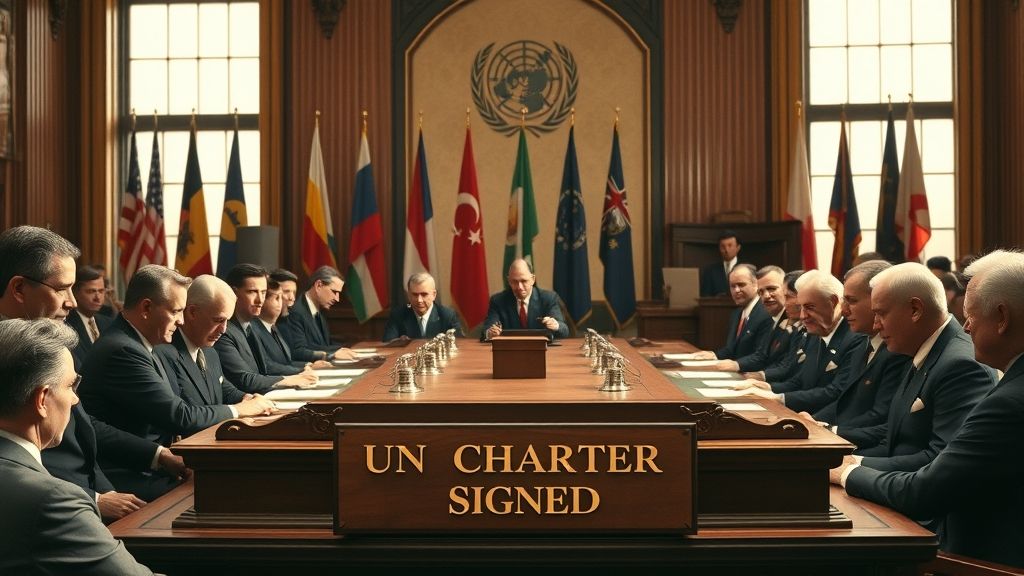
When the Delegates gathered on June 26, 1945, the atmosphere was electrifying. Flags fluttered; photographers snapped; speeches echoed.
The signing was not a mere formality but a profound historic act. Each signature symbolized a pledge to humanity, a rejection of war and a commitment to dialogue.
Among the signatories were statesmen whose countries had suffered unspeakable atrocities, alongside others emerging from shadows of colonial rule.
The Charter became the framework of an unprecedented global community.
The Global Reaction: Cheers, Skepticism, and Quiet Doubts
Across the world, reactions to the Charter’s signing varied. Many celebrated the dawn of a new world order—the newspapers hailed it as a beacon of hope.
Yet skepticism lingered. Could a document bind nations whose interests so often clashed? Would great powers truly subordinate military ambitions to collective security?
Some saw the Charter as idealistic, others as a veiled instrument of new power balances. The true test lay ahead.
Implementation and Early Tests: The UN’s Trial by Fire
Soon after the Charter’s enforcement in October 1945, the United Nations faced immediate challenges: territorial disputes, refugee crises, and nascent Cold War tensions.
The first Security Council resolutions tested the body’s credibility amid emerging ideological divides. The UN’s peacekeeping and mediation efforts fell unevenly, but established important precedents.
It became clear that the Charter offered a framework—not a guarantee—requiring political will to realize its promises.
From Charter to Reality: The Cold War’s Shadow
The decades following the Charter’s signing were defined by near-constant rivalry between East and West. The UN became a battleground for ideological conflict as much as a forum for peace.
Yet, paradoxically, the Charter allowed the world to avoid direct superpower confrontation. Through diplomacy, negotiations, and peacekeeping, the risk of global war was tempered.
The UN expanded its agencies, addressed humanitarian crises, and oversaw decolonization, embedding itself deeper into international life.
Decolonization and Development: The UN’s Expanding Mandate
The Charter’s principles inspired colonized peoples to claim rights of self-determination. Over the 1950s and 1960s, dozens of new nations entered the UN.
The organization pivoted toward development, humanitarian aid, and the fight against poverty and disease. Economic and Social Council initiatives and the establishment of agencies like UNICEF embodied this broadened mission.
The UN evolved from a peacekeeping body into a platform for global solidarity and progress.
The Charter’s Enduring Legacy: A Framework for Global Cooperation
Nearly eight decades on, the United Nations Charter remains a foundational text. It is quoted in treaties, court rulings, and international disputes. Its vision continues to inspire efforts to manage global challenges from climate change to conflict resolution.
The Charter stands as a manifesto of shared humanity—a reminder that peace demands not only treaties but collaboration, empathy, and perseverance.
Critiques and Calls for Reform: Questions Still Unanswered
No document is perfect. The veto power, unequal representation, and bureaucracy have invited critiques. Voices have called for Security Council reform, expanded roles for emerging powers, and better enforcement mechanisms.
Critics question the UN’s effectiveness in genocides, civil wars, and human rights violations.
Yet debates reflect the living nature of the Charter—a text that must adapt with history rather than remain static.
The Charter in the 21st Century: Relevance in a Changed World
In an era of globalization, technological revolutions, and transnational threats such as terrorism and pandemics, the Charter’s relevance is under scrutiny and reinvention.
New actors—non-governmental organizations, multinational corporations, civil society—interact with the UN system shaped by the Charter.
Its principles guide efforts to tackle inequality, environmental concerns, and security in an interconnected world.
Reflections on Peace: Lessons from 1945 for Today’s Diplomacy
The United Nations Charter reminds us that peace is a process, not an event. The ideals embedded in 1945 carry a timeless call for respect, dialogue, and shared responsibility.
In today’s fractured world, the momentum of San Francisco echoes—a beacon urging nations toward common ground.
The Charter, born from wartime devastation, challenges us to continuously strive for a just and peaceful order.
Conclusion
The signing of the United Nations Charter on June 26, 1945, represents one of humanity’s most profound collective pledges. From the shattered ruins of global war emerged a hopeful vision—a legal and moral compass to steer unruly nations toward peace, cooperation, and respect for human dignity.
Yet the Charter is more than a historic document; it is a living testament to the persistent struggle for a better world. Its strength lies not only in law but in the enduring courage of people and states committed to forge together a future where war’s horrors may be spoken of only in history books.
As conflicts, inequalities, and uncertainties persist, the Charter’s ideals remind us that the pursuit of peace is always worth the effort. It is, ultimately, a mirror reflecting the best aspirations and complex realities of humankind.
FAQs
Q1: Why was the United Nations Charter signed in San Francisco?
A1: San Francisco was chosen for its symbolic status as an American city representing the Pacific theater of WWII and as a convenient neutral ground. The conference drew delegates globally to finalize and sign the Charter in a city that embodied hope and renewal.
Q2: What key failures of the League of Nations influenced the UN Charter’s design?
A2: The League’s inability to prevent aggression by Axis powers and lack of enforcement mechanisms highlighted the need for stronger collective security, the inclusion of major powers, and enforceable resolutions, all addressed in the UN Charter.
Q3: Who were the major powers involved in drafting the Charter?
A3: The United States, Soviet Union, United Kingdom, China, and later France were pivotal. They held permanent seats on the Security Council and exercised veto power to ensure stability and consensus.
Q4: What is the significance of the Security Council veto?
A4: The veto was a compromise to secure great powers’ buy-in but has drawn criticism for enabling gridlock. It ensures that no Security Council decision can override a permanent member’s objection, balancing power and preventing unilateral actions.
Q5: How did the Charter address human rights?
A5: While peace and security were core, the Charter’s preamble and ECOSOC provisions laid foundations for global human rights discourse, influencing later instruments like the Universal Declaration of Human Rights.
Q6: How has the United Nations Charter evolved since 1945?
A6: The Charter itself has not been drastically amended but its principles have been applied and interpreted in new contexts, such as peacekeeping, development, and environmental protection, reflecting a dynamic institution adapting over time.
Q7: What were some early challenges faced by the UN after the Charter’s signing?
A7: The UN had to navigate rising Cold War tensions, colonial conflicts, refugee crises, and the establishment of operational peacekeeping efforts, putting its principles to immediate and difficult tests.
Q8: Is the Charter still relevant today?
A8: Absolutely. Despite challenges, the Charter continues to underpin international law and diplomacy, guiding global governance efforts in a complex and interconnected world.