Table of Contents
- A Day Like No Other: The Setting of Tokyo Bay, September 2, 1945
- The Journey to Surrender: From Pearl Harbor to Tokyo Bay
- The Winds of War: The Pacific Theater’s Brutal Course
- The Manhattan Project and the Dawn of the Atomic Age
- The Bombing of Hiroshima and Nagasaki: The Deadly Ultimatum
- Japan’s Internal Turmoil: Imperial Resolve vs. Growing Desperation
- The Role of the Allies: A Collective Decision to End the War
- The Emperor’s Voice: Hirohito’s Historic Radio Address
- Preparing the Deck: The USS Missouri as a Floating Symbol of Peace
- The Delegations Arrive: Faces of Rival Nations United in History
- The Signing Ceremony: Formalizing the End of Conflict
- The Words That Changed the World: Key Passages from the Instrument of Surrender
- Silent Witnesses: The Emotional Weight of the Ceremony
- Beyond the Ink: Immediate Global Reactions and Political Ripples
- Japan’s Path After Surrender: Reconstruction and Redemption
- The Legacy of Tokyo Bay: Defining Modern Japan and International Relations
- Memory and Commemoration: Honoring the Past in Present-Day Japan
- Reflection on War and Peace: Lessons Drawn from the Signing
- How the Surrender Shaped the United Nations and Postwar Order
- Individuals Behind the Document: Profiles of Key Signatories
- Controversies and Conspiracies: Myths Surrounding the Surrender
- Cultural Impact: The Surrender in Literature, Film, and Art
- Closing the Chapter: The Surrender’s Enduring Symbolism in Global History
- Conclusion
- FAQs
- External Resource
- Internal Link
1. A Day Like No Other: The Setting of Tokyo Bay, September 2, 1945
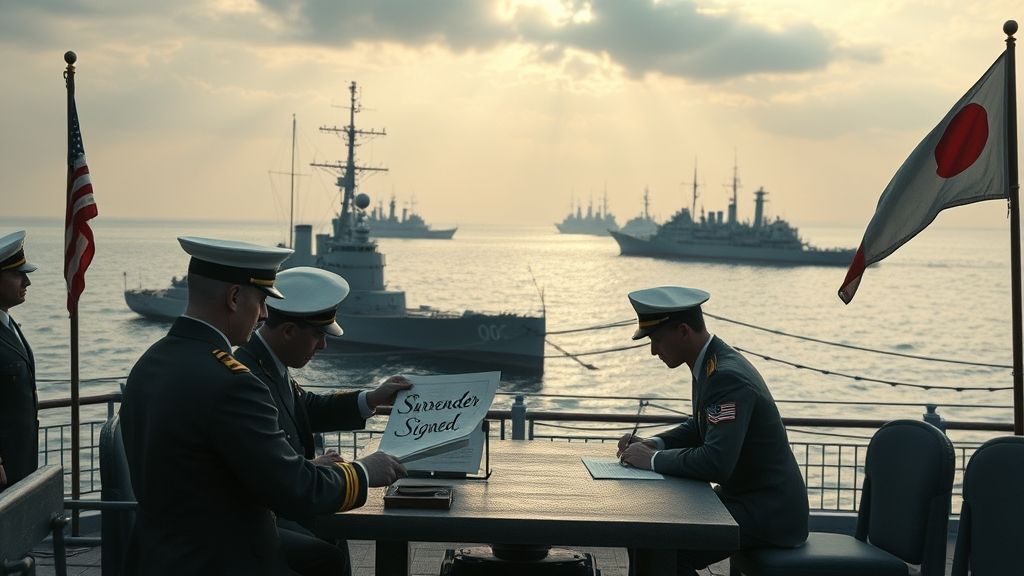
The morning sun broke gently over Tokyo Bay, a mist hovering just above the calm waters, softening the stark outlines of warships anchored solemnly. It was September 2, 1945, a day poised on the cusp of history. The world was holding its breath. Amid the quiet, thousands of voices and an uncountable number of lives converged toward one moment—the formal surrender of Imperial Japan. This was the day the long, brutal agony of the Pacific War hinged upon a single signing, transforming decades of conflict into a reluctant peace.
As the solemn lineup of Allied flags fluttered against the steel behemoth of the USS Missouri, docked like a guardian of peace in the harbor, the weight of countless sacrifices and memories filled the air. Survivors of early Pacific battles, POWs, military commanders, and diplomats prepared to witness the end of one of humankind's darkest chapters.
But the surrender was not simply the cessation of hostilities: it was the beginning of an uncertain new era for Japan and the world.
2. The Journey to Surrender: From Pearl Harbor to Tokyo Bay
The road to Tokyo Bay began in the chaotic dawn hours of December 7, 1941, when Japanese warplanes struck the American naval base at Pearl Harbor. This sudden attack jolted the United States awake, pulling it into World War II’s global maelstrom. What followed were years of blood-soaked battles fought across islands, jungles, and cities—each victory and defeat reshaping the political and moral landscape.
Japanese forces initially soared in confidence, swarming across Southeast Asia and the Pacific, claiming vast territories with ruthless precision. Yet, the tides shifted as the Allies regrouped, their combined industrial might and resolve slowly encroaching on Japanese ambitions. The months turned to years, and the once-unassailable imperial war machine found itself wavering under the relentless pressure of combined Allied offensives.
3. The Winds of War: The Pacific Theater’s Brutal Course
The Pacific War was unlike any other. Exhausting, complex, and brutal, it was a theater defined by incomparable endurance and human suffering. From Guadalcanal’s jungled heat to the volcanic vulnerability of Iwo Jima, American Marines and Japanese soldiers met in clashes that dragged on with catastrophic losses.
The ferocity was not only physical but psychological. Kamikaze pilots were sent to plunge their aircraft into Allied ships, embodying the desperation and ideological extremism that gripped Japan’s last stand. The ferocious battles hollowed out entire islands, turning sand and stone into graves.
Perhaps most haunting was the toll on ordinary civilians caught in the crossfire—a human story too often overshadowed by strategic narratives.
4. The Manhattan Project and the Dawn of the Atomic Age
While bloody battles raged, an entirely different front was opening beyond the horizon—a scientific race spearheaded by the United States. The Manhattan Project, a vast and secretive collaboration involving some of the era’s greatest minds, was pushing the boundaries of human knowledge and ethical limits.
By mid-1945, the first atomic bomb was successfully tested in New Mexico. The gravity of this invention was staggering: an explosive device capable of leveling entire cities, with devastating aftermaths no conventional weapon could match. This new weapon changed the calculus of war, promising swifter ends but at horrific costs.
The looming presence of the bomb created a chilling ultimatum for Japan’s leadership.
5. The Bombing of Hiroshima and Nagasaki: The Deadly Ultimatum
On August 6, 1945, the world witnessed a moment of unparalleled destruction as the B-29 bomber Enola Gay dropped "Little Boy" over Hiroshima. The city was engulfed in firestorms and radiation, killing tens of thousands instantly, with more succumbing to injuries and radiation sickness in the following months.
Three days later, another bomb, "Fat Man," devastated Nagasaki. The shock was seismic, forcing Japan’s government to confront an existential crisis. Some military hardliners continued to advocate resistance, but the scale of devastation was impossible to ignore.
These bombings, coupled with the Soviet Union's declaration of war on Japan and swift invasion of Manchuria, converged into a decisive moment. Japan’s leaders now had a narrow path: to accept surrender or face complete annihilation.
6. Japan’s Internal Turmoil: Imperial Resolve vs. Growing Desperation
Within the halls of the Imperial Palace, a fierce struggle unfolded. War hawks demanded to fight on, invoking traditional codes of honor and national pride, while moderates and civilians bore the trauma of devastation and desired peace.
Emperor Hirohito’s position was unique—he was a divine figurehead and a constitutional monarch bound by military and political advisors. Yet, in a rare wartime radio statement on August 15, 1945, Hirohito broke custom by addressing his people directly, announcing Japan’s unconditional surrender. This moment stunned both Japanese citizens and the world alike. It wasn’t just a capitulation; it was the first time many Japanese realized the war was truly over.
7. The Role of the Allies: A Collective Decision to End the War
The surrender was not a unilateral act but the result of complex negotiations and decisions by multiple Allied powers. The United States, United Kingdom, Soviet Union, China, Australia, Canada, New Zealand, India, and others formed a united front, laying down stipulations and expecting full compliance.
The Potsdam Declaration issued in July 1945 called for Japan's unconditional surrender, promising “prompt and utter destruction” if ignored. The Allies aimed not only to end the war but to restructure the post-war era, promoting peace and preventing future conflicts.
The Tokyo Bay signing was, therefore, a moment where victorious powers imposed a new order on a humbled nation.
8. The Emperor’s Voice: Hirohito’s Historic Radio Address
On August 15, in a broadcast transmitted over the Radio Tokyo station, Emperor Hirohito’s voice, uncommon and ethereal, spoke directly to the Japanese people. For many, it was the first time they heard their sovereign—a voice they revered—acknowledge defeat.
Hirohito’s message balanced sorrow and hope, emphasizing the unbearable pain of continued war and urging his citizens to "endure the unendurable." It was a subtle pivot from divine invincibility to fragile humanity.
This address laid the groundwork for surrender acceptance and prepared the people psychologically for the post-war reality.
9. Preparing the Deck: The USS Missouri as a Floating Symbol of Peace
Known affectionately as “Big Mo,” the USS Missouri was a grand battleship commissioned in 1944, symbolizing American naval might. It was no coincidence that it was chosen to host the surrender ceremony.
Moored in Tokyo Bay on that September morning, the ship became a floating arena for history—with meticulously laid flags, handshake-ready delegates, and the somber orchestration of procedures.
Its steel decks bore the weight of regime change, and the contrast between its blend of guns and flags reflected a transformation from war’s machinery to instruments of peace.
10. The Delegations Arrive: Faces of Rival Nations United in History
Representatives from the Allied powers converged aboard the Missouri. Among them was General Douglas MacArthur, appointed Supreme Commander for the Allied Powers, charged with overseeing Japan’s surrender and occupation.
On the Japanese side, Foreign Minister Mamoru Shigemitsu and General Yoshijirō Umezu represented a nation humbled but dignified. Alongside them were other officers, interpreters, and officials—each carrying the burden of their country’s future.
There was tension in the air, but also a peculiar solemnity—foes turned witnesses to history.
11. The Signing Ceremony: Formalizing the End of Conflict
At approximately 9:02 a.m., the ceremony commenced. General MacArthur opened with a brief address, emphasizing the moment’s gravity, humility, and hope.
One by one, the representatives signed the Instrument of Surrender, placing their marks upon the pages that would officially close this chapter.
This was not mere bureaucracy but a ritual charged with symbolic meaning—a collective acceptance of responsibility, defeat, and the obligation to rebuild.
12. The Words That Changed the World: Key Passages from the Instrument of Surrender
The document was precise and unequivocal. Japan renounced the use of force, accepted Allied occupation, and pledged cooperation. It preserved the Emperor’s position but under Allied authority, a critical factor for the nation’s acceptance.
These words underscored a shift in global geopolitics—the end of imperial militarism in Japan and a step toward a new international framework governed by rules rather than brute force.
13. Silent Witnesses: The Emotional Weight of the Ceremony
Though recorded in cold ink, the atmosphere was far from detached. Many diplomats and observers later recounted the emotional gravity that settled over the deck. Tears mingled with stoic gazes; relief clashed with loss.
Among the most poignant moments was Hirohito’s absence—the Emperor did not attend, his presence symbolically preserved in Tokyo, while his proxies bore witness on his behalf. Still, one could feel the intangible thread linking this ceremony to the very soul of Japan.
14. Beyond the Ink: Immediate Global Reactions and Political Ripples
News of the surrender spread rapidly. Streets erupted in celebration across Allied nations. For many Americans and Europeans, it was the long-awaited closure of the world’s most devastating conflict.
Yet, geopolitical tensions simmered. The Soviet Union’s swift advances in Asia and the emerging rift between East and West foreshadowed the Cold War era.
Japan, meanwhile, faced immense challenges—occupation, disarmament, and profound societal transformation.
15. Japan’s Path After Surrender: Reconstruction and Redemption
The surrender marked the beginning of a dramatic journey for Japan. Under MacArthur’s supervision, the US-led Allied occupation redefined Japan’s institutions: disarmament, democratization, and economic revival.
The 1947 constitution, known as the “Peace Constitution,” renounced war forever. Reform in education, politics, and industry laid foundations for Japan’s post-war economic miracle.
Yet the scars of war—physical and psychological—continued to shape post-war generations.
16. The Legacy of Tokyo Bay: Defining Modern Japan and International Relations
Tokyo Bay became synonymous with the rebirth of a nation. It symbolized not just an end, but a beginning mediated by reconciliation rather than revenge.
The surrender reconfigured Asia-Pacific dynamics, aligning Japan with Western powers and setting a template for postwar peace and multinational diplomacy.
17. Memory and Commemoration: Honoring the Past in Present-Day Japan
In Japan, the events of September 2 remain deeply embedded in the collective consciousness. Memorials, museums, and annual ceremonies honor those lost and the peace won through surrender.
Yet, debates continue regarding interpretations of the war and its end—an ongoing engagement with history’s moral ambiguities.
18. Reflection on War and Peace: Lessons Drawn from the Signing
The surrender teaches us about the costs of hubris, the limits of power, and the resilience of the human spirit. It challenges us to remember that peace is not simply the absence of war but a fragile achievement sustained by empathy and justice.
19. How the Surrender Shaped the United Nations and Postwar Order
The events in Tokyo Bay paralleled the birth of a new global order, epitomized by institutions like the United Nations. They embodied a collective hope to prevent future world wars through dialogue and cooperation.
Japan’s surrender became a case study in the potential and limits of international law and diplomacy.
20. Individuals Behind the Document: Profiles of Key Signatories
General Douglas MacArthur—Commander and Architect of the Occupation
Foreign Minister Mamoru Shigemitsu—Bearing the weight of a humbled nation
General Yoshijirō Umezu—Military leader faced with defeat
Fleet Admiral Chester W. Nimitz—Japanese foe turned overseer of peace
Each brought to the ceremony not only authority but profound personal narratives shaped by war’s horrors.
21. Controversies and Conspiracies: Myths Surrounding the Surrender
Over the decades, myths have shrouded the surrender. From alleged secret agreements to supposed delays in surrender announcements, conspiracies reflect the difficulty of truly understanding such monumental events in their entirety.
Yet, sober historical research dispels many of these tales, revealing the complex but transparent reality.
22. Cultural Impact: The Surrender in Literature, Film, and Art
The moment in Tokyo Bay rippled through culture around the world. Films like “Tora! Tora! Tora!” and literary works capture not only the event but the human tragedy behind it.
Artistic depictions mediate the balance between memory and trauma, celebrating peace while memorializing loss.
23. Closing the Chapter: The Surrender’s Enduring Symbolism in Global History
Even nearly eight decades on, the Japanese surrender remains a powerful symbol. It reminds us that even in darkest times, humanity is capable of folding hostility into peace.
The ceremony aboard the USS Missouri was not an end but a promise—a collective human commitment to forge a better future.
Conclusion
The signing of Japan’s surrender on September 2, 1945, in Tokyo Bay was more than a mere formal act; it was the culmination of years of unimaginable struggle, sacrifice, and moral reckoning. It closed a brutal chapter but simultaneously opened a path toward renewal for a devastated nation and a world eager for peace.
Through pain, loss, and resilience, this moment carved the foundations of modern Japan and influenced global efforts toward diplomacy, reconciliation, and hope. Remembering this day calls on us all—not just to honor history, but to heed its lessons: that peace, once forged through the fires of war, must be vigilantly preserved with humility and courage.
FAQs
Q1: What were the primary causes that led to Japan’s surrender in 1945?
A1: The surrender was caused by a combination of devastating military defeats, the atomic bombings of Hiroshima and Nagasaki, the Soviet Union’s entry into the war, and internal pressures within Japan’s government and society.
Q2: Who were the key figures involved in signing the surrender document?
A2: On the Allied side, General Douglas MacArthur, Fleet Admiral Chester Nimitz, and other senior officers signed. Representing Japan were Foreign Minister Mamoru Shigemitsu and General Yoshijirō Umezu.
Q3: How did the Japanese people react to the surrender announcement?
A3: The reaction was complex, blending relief, shock, sorrow, and uncertainty. The Emperor’s radio broadcast helped frame the surrender as a necessity, but many citizens mourned their losses.
Q4: What was the significance of the USS Missouri during the ceremony?
A4: The USS Missouri symbolized American naval dominance and peace authority. Hosting the ceremony aboard this battleship elevated the event’s gravitas and served as a historic venue linking war and peace.
Q5: How did the surrender influence Japan’s post-war recovery and governance?
A5: It paved the way for Allied occupation, democratization, disarmament, and economic rebuilding under American oversight, resulting in Japan’s transformation into a pacifist, prosperous democracy.
Q6: What controversies surround the surrender event?
A6: Some myths include delayed announcements, secret deals, and internal Japanese conspiracies. However, historical evidence largely confirms an open, complex process marked by difficult decisions.
Q7: How is the surrender commemorated in Japan today?
A7: Through memorials, museums, peace ceremonies, and education, Japan remembers both the devastation of war and the importance of peace, though debates about interpretation continue.
Q8: What global impact did the surrender have on international relations?
A8: It helped define post-war geopolitics, contributed to the formation of the United Nations, and shaped Cold War dynamics in the Asia-Pacific region.