Table of Contents
- The Dawn of a New Era: September 8, 1951
- Shadows Over the Pacific: The Aftermath of World War II
- The Road to Peace: Early Postwar Diplomacy
- The Players Assemble: Key Nations and Their Stakes
- Japanese Surrender and Occupation: Seeds of Change
- Washington to San Francisco: Choosing the Venue
- Drafting the Treaty: A Delicate Balancing Act
- The Signing Ceremony: Symbolism and Significance
- The San Francisco Peace Treaty: Text and Terms
- The Allied Powers’ Vision versus Asian Realities
- Absence Speaks Loudly: The Case of the Soviet Union and China
- Territorial Rearrangements: Shrinking the Japanese Empire
- Security and Sovereignty: Japan’s New Role in the World
- Controversies and Criticisms: Voices from Within and Without
- The Treaty’s Impact on Regional Stability and the Cold War
- Japan’s Path to Recovery: Economic and Political Revival
- The San Francisco Treaty and Japan’s Constitutional Identity
- Legacy of the Treaty in U.S.-Japan Relations
- Continued Tensions: The Korean Peninsula and Taiwan
- Memory and Commemoration: How the Treaty Lives On
- Lessons Learned: Diplomacy in the Shadow of War
- Final Reflections: A Peace Forged, Yet Fragile
1. The Dawn of a New Era: September 8, 1951
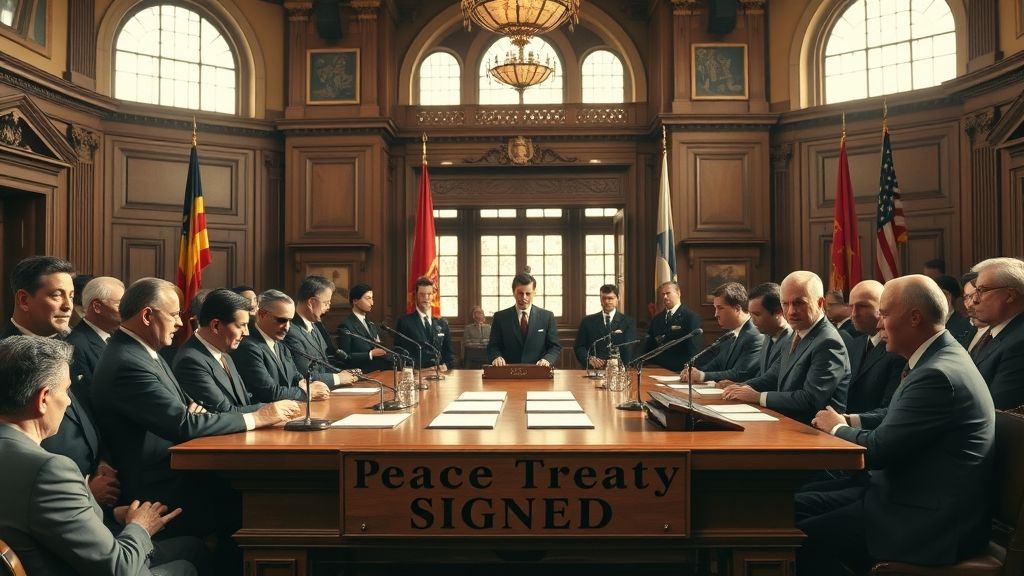
On a crisp early autumn morning in San Francisco, the ornate chamber of the War Memorial Opera House pulsed with a mix of solemnity and hope. Flags representing 48 nations hung side by side, their vibrant colors an emblem of cautious unity. The air was thick with the weight of history—peace was being re-forged at a moment when the world teetered between healing and fresh confrontation. As representative diplomats, military officials, and politicians took their seats, the San Francisco Peace Treaty was set to be signed, formally ending Japan's role as an imperial aggressor and political pariah. Yet beneath the polished words and handshakes lay complex tensions, unresolved grievances, and new anxieties that would shape East Asia for decades.
2. Shadows Over the Pacific: The Aftermath of World War II
The Second World War had drawn to a devastating close less than six years earlier. The Pacific theater had been marked by brutal island battles, atomic bombings of Hiroshima and Nagasaki, and the collapse of the Japanese Empire. Hundreds of thousands had perished, cities lay in ruins, and millions of lives had been irrevocably altered. Japan was occupied by Allied forces, primarily the United States, under the supreme command of General Douglas MacArthur. The occupation aimed not merely to punish but to reform Japan—dismantling militarism, introducing democracy, and rebuilding a peaceful nation. Globally, the war’s end had sown new fault lines, with the United States and the Soviet Union emerging as rival superpowers.
3. The Road to Peace: Early Postwar Diplomacy
From the fiery devastation of war emerged pressing questions: How would Japan reintegrate into the international community? What would become of the territories it once controlled? As early as 1945, the Allies outlined the conditions for peace, but discussions quickly became tangled in Cold War politics. The growing divide between communist and capitalist blocs complicated consensus. The United States, eager to turn Japan into a strong bulwark against communism in Asia, pushed for a swift resolution. Other territory-claimant nations, particularly China and Korea, demanded reparations and recognition of their sovereignty.
4. The Players Assemble: Key Nations and Their Stakes
The San Francisco Conference brought together 49 countries, though only 48 signed the treaty. The United States, Britain, France, Australia, Canada, New Zealand, the Netherlands, and others represented the victorious Allies. Japan was there not as a signatory but seated as an observer—symbolic of its still ambiguous status as both a defeated nation and a future partner. China was invited but later refused to participate following political upheaval at home. The Soviet Union also declined, objecting to the treaty’s terms and citing concerns over regional balance. These absences would prove critical.
5. Japanese Surrender and Occupation: Seeds of Change
Japan’s formal surrender on September 2, 1945, aboard the USS Missouri, marked the beginning of a new chapter. The occupation under MacArthur initiated sweeping reforms: land redistribution, women’s suffrage, freedom of speech, and a new pacifist constitution that renounced war forever. This transformation was radical and unprecedented. Yet, beneath the surface, cultural tensions simmered. Many Japanese still grappled with national pride and identity, while the occupation authorities faced resentment and resistance.
6. Washington to San Francisco: Choosing the Venue
Why San Francisco? The city had been a focal point of Pacific engagement throughout the war and symbolized Western commitment to peace in Asia. Hosting the peace conference there was as much a strategic message as practical convenience—it underscored American leadership in shaping the postwar order. The War Memorial Opera House, once a space for concerts and culture, now served as a stage for international diplomacy, where the heartache of war would be confronted with the promise of peace.
7. Drafting the Treaty: A Delicate Balancing Act
Drafting the San Francisco Peace Treaty was a painstaking process. Negotiators wrestled with language and boundaries, sovereignty and reparations. The United States sought to limit Soviet influence, keep Japan contained yet empowered, and secure military bases in Asia. Allied nations pressed for recognition of their rightful interests, while Japan sought to reclaim dignity. Controversies over territories such as Taiwan, the Kuril Islands, and Korea became battlegrounds in the negotiation room. Despite stark differences, a document was hammered out—a compromise reflecting both pragmatism and political expediency.
8. The Signing Ceremony: Symbolism and Significance
September 8 arrived with a crowd of journalists and dignitaries buzzing in anticipation. Delegates took their seats beneath a profusion of flags. Japan’s Foreign Minister Shigemitsu Mamoru, himself a former diplomat imprisoned for war crimes, signed the treaty, a gesture heavy with irony and hope. U.S. Secretary of State Dean Acheson placed the signature of the United States, emblematic of solidarity and power. Cameras flashed; speeches were delivered calling for peace and reconciliation. The world watched silently, some skeptical, others hopeful.
9. The San Francisco Peace Treaty: Text and Terms
The treaty officially ended Japan’s position as an imperial power and restored its sovereignty. It declared Japan’s renunciation of claims to Korea, Taiwan, the Kuril Islands, the Pescadores, and other territories. Japan agreed to reparations and accepted a legal framework banning war as a sovereign right. Importantly, it recognized existing security arrangements, allowing the United States to maintain military bases. Ambiguity remained over some islands and future conflicts, sowing seeds of future disputes. The treaty was effective from April 28, 1952.
10. The Allied Powers’ Vision versus Asian Realities
Despite its legal formality, the treaty masked deep tensions. Many Asian countries saw it as imposed by Western powers, ignoring local demands. Koreans lamented the absence of their input, while China’s Nationalist government rejected the treaty for failing to resolve the Taiwan issue definitively. The Soviet Union condemned the treaty as unjust. For Japan, the treaty was both liberation and limitation—restoring independence but shackling sovereignty in strategic ways.
11. Absence Speaks Loudly: The Case of the Soviet Union and China
The Soviet Union and China’s refusal to sign cast a long shadow. Soviet objections stemmed from both territorial claims and Cold War politics. Their absence questioned the treaty’s legitimacy in some quarters. China’s refusal derived from their civil war and later Communist takeover, which the Western powers refused to recognize. These exclusions complicated East Asian diplomacy and established two competing peace regimes that mirrored the global ideological divide.
12. Territorial Rearrangements: Shrinking the Japanese Empire
Once commanding vast colonial possessions, Japan’s empire collapsed abruptly. The treaty formalized this shrinkage: Korea regained independence (though divided), Taiwan was handed to China, the Kuril Islands became Soviet territory, and Okinawa remained under US administration until 1972. These territorial changes created new national boundaries but also unresolved claims that continue to cause disputes, such as those over the Senkaku/Diaoyu Islands.
13. Security and Sovereignty: Japan’s New Role in the World
Japan emerged as a demilitarized, pacifist nation but aligned firmly with US interests. The treaty laid groundwork for the US-Japan Security Treaty, permitting American bases and military presence, which Japan accepted as necessary for its defense. Japan transitioned from imperial aggressor to economic powerhouse and strategic ally, a transformation that altered its self-perception and international position dramatically.
14. Controversies and Criticisms: Voices from Within and Without
Not everyone celebrated the treaty. Critics highlighted that reparations were inadequate, and many war crimes issues remained unresolved. Leftist parties in Japan and some Asian activists condemned the treaty as a whitewash, accusing it of letting war criminals off the hook. Nationalists lamented the loss of territory and autonomy. For many victims in Asia, the peace was incomplete, setting the stage for future reckonings.
15. The Treaty’s Impact on Regional Stability and the Cold War
The San Francisco Peace Treaty was much more than a bilateral accord; it was a keystone in the burgeoning Cold War architecture. By stabilizing Japan as a capitalist democracy allied to the US, it created a bulwark against communist expansion in Asia. However, it also hardened divisions with the Soviet Union and Communist China. The treaty influenced conflicts in Korea and Vietnam and shaped US foreign policy in the region for decades.
16. Japan’s Path to Recovery: Economic and Political Revival
Freed from occupation by 1952, Japan embarked on a meteoric recovery. The treaty’s support and ongoing American security umbrella allowed Japan to focus on economic reconstruction rather than military spending. Industrial growth, technological innovation, and political democratization transformed Japan into the world’s second-largest economy by the 1960s. The treaty’s legacy thus includes the peaceful rebirth of a nation once devastated by war.
17. The San Francisco Treaty and Japan’s Constitutional Identity
Central to postwar Japan’s identity was its pacifist constitution, especially Article 9, which renounced war. The San Francisco Treaty reinforced this new ethos, embedding Japan firmly within an international order rejecting militarism. Yet debates over constitutional reinterpretations and the right of self-defense continue, reflecting tensions between peace aspirations and security realities inherited from this era.
18. Legacy of the Treaty in U.S.-Japan Relations
The treaty cemented the US-Japan alliance, which endures as one of the most significant strategic partnerships in modern history. It fostered cooperation in trade, security, and culture. Yet it also introduced asymmetries and debates over sovereignty and military bases, issues that are still discussed in Japan’s domestic and foreign policies today.
19. Continued Tensions: The Korean Peninsula and Taiwan
Though Japan renounced claims over Korea and Taiwan, the legacy of occupation and war lingered. Korea remained divided, and tensions over Taiwan’s status persisted with China. Japan’s post-treaty role in these disputes was cautious, influenced by broader Cold War stakes, and the need to maintain relations both with the US and Asia’s evolving powers.
20. Memory and Commemoration: How the Treaty Lives On
Anniversaries of the San Francisco Treaty evoke mixed emotions: pride in peace achieved, but also reflection on pain endured. Memorials, academic debates, and cultural works revisit the treaty’s meaning. In Japan and across Asia, it remains a potent symbol of both reconciliation and unresolved wounds.
21. Lessons Learned: Diplomacy in the Shadow of War
The treaty offers timeless lessons about balancing justice and peace, national pride and international cooperation, and the complexity of postwar realities. It highlights how treaty-making is rarely neat or universally accepted but can nonetheless lay foundations for lasting peace.
22. Final Reflections: A Peace Forged, Yet Fragile
The San Francisco Peace Treaty, signed in a moment brimming with hope, was neither perfect nor final. It was a pragmatic achievement that ended hostilities, redefined national identities, and reshaped regional dynamics. As we reflect on that moment in 1951, we are reminded that peace is an ongoing project—fragile, demanding vigilance, understanding, and the willingness to confront history’s shadows.
Conclusion
The signing of the San Francisco Peace Treaty marked a watershed moment—not just for Japan but for the entire Asia-Pacific region and the postwar international order. More than a mere legal document, it was a powerful narrative of transformation, a symbol of defeat and renewal wrapped in diplomatic complexity. While it ended a dark chapter of aggression and conflict, it also set in motion dynamics—political, military, and social—that define Asia even today. The treaty illustrates the paradox of peace: it brings relief and reconciliation, yet also reminds us of divisions and memories that persist. In the end, the San Francisco Peace Treaty stands as a testament to the enduring human desire to build a more peaceful world, amid the difficult and often painful legacies of history.
FAQs
Q1: What prompted the signing of the San Francisco Peace Treaty in 1951?
A1: The treaty was signed to formally end World War II state of war between Japan and the Allied powers, restore Japan’s sovereignty, and establish the legal and political framework for postwar peace and reconstruction in the Asia-Pacific.
Q2: Which countries participated in the treaty, and who notably refused to sign it?
A2: Forty-eight countries signed the treaty, including the United States, Britain, and Japan (as a signatory under certain conditions). Notably, the Soviet Union and the People’s Republic of China refused to participate due to political disputes and ideological differences.
Q3: How did the treaty affect Japan’s territorial holdings?
A3: Japan renounced claims to Korea, Taiwan, the Kuril Islands, and other territories, effectively ending its empire and recognizing the independence or control of these lands by other nations, like the Soviet Union and China.
Q4: In what way did the treaty influence Japan’s military and constitutional status?
A4: The treaty reinforced Japan’s acceptance of its pacifist constitution, which renounced war and military aggression, and allowed the United States to maintain military bases in Japan for defense purposes.
Q5: What were some criticisms against the San Francisco Peace Treaty?
A5: Critics argued that the treaty failed to adequately address war crimes, reparations, and the grievances of occupied Asian countries. Some viewed it as prioritizing Cold War strategic interests over justice and reconciliation.
Q6: How did the treaty shape the Cold War dynamics in East Asia?
A6: By stabilizing Japan as a US-aligned democratic state, the treaty contributed to containing communism in the region but also entrenched divisions with the Soviet bloc and Communist China, influencing regional conflicts such as the Korean War.
Q7: What is the legacy of the San Francisco Peace Treaty in today’s international relations?
A7: The treaty laid the foundation for modern Japan’s peaceful and prosperous identity and its strategic alliance with the United States, while also leaving unresolved territorial disputes and complex historical memories that continue to affect regional diplomacy.
Q8: How is the treaty remembered and commemorated today?
A8: The treaty’s anniversaries are observed with solemn reflection and academic discourse. It is remembered as a milestone of peace but also as a reminder of the unfinished business of war’s aftermath and the perpetual quest for reconciliation.