Table of Contents
- The Dawn of Silence: July 27, 1953
- The Korean Peninsula Before the War: Seeds of Conflict
- Colonial Legacies and Division: Korea in the Early 20th Century
- The Outbreak of War: June 25, 1950
- Global Tensions and Proxy Battles: Korea as the Cold War's Flashpoint
- The Early Struggles: North’s Advance and the Pusan Perimeter
- The Inchon Landing: A Dramatic Turning Point
- Fighting to the Yalu: The Push Toward China’s Border
- Chinese Intervention: A New Player Enters the Stage
- Stalemate and Attrition: The War Enters a Deadlock
- Truce Talks Begin: From Kaesong to Panmunjom
- Lives on the Line: The Human Toll of Protracted Negotiations
- Negotiating Peace: The Contentious Issues at the Table
- July 27, 1953: Signing the Armistice at Panmunjom
- Immediate Aftermath: Suspended Hostilities but No Peace Treaty
- The Demilitarized Zone: A Tense Truce in a Divided Land
- Political and Social Consequences Across the Peninsula
- The Armistice’s Global Impact: Cold War Repercussions
- Memories and Myths: Korea’s War in Collective Consciousness
- Reflections Forty Years On and Beyond: Attempts at Reconciliation
- The Korean Armistice in Today’s Geopolitical Landscape
- Legacy of the Korean War: A Conflict Frozen in Time
- Conclusion: Armistice as a Pause, Not a Closure
- FAQs: Understanding the Korean Armistice and Its Significance
- External Resource
- Internal Link
The Dawn of Silence: July 27, 1953
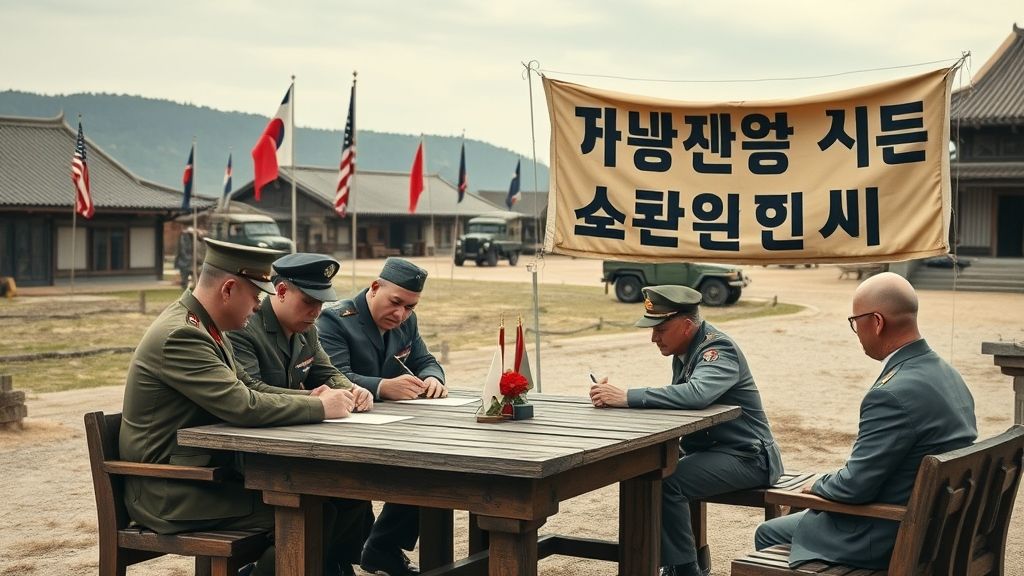
On a sweltering July afternoon, beneath the tense gaze of weary diplomats and war-weary soldiers, a paper was signed in the modest village of Panmunjom, nestled close to the 38th parallel that had, for three long years, been a line of blood and fire. The Korean Armistice Agreement, inked on July 27, 1953, brought a halt to a war that had sundered a peninsula, caught in the deadly grip of ideological struggle and global power rivalry. Yet, the silence it promised was uneasy, fragile, and incomplete.
The solemn signing, made in a plain meeting house within the demilitarized zone (DMZ), marked not the end of the Korean War but the cessation of active hostilities—a truce indefinitely postponed amid frozen animosities. The Korean Armistice was a complex document born from exhaustion and desperation, shaped by fierce battles, bloodshed, political brinkmanship, and the ever-present shadow of global confrontation between East and West.
As the pens lifted from the parchment that day, a fragile stillness settled over a land ravaged by conflict, signaling a pause, not peace; a ceasefire, not a treaty. The two Koreas, divided by a militarized no-man’s land, remained locked in a stalemate that echoes in the geopolitical tensions on the peninsula to this day.
The Korean Peninsula Before the War: Seeds of Conflict
Long before bullets flew in 1950, the Korean Peninsula had been a stage of contested sovereignty, colonial subjugation, and national awakening. The dawn of the 20th century saw Korea caught between imperial ambitions—Japan, China, and Russia constantly maneuvered for influence over this strategic land bridging East Asia’s great powers.
After decades of Qing tributary status and subsequent influence, Japan forcefully annexed Korea in 1910, imposing harsh colonial rule. The Japanese occupation installed industrial growth but crushed Korean culture, political freedom, and fostered widespread nationalist resentment. The occupation deeply scarred the collective psyche of Koreans and sowed the seeds for post-war division.
Colonial Legacies and Division: Korea in the Early 20th Century
World War II’s end heralded the collapse of Japanese imperial control over Korea. Yet, the power vacuum did not restore unity. Instead, it exposed the ideological fissures that harsh years of colonial rule had both masked and exacerbated.
The Cold War’s curtain, descending in the wake of World War II, split the peninsula along the 38th parallel. The Soviet Union occupied the North, while the United States took up control in the South. In this bifurcated terrain, rival Korean governments emerged: the communist Democratic People’s Republic of Korea under Kim Il-sung in the North, and the Republic of Korea under Syngman Rhee in the South. Each claimed legitimacy over the whole peninsula, setting the stage for confrontation.
The Outbreak of War: June 25, 1950
At 4 a.m. on June 25, 1950, sirens shattered the fragile calm. North Korean forces launched a massive surprise invasion across the 38th parallel, sweeping rapidly southward with tanks and artillery. For the South, it was a lightning strike; for the world, the Korean War had exploded into full-scale violence.
Caught off guard, South Korean and U.S. forces retreated. The swift assault revealed the brutal reality of global ideological confrontation made manifest in a localized conflict. The invasion galvanized the United States and its United Nations allies into action under the banner of containing communism, marking Korea’s war as a proxy frontline of the Cold War.
Global Tensions and Proxy Battles: Korea as the Cold War’s Flashpoint
Beyond Korea itself, the conflict reflected the fractures of a world divided by East-West antagonism. The Soviet Union provided weapons and strategic advisors—yet avoided direct combat. China initially hesitated before joining as “volunteers,” driven by fears of hostile forces on its border and ideological solidarity.
The Korean War became a deadly chess match, a test of wills and resources between superpowers, with terrible consequences for ordinary Koreans who bore the war’s human cost.
The Early Struggles: North’s Advance and the Pusan Perimeter
The North Korean army’s rapid advance pushed UN and South Korean troops back to the southeastern tip of the peninsula, the Pusan Perimeter, where desperate fighting forged a desperate defense. The situation was dire; if Pusan fell, the war might have ended in the North’s favor swiftly.
Yet, against the odds, this beleaguered pocket held firm. It marked a crucial turning point—demonstrating the resilience of those defending the South and setting up the dramatic counteroffensive that soon followed.
The Inchon Landing: A Dramatic Turning Point
In September 1950, General Douglas MacArthur masterminded a bold amphibious assault at Inchon, a daring gamble far behind enemy lines. The surprise attack shattered North Korean supply lines and communications, forcing a rapid strategic reversal.
The success at Inchon turned the tide, recapturing Seoul and pushing communist forces into retreat. This moment was emblematic of the war’s shifting fortunes and the broader contest between military audacity and geopolitical realities.
Fighting to the Yalu: The Push Toward China’s Border
Emboldened by victories, UN troops pursued the retreating North Koreans all the way to the Yalu River, the natural border with China. This advance, seen by the communist powers as a direct threat, would provoke a dramatic intervention.
Yet even amid optimism and military gains, decision-makers underestimated China’s resolve and capacity to enter the conflict decisively.
Chinese Intervention: A New Player Enters the Stage
In late October 1950, hundreds of thousands of Chinese "People's Volunteer Army" soldiers flooded into North Korea. Their entry caught UN forces by surprise, reversing the war's momentum.
This intervention prolonged the conflict by years, turning battles into brutal stalemates and forcing cautious recalculations on all sides. The ferocity of Chinese troops became a defining chapter in the war’s brutal narrative.
Stalemate and Attrition: The War Enters a Deadlock
As 1951 unfolded, frontlines ossified roughly near the 38th parallel. The war became one of attrition, with trench lines, artillery duels, and limited offensives dominating.
Both sides suffered grievously while diplomatic efforts labored to find a path to ceasefire. The human cost was staggering; millions of soldiers and civilians perished or were wounded in a war that seemed endless.
Truce Talks Begin: From Kaesong to Panmunjom
Negotiations to end the conflict began in July 1951 in Kaesong before moving to Panmunjom in October. These talks were tortuous, punctuated by disagreements over prisoner repatriation and territorial control.
Despite intermittent violence and mutual suspicion, both sides faced war-weariness—soldiers long to come home, civilians to rebuild shattered lives.
Lives on the Line: The Human Toll of Protracted Negotiations
Between the trenches and negotiation tables, individual stories of suffering and heroism unfolded. POWs awaited uncertain fates; families lived in fear and hope.
The Armistice talks were as much about human dignity as political compromise. Women’s informal roles, relief workers, and war correspondents all shaped the wartime humanitarian landscape.
Negotiating Peace: The Contentious Issues at the Table
Three contentious issues dominated: prisoner of war repatriation, the precise location and width of the demilitarized zone, and the political future of Korea.
Discussions dragged on because these were not mere territorial disputes but reflected larger ideological battles, deeply entwined with Cold War rivalries.
July 27, 1953: Signing the Armistice at Panmunjom
After months of grueling talks, the armistice was finally signed at 10 a.m. on July 27, 1953. Representatives of the United Nations Command, the Korean People’s Army, and the Chinese People’s Volunteer Army affixed their signatures.
The agreement outlined a ceasefire, established the DMZ as a buffer zone, and included provisions for prisoner exchange. Yet, it intentionally avoided a formal peace treaty, leaving the peninsula technically still at war.
Immediate Aftermath: Suspended Hostilities but No Peace Treaty
Gunfire ceased, but political tension remained taut. The DMZ, one of the most fortified borders in the world, emerged as a grim monument to an uneasy peace.
Neither side relinquished claims to all of Korea. Families remained separated, and the peninsula was split into two starkly different political and economic systems.
The Demilitarized Zone: A Tense Truce in a Divided Land
Stretching roughly 250 kilometers across the peninsula, the DMZ represented both symbolic and literal division. Nature reclaimed much of this no-man’s land, while military vigilance kept it among the globe’s most fortified frontiers.
The zone witnessed sporadic incidents and became a potent symbol of the unresolved conflict.
Political and Social Consequences Across the Peninsula
The armistice shaped the future of both Koreas. The South embarked on rapid industrialization with U.S. support, while the North pursued rigid communism under Kim Il-sung.
Though separated by ideology, the two societies retained a shared cultural heritage tinged with nostalgia, loss, and rivalry.
The Armistice’s Global Impact: Cold War Repercussions
The Korean Armistice reinforced the global bipolar order, intensified U.S. military presence in Asia, and shaped subsequent conflicts, including Vietnam.
It also underscored the dangers of proxy wars, the limits of diplomacy in ideological conflicts, and the complexity of post-colonial nation-building.
Memories and Myths: Korea’s War in Collective Consciousness
In South Korea, the war is remembered as a struggle for democracy and freedom; in the North, a heroic fight against imperialist aggression. Veterans, families, and governments crafted divergent narratives.
These memories continue to influence identity, politics, and relations on and beyond the peninsula.
Reflections Forty Years On and Beyond: Attempts at Reconciliation
Despite decades of hostility, attempts at dialogue have emerged. Summits, family reunions, and cultural exchanges aimed to soften divisions but progress often faltered.
The armistice remains a haunting reminder of peace deferred, a challenge to future generations.
The Korean Armistice in Today’s Geopolitical Landscape
Today, the Korean Peninsula remains one of the world’s most volatile flashpoints. The armistice, decades-old, is tested by nuclear tensions, diplomatic breakthroughs, and ongoing military vigilance.
Understanding this historical moment is key to comprehending contemporary challenges and hopes for lasting peace.
Legacy of the Korean War: A Conflict Frozen in Time
The Korean War and its armistice left an indelible mark. It changed warfare, geopolitics, and global strategies during the Cold War and beyond.
Its legacy endures in the lives of millions, the politics of nations, and the persistent yearning for peace on a divided land.
Conclusion
The signing of the Korean Armistice on July 27, 1953, was not an end but a complex pause—a breath drawn in the midst of a long-standing divide. It froze a brutal conflict into a stalemate that continues to shape global politics and human lives across generations.
The war had torn apart families, landscapes, and hopes for a united Korea. Yet, amidst destruction and division, it also forged a poignant lesson about the cost of ideological confrontation and the price of peace deferred.
As the sun set on that summer day in Panmunjom, the pens lifted but the scars remained—silent testaments to a conflict that changed the course of history and reminded the world of the fragile, hard-won balance between war and peace.
FAQs
1. What exactly was signed on July 27, 1953?
The Korean Armistice Agreement was signed, establishing a ceasefire, a demilitarized zone, and procedures for prisoner exchanges. It halted active combat but did not declare peace.
2. Why was there no formal peace treaty after the armistice?
The deep ideological and political divisions, along with mutual distrust, prevented a formal peace treaty. The war technically remains unresolved, though active fighting ceased.
3. Who were the main parties involved in the armistice?
The armistice was signed by representatives of the United Nations Command (led by the U.S.), the Korean People’s Army of North Korea, and the Chinese People’s Volunteer Army.
4. What was the significance of the demilitarized zone?
The DMZ served as a buffer zone to prevent direct military clashes and became one of the most heavily fortified borders globally, symbolizing ongoing division.
5. How did the Korean War shape global Cold War dynamics?
The war entrenched superpower rivalry, led to increased U.S. military presence in Asia, and demonstrated the perilous nature of proxy wars during the Cold War era.
6. What has been the human cost of the Korean War?
Millions of soldiers and civilians died or were wounded; countless families remain separated. The war deeply scarred Korean society on both sides.
7. Have there been efforts to replace the armistice with a peace treaty?
Several diplomatic attempts, including inter-Korean summits and international negotiations, have sought to formalize peace, but none have succeeded definitively.
8. Why is the Korean War often called “the forgotten war”?
Overshadowed by World War II before and the Vietnam War after, the Korean War’s complex legacy and the absence of a formal peace treaty have contributed to its “forgotten” status in some narratives.