Table of Contents
- The Dawn of a New Era: Bandung, April 18, 1955
- Post-War Realities and the Colonial Shadow
- Seeds of Unity: The Road to Bandung
- The Architects of Bandung: Visionaries and Statesmen
- Arrival in Bandung: A Melting Pot of Nations
- Opening Speeches: Echoes of Anti-Colonial Resolve
- The Spirit of Non-Alignment Emerges
- Debates and Divisions: Between Ideologies and Interests
- The Role of India and Nehru’s Diplomatic Mastery
- Indonesia’s Sukarno: The Host with a Revolutionary Heart
- African Participation and the Awakening of a Continent
- The Conference Agenda: Peace, Development, and Sovereignty
- Media and the World’s Gaze: Bandung on the Global Stage
- Subtle Tensions: Cold War undercurrents and superpower eyes
- Bandung’s Final Communiqué: Voice of the “Third World”
- From Bandung to Non-Alignment: A Global Movement is Born
- Immediate Reactions: Praise, Skepticism, and Opposition
- Bandung's Legacy in Post-Colonial Asia and Africa
- The Conference’s Impact on Cold War Dynamics
- Cultural Impressions: Art, Music, and Camaraderie in Bandung
- The Human Stories: Behind the Diplomatic Facades
- Bandung Today: Memory, Celebration, and Lessons
- Conclusion: The Unfinished Symphony of Bandung
- FAQs: Illuminating the Bandung Conference
- External Resource
- Internal Link
The Dawn of a New Era: Bandung, April 18, 1955
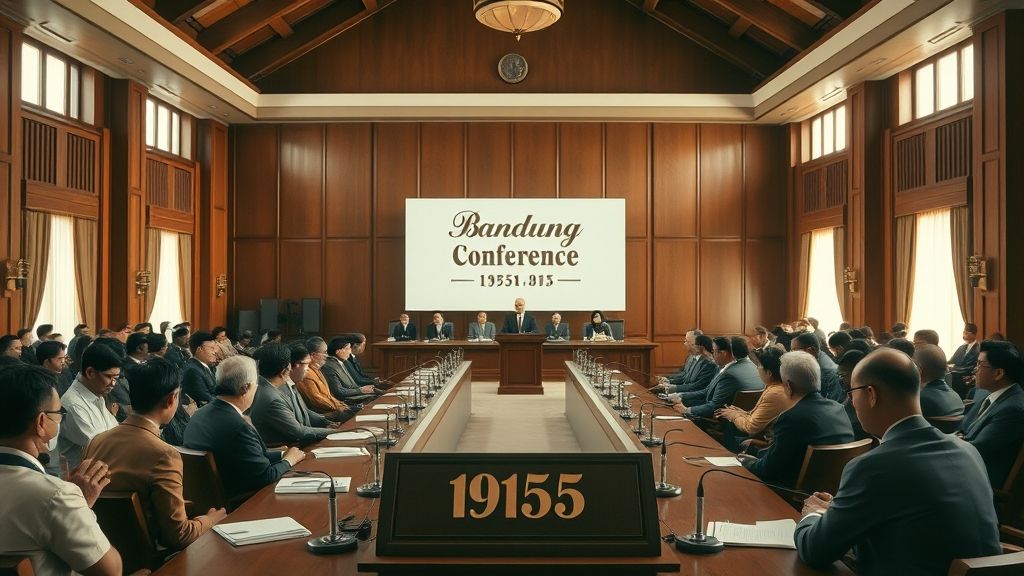
It was a humid morning in April when delegates from twenty-nine nations, mostly recently freed from the yoke of colonialism, stepped onto the rugged soil of Bandung. The air shimmered with anticipation and the mingled scents of tropical blooms and burning coal from nearby factories. The city, nestled on the western part of Java, Indonesia, had been chosen as the backdrop for what would become a defining moment in 20th-century history—a gathering heralding the dawn of a new international order.
The streets were alive not only with the bustle of local vendors but also with an extraordinary sense of unity and purpose. Flags, vibrant and unfamiliar to many eyes, fluttered alongside makeshift banners announcing slogans of liberation, peace, and equality. As the delegates filed into the newly constructed Gedung Merdeka—literally the “Freedom Hall”—they brought with them the heavy weight of their peoples’ past struggles and the fragile hope for a future free from domination.
Among the crowds, there was talk not merely of diplomacy, but of revolution—a revolution of thought, of alliances, and of global justice. The Bandung Conference wasn’t just a meeting; it was a vocal declaration that the “Third World” had arrived on the stage of world politics to be counted.
Post-War Realities and the Colonial Shadow
In the aftermath of the Second World War, the face of the world was irreversibly altered. Empires that had once spanned continents were fracturing under the pressures of nationalist movements and changing economic realities. Asia and Africa—a vast expanse of diverse cultures and histories—were largely under colonial rule, but the tide had begun to turn.
The war had weakened European powers; Britain was entangled in the Suez crisis; France was embroiled in Indochina; the Netherlands fought desperately in Indonesia. Meanwhile, the United States and the Soviet Union emerged as superpowers, each intent on bending the globe to its ideological will—capitalist democracy against communist socialism.
Yet, in this bipolar world, many recently independent nations found themselves marginalized, neither aligned with the West nor the East, often considered pawns rather than players. They yearned for recognition, for agency. The seeds of frustration would soon germinate into a movement calling for sovereignty, economic independence, and peace.
Seeds of Unity: The Road to Bandung
The idea of a summit united against colonialism and geopolitical domination was originally conceived by countries like India, Indonesia, Burma (now Myanmar), Ceylon (now Sri Lanka), and Egypt. Even before the conference itself, their leaders had been quietly laying the groundwork for a platform where voices from formerly colonized—and sometimes not yet independent—nations could challenge the prevailing global order.
With the Cold War dividing the globe, these nations sought a middle path. How could the newly independent assert their sovereignty without becoming caught in a dangerous ideological tug-of-war? How could non-European nations collaborate internationally on economic and cultural fronts, rebuilding societies shattered by centuries of exploitation?
The Bandung Conference was to be the first major gathering to attempt this bold vision.
The Architects of Bandung: Visionaries and Statesmen
The men and women who gathered in Bandung were, above all else, architects of change. Jawaharlal Nehru of India, whose eloquence and pragmatism became the voice of non-alignment; Kwame Nkrumah of the Gold Coast (soon Ghana), a fervent advocate for African unity; Egypt’s Gamal Abdel Nasser, charismatic and daring, who would soon reshape Middle Eastern politics; Zhou Enlai, China’s skilled diplomat representing the rising communist power; and Indonesia’s own President Sukarno, a gifted orator and symbol of anti-colonial perseverance.
Each brought to Bandung their nation’s particular struggles, aspirations, and complex relationships with power. They were linked not merely by proximity in geography but by the shared scars of occupation, economic estrangement, and the sublime hope for a just world.
Arrival in Bandung: A Melting Pot of Nations
The logistics alone were birdlike in their complexity: twenty-nine countries, hundreds of officials, journalists, and observers converging in a city that, until then, was known primarily for its colonial-era architecture and cool mountain air.
Delegates arrived by sea and air, greeted enthusiastically by Indonesia’s youth, waving pennants and greeting their visitors not as diplomats but as fellow comrades in struggle. The city was rapidly transformed; hotels were filled to capacity, the streets pulsed with conversations in dozens of languages, and alliances began to form.
There was an undeniable electricity to the scene: this was not an ordinary conference.
Opening Speeches: Echoes of Anti-Colonial Resolve
President Sukarno inaugurated the conference with a speech that was part inspiration, part warning. His words echoed across the grand hall: a call for unity, resistance against imperialism, and a plea for peace in a divided globe. His presence was magnetic—he embodied the triumph of determination over adversity.
Nehru’s speech solidified the underlying philosophy: a rejection of colonial domination and ideological imperialism. He stressed that the so-called “Third World” nations sought not only freedom but the dignity of self-determination—a dignity long denied.
These speeches were not mere rhetoric; they were a pledge. The delegates were committing themselves to the unprecedented goal of solidarity across vast differences.
The Spirit of Non-Alignment Emerges
Bandung was not simply anti-colonialism; it was the crucible where the doctrine of non-alignment was forged. In the shadow of Eisenhower’s America and Stalin’s USSR, many nations sought to avoid becoming mere pawns in a global chess match.
Nehru famously articulated the principle: countries would neither align with the capitalist bloc nor the communist bloc, preserving their sovereignty and freedom of action. This was a refusal to capitulate to pressure from either superpower—a stance that many saw as dangerous, idealistic, or both.
Yet, this middle path was vital for the dignity and independence of Asian and African nations.
Debates and Divisions: Between Ideologies and Interests
The conference, however, was not without its fractures. Beneath the shared commitment to sovereignty lay different political orientations and pragmatic interests.
China’s presence was a source of concern, especially for Western nations. Zhou Enlai sought to bridge ideological divides, advocating unity among the newly independent, but communist expansion was a specter that unsettled some.
The United States and the Soviet Union watched closely, wary of the conference’s implications. Some delegates fearing Western domination, others cautious of communist intent, created subtle tensions.
Moreover, divisions over the question of colonial territories—such as South Africa and Algeria—created passionate disputes. These debates highlighted that unity was a goal still being imagined rather than fully realized.
The Role of India and Nehru’s Diplomatic Mastery
India, as the world’s largest democracy and a symbol of peaceful resistance, held a special role. Nehru’s leadership embodied the hopes for a peaceful multipolar world.
Throughout the conference, Nehru worked tirelessly to mediate rivalries, articulate visions of peaceful coexistence, and build consensus. His emphasis on cooperation in economics, education, and culture laid foundations for future collaborations.
India’s approach balanced idealism with practical diplomacy, vital for the conference’s success.
Indonesia’s Sukarno: The Host with a Revolutionary Heart
Sukarno was not just host but an active participant shaping the conference’s tone. His charisma, fiery rhetoric, and personal history as a freedom fighter gave Bandung an unmistakable sense of urgency.
His vision extended beyond mere independence; he imagined an Asia and Africa that would assert power economically and culturally on the world stage.
Sukarno’s Indonesia, emerging from a brutal war for independence, aimed to lead the “New Asia.” His nationalism, blended with internationalist ideals, created a complex but inspiring leadership.
African Participation and the Awakening of a Continent
For many African nations—some still under colonial rule—Bandung was a bold statement of emerging identity. Delegates from Egypt, Ghana, Ethiopia, and others expressed solidarity, and the conference helped inspire African nationalist movements.
Kwame Nkrumah’s passionate speeches foreshadowed the wave of independence movements that would sweep Africa over the next decades. Bandung planted the seed for continental unity and action that would culminate in organizations like the Organization of African Unity.
The Conference Agenda: Peace, Development, and Sovereignty
The official agenda addressed three primary pillars: peace and security, economic development, and the assertion of sovereignty.
Deliberations advocated the avoidance of foreign military bases, peaceful resolution of conflicts, mutual respect of territorial integrity, and cooperation in cultural exchanges.
These themes reflected a hope to transcend Cold War antagonisms and build a new framework for international relations.
Media and the World’s Gaze: Bandung on the Global Stage
By 1955, media coverage of international events was growing, and Bandung attracted unprecedented attention. Journalists from across the world covered the summit, capturing images of hopeful leaders, the festive atmosphere, and the potent symbolism.
The broadcast of the conference challenged Western perceptions of global power structures, showcasing vibrant nations reclaiming agency and dignity.
This visibility fed both admiration and apprehension internationally—a sign that global geopolitics were evolving.
Subtle Tensions: Cold War undercurrents and superpower eyes
Though Bandung aimed to transcend Cold War divides, the conference was not immune to their influence.
The Soviet Union initially hesitated to participate, suspicious of Western-allied nations, and China’s involvement signaled the Communist bloc’s desire for influence.
The United States, for its part, monitored Bandung warily, concerned that the “Third World” might gravitate toward Soviet sympathies.
Therefore, amidst the hope, tensions simmered beneath the surface, reflective of the era’s precarious geopolitical balance.
Bandung’s Final Communiqué: Voice of the “Third World”
The conference concluded with a final communiqué embodying a vision of peaceful coexistence and mutual respect. It stressed the principles of sovereignty, non-interference, equality, and the right to economic development without external domination.
This document laid the groundwork for the “Bandung Spirit,” the informal but powerful ethos that inspired the Non-Aligned Movement and various struggles for autonomy and justice worldwide.
But more than words, Bandung was a manifestation of an idea: that nations, regardless of their economic or military might, deserved a seat at the global table.
From Bandung to Non-Alignment: A Global Movement is Born
The conference was not an isolated event but the seed from which the Non-Aligned Movement (NAM) sprouted, formally founded in 1961. Leaders who had met in Bandung continued to collaborate, inspired to assert independence from the major Cold War blocs.
NAM became a political force advocating decolonization, disarmament, and social justice, using Bandung’s principles as its moral compass.
Immediate Reactions: Praise, Skepticism, and Opposition
Reactions to Bandung were mixed in the West. Some praised the conference as a hopeful sign of global democratization; others dismissed it as naïve or a Soviet ploy.
Former colonial powers viewed Bandung with suspicion, fearful of losing influence. Western intelligence agencies increased surveillance of the participating nations.
Nonetheless, for the peoples of Asia and Africa, Bandung was a source of pride and inspiration.
Bandung's Legacy in Post-Colonial Asia and Africa
The conference helped catalyze a series of independence movements and encouraged cooperation across the two continents.
It affirmed a collective identity and political voice, inspiring cultural renaissance, economic partnerships, and diplomatic initiatives.
Bandung’s ideals reverberate today in diplomatic forums, cultural exchanges, and the continuing quest for global justice.
The Conference’s Impact on Cold War Dynamics
While the Cold War remained dominant, Bandung introduced complexity into the binary global rivalry.
It offered a third path, challenging superpower assumptions and complicating alliances.
This “Third Force” would influence global diplomacy for decades, demonstrating that power could emerge not only from military might but from collective will.
Cultural Impressions: Art, Music, and Camaraderie in Bandung
Bandung was not merely a summit of politicians—it became a cultural festival celebrating diverse heritages.
Music, dance, and art filled the evenings, fostering personal connections and mutual appreciation.
These moments of shared humanity deepened the bonds that policy alone could not forge.
The Human Stories: Behind the Diplomatic Facades
Beyond speeches and communiqués were countless personal stories: friendships forged between leaders from distant lands, the warmth of simple local hospitality, the nervous excitement of young assistants.
These anecdotes remind us that history is lived by people, not just headlines.
Bandung Today: Memory, Celebration, and Lessons
More than six decades later, Bandung remains a symbol. Indonesia commemorates the conference annually, preserving Gedung Merdeka as a museum and event space.
Global scholars return to Bandung’s lessons about solidarity, independence, and dialogue in an increasingly fragmented world.
Conclusion: The Unfinished Symphony of Bandung
The Bandung Conference was a moment of hope, a crescendo of voices long silenced. It did not solve all the world’s problems, nor did it prevent future conflicts and struggles. Yet, it set in motion a powerful narrative: that freedom, peace, and dignity were the rightful inheritance of all nations, not privileges reserved for a few.
The “Bandung Spirit” reminds us that even amidst division, unity is possible. That in the face of overwhelming odds, shared humanity and determination can light the path forward.
It calls on us to remember that history is not just a record of power, but a testament to the courage of those who dare to dream of a better future.
FAQs
What was the primary goal of the Bandung Conference?
The conference aimed to promote cooperation among newly independent Asian and African nations, advocate against colonialism and imperialism, and establish a unified “Third World” voice independent of Cold War blocs.
Which countries led the initiative to organize the conference?
India, Indonesia, Burma, Ceylon, and Egypt were pivotal in organizing the conference, with leaders like Nehru and Sukarno playing key roles.
Why was Bandung chosen as the host city?
Bandung was symbolic—a city in Indonesia, a country that had recently won independence after a brutal struggle. It represented the emerging post-colonial Asia and was logistically suitable.
How did the Bandung Conference influence the Cold War?
It introduced the concept of non-alignment, challenging the binary division of global power and encouraging countries to avoid aligning strictly with either the US or USSR.
What was the significance of the final communiqué?
It articulated principles of sovereignty, non-interference, peaceful coexistence, and cooperation, laying the ideological foundation for the Non-Aligned Movement.
How did the conference impact African independence movements?
It fostered solidarity among African nations, inspired nationalist leaders, and helped catalyze movements that eventually led to widespread decolonization in Africa.
Are there any cultural legacies from the conference?
Yes, Bandung highlighted cultural exchange, with music, art, and personal fellowship enhancing mutual respect among diverse peoples.
How is the Bandung Conference remembered today?
It is commemorated as a milestone in international diplomacy, symbolizing unity among developing nations and serving as inspiration for ongoing efforts toward global equity and peace.