Table of Contents
- Dawn Over Casablanca: The Year Morocco Stood on the Precipice of Freedom
- The Weight of Colonial Shadows: Morocco under French and Spanish Rule
- The Stirring of National Consciousness: Early Movements for Independence
- Sultan Mohammed V: The Symbol of Moroccan Unity and Resistance
- World War II’s Impact: Global Shifts Catalyzing Local Aspirations
- The Istiqlal Party: Organizing the Cry for Freedom
- 1944 Manifesto of Independence: A Bold Declaration
- Rising Tensions: Repression and Resistance through the Late 1940s and Early 1950s
- The Exile of Sultan Mohammed V: A Nation’s Heart Removed
- The Moroccan Crisis: International and Local Pressures Mount
- Return of the Sultan: A Hero’s Triumphant Comeback
- Negotiating Freedom: Behind Closed Doors in Rabat and Paris
- March 2, 1956: The Official Proclamation of Moroccan Independence
- The Immediate Aftermath: Euphoria, Uncertainty, and Realignment
- Morocco’s Path to Sovereignty: Challenges and Opportunities Ahead
- Enduring Legacy: How 1956 Forged Modern Moroccan Identity
- The International Reverberations of Moroccan Independence
- Remembering the Struggle: Memory, Monuments, and National Pride
- Conclusion: Morocco’s Journey from Colonization to Nationhood
- FAQs: Answering the Most Pressing Questions about Morocco’s Independence
- External Resource
- Internal Link
Dawn Over Casablanca: The Year Morocco Stood on the Precipice of Freedom
The morning of March 2, 1956, broke with an electric charge in the air—a mixture of anticipation, cautious hope, and the quiet reverence that accompanies the dawn of a new era. Across the capital city of Rabat, and stretching out to the rugged expanses of the Atlas Mountains and the bustling souks of Casablanca, tens of thousands held their breath. After decades under the shadow of foreign domination, the promise bloomed: Morocco was finally to be free.
The streets were alive with a primal joy, yet threaded with the solemn weight of sacrifice. This was not an overnight triumph but the culmination of years of patience, struggle, and resilience—a narrative written in the tears and triumphs of countless Moroccans. The declaration of independence was more than a political milestone; it was a rebirth of identity, dignity, and sovereignty.
The Weight of Colonial Shadows: Morocco under French and Spanish Rule
At the dawn of the 20th century, Morocco was a mosaic of tribes, cultures, and kingdoms, ruled nominally by the ancient Alaouite dynasty. Yet, the increasing predatory gaze of European powers cast dark shadows across this complex tapestry. The 1912 Treaty of Fez, imposed by France after decades of coercion and military pressure, turned Morocco into a protectorate—a land whose fate was largely dictated by Paris.
Simultaneously, Spain, eager to secure its own interests, claimed parts of northern Morocco and the Sahara. This partition fractured Morocco’s territorial and administrative cohesion. French colonial authorities established an elaborate system designed to suppress traditional power structures while exploiting the country’s abundant resources and strategic geographic position.
For Moroccans, who had seen their sovereignty relentlessly diminished, colonial rule was a daily reality marked by economic exploitation, cultural suppression, and political marginalization. The French introduced infrastructures—railways, administrative institutions—but these served primarily to strengthen colonial control rather than to benefit local populations.
The colonial era was thus a paradox of modernity and oppression, setting the stage for the nationalist ferment that would ultimately lead to freedom.
The Stirring of National Consciousness: Early Movements for Independence
The seeds of resistance were sown early. Moroccan intellectuals and religious leaders, educated both at home and abroad, began articulating visions of self-determination. They grappled with reconciling Islamic, Arab, Berber traditions with the political ideas of nationalism that were sweeping across the colonized world.
The interwar years witnessed the emergence of newspapers, political clubs, and associations dedicated to reclaiming Moroccan dignity and autonomy. The colonial powers tried to quash dissent, but the sentiment only grew stronger. Imperial domination could never fully extinguish the yearning for freedom.
The National Reform Party, established in 1927, and other groups began voicing a unified opposition to French and Spanish interference. These were embryonic steps towards the cohesive nationalism that would coalesce after World War II.
Sultan Mohammed V: The Symbol of Moroccan Unity and Resistance
Central to the story of Moroccan independence is Sultan Mohammed V, a figure who embodied both the continuity of tradition and the hope for transformation.
Ascending to the throne in 1927, Mohammed V navigated a delicate path. He was carefully balancing his role under the colonial framework while quietly sympathizing with burgeoning nationalist aspirations. Over time, he became a rallying point, lending legitimacy and spiritual authority to the independence movement.
His measured defiance of French attempts to curtail autonomy won him wide respect among Moroccans from all walks of life. Mohammed V was more than a monarch; he was an emblem of Moroccan identity, a living symbol around whom resistance crystallized.
World War II’s Impact: Global Shifts Catalyzing Local Aspirations
The cataclysm of the Second World War reshaped global politics, weakening European colonial powers and inspiring colonized peoples to envision new futures.
Morocco, under Vichy French control and later a base for the Allied forces, experienced turbulent years marked by wartime hardship and shifting allegiances. The conflict exposed contradictions in colonial rhetoric—most visibly, the hypocrisy of fighting for liberty abroad while denying it at home.
As liberation swept Europe, Moroccan nationalist leaders seized the moment to press their cause more assertively. They marshaled arguments grounded in the universal language of freedom and self-determination.
The Istiqlal Party: Organizing the Cry for Freedom
Founded in 1944, the Istiqlal Party became the spearhead of organized Moroccan nationalism. Composed of intellectuals, clerics, and urban professionals, it championed the cause of full independence and the restoration of the Sultan’s powers.
The party’s manifesto was uncompromising: Morocco was to be free, free from protectorate status and foreign interference. With mass appeal, Istiqlal galvanized support in cities and countryside alike, uniting varied social groups around a single, potent demand.
The French colonial administration responded with repression, imprisonments, and attempts to co-opt opposition leaders. But the movement only deepened its resolve.
1944 Manifesto of Independence: A Bold Declaration
In January 1944, the Istiqlal Party unveiled the Manifesto of Independence, a document that laid out the Moroccan vision for freedom and sovereignty.
Addressed to both the Moroccan people and the French authorities, the manifesto was an unyielding call to restore Morocco’s full political rights and end colonial domination. It was a text that combined national pride with legalistic argumentation, drawing upon Morocco’s historical rights.
This document marked a pivotal point—no longer were demands whispered in secret; they were voiced boldly, publicly, and with clear political intent.
Rising Tensions: Repression and Resistance through the Late 1940s and Early 1950s
The years following the manifesto witnessed escalating conflict. French authorities cracked down hard, arresting nationalist leaders, censoring press, and deploying military force.
Resistance took multiple forms: street demonstrations, political organizing, tribal uprisings, and cultural renaissance. The Moroccan public faced a choice between resignation or rebellion.
Violence sometimes erupted, paradoxically drawing more attention internationally to Morocco’s plight. The struggle became not simply national but a symbol of the anti-colonial wave sweeping across Africa and Asia.
The Exile of Sultan Mohammed V: A Nation’s Heart Removed
In 1953, in a desperate bid to strangle nationalism, France exiled Sultan Mohammed V to Madagascar, replacing him with a compliant puppet ruler.
This act was a grievous miscalculation. Rather than quelling dissent, it galvanized the nation in a profound way. Mohammed V’s exile was perceived as an assault on Moroccan identity itself. Strikes, protests, and violent confrontations followed.
International opinion began to shift, with growing support for Morocco’s legitimate aspirations. The Sultan’s removal was a spark that ignited widespread resistance.
The Moroccan Crisis: International and Local Pressures Mount
The early 1950s brought a complex diplomatic crisis. France found itself under pressure from emerging global powers and the United Nations, while Moroccan nationalists solidified their base.
Moroccan activists abroad lobbied Western capitals; the Cold War context framed the independence movement as part of larger geopolitical currents.
Negotiations and behind-the-scenes diplomacy intensified. The colonial order trembled as Moroccans demonstrated relentless unity and courage.
Return of the Sultan: A Hero’s Triumphant Comeback
In a dramatic turn, under mounting pressure, France allowed Sultan Mohammed V to return in November 1955.
His homecoming was a moment of exquisite triumph. Crowds erupted into jubilation; streets overflowed with celebrants waving Moroccan flags. Mohammed V’s return signified a profound victory—not just for the man, but for the nation’s indomitable spirit.
His role now shifted toward guiding Morocco through a delicate political transition from protectorate status to full sovereignty.
Negotiating Freedom: Behind Closed Doors in Rabat and Paris
The months following the Sultan’s return saw intense talks between Moroccan leaders and French officials.
This period was marked by a cautious optimism mingled with strategic calculation. Morocco demanded full independence, while France sought to protect certain interests.
The negotiations took place amid popular enthusiasm and continuing nationalist vigilance. Eventually, a framework emerged, culminating in France recognizing Moroccan sovereignty while maintaining certain security and economic ties.
March 2, 1956: The Official Proclamation of Moroccan Independence
At last, on March 2, 1956, Morocco was declared independent.
The proclamation was both momentous and symbolic. It marked an end to decades of foreign domination and an affirmation of national dignity.
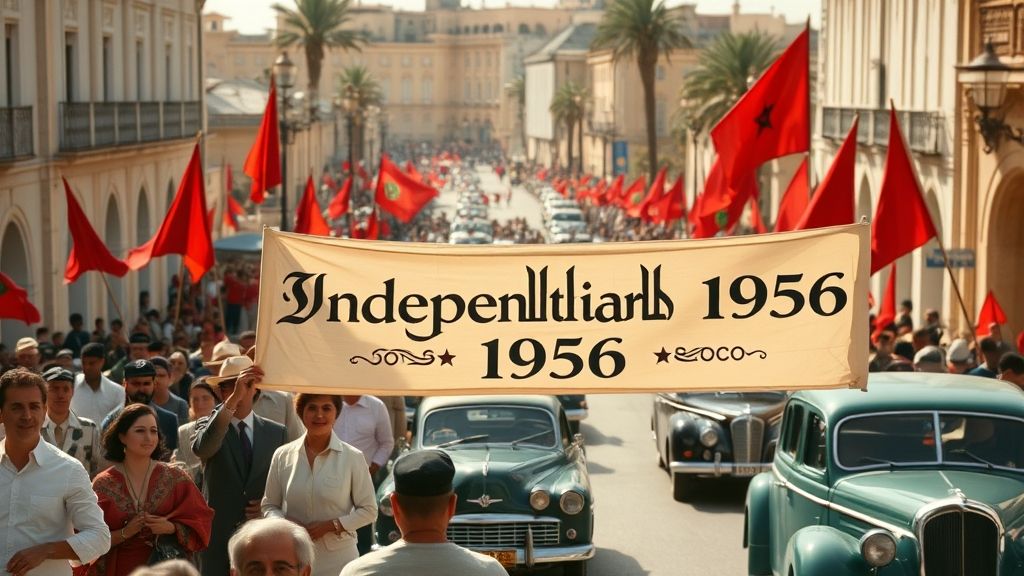
Across Moroccan cities, celebrations erupted. Flags flew, prayers were held, and voices sang the songs of freedom. Yet, the declaration was also a beginning—a foundation upon which to build a modern, sovereign nation.
The Immediate Aftermath: Euphoria, Uncertainty, and Realignment
Independence was not an endpoint but a new chapter fraught with challenges.
Administratively, Morocco faced the immense task of dismantling colonial structures and constructing new political, economic, and social institutions. The balance between tradition and modernity had to be negotiated delicately.
International relationships required recalibration, particularly with former colonial powers and emerging neighbors.
Yet, the euphoria of liberation provided a reservoir of energy and hope that propelled the country forward.
Morocco’s Path to Sovereignty: Challenges and Opportunities Ahead
The post-independence years brought both trials and promise.
Challenges included integrating diverse ethnic and political factions, addressing economic disparities, and managing regional tensions, especially regarding the Spanish enclaves and Saharan territories.
At the same time, Morocco sought to assert itself on the international stage, joining the United Nations and forging diplomatic relations worldwide.
The careful stewardship of Sultan Mohammed V—and after his death in 1961, his son Hassan II—would steer Morocco through these turbulent waters.
Enduring Legacy: How 1956 Forged Modern Moroccan Identity
More than six decades later, the 1956 independence remains a foundational event in Moroccan collective memory.
It has shaped the nation’s identity, values, and political culture. The narrative of resistance and sovereignty continues to inspire civic pride and cultural expression.
Moroccan independence stands as a testament to a people’s determination to reclaim their destiny, blending ancient tradition with modern aspirations.
The International Reverberations of Moroccan Independence
Morocco’s liberation was part of a broader wave of decolonization that reshaped the global order.
Its success inspired other African and Arab countries fighting for emancipation. It tested the policies of colonial powers and contributed to the eventual unraveling of European empires.
Morocco’s position as a crossroads between Africa, Europe, and the Arab world gave its independence a unique strategic significance.
Remembering the Struggle: Memory, Monuments, and National Pride
Throughout Morocco, monuments, museums, and annual commemorations pay homage to the heroes of independence.
Institutions like the Mohamed V National Library and Independence Square in Rabat stand as reminders of the sacrifices made.
Education teaches younger generations about the struggle, ensuring that the lessons and spirit of 1956 endure.
Conclusion
The emancipation of Morocco in 1956 was not merely a political act; it was a profound human saga of resilience, identity, and hope. It demonstrated how a nation under the yoke of foreign domination can summon the collective will to reclaim its story and its future.
Through the figures of its leaders and the courage of ordinary Moroccans, independence became a beacon not only for Morocco but for all peoples striving against oppression. Today, as Morocco continues to evolve amid global challenges, the spirit of 1956 remains alive—a testament to the power of unity, perseverance, and faith in freedom.
FAQs
Q1: What were the main causes of Morocco’s independence movement?
The primary causes included decades of French and Spanish colonial domination, economic exploitation, cultural suppression, and the rise of nationalist consciousness fueled by political parties like Istiqlal and the symbolic leadership of Sultan Mohammed V.
Q2: Who was Sultan Mohammed V, and why was he important?
Sultan Mohammed V was the Alaouite monarch who became a unifying symbol for Moroccan nationalism. His measured resistance to French rule and eventual exile made him a national hero, embodying Moroccan aspirations for sovereignty.
Q3: What role did the Istiqlal Party play in the independence movement?
Founded in 1944, the Istiqlal Party organized political opposition to colonial rule, produced the 1944 Manifesto of Independence, coordinated nationalist activities, and mobilized widespread support for full sovereignty.
Q4: Why was the exile of Sultan Mohammed V significant?
Exiling the Sultan in 1953 was a French attempt to suppress the independence movement but backfired by provoking widespread unrest, uniting Moroccans, and drawing international attention to their cause.
Q5: How did World War II influence Morocco’s push for independence?
WWII weakened colonial powers, exposed contradictions in their claims about liberty, and emboldened Moroccan nationalists to demand freedom in a postwar world increasingly sensitive to self-determination.
Q6: What challenges did Morocco face immediately after independence?
Morocco had to dismantle colonial institutions, build new political structures, address economic disparity, manage ethnic and regional tensions, and establish itself diplomatically.
Q7: How is Morocco’s independence commemorated today?
Through national holidays, monuments like Independence Square, museums, educational curricula, and cultural celebrations that honor the sacrifices and achievements of the independence movement.
Q8: What was the international impact of Morocco’s independence?
Morocco’s independence was a herald of the broader decolonization wave across Africa and the Arab world, influencing colonial policies and inspiring other liberation movements globally.