Table of Contents
- The Dawn of Revolution: Budapest on October 23, 1956
- Seeds of Discontent: Hungary Under Stalinist Rule
- The Spark Ignites: Student Demonstrations and Calls for Reform
- The Moment of Resolve: The Crowd Fills the Streets
- The First Shots: Violence Erupts and Soviet Troops Respond
- Voices of Freedom: The Revolutionary Leaders and Their Demands
- The Flight of Imre Nagy: Hope for a New Hungary
- The Soviet Retaliation: Tanks Roll Back into Budapest
- The Battle for the City: Urban Warfare and Civilian Courage
- The People's Struggle: Stories from the Frontlines and the Homefront
- Media Under Siege: Images and Words amidst Chaos
- The International Response: Cold War Politics and Silent Allies
- The Collapse of the Revolution: Repression and Defeat
- The Aftermath: Imprisonments, Executions, and Exile
- Memory and Myth: The Hungarian Revolution in Global Consciousness
- The Long Shadow: How 1956 Shaped Hungary’s Future
- Revisiting the Past: Commemorations and Historical Debates
- Lessons of 1956: Resistance, Sovereignty, and the Price of Freedom
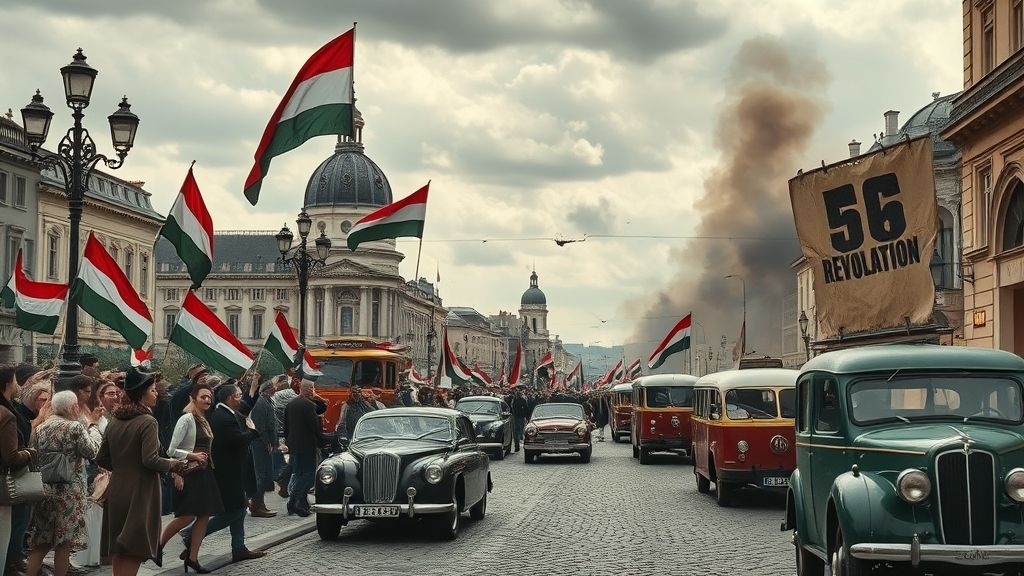
On a crisp autumn afternoon, the heart of Budapest pulsed with a restless energy unlike anything the city had known in a decade. October 23, 1956: the day when streets that once echoed with subdued silence now roared with the fervor of a people awakening. Flags waved, a chorus of voices demanding dignity and change rose, and hope surged as if spring had returned in the throes of fall. This was no ordinary protest. It was the beginning of a revolution—one that would expose the brittle bones of Soviet-imposed oppression and ignite embers of defiance far beyond Hungary’s borders.
The Dawn of Revolution: Budapest on October 23, 1956
Budapest’s usual rhythm had been disrupted early that morning. Young students gathered under the fading light of dawn, clutching leaflets and slogans penned with a sharp urgency. The air, though crisp, was charged with the heat of anticipation and the collective breath of a nation standing at a crossroads. From university halls to the narrow cobblestone streets, word spread like wildfire: this was not a simple demonstration but a call for liberation.
The city’s centuries-old buildings bore witness to an unfolding drama. The venerable Parliament, the iconic Chain Bridge, and the banks of the Danube all framed this grand narrative—a clash of ideologies, the assertion of human dignity, and the raw will to reclaim sovereignty. Groups assembled, swelling from hundreds to thousands, soon spilling into every avenue and square.
Seeds of Discontent: Hungary Under Stalinist Rule
To understand the explosion of 1956, one must journey back to the twilight years of World War II and the shadow cast by Soviet occupation. Hungary, a nation scarred by war and shifting alliances, found itself under the iron grip of a Stalinist regime, where political purges, forced collectivization, and brutal repression stifled dissent. The Communist Party, backed by Moscow's authority, crushed political plurality under its boot.
By the mid-1950s, the country was a powder keg. Widespread poverty, the suppression of religion, censorship, and an economy in ruins fueled simmering unrest. The doctrine that promised progress and equality was, in reality, a machine of fear and conformity. Yet, beneath the surface, a yearning for freedom pulsated, nurtured by intellectuals, students, and workers alike.
The Spark Ignites: Student Demonstrations and Calls for Reform
It was a seemingly ordinary student demonstration that ignited the revolution. Inspired by de-Stalinization speeches from Moscow and Poland’s recent political thaw, Hungarian students drafted a list of sixteen demands. These included free elections, the withdrawal of Soviet troops, freedom of the press, and civil liberties long denied.
As they presented their call at the statue of Józef Bem, a hero of the 1848 Hungarian revolution, the symbolism was unmistakable—the fight for Hungary's future was linked to a history of struggle and hope. The crowd listened, nerves taut, as these young voices channeled decades of frustration and dreams for genuine self-rule.
The Moment of Resolve: The Crowd Fills the Streets
The students’ words acted like a clarion call. Workers from factories stopped their machines, citizens abandoned shops, and even some officials feigned ignorance of the coming storm. By mid-afternoon, more than 100,000 people flooded the heart of Budapest, united in purpose and unbowed by the threat of force.
Among the chants and cries, a spontaneous Republic was born—one not declared by governments but by millions empowered to reclaim their destiny. Flags—red, white, and green—fluttered in the wind as old Soviet stars were torn down. The atmosphere was electric: fear mingled with hope, and every corner held stories of courage.
The First Shots: Violence Erupts and Soviet Troops Respond
But paradise was short-lived. What began as a peaceful demonstration swiftly escalated when Soviet troops, ordered to maintain “order,” opened fire on the crowd. The streets turned violent; gunshots replaced chants, and the river of people bewildered and enraged surged against tanks and armed units.
The violence was chaotic and brutal. The initial resistance of students and workers forced a retreat of some Soviet units, but casualties mounted on both sides. Hungarian forces loyal to the revolution seized weapons from armories, turning the tide in a desperate bid for self-defense. For many, these moments blurred the line between revolution and civil war.
Voices of Freedom: The Revolutionary Leaders and Their Demands
From the tumult emerged figures who would come to personify the revolution. Imre Nagy, a reform-minded former Prime Minister, became a beacon of hope when summoned back to power by the insurgents and political elements eager for change. Nagy promised reforms, a multi-party system, and the end of one-party tyranny.
Alongside him were intellectuals, former political prisoners, and workers’ leaders—people who had long dreamed of democratic socialism, not Soviet domination. Their vision was clear but fraught with danger: they sought to balance revolution and diplomacy, hoping to negotiate Hungary’s withdrawal from the Warsaw Pact without provoking full-scale Soviet retaliation.
The Flight of Imre Nagy: Hope for a New Hungary
For a brief moment, Nagy’s government embodied possibility. The announcement that Hungary would leave the Warsaw Pact was a declaration of independence with seismic Cold War implications. The people rallied, euphoric at the chance to rewrite their history.
Yet Nagy’s tenure was precarious. While he attempted to calm revolutionary forces and negotiate with the Kremlin, his intentions were challenged by both radical revolutionaries demanding more radical action and Soviet hardliners readying their response. His plight was the personification of Hungary’s uncertain freedom—a fragile flower caught in a storm.
The Soviet Retaliation: Tanks Roll Back into Budapest
On November 4, the complacency of hope shattered as a massive Soviet offensive crushed the revolution with overwhelming force. Hundreds of thousands of troops and thousands of tanks flooded into Budapest and other cities. The once jubilant streets became battlegrounds echoing with gunfire, explosions, and cries of defiance.
The revolutionaries fought with whatever weapons they could muster—homemade bombs, rifles, even bare hands—transforming Budapest into a fierce urban battlefield. Over ten thousand Hungarians died. The city was scarred physically and emotionally. But the Soviet Union’s message was brutally clear: dissent would not be tolerated.
The Battle for the City: Urban Warfare and Civilian Courage
The fighting in Budapest was unlike any seen since the Second World War. Sweeping from public squares into narrow alleyways, the battles became a testament to human resilience. Civilians became combatants, couriers, nurses, and witnesses to history.
Stories abound of daring rescues, last stands, and the indomitable spirit of a people unwilling to yield. One could see teenage boys manning barricades; elderly women distributing food and medicine; students hurling Molotov cocktails; families fleeing shell-shocked neighborhoods—a city transformed into a crucible of human survival and sacrifice.
The People's Struggle: Stories from the Frontlines and the Homefront
Lost amid the grand strategies and political decisions were the countless individuals whose lives forever altered in those weeks. László, a factory worker, recalled hiding weapons in his home’s basement while comforting his frightened children. Erzsébet, a nurse, worked for days without rest amidst bombed-out hospitals.
Their stories, stitched together, create a rich tapestry of humanity under pressure: fear, courage, loss, and hope. The revolution was not just political but profoundly personal, lived and suffered by ordinary citizens caught between ideologies.
Media Under Siege: Images and Words amidst Chaos
In 1956, journalism was itself a battlefield. Radio Free Europe beamed messages of hope and calls for solidarity into Hungary while Soviet censorship sought to silence the truth. Photographs of burning buildings and grieving mothers slipped through the Iron Curtain, haunting the world.
International media coverage brought global attention, yet the complexity of events was often reduced to Cold War narratives. Nonetheless, images of the Hungarian brave resistance imbued a generation with courage and a sense of urgency for freedom.
The International Response: Cold War Politics and Silent Allies
The Hungarian Revolution unfolded on the global stage at the height of the Cold War. Western powers watched with sympathy but little action. The United States and NATO feared direct confrontation with the Soviet Union. Diplomatic condemnations and radio broadcasts were the extent of their support.
Meanwhile, communist states wrangled with the implications of Hungary’s rebellion. Poland’s own thaw made Budapest’s falling more poignant. The international response highlighted the limits of power and the high stakes of ideological conflict.
The Collapse of the Revolution: Repression and Defeat
By mid-November, resistance was crushed, leaders arrested or forced into exile, and order brutally restored. Soviet forces executed harsh reprisals: summary executions, mass arrests, and a climate of terror. Imre Nagy was eventually captured, secretly tried, and executed in 1958—a martyr for freedom.
The dream of a democratic Hungary was temporarily extinguished but never forgotten. The scars of repression ran deep, leaving a society wary of further rebellions but simmering with the need for change.
The Aftermath: Imprisonments, Executions, and Exile
Post-revolution Hungary was a nation under siege from within. Thousands were imprisoned, tortured, or fled into exile, spreading the story of 1956 worldwide. The revolution catalyzed waves of refugee movement, dramatically impacting Western Europe and the United States, where émigré communities raised awareness.
Yet, the repression planted seeds that would eventually lead to Hungary’s slow and painful path toward reform—decades later culminating in the fall of communism in 1989.
Memory and Myth: The Hungarian Revolution in Global Consciousness
Over the decades, 1956 became more than a historical event; it became a symbol of resistance against totalitarianism. Western media invoked it during subsequent crises; Hungarian exiles kept its story alive through art, literature, and scholarship.
In Hungary, public memory was shaped by shifting narratives—from Soviet condemnation labeling it “counter-revolution” to eventual national commemoration celebrating its heroes and martyrs.
The Long Shadow: How 1956 Shaped Hungary’s Future
The revolution’s legacy rippled through Hungarian history. Politically repressed but culturally vibrant, Hungary’s population harbored a quiet defiance that informed its eventual peaceful transition from communism to democracy.
Moreover, 1956 influenced the broader dynamics of Cold War détente and highlighted the human yearning for freedom, inspiring dissidents in Eastern Europe and beyond.
Revisiting the Past: Commemorations and Historical Debates
In recent decades, Hungary has grappled with how best to honor and interpret 1956. Museums, documentaries, and public commemorations underscore the complexity of the uprising—its triumphs, tragic defeats, and enduring spirit.
Academic debates continue regarding the revolution’s causes, the effectiveness of leadership, and the balance between nationalism and socialism in its aspirations.
Lessons of 1956: Resistance, Sovereignty, and the Price of Freedom
The Hungarian Revolution of 1956 stands as a poignant reminder of the human cost of oppression and the unyielding desire for self-determination. It teaches us about the complexities of power, the ambiguities of international politics, and the courageous choices made when people refuse to be silenced.
Its story resonates today, encouraging reflection on the meaning of freedom and the ongoing struggles for justice worldwide.
Conclusion
The Hungarian Revolution of 1956 was, in every sense, a crucible of human spirit and political complexity. In the shimmering streets of Budapest, individual bravery collided with the brutal machinery of empire. For a fleeting moment, the dreams of a free Hungary flickered brightly, illuminating the darkness of oppression. Though crushed, the revolution’s flame never died; it smoldered through decades of silence, inspiring generations to hold fast to the ideals of liberty and dignity.
History often remembers grand victories, yet sometimes its greatest lessons emerge from profound loss—when people refuse quietly to succumb. The story of 1956 teaches us that freedom is forged not in ease but in struggle, in the courage to stand when every odds screams no. Budapest’s uprising was not merely a historical episode; it was, and remains, a testament to the enduring power of hope.
FAQs
Q1: What were the main causes of the Hungarian Revolution of 1956?
A1: The revolution stemmed from widespread dissatisfaction with Soviet-imposed Stalinist policies, political repression, economic hardship, and a longing for national sovereignty and democratic reforms. The immediate catalyst was student-led protests demanding change.
Q2: Who was Imre Nagy, and why was he important?
A2: Imre Nagy was a reformist Hungarian politician who briefly led the revolution’s government, advocating for Hungary’s withdrawal from the Warsaw Pact and democratic reforms. He symbolized hope for many Hungarians before being suppressed and executed by Soviet forces.
Q3: How did the Soviet Union respond to the revolution?
A3: Initially caught off guard, the Soviet Union launched a massive military intervention on November 4, crushing the revolution with overwhelming force—bringing tanks into Budapest, arresting leaders, and reinstalling a pro-Soviet regime.
Q4: What was the international reaction to Hungary’s uprising?
A4: Western countries expressed sympathy but took no direct military action due to the risk of escalating Cold War tensions. The revolution highlighted the geopolitical limits faced by Hungary’s allies.
Q5: How did the revolution impact Hungary in the long term?
A5: Although the immediate rebellion was crushed, 1956 became a powerful symbol of resistance. It influenced future reform movements, contributed to Hungary’s eventual transition to democracy in 1989, and left a lasting imprint on national identity.
Q6: Why is the Hungarian Revolution of 1956 still remembered today?
A6: It is remembered as a courageous stand for freedom against oppression—a powerful example of popular uprising, national pride, and the universal quest for human rights.
Q7: Were there any significant cultural effects of the revolution?
A7: Yes; the revolution inspired literature, film, music, and art both within Hungary and internationally, capturing the complexity of hope and tragedy in the face of tyranny.