Table of Contents
- The Dawn of a New Republic: Paris, October 4, 1958
- France in Turmoil: A Nation at the Crossroads
- The Crisis of the Fourth Republic: Weakness and Instability
- The Algerian War: An Explosive Backdrop
- Charles de Gaulle’s Return: The Man of Destiny
- The Call for Constitutional Reform: Urgency and Debate
- Drafting the New Constitution: Vision, Controversies, and Compromises
- The Fifth Republic’s Constitutional Assembly: Actors and Agendas
- The Content of the Constitution: Power, Presidency, and Parliament
- The Referendum of September 28, 1958: A Nation’s Choice
- October 4, 1958: The Birth of the Fifth Republic
- Immediate Reactions: Political Elation and Popular Hope
- De Gaulle’s Initial Actions: Steering the New Republic
- The New Political Architecture: Strengthening Executive Power
- The Role of the Constitution in Ending the Algerian Crisis
- Transformations in French Society and Governance
- The Fifth Republic’s Global Impact: France on the World Stage
- Enduring Legacy: Stability Amidst Storms
- Critics and Challenges: Democracy or Authoritarianism?
- The Constitution Today: Evolution, Amendments, and Relevance
- Lessons from 1958: Crisis as a Catalyst for Change
- Memory and Commemoration: How France Remembers the Fifth Republic
- Conclusion: The Constitution as a Living Testament
- FAQs: Understanding the Fifth Republic Constitution
- External Resource: Official Wikipedia Entry
- Internal Link: Visit History Sphere
1. The Dawn of a New Republic: Paris, October 4, 1958
October 4, 1958, dawned with a mix of apprehension and hope in the streets of Paris. The air was dense with anticipation — a fragile peace after years of political instability, colonial wars, and social unrest. Newspapers bore headlines announcing the promulgation of a new constitution— a bold step marking the birth of the Fifth French Republic. As the official decree was signed at the Élysée Palace, the country found itself at a threshold between chaos and order, tradition and innovation, old political failures and promises of renewal. This was not merely a legal formality; it was the beginning of an ambitious project designed to save a nation in turmoil.
2. France in Turmoil: A Nation at the Crossroads
The 1950s were a period of turbulent unrest for France. The scars of World War II had barely begun to heal when renewed political instability plunged the country into uncertainty. The Fourth Republic, established after the war, was struggling under a fragile parliamentary system riddled with factionalism and cabinet collapses. On top of this, overseas wars, particularly the brutal conflict in Algeria, exposed deep divisions and tested the very fabric of French unity. It was a nation fractured by discord and desperate for decisive leadership.
3. The Crisis of the Fourth Republic: Weakness and Instability
The Fourth Republic was born in 1946 out of resistance against fascism and wartime collaboration. But its parliamentary regime was often paralyzed by short-lived governments and weak coalitions. Between 1946 and 1958, France witnessed over 20 prime ministers take office in rapid succession. This rotunda of political turnover blocked meaningful reforms and left France exposed to crises both foreign and domestic. Many voices cried out for a change — a stronger executive that could impose stability and vision. Yet no consensus emerged… until the storm of Algeria forced the issue.
4. The Algerian War: An Explosive Backdrop
The Algerian War of Independence (1954–1962) was both a colonial conflict and a political reckoning. Algeria was not just a colony but considered part of metropolitan France, home to millions of French settlers (the pieds-noirs). The war stirred passions across the social spectrum, driving violent confrontations on French soil and distress in political circles. Terrorist attacks, military insubordination, and urban guerrilla warfare blurred lines between home front and battlefield. The colonial war amplified the instability and sharpened the urgency for constitutional reform.
5. Charles de Gaulle’s Return: The Man of Destiny
Into this vortex stepped Charles de Gaulle. A towering figure of the French Resistance and wartime leader, De Gaulle had retreated from politics after 1946, skeptical of the parliamentary regime. But as the crisis deepened, calls for his return multiplied. Viewed by many as France’s only hope for order and dignity, he was summoned back in May 1958 amid fears that the country faced a coup or civil war. De Gaulle agreed to form a government but on the condition that a new constitution be drafted— one that would rectify the weaknesses of the Fourth Republic.
6. The Call for Constitutional Reform: Urgency and Debate
Constitutional reform was urgent. The interim government under de Gaulle was given extraordinary powers to put in place a new foundation for French governance. But the political class was divided — some feared authoritarian drift, others demanded a presidency with real power to discipline fractious parties. Intellectuals, politicians, and citizens debated heatedly about the nature of France’s future regime. Should sovereignty reside in the parliament or be shared with a strong president? How to balance democracy and order? The answers would shape decades to come.
7. Drafting the New Constitution: Vision, Controversies, and Compromises
Drafting the new constitution was a delicate act of balancing vision and pragmatism. The drafting committee, heavily influenced by de Gaulle’s views, sought to empower the executive while preserving democratic checks. Controversies swirled around presidential election methods, parliamentary prerogatives, and emergency powers. The text was a hybrid — not a complete presidential system à la American style, but neither the weak parliamentary regime of before. Instead, a semi-presidential model emerged, unprecedented in France’s history.
8. The Fifth Republic’s Constitutional Assembly: Actors and Agendas
The Constitutional Assembly included lawyers, politicians, and intellectuals tasked with transforming de Gaulle’s vision into law. Figures such as Michel Debré, who would become the first Prime Minister of the Fifth Republic, played a crucial role. The assembly navigated conflicting interests of parties: the Gaullists pushing for strong executive power; the Socialists wary of authoritarianism; the Christian Democrats seeking a balanced republic. Despite tensions, the assembly fast-tracked the process, knowing the country could not wait.
9. The Content of the Constitution: Power, Presidency, and Parliament
The new constitution, while complex, had several key innovations:
- A powerful President of the Republic elected by an electoral college (later by direct universal suffrage).
- The President’s right to appoint the Prime Minister and dissolve the National Assembly.
- The establishment of a strong executive to avoid governmental paralysis.
- Maintenance of a parliamentary chamber with legislative authority.
- Constitutional Council to oversee the constitutionality of laws.
- The recognition of national sovereignty and republican values in the preamble.
This system was designed to combine stability and democracy, a delicate architectural feat born of hard lessons.
10. The Referendum of September 28, 1958: A Nation’s Choice
On September 28, 1958, the new constitution was submitted to the French people via a referendum. The campaign was intense but also permeated with a collective desire to end chaos. With 79.2% voting in favor, the approval marked a clear mandate for de Gaulle’s vision and the Fifth Republic itself. It was a moment of collective catharsis — the dawn of a new political era backed by popular legitimacy.
11. October 4, 1958: The Birth of the Fifth Republic
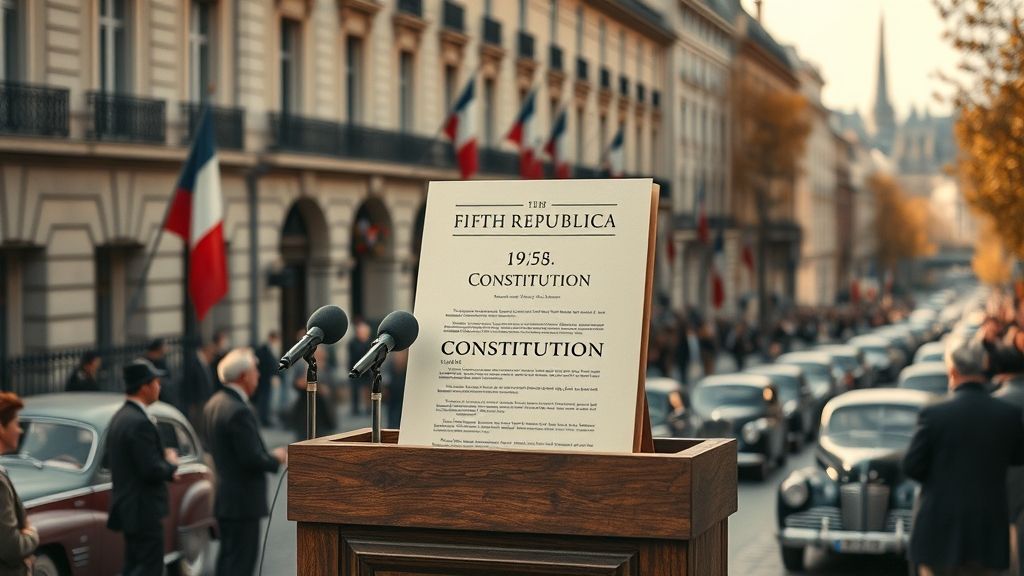
Just days after the referendum victory, on October 4, 1958, President René Coty promulgated the constitution. The act was both ceremonial and momentous. France had officially abandoned the Fourth Republic, casting off its weaknesses and embracing a more stable, presidential regime. The document went into effect immediately, signaling the start of a republic designed for endurance. De Gaulle had achieved a historic transformation — but his work was only beginning.
12. Immediate Reactions: Political Elation and Popular Hope
The promulgation unleashed a wave of relief and expectation across France. Politicians who had suffered years of gridlock now hailed the new order. Ordinary citizens, weary of strikes and instability, saw hope in a government that could act decisively. Editorials spoke of “return to grandeur” and “restoration of French pride.” Nevertheless, some opposition voices warned against excessive centralization and loss of parliamentary democracy. The debates of the past were far from over.
13. De Gaulle’s Initial Actions: Steering the New Republic
President De Gaulle wasted no time. He carefully shaped his government, appointed ministers loyal to his vision, and began implementing policies aligned with the constitution’s spirit. Crucially, he focused on resolving the Algerian crisis, pushing for a negotiated settlement that would end years of bloodshed. De Gaulle’s authority, enhanced by the constitution, allowed him to steer France with a firm hand, restoring order internally and reasserting France’s international standing.
14. The New Political Architecture: Strengthening Executive Power
The Fifth Republic’s political architecture was revolutionary in France. The executive’s new latitude contrasted with the parliamentary primacy that had often led to deadlock. The presidency became the linchpin of power, capable of decisively setting policy and dissolving parliament. This new balance addressed the flaws of the Fourth Republic while integrating democratic mechanisms, a “double legitimacy” system between president and parliament that remains original to this day.
15. The Role of the Constitution in Ending the Algerian Crisis
While the constitution itself did not end the Algerian War, it provided the political stability De Gaulle needed to negotiate. It enabled him to withstand pressure from military and settler factions longing for continued colonial rule. Eventually, through the Evian Accords of 1962, Algeria achieved independence. The new constitutional order allowed painful but necessary transformations, showing how institutional reform can underlie conflict resolution.
16. Transformations in French Society and Governance
Beyond politics, the Fifth Republic’s constitution ushered in reform across French society. Greater executive control expedited economic modernization, social reforms, and reorganization of administrative structures. It contributed to the “Trente Glorieuses” (Thirty Glorious Years) of post-war prosperity and stability. The redefined state institution inspired confidence domestically and abroad, building a republic that could face the challenges of the Cold War and decolonization confidently.
17. The Fifth Republic’s Global Impact: France on the World Stage
Internationally, the Fifth Republic marked France’s return to prominence. De Gaulle’s assertive foreign policies — from withdrawing from NATO’s integrated command to supporting European cooperation — were made possible by strong leadership rooted in the constitution. France positioned itself as an independent power, capable of influencing global affairs. The constitution, by securing domestic order, was instrumental in this geopolitical reassertion.
18. Enduring Legacy: Stability Amidst Storms
Over six decades, the Fifth Republic constitution has provided an extraordinary framework for political stability amid social and global upheavals. From May 1968 protests to economic crises, terror attacks, and transformations in the European Union, the constitutional system has adapted, survived, and often thrived. Its endurance testifies to a finely balanced design, reflecting lessons learned in 1958’s crucible.
19. Critics and Challenges: Democracy or Authoritarianism?
Notwithstanding its successes, the constitution faces criticism. Some argue it risks concentrating power excessively in the presidency, threatening parliamentary democracy and pluralism. Others lament a “presidential monarchy” with too little legislative independence. These debates fuel ongoing reforms and amendments, highlighting tensions between effective governance and democratic representation—an eternal dance in democratic constitutionalism.
20. The Constitution Today: Evolution, Amendments, and Relevance
Since 1958, the constitution has been amended multiple times to adapt to new political realities: introducing two-round presidential elections (1962), reducing presidential terms, enhancing parliamentary roles, and integrating European legal norms. Still, its core principles remain foundational. As France grapples with contemporary challenges—migration, digital sovereignty, climate change—the constitution provides both a tested guide and a living document.
21. Lessons from 1958: Crisis as a Catalyst for Change
The story of the Fifth Republic constitution reaffirms how crises can trigger profound institutional renewal. Political chaos and social tensions gave birth to a more resilient and adaptable political system in France. It shows that legal and political innovation often arise from necessity, and that visionary leadership combined with popular mandate can reshape nations. The constitution is not a frozen artifact but a testament to historical transformation.
22. Memory and Commemoration: How France Remembers the Fifth Republic
In French collective memory, 1958 is recalled as a turning point. Commemorations, history books, and political discourse emphasize the courage to reform and the role of leaders like de Gaulle. Yet the awareness remains nuanced — a recognition of the gains balanced by critical reflection on democratic practices. Museums, academic institutions, and public debates keep the memory alive and relevant for new generations.
23. Conclusion: The Constitution as a Living Testament
The promulgation of the Fifth Republic constitution on October 4, 1958, marked not only a legal rebirth but a profound political awakening. It was the culmination of a painful journey through crisis, reflection, and innovation. More than sixty years later, the constitution endures—an emblem of French resilience, adaptability, and democratic aspiration. It reminds us that history, law, and politics are inextricably intertwined in shaping human destiny.
Conclusion
The birth of the Fifth Republic constitution is a story of a nation rising from the brink of fragmentation to forge a durable political order. Against the backdrop of colonial wars, political paralysis, and social unrest, France chose bold reform over disintegration. It entrusted Charles de Gaulle to craft an institutional architecture that balanced strength and democracy, vision and pragmatism. This constitution did not merely change governance; it restored confidence, stability, and a reassertion of France’s place in the modern world. As crises beckon new challenges, the lessons and spirit of 1958 continue to offer inspiration to those who believe in the possibility of renewal amid adversity.
FAQs
Q1: Why was the Fourth Republic’s constitution seen as ineffective?
The Fourth Republic’s parliamentary system caused frequent government collapses and policy paralysis, as fragmented parties struggled to form stable coalitions. This chronic instability led to a loss of public confidence and political dysfunction.
Q2: How did the Algerian War influence the creation of the Fifth Republic?
The war exacerbated political tensions and exposed the weaknesses of the Fourth Republic. The inability to manage the conflict effectively accelerated the demand for a stronger executive and institutional reforms, paving the way for de Gaulle’s return and the new constitution.
Q3: What are the key features that distinguish the Fifth Republic’s constitution?
Its hallmark is a strong presidency with significant powers including appointing the Prime Minister, dissolving parliament, and leading foreign policy, balanced with a parliamentary system and judicial oversight.
Q4: How did Charles de Gaulle shape the constitution?
De Gaulle’s vision of a strong, stable executive influenced the semi-presidential system, where the president possesses real authority to prevent the governmental chaos of the past. His political stature also secured broad public support.
Q5: Was the new constitution immediately accepted by the French people?
Yes, the referendum approved the constitution with nearly 80% of votes in favor, reflecting popular desire for stability and reform.
Q6: What impact did the constitution have on the Algerian War?
It enabled stronger leadership to negotiate an end to the war, culminating in Algeria’s independence—a painful but decisive political transformation.
Q7: Has the constitution changed since 1958?
Yes, multiple amendments have modernized electoral processes, strengthened parliamentary roles, and adapted to European integration, but the core principles remain intact.
Q8: How is the Fifth Republic remembered today?
It is remembered as a foundation of France’s modern political stability and resilience, though scholars and citizens continue to debate its balance of power and democratic nature.