Table of Contents
- Dawn over Léopoldville: June 30, 1960, a New Nation is Born
- The Heartbeat of Africa: Belgian Congo on the Eve of Independence
- Shadows of Colonialism: The Belgian Grip and Its Complex Legacy
- The Rise of Nationalism: Voices That Shook an Empire
- Patrice Lumumba: The Charismatic Firebrand of Congolese Independence
- The Round Table Conference: Negotiating Freedom under Unequal Terms
- The World Watches: Cold War Tensions Loom over Congo’s Future
- The Day of Liberation: Scenes from Independence Day, 1960
- Public Celebrations and Underlying Anxieties: A Nation in Transition
- The Storm Beneath the Surface: Immediate Challenges After Independence
- The Military Mutiny: Cracks in the New Republic
- The Secession of Katanga: A Threat to Congolese Unity
- Lumumba’s Vision and His Struggle Against External Interference
- The United Nations Deployment: International Involvement Deepens
- The Tragic Downfall of Lumumba: Assassination and Reverberations
- Congo’s Long Road: Post-Independence Political Turmoil
- Economic Shocks and Social Upheaval: The Congo’s Tumultuous Early Years
- The Cold War’s Proxy Battle: Congo as a Geopolitical Chessboard
- Remembering 1960: The Independence Day That Changed Africa
- Legacy and Memory: How Congo’s Independence Resonates Today
- Conclusion: The Fragile Birth of a Nation and the Enduring Quest for Sovereignty
- FAQs: Understanding Congo’s Independence and Its Impact
- External Resource
- Internal Link
Dawn over Léopoldville: June 30, 1960, a New Nation is Born
The sun rose slowly over the turbulent streets of Léopoldville on June 30, 1960. For most, it was just another equatorial dawn piercing the sprawling chaos of an African metropolis riddled with contradictions — colonial relics sat alongside the fervor of newfound hope. But on that day, this city, soon to be called Kinshasa, became the beating heart of a continent’s dream: independence.
Millions watched and waited as Congo, a vast land once branded as Belgium’s “crown jewel,” tore off the shackles of colonial rule. It was not just the birth of a country; it was a defining moment in the narrative of decolonization, symbolizing both hope and fragility, triumph and tragedy.
Crowds gathered in the Palais de la Nation, where Ugandan-born Congolese nationalist Patrice Lumumba delivered a fiery and poignant speech, declaring the Congo’s freedom with fervor and passion. Yet in the shadows of celebration loomed the daunting challenges awaiting this youthfully independent republic — ethnic divisions, economic dependencies, and Cold War rivalries that would soon engulf the nation and the world.
This monumental day marked both the culmination of a long struggle and the precarious prologue to a tempestuous future — a crossroads where dreams met geopolitical realities in a drama that shaped Africa’s post-colonial history.
The Heartbeat of Africa: Belgian Congo on the Eve of Independence
To understand the significance of June 30, 1960, is to grasp the complex reality that was the Belgian Congo in the late 1950s. Spanning over 2.3 million square kilometers, it was among the largest and most resource-rich territories in Africa. Mountains, rainforests, rivers, and mineral wealth combined to create a land of enormous strategic and economic interest.
Despite its riches, the Congolese people had lived under a tightly controlled colonial system where Belgian ambitions dictated every facet of life. Political expression was repressed, and social structures were radically transformed to suit Belgian economic interests. Education was minimal, and political organizations were discouraged until the late 1950s. The vast majority of Congolese remained marginalized, with no political voice, caught in a colonial machine increasingly out of step with the wave of independence elsewhere on the continent.
Yet, beneath this veneer of control, the pulse of change quickened. Cities like Léopoldville mushroomed with ideas, demands, and restless youth eager to reclaim their destiny. The winds of Pan-Africanism and anti-colonial fervor sweeping the continent inspired Congo’s burgeoning leaders and populations alike.
Shadows of Colonialism: The Belgian Grip and Its Complex Legacy
The history of Belgian colonial rule in Congo was brutal and paradoxical. Often described as one of the harshest European regimes in Africa, Belgium treated the Congo as a personal possession following King Leopold II’s private rule from 1885 to 1908, during which forced labor, violence, and exploitation resulted in millions of deaths.
When Belgium annexed the territory officially, reform attempts improved some infrastructure and introduced Western education, but political liberation remained absent. Belgian paternalism framed Congolese as incapable of self-governance, a racist ideology that justified political exclusion and economic exploitation.
The administration favored a small European elite and limited Congolese political participation, suppressing nationalist movements as late as the 1950s. This deep asymmetry planted seeds of resentment and fragmentation while leaving the country unprepared for sovereignty.
The Rise of Nationalism: Voices That Shook an Empire
By the mid-20th century, political awareness had spread among the Congolese, especially the urban elite and educated classes. Numerous political groups emerged, ranging from moderate advocates of gradual reform to radical voices demanding immediate independence.
Among these figures, Patrice Lumumba stood out — a union leader and orator who embodied the fiery nationalism many Congolese aspired to. Other political leaders included Joseph Kasa-Vubu, head of the ABAKO party, which championed ethnic identity and pushed a cautious nationalist agenda, and Moise Tshombe of Katanga, whose ambitions would later breed conflict.
Nationalist activists harnessed ethnic identities, cultural pride, and the frustrations with Belgium’s paternalism, fueling popular pressure that Belgium could no longer ignore.
Patrice Lumumba: The Charismatic Firebrand of Congolese Independence
Lumumba’s meteoric rise from schoolteacher to nationalist leader was emblematic of the Congo’s restless spirit. His impassioned calls for unity and liberation captured the imagination of many, transcending ethnic and regional divides.
He envisioned a free Congo—not just politically independent but socially just and united. His pan-Africanist ideals aligned him with broader liberation movements across Africa, such as those in Ghana under Kwame Nkrumah.
Yet, his outspoken criticism of colonialism and Western interference frightened Belgian authorities and foreign powers wary of a radical turn in their interests.
The Round Table Conference: Negotiating Freedom under Unequal Terms
The winds of change forced Belgium into holding negotiations in Brussels in early 1960. The Round Table Conference brought together Congolese leaders and Belgian officials to hammer out the terms of independence.
The talks were rushed, constrained by Belgium’s desire to exit gracefully while preserving economic privileges and political influence. For Congolese delegates, the rushed timetable — independence was set for June 30, 1960, barely months away — felt both a victory and a source of unease.
Despite divisions, including between radical and moderate factions, leaders agreed to the impending transfer of sovereignty, though little consensus existed on how to handle the newly sovereign state’s challenges.
The World Watches: Cold War Tensions Loom over Congo’s Future
In 1960, the Congo’s independence reverberated far beyond Africa. It was the quintessential battleground for Cold War politics, where the United States and Soviet Union eyed influence over this strategically placed, resource-rich country.
Western powers feared the spread of communism in Africa, while Moscow supported anti-colonial movements that promised socialist transformation.
This geopolitical tug-of-war meant that Congo’s future was never solely in the hands of its people — foreign actors were already maneuvering to shape the newborn nation’s destiny.
The Day of Liberation: Scenes from Independence Day, 1960
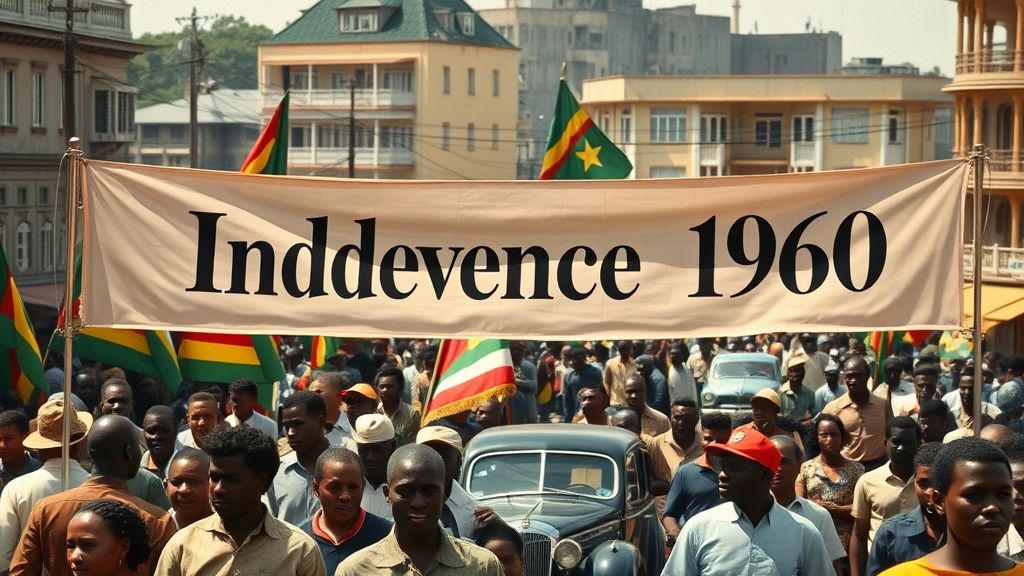
On June 30, Léopoldville erupted in a tableau of jubilation and ceremony. Crowds thronged the streets — some in traditional dress, others waving Congolese flags freshly unfurled. The Belgian flag was lowered, and the new flag of the Republic of Congo raised to the resonating strains of the national anthem.
King Baudouin of Belgium delivered a speech praising Belgium’s “civilizing mission,” a tone that starkly contrasted with the Congolese mood. In response, Patrice Lumumba’s speech electrified the crowd with its uncompromising call for genuine liberation and dignity.
The atmosphere was electric, but beneath the surface, fissures of political instability and economic vulnerability lurked.
Public Celebrations and Underlying Anxieties: A Nation in Transition
While the streets celebrated, concerns simmered. The Congolese administration was inexperienced, lacking trained functionaries, as many Belgian officials left abruptly. The military was fragile, and ethnic tensions threatened unity.
The economy, heavily dependent on Belgian companies, faced uncertainty. Social services, infrastructure, and governance mechanisms were not yet ready for the burden of sovereignty.
Despite the hope and pride, uncertainty weighed heavily on leaders and citizens alike.
The Storm Beneath the Surface: Immediate Challenges After Independence
The honeymoon was brief. Within days, the Congolese army—the Force Publique—mutinied, demanding Africanization of the officer corps and improved conditions. The Belgian response, involving troops returning to quell unrest, inflamed nationalist sentiments further.
Political rivalries intensified between Lumumba and President Kasa-Vubu, as competing visions for Congo’s direction emerged.
Furthermore, regional leaders, like Moise Tshombe, began agitating for autonomy from the central government, stoking centrifugal forces.
The Military Mutiny: Cracks in the New Republic
The army’s mutiny signaled the fragility of Congo’s sovereignty. For decades, the Force Publique had been a pillar of Belgian colonial rule, commanded exclusively by Europeans.
The abrupt political change without a gradual transition left African soldiers feeling marginalized and disrespected, leading to violent outbreaks and chaos in several cities.
This breakdown of order foreshadowed the fragility of Congo’s institutions and the challenges ahead.
The Secession of Katanga: A Threat to Congolese Unity
In July 1960, just days after independence, Moise Tshombe declared Katanga’s independence, backed by Belgian business interests fearful of losing access to rich mineral resources.
The secession plunged Congo into civil war and fragmented the nation’s territorial integrity, threatening the very fabric of the republic.
This audacious move drew immediate international attention and complicated Congo’s quest for unity and sovereignty.
Lumumba’s Vision and His Struggle Against External Interference
Determined to preserve Congo’s unity, Lumumba turned to the United Nations for assistance and appealed to the Soviet Union for military and political support when Western powers hesitated.
His bold stance angered Western governments who feared Soviet influence in Africa, creating a dangerous geopolitical tension.
Lumumba’s refusal to compromise on Congo’s sovereignty ultimately made him a target for internal and external enemies.
The United Nations Deployment: International Involvement Deepens
The UN deployed peacekeepers to the Congo with the mandate to restore order and prevent further fragmentation.
However, its operations were hampered by complex political realities and diverging interests among international actors.
The Congo became a stage where global powers engaged in indirect confrontation, turning local struggles into international crises.
The Tragic Downfall of Lumumba: Assassination and Reverberations
In January 1961, Lumumba was arrested, tortured, and assassinated under murky circumstances involving Belgian and possibly CIA complicity.
His death shocked Africa and the world, turning him into a martyr for anti-colonialism and symbol of the challenges facing African sovereignty amid Cold War intrigues.
The loss of Lumumba deepened the Congo’s crisis and set the tone for decades of instability.
Congo’s Long Road: Post-Independence Political Turmoil
Following Lumumba’s death, the Congo endured a succession of unstable governments, coups, and foreign interventions.
Joseph Mobutu seized power in 1965, ruling as a dictator for over three decades, suppressing opposition and exploiting state resources amid Cold War dynamics.
This era profoundly shaped Congo’s political and social landscape for generations.
Economic Shocks and Social Upheaval: The Congo’s Tumultuous Early Years
Economic faltering accompanied political instability. Dependence on mining revenues, flight of capital, and sabotage of infrastructure created hardship for the Congolese people.
Social services deteriorated, and the promise of independence seemed distant for many caught in poverty and dislocation.
Yet, cultural and intellectual ferment persisted, sewing seeds for future struggles.
The Cold War’s Proxy Battle: Congo as a Geopolitical Chessboard
The Congo’s fate during the early 1960s was inseparable from the Cold War.
The U.S. and USSR competed fiercely for influence, deploying covert operations, propaganda, and diplomatic pressure.
The Congo became emblematic of the perils of superpower rivalry on nascent African states.
Remembering 1960: The Independence Day That Changed Africa
Despite the chaos that followed, June 30, 1960 remains a defining moment for Congolese and Africans worldwide.
It marked the undoing of European colonial empires and inspired liberation movements continent-wide.
The day holds emotional power as a symbol of hope, sovereignty, and the resilience of African peoples.
Legacy and Memory: How Congo’s Independence Resonates Today
Today, Congo’s complex history from that independence day informs ongoing struggles for democracy and development.
Memorials, films, and literature keep alive the memory of the era, including the luminous and tragic figure of Lumumba.
The legacy calls for reflection on the costs of colonization, the challenges of nation-building, and the continuing quest for justice.
Conclusion: The Fragile Birth of a Nation and the Enduring Quest for Sovereignty
June 30, 1960, was not merely a date in the calendar but the birth cry of a people freed at last from foreign chains. But freedom brought no easy peace. The Congo’s story is one of immense promise shadowed by immense suffering—a cautionary tale of imperialism’s enduring legacies and the intricate dance of cold geopolitics and grassroots nationalism.
It is incredible to reflect on how that day in Léopoldville illuminated both Africa’s potential and its vulnerabilities. Lessons from that moment continue to echo, reminding us that independence is not only a destination but an ongoing journey requiring courage, wisdom, and solidarity.
FAQs
Q1: Why did Belgium grant independence to Congo in 1960?
Belgium faced increasing pressure from Congolese nationalist movements and changing international attitudes favoring decolonization. Coupled with economic and political costs of colonial rule, Belgium moved to grant independence quickly, though without fully preparing Congo for self-rule.
Q2: Who was Patrice Lumumba and why is he significant?
Lumumba was a leader of Congo’s independence movement and its first Prime Minister. Known for his passionate nationalism and vision of unity and social justice, Lumumba became a symbol of African anti-colonial aspirations before his assassination turned him into a martyr.
Q3: What challenges did the Congo face immediately after independence?
The new nation confronted military mutinies, ethnic and regional secession attempts (notably Katanga), economic instability, lack of experienced administrators, and foreign interference during the Cold War.
Q4: How did the Cold War influence the Congo crisis?
East and West superpowers sought to control the Congo’s vast resources and strategic position. The U.S. and Belgium opposed Lumumba’s Soviet ties, leading to covert actions that contributed to political instability and Lumumba’s assassination.
Q5: What was the role of the United Nations in Congo's early independence?
The UN intervened through peacekeeping forces aimed at stabilizing the country and preventing secession but struggled with limited mandates, lack of neutrality, and the complexities of Congolese politics.
Q6: How is Congo's independence remembered today?
June 30 remains a national holiday and symbolizes African emancipation. However, reflections often include mourning over lost opportunities and the recognition of ongoing struggles born from the challenges of early independence.
Q7: What was the impact of the Katanga secession?
Katanga’s secession created civil war, threatened Congo’s territorial integrity, and intensified foreign involvement, significantly complicating Congo’s nation-building process.
Q8: How did independence impact the Congolese people socially and economically?
Many Congolese faced hardships as governance systems faltered, economies destabilized, and ethnic tensions rose. While political liberation was achieved, social and economic advances lagged, affecting daily life.
External Resource
Congo (Léopoldville) Independence, Wikipedia
Internal Link
🏠 Visit History Sphere → https://historysphere.com/