Table of Contents
- The Dawn of a New Nation: October 1, 1960
- Colonial Shadows: Nigeria under British Rule
- The Winds of Change: Nationalism and Political Awakening
- Ethnic Tensions and Federal Realities
- Icons of Independence: Nnamdi Azikiwe, Obafemi Awolowo, and Ahmadu Bello
- The Road to Self-Governance: Constitutional Developments
- Lagos: From Colonial Capital to Symbol of Freedom
- The Independence Ceremony: A Nation’s Moment in Time
- The Role of the Commonwealth in Nigeria’s Transition
- Celebrations Across the Nation: Joy and Hope
- Hurdles Ahead: Economic Challenges of a New State
- Political Struggles in the Early Years of Independence
- The Legacy of Colonial Borders and Ethnic Divisions
- Nigeria on the World Stage: International Reactions
- Cultural Renaissance: Identity and Expression after Independence
- The Youth and Education: Building a New Generation
- The Military and Civilian Relations: Seeds of Future Conflicts
- Women’s Role in the Independence Movement and Beyond
- The British Withdrawal: Economic and Administrative Implications
- Memory and Myth: How Independence is Remembered
- Nigeria’s Independence Today: Reflection and Continuity
The Dawn of a New Nation: October 1, 1960
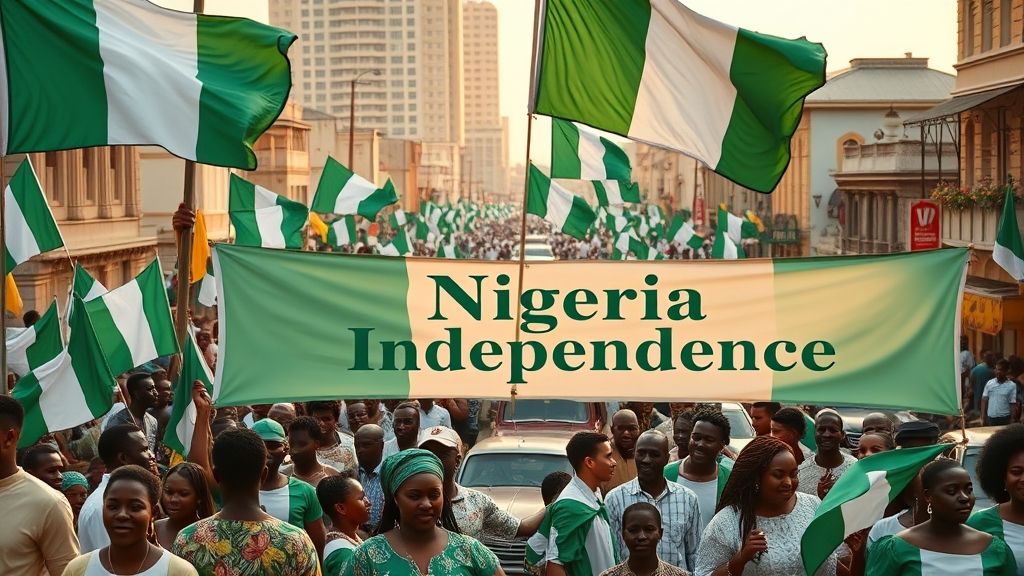
On a brilliant equatorial morning, the air in Lagos pulsated with an unusual electricity. Streets once heavy with the sighs of colonial rule erupted in vibrant colors, voices united in song and proclamation. It was October 1, 1960 — the day Nigeria, a sprawling mosaic of cultures, ethnicities, and histories, stepped from the shadows of the British Empire into the uncertain but exhilarating dawn of independence. The Union Jack was lowered, replaced with the green-white-green of a flag that would come to embody hope, resilience, and unity.
The atmosphere was electric, charged with expectation and anxiety. Thousands gathered at Tafawa Balewa Square, eyes fixed on the towering figure of Sir Abubakar Tafawa Balewa, the nation’s first Prime Minister, who stood poised to utter words that had long been anticipated: Nigeria’s birth as a self-governing state after decades of colonial subjugation. Yet, even in this moment of jubilation, a deeper complexity tugged at the newfound joy—how would a nation of over 250 ethnic groups, with histories often at odds, navigate the path ahead?
Colonial Shadows: Nigeria under British Rule
To truly grasp the magnitude of Nigeria’s independence, one must first understand the weight of its colonial past. From the late 19th century, the British Empire had cast its net wide over West Africa, carving Nigeria from diverse kingdoms, emirates, and tribal lands. Its name—derived from the great Niger River flowing through it—masked the brutal intricacies of colonial rule.
The British administration operated through indirect rule, a system that sought to govern vast territories by co-opting indigenous rulers, especially in the Muslim-dominated north. Yet, this policy inevitably deepened divisions between the predominantly Muslim north and the Christian and animist south. British economic interests also shaped policies that prioritized resource extraction over development, leaving Nigeria’s infrastructure and education underdeveloped in many regions.
Decades of exploitation, racial discrimination, and political marginalization sowed seeds of discontent. The colonial landscape was one of stark contrasts: railways and ports built to serve commerce, juxtaposed with impoverished rural communities and emerging urban working classes yearning for dignity and voice.
The Winds of Change: Nationalism and Political Awakening
The early 20th century witnessed the slow but sure rise of Nigerian nationalism. A new generation of leaders, educated both at home and abroad, began to question the legitimacy of foreign rule. Influenced by ideas of self-determination sparked by World War I and II, they formed political parties, unions, and intellectual societies.
The Nigerian Youth Movement (NYM), founded in the 1930s, was among the first to challenge colonial authority openly. Newspapers, literature, and sermons became powerful tools rallying Nigerians to the cause of freedom. The segmented geography of Nigeria presented both a hurdle and a catalyst, as different regions grappled with what independence would mean for their unique identities.
The 1940s and 1950s saw the emergence of political giants—Nnamdi Azikiwe in the east, Obafemi Awolowo in the west, and Ahmadu Bello in the north—each articulating visions of a post-colonial Nigeria that would respect the interests of their regions while striving for national unity.
Ethnic Tensions and Federal Realities
Nigeria’s ethno-linguistic diversity is staggering. Hausa-Fulani in the north, Yoruba in the southwest, Igbo in the southeast, along with hundreds of other groups, complicated nation-building efforts. Colonial policies had entrenched these identities and fostered competition for political and economic power.
The constitutional reforms of the 1950s, especially the Lyttleton Constitution of 1954, established a federal system aimed at balancing regional autonomy with central governance. It granted significant powers to the regions—recognized as distinct “nations” within Nigeria—while paving the way to full self-rule.
Yet, this federation was fragile. Ethnic rivalries often intensified under the spotlight of political representation and resource control, foreshadowing tensions that would later challenge Nigeria’s unity. The independence celebrations masked a simmering anxiety about how this diverse country could remain united post-colonialism.
Icons of Independence: Nnamdi Azikiwe, Obafemi Awolowo, and Ahmadu Bello
It is impossible to narrate Nigeria’s independence without evoking its towering leaders. Nnamdi Azikiwe—“Zik”—combined charisma with intellectual rigor. A journalist, scholar, and passionate advocate for pan-Africanism, Azikiwe became Nigeria’s first Governor-General, the symbolic head of state.
Obafemi Awolowo, the fiery Yoruba leader, championed education and welfare, pioneering free primary education in the west and advocating federalism. His oratory and political savvy earned him a revered place in Nigerian history.
Ahmadu Bello, the Sardauna of Sokoto, represented the interests of the north. A skilled administrator and traditional ruler, he worked to modernize the region while safeguarding its Islamic heritage.
Together, these leaders negotiated the complex dance of power-sharing and compromise necessary to transition from colonial rule to independence, each embodying the hopes and fears of their regions.
The Road to Self-Governance: Constitutional Developments
Nigeria’s march toward independence was neither instant nor without friction. The post-WWII era saw Britain gradually introduce constitutional reforms enabling Nigerian participation in governance. The Richards Constitution (1946), Macpherson Constitution (1951), and eventually the Lyttleton Constitution progressively decentralized power.
The 1959 Independence Conference in London was crucial, bringing together Nigerian leaders to finalize terms. Britain’s willingness to grant independence was partly driven by geopolitical shifts and domestic pressures but required Nigerian elites to demonstrate readiness to govern.
A parliamentary system mirroring the British model was adopted, with Sir Abubakar Tafawa Balewa as the first Prime Minister and Nnamdi Azikiwe as Governor-General. The new constitution enshrined federalism, minority rights, and the rule of law—ideals that Nigerian politicians hoped would bind the nation.
Lagos: From Colonial Capital to Symbol of Freedom
Lagos—a bustling port city, a hub of commerce, and a melting pot of Nigeria’s diverse peoples—was the heart of independence celebrations. For decades under colonial rule, it was a city of contradictions: modern skyscrapers casting long shadows over colonial barracks and indigenous markets.
On October 1, 1960, Lagos transformed into a stage for the new Nigeria. The annual Durbar Festival traditionally celebrated in the north found new meaning in the city’s independence parade. The air vibrated with drumbeats, chants, and the patriotic singing of “Arise O Compatriots.”
The city’s streets overflowed with citizens waving flags, children draped in traditional attire, and dignitaries from across Africa and the world. Lagos was not only the political capital but a symbol of Nigeria’s hopes and challenges—a crossroads where ancient traditions met modern aspirations.
The Independence Ceremony: A Nation’s Moment in Time
The ceremony itself was a spectacle, carefully choreographed yet deeply emotional. British Governor-General Sir James Robertson formally handed over power to Nnamdi Azikiwe. Prime Minister Balewa, standing tall in a crisp white agbada, addressed the crowd with words soaked in solemnity and hope:
“We proclaim before the world that Nigeria is no longer a colony but a sovereign and independent nation. We are entrusted now with a great responsibility—to build a united, free, and prosperous Nigeria.”
The singing of the national anthem, the raising of the flag, and the playing of the national pledge echoed across the square. Yet many watching knew this moment was not an endpoint but rather a beginning filled with enormous challenges.
The Role of the Commonwealth in Nigeria’s Transition
Nigeria’s independence was not a parting of ways but a redefinition of relationships. Joining the Commonwealth of Nations allowed Nigeria to maintain diplomatic and economic ties with Britain and other former colonies.
The Commonwealth provided a platform for newly independent countries to collaborate and navigate post-colonial realities. Nigeria participated actively, balancing its desire for autonomy with pragmatic alliances. This approach helped Nigeria secure financial aid, technical expertise, and political legitimacy on the global stage.
However, this connection also meant that Nigeria’s independence was watched closely by both supporters and skeptics, especially as Cold War tensions refracted across African liberation movements.
Celebrations Across the Nation: Joy and Hope
Across Nigeria, celebrations were jubilant and widespread. From the northeastern city of Kano to the western metropolis of Ibadan, people danced, feasted, and offered prayers. Traditional leaders held elaborate festivals, while urban centers hosted modern concerts and speeches.
Yet, beyond exuberant singing, the mood carried a quiet determination. Independence was more than a party; it was a call to action. Schools, markets, villages, and offices buzzed with conversations about how to build the future and overcome decades of neglect.
This collective spirit of hope transcended language, religion, and region, even as underlying tensions quietly persisted.
Hurdles Ahead: Economic Challenges of a New State
Nigeria’s independence brought immense responsibility but also daunting economic realities. The country was heavily reliant on agricultural exports—cocoa, groundnuts, palm oil—with limited industrial infrastructure.
The colonial economy was extractive rather than developmental; roads and railways poorly connected many regions, and income disparity was rife. Additionally, the global commodity prices fluctuated unpredictably, threatening government revenues.
Providing education, healthcare, and employment to a rapidly growing population required massive investments. The new government faced competing priorities: balancing regional development with national unity, addressing rural poverty, and encouraging modernization—all with limited funds.
Political Struggles in the Early Years of Independence
The euphoria of October 1960 began to fade as political realities asserted themselves. Nigeria’s federal system proved contentious, with regional governments often at odds. Ethnic rivalries intensified within political parties, and corruption started to erode public trust.
The first elections held in the 1960s reinforced regional power bases but failed to fully integrate the nation’s diverse groups. The western region was particularly unstable, with political crises leading to state interventions.
These struggles pointed to the fragile nature of Nigerian democracy and set the stage for the military coups that would erupt less than a decade later.
The Legacy of Colonial Borders and Ethnic Divisions
The borders drawn by colonial powers had ignored ethnic and cultural realities, bundling diverse peoples under one flag. Though independence removed foreign control, the colonial legacy of division remained an inescapable reality.
Conflicts between the north, west, and east often revolved around issues of representation, resource control, and cultural dominance. Minority groups also struggled with marginalization.
This patchwork of identities required a delicate balancing act—one that Nigerian leaders continually grappled with, sometimes successfully, sometimes tragically.
Nigeria on the World Stage: International Reactions
Nigeria’s independence was celebrated globally as a victory for the wave of decolonization sweeping Africa. Newly liberated nations looked to Nigeria as a model for peaceful transition.
World powers, including the United States and Soviet Union, viewed Nigeria as a strategically important African player during the Cold War. The country’s vast population and resources made it a prize in geopolitical contests.
Nigeria’s subsequent leadership in the Organization of African Unity (OAU) and Non-Aligned Movement reinforced its role in shaping continental and global policies.
Cultural Renaissance: Identity and Expression after Independence
Independence ignited a cultural renaissance. Nigerian artists, writers, and musicians drew inspiration from the newfound freedom. Figures like Chinua Achebe emerged, whose novel Things Fall Apart voiced complex narratives of colonial impact and indigenous resilience.
Music genres like highlife and juju thrived, blending traditional and western influences. Theatre and film also blossomed as avenues to explore identity and modernity.
The arts became a canvas upon which Nigerians painted their pride, struggles, and dreams, offering the world a glimpse into a dynamic society in flux.
The Youth and Education: Building a New Generation
Nigeria’s leaders understood that the future rested with its youth. Massive efforts went into expanding education, from primary schools to universities. The University of Ibadan and Ahmadu Bello University became centers of excellence.
Youth organizations flourished, promoting civic engagement and leadership. Yet disparities endured: northern Nigeria lagged behind in literacy rates, highlighting regional inequalities.
Nevertheless, the drive to educate a new generation symbolized Nigeria’s commitment to self-determination and national progress.
The Military and Civilian Relations: Seeds of Future Conflicts
While Nigeria began as a parliamentary democracy, the relationship between the military and civilian government was complex. The military, trained and equipped by the British, was expected to be apolitical.
However, rising ethnic tensions and political instability saw the rise of military assertiveness. Fears of corruption and mismanagement led sectors of the armed forces to justify eventual intervention.
The roots of the 1966 military coups—events that would profoundly alter Nigeria’s trajectory—were being sown during these fragile early years.
Women’s Role in the Independence Movement and Beyond
Women played vital, though often under-recognized, roles in Nigeria’s push for independence. Figures like Funmilayo Ransome-Kuti mobilized mass protests, challenged colonial policies, and advocated for women’s rights.
Post-independence, women’s organizations sought greater participation in governance and education. Yet patriarchal structures remained strong, limiting female political representation.
Their contributions set the stage for ongoing gender struggles and the fight for equality in Nigeria’s evolving society.
The British Withdrawal: Economic and Administrative Implications
The British disengagement was not simply symbolic but had practical implications. Colonial officials and administrators, often the backbone of effective governance, began withdrawing, creating administrative gaps.
Economically, the colonial system’s closure raised concerns about trade continuity and investment. Nigeria had to rapidly develop indigenous capacities to manage its affairs.
This transition was bumpy but essential in forging Nigeria’s sovereignty beyond ceremonial independence.
Memory and Myth: How Independence is Remembered
Nigeria’s independence remains a foundational narrative of national identity, celebrated annually with patriotic ceremonies and public holidays. Yet, collective memory is multi-layered.
To many, independence symbolizes liberation and hope; to others, it reflects the beginning of complex challenges—civil war, coups, and divisions. Historical debates about what independence truly meant continue to shape politics and culture.
Monuments and museums in Lagos and Abuja seek to preserve this history, reminding new generations of the sacrifices and aspirations of their forebears.
Nigeria’s Independence Today: Reflection and Continuity
More than six decades after October 1, 1960, Nigeria stands as a powerhouse of Africa, yet still grapples with many of the unresolved issues from its beginnings. Democracy, economic diversification, ethnic harmony, and social justice remain central concerns.
The spirit of independence continues to inspire activists, artists, and citizens who envision a Nigeria that fulfills the dreams envisioned on that radiant day in 1960. It is a testament to a nation that chose freedom amid uncertainty and continues to write its story.
Conclusion
Nigeria’s march to independence was an epic tale of courage, contradiction, and hope. On that memorable day in 1960, a country fractured by colonial ruses found itself united under a single flag, faced with the immense task of forging a national identity. The achievements of independence are monumental—overthrowing centuries of foreign dominance, mobilizing diverse peoples, and envisioning self-rule.
Yet independence was not merely a final chapter but a new beginning, replete with complexities that still echo today. The leaders who shaped this history—both celebrated and contested—reflected the nation’s mosaic, and their legacy remains alive in Nigeria’s ongoing struggle for unity, justice, and progress.
Remembering Nigeria’s independence is to honor a past filled with resilience, to acknowledge current challenges, and to believe in the promise of a country whose capacity to reinvent itself is boundless.
FAQs
Q1: What were the main factors that led to Nigeria’s independence in 1960?
A1: Nigeria’s independence was driven by growing nationalist movements spurred by educated elites, the weakening of the British Empire after World War II, increasing political activism across ethnic groups, and Britain’s strategic decision to decolonize peacefully amid changing global attitudes.
Q2: Who were the key leaders involved in Nigeria’s independence?
A2: The central figures included Nnamdi Azikiwe, Nigeria’s first Governor-General; Sir Abubakar Tafawa Balewa, the first Prime Minister; Obafemi Awolowo, a key regional leader; and Ahmadu Bello, the influential northern leader.
Q3: How did ethnic diversity impact Nigeria’s transition to independence?
A3: Nigeria's vast ethnic diversity created challenges in political representation and governance, leading to federal structures aimed at balancing regional autonomy but also sowing tensions that complicated national unity.
Q4: What role did Lagos play in the independence celebrations?
A4: Lagos, as the colonial capital and economic hub, was the focal point of independence ceremonies, hosting large public gatherings, official handovers of power, and festive events symbolizing Nigeria’s break from colonial rule.
Q5: What were some of the significant challenges Nigeria faced immediately after independence?
A5: Nigeria grappled with economic dependence on agriculture, regional political rivalries, ethnic tensions, infrastructural deficits, educational disparities, and the task of building effective governance structures.
Q6: How did Nigeria’s independence influence the broader African decolonization movement?
A6: Nigeria’s peaceful transition served as a model and inspiration for other African nations seeking independence, reinforcing pan-African solidarity and the legitimacy of newly formed states on the global stage.
Q7: How is Nigerian independence commemorated today?
A7: Every October 1st, Nigeria observes Independence Day with national ceremonies, parades, cultural festivals, and reflections on the country’s history and aspirations.
Q8: Did colonial policies affect Nigeria’s political stability after independence?
A8: Yes, colonial policies such as indirect rule and arbitrary borders heightened ethnic divisions and left institutional weaknesses, contributing to political instability in the post-independence era.