Table of Contents
- The Dawn of a New Era: South Africa’s Leap into Republic Status
- From Union to Republic: The Historical Backdrop
- The Seeds of Division: Apartheid’s Deepening Roots
- The 1960 Referendum: A Nation Divided
- The Role of the National Party: Vision and Contestation
- Pretoria in May 1961: The Stage is Set
- The Midnight Hour: Proclamation of the Republic
- The Symbolic Shift: New Flags, New Citizenship, New Identity
- International Reactions: Isolation and Realignment
- The Commonwealth Exit: A Turning Point in Diplomacy
- The Impact on Black South Africans: Hope, Despair, and Resistance
- The Border and Beyond: Regional and Global Consequences
- Economic Ripples: How the Republic Shifted Trade and Industry
- Cultural Reflections: Art, Literature, and National Psyche Post-1961
- Legacy of the Republic: Apartheid’s Fortification or Fracture?
- The Republic in Retrospect: Historical Interpretations Over Time
- The Human Cost: Lives Caught in the Transitional Tide
- The Seeds of Rebellion: Early Resistance and International Solidarity
- The Republic’s Role in Shaping Post-Apartheid South Africa
- Conclusion: A Nation’s Identity in Flux
- FAQs: Understanding South Africa’s Republic Birth
- External Resource
- Internal Link
The Dawn of a New Era: South Africa’s Leap into Republic Status
On the night of May 30 to 31, 1961, under the cold starry skies of Pretoria, a quiet yet seismic transformation stretched across the heart of Southern Africa. The solemn voices in Parliament whispered not of compromise or reform, but of rupture — a deliberate pivot away from the British Crown and an eschewal of colonial legacies for an assertion of autonomous sovereignty. The Union of South Africa officially dissolved, and a new dawn broke with the birth of the Republic of South Africa, a nation reborn in ceremony, yet shackled by the growing chains of apartheid.
That midnight, the trappings of empire were ceremoniously swept aside; the Union Jack faded from official display, replaced by the new South African flag, symbols of identity and control newly minted. For many, this was a triumphant staking of a destiny self-forged; for others, a dark crucible was sealed — an intensification of racial segregation, repression, and international isolation.
History remembers May 31, 1961, not merely as a date but as a turning point steeped in hope, fear, ambition, and conflict—a chapter where modern South Africa made a decision that would echo through generations.
From Union to Republic: The Historical Backdrop
South Africa's journey to republic status was neither sudden nor accidental. It was a culmination of decades of political evolution, racial tensions, and nationalist ambitions. The Union of South Africa, formed in 1910 under the British Monarch, was initially an amalgamation of former Boer republics and British colonies—an uneasy marriage between English and Afrikaner nationalism.
The post-war years witnessed the rise of Afrikaner nationalism as a force that challenged British imperial influence. The scars of the Anglo-Boer War still fresh, many Afrikaners aspired for a South Africa free from British dominion, not just in symbolism but in governance. This dream was complicated by the diverse populations within the country: white minorities, black majorities, Coloured communities, and Indian populations, each with distinct political aspirations and grievances.
The interwar period and the aftermath of World War II inflamed these tensions, with the National Party rising in 1948 on a platform of apartheid, promising not only racial separation but an unequivocal break from Britain’s lingering oversight.
The Seeds of Division: Apartheid’s Deepening Roots
By the late 1950s, apartheid was no longer just a policy—it was the heartbeat of the republic it sought to create. The government institutionalized racial segregation with a cold legal precision: forced removals, pass laws, political disenfranchisement. Africans, often the largest demographic in many provinces, were consigned to second-class status, their rights suppressed and voices muted.
This social engineering intersected brutally with the republican debate. For the ruling National Party, creating a republic was a tool of symbolic and practical sovereignty, a banner under which to strengthen apartheid without imperial interference. But for non-white South Africans—and many white English-speaking South Africans—this transformation threatened to cement racial injustice further.
The stage was therefore set for a bitter and divisive future. As the republic drew near, so grew the fissures within the nation—a country hurtling towards intensified segregation even as it claimed political independence.
The 1960 Referendum: A Nation Divided
In October 1960, Prime Minister Hendrik Verwoerd held a whites-only referendum that would decide South Africa’s future. The question was straightforward: should South Africa become a republic outside the British Commonwealth?
The results revealed a deeply fractured society. About 52% voted in favor, with the Afrikaner community strongly supporting the move, while most English-speaking South Africans opposed it. The exclusion of the majority black population from voting—a stark apartheid reality—meant the referendum was not only a measure of political will but also an exposé of the democratic deficit underpinning the republic.
This narrow, exclusive mandate cleared the way for the constitutional change but sowed seeds of long-term internal and external contention. The international community began to question South Africa’s place in the emerging post-colonial world order.
The Role of the National Party: Vision and Contestation
The architects of the republic were figures like Hendrik Verwoerd, often called the “Architect of Apartheid,” whose vision of an all-white sovereign South Africa manifested in both constitutional change and social engineering. The National Party framed the republic as liberation from British colonialism, a chance to create a “volkstaat” (people’s state) where Afrikaner identity could flourish without external interference.
Yet, the party’s vision was far from universal. The United Party and other opposition forces argued that severing ties with Britain would isolate the country economically and diplomatically. Meanwhile, black resistance groups intensified their critiques, viewing the republic as a fortress for racial oppression.
The National Party, embodying the dominant white Afrikaner electorate, pressed on relentlessly, confident that political sovereignty could be wielded to enforce apartheid without British check or balance.
Pretoria in May 1961: The Stage is Set
Pretoria, South Africa’s administrative capital, became the solemn stage for the republic’s birth. In the weeks leading up to May 31, security was heightened; political rallies brimmed with Afrikaner nationalist fervor, banners and speeches emblazoned with calls for freedom from “imperial shackles.”
International journalists descending on the city sensed the tensions beneath the pageantry. While official ceremonies spoke of unity and progress, beneath the surface lay anxieties: fears among white English speakers, despair within the black majority, and anticipation of how the world might react.
The government’s desire to control the narrative was evident, but they knew the republic carried risks as much as promises.
The Midnight Hour: Proclamation of the Republic
At precisely midnight, as shadows danced on the cold stone walls of Parliament, the Union of South Africa ceased to exist. The Republic of South Africa was born, with Charles Robberts Swart, the Governor-General turned State President, sworn in as the first head of state—a symbolic replacement of the British monarch’s role.
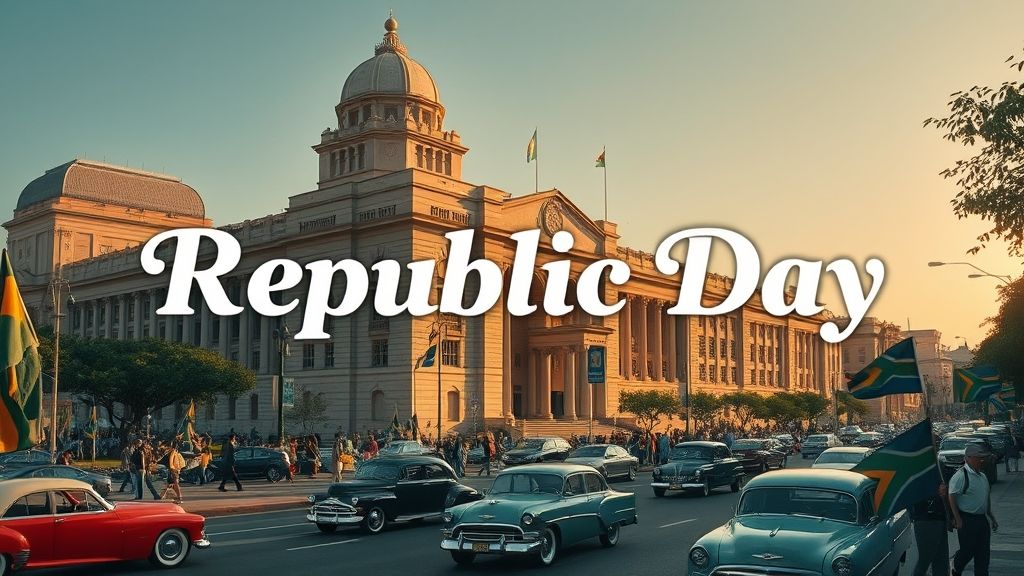
The ceremony was austere but significant. The old Union Jack was lowered solemnly, replaced by the orange-white-blue flag symbolizing Afrikaner heritage. Bells tolled, gun salutes echoed across the capital, and a new South African anthem cemented the moment.
Yet, celebrations remained muted for those excluded by the new political order. The republic, for many, was less a birth than a re-entrenchment of systemic exclusion.
The Symbolic Shift: New Flags, New Citizenship, New Identity
The creation of the republic was as much about symbols as substance. A new national flag replaced the Union Jack. The “Die Stem van Suid-Afrika” (The Call of South Africa) was elevated as a national anthem, supplanting “God Save the Queen.” Citizenship was asserted independently from British oversight, rewriting the legal and cultural bonds that had linked South Africa to the Crown.
But these symbols carried a dual legacy. For the ruling Afrikaners, they represented pride and autonomy; for the disenfranchised majority, they became stark reminders of exclusion and oppression. Identity, in this republic, was now inextricable from the politics of race and power.
International Reactions: Isolation and Realignment
The world’s response to South Africa’s republicanism was immediate and complex. Western powers balanced diplomatic caution with criticism as the apartheid state tightened.
Most notably, South Africa’s application to remain within the British Commonwealth as a republic was denied, following protests from Asian and African member states who condemned apartheid. This rejection heralded South Africa’s growing international isolation.
Countries in Africa and Asia, many newly independent, saw South Africa’s republican move as a regression, a defiance of anti-colonial solidarity. Economic sanctions debates began to take shape, and South Africa’s governments turned increasingly inward and defensive.
The Commonwealth Exit: A Turning Point in Diplomacy
South Africa's departure from the Commonwealth on May 31, 1961, was not merely a political statement but a pivotal shift in its global status. No longer a member of a community of former British colonies striving for cooperation, South Africa found itself alone, alienated for its apartheid policies.
The exit deepened the country’s diplomatic and economic challenges, limiting access to beneficial trade agreements and international goodwill. It also made South Africa a pariah on the world stage, setting the tone for decades of boycott and protest from governments and civil societies alike.
The Impact on Black South Africans: Hope, Despair, and Resistance
For the vast majority of black South Africans, the republic’s birth was not cause for celebration. It reaffirmed their exclusion from political participation and reinforced the legal framework that relegated them to the margins of society.
Yet, amidst despair, resistance grew. Underground movements, such as the African National Congress (ANC) and Pan Africanist Congress (PAC), saw the republic as the entrenchment of the very system they sought to overturn. The Sharpeville Massacre of 1960 was a painful prelude to the republic, a brutal reminder of the lengths to which the state would go to preserve apartheid.
The republic hardened racial lines but also galvanized internal opposition, sowing the seeds for future liberation struggles.
The Border and Beyond: Regional and Global Consequences
South Africa’s new political status rippled far beyond its borders. Its neighbours—Botswana, Lesotho, Swaziland, and newly independent African states—watched with concern as Pretoria’s policies threatened regional stability.
South Africa’s borders became flashpoints of conflict, with cross-border raids, exile movements, and Cold War strategic considerations all intertwined in the growing complexity of southern African geopolitics.
Internationally, the republic’s policies sparked debates in the United Nations and fueled increasing support for sanctions and anti-apartheid campaigns, turning South Africa into a key battleground of post-colonial ideological struggles.
Economic Ripples: How the Republic Shifted Trade and Industry
The establishment of the republic brought economic shifts as South Africa sought to reduce reliance on traditional trade partners like Britain. The government invested heavily in mining, manufacturing, and agriculture, determined to sustain economic growth amidst rising international pressure.
However, apartheid’s social policies also hampered potential by creating workforce inequalities and inciting labor unrest. Sanction threats and actual limitations posed challenges, forcing Pretoria to navigate a complex matrix of self-sufficiency and cautious engagement in global markets.
Cultural Reflections: Art, Literature, and National Psyche Post-1961
The creation of the republic stirred the creative realms of South Africa. Artists, writers, and intellectuals grappled with themes of identity, exclusion, and defiance.
Afrikaner cultural institutions sought to celebrate the republic’s values, while black South African writers such as Alan Paton and playwrights like Athol Fugard illuminated the human cost of apartheid.
In poems, novels, and plays, the republic became both setting and subject—a fractured landscape where national pride and protest intertwined.
Legacy of the Republic: Apartheid’s Fortification or Fracture?
Was South Africa’s republic the crown jewel of apartheid’s fortress or the beginning of its eventual fracture? History suggests both.
The republic hardened racial divisions and extended apartheid’s endurance for decades. Yet, it also crystallized opposition and set the stage for global condemnation and internal rebellion.
Its legacy is thus paradoxical—a symbol of rigid exclusion and a spark for eventual transformation.
The Republic in Retrospect: Historical Interpretations Over Time
As decades unfolded, historians reflected widely on the republic’s meaning. Early narratives tended to celebrate the republic as a political achievement. Later, more critical histories emphasized its role in entrenching apartheid and delaying justice.
Post-apartheid scholarship presents it as a complex turning point, one that must be examined through lenses of power, identity, and resistance.
The Human Cost: Lives Caught in the Transitional Tide
Beneath political maneuvering lay real human stories—families displaced under segregation, activists jailed or exiled, ordinary citizens navigating a world increasingly fragmented.
The republic was not just a constitutional change; it was a source of suffering and resilience, shaping personal narratives of hope, loss, and courage.
The Seeds of Rebellion: Early Resistance and International Solidarity
The republican dawn fueled movements both inside and outside South Africa. The ANC’s armed struggle gained momentum, the global anti-apartheid movement powered by international solidarity expanded.
May 31, 1961, was a call to arms for many, a moment when the world’s spotlight fixed on the injustices beneath the surface.
The Republic’s Role in Shaping Post-Apartheid South Africa
Ultimately, the birth of the republic in 1961 set in motion dynamics that would influence South Africa’s long path to democracy. Its rigid structures created conditions for profound questioning and eventual dismantling.
The republic’s legacy informs contemporary debates on national identity, reconciliation, and justice in the “Rainbow Nation.”
Conclusion
The transformation of South Africa on May 31, 1961, from a Union under British rule to a republic was more than a constitutional shift—it was a seismic moment of political assertion entwined with profound social injustice. Standing at the crossroads of empire and nationhood, of division and identity, that midnight in Pretoria marked the birth of a republic forged through exclusion and ambition, yet resonating with the cries of those relegated to the dark margins.
The republic embodied Afrikaner nationalism’s ascendancy and apartheid’s deepening entrenchment. It catalyzed international isolation and internal resistance, creating a paradox of sovereignty mingled with oppression. The legacy of that night remains a somber reminder of how the politics of identity and power shape not just nations, but the lives within them.
History remembers May 31, 1961, not as an endpoint, but as the beginning of a turbulent journey—a narrative of division and, ultimately, of hope for a future beyond the shadows cast by the republic’s birth.
FAQs
Q1: Why did South Africa decide to become a republic in 1961?
A1: The move to a republic represented Afrikaner nationalist aspirations to assert full sovereignty free from British influence, enabling the government to consolidate apartheid policies without external interference.
Q2: What was the significance of the 1960 referendum?
A2: The whites-only referendum determined South Africa’s transition to a republic with slim majority support, revealing deep divisions between Afrikaans and English speakers and excluding the majority black population entirely.
Q3: How did the international community react to South Africa becoming a republic?
A3: Many countries, especially newly decolonized African and Asian states, condemned the move due to apartheid, leading to South Africa’s exit from the Commonwealth and increasing international isolation.
Q4: What were the immediate effects on South Africa’s black population?
A4: The republic entrenched apartheid laws, exacerbating political disenfranchisement and social oppression, but also invigorated resistance movements like the ANC and PAC.
Q5: How did the republic affect South Africa’s economy?
A5: South Africa pursued economic self-sufficiency and industrial growth, though apartheid policies limited labor potential, and international sanctions and boycotts posed challenges.
Q6: Did the republic contribute to South Africa’s eventual democracy?
A6: Paradoxically, while the republic fortified apartheid, it also galvanized both internal resistance and global anti-apartheid solidarity that would be crucial for the transition to democracy decades later.
Q7: Who was Charles Robberts Swart?
A7: Charles Robberts Swart was the last Governor-General of the Union and became the first State President of the Republic of South Africa, symbolizing the shift from British monarchy to republic.
Q8: What symbols changed with the creation of the republic?
A8: The Union Jack was replaced by a new flag distinctively Afrikaner, and “Die Stem van Suid-Afrika” became the national anthem, symbolizing a shift in political and cultural identity.