Table of Contents
- The Dawn of Division: August 13, 1961, East Berlin’s Fateful Morning
- The Shadow of the Iron Curtain: Post-War Germany and the Cold War Context
- The Rise of Tensions: From Refugees to Political Standoff
- The East German Government’s Dilemma: Stability or Suppression?
- Behind Closed Doors: Soviet Influences and Khrushchev’s Calculations
- Midnight Orders: The Secret Deployment of Border Troops
- Dawn of the Wall: The Physical Erection Begins
- Families Torn Apart: The Human Face of a Concrete Barrier
- The World Reacts: Shock, Silence, and Strategic Posturing
- Checkpoints and Control: How the Wall Regulated Everyday Life
- East-Berliners’ Resistance and Ingenuity in the Shadow of the Wall
- Western Allies’ Responses: Propaganda, Patience, and Power Plays
- The Wall’s Expansion: From Barbed Wire to Concrete Fortress
- Psychological Borders: The Wall as a Symbol of Cold War Anxiety
- Life under Surveillance: The GDR’s Security Apparatus Takes Hold
- Escape Attempts and Tragedies: Stories of Courage and Despair
- The Wall’s Impact on German Identity and Memory
- Global Repercussions: The Berlin Wall in International Diplomacy
- The Iron Curtain's Legacy: From Division to Reunification
- Conclusion: A Monument to Division, A Testament to Human Will
- FAQs About the Berlin Wall Construction
- External Resource
- Internal Link
1. The Dawn of Division: August 13, 1961, East Berlin’s Fateful Morning
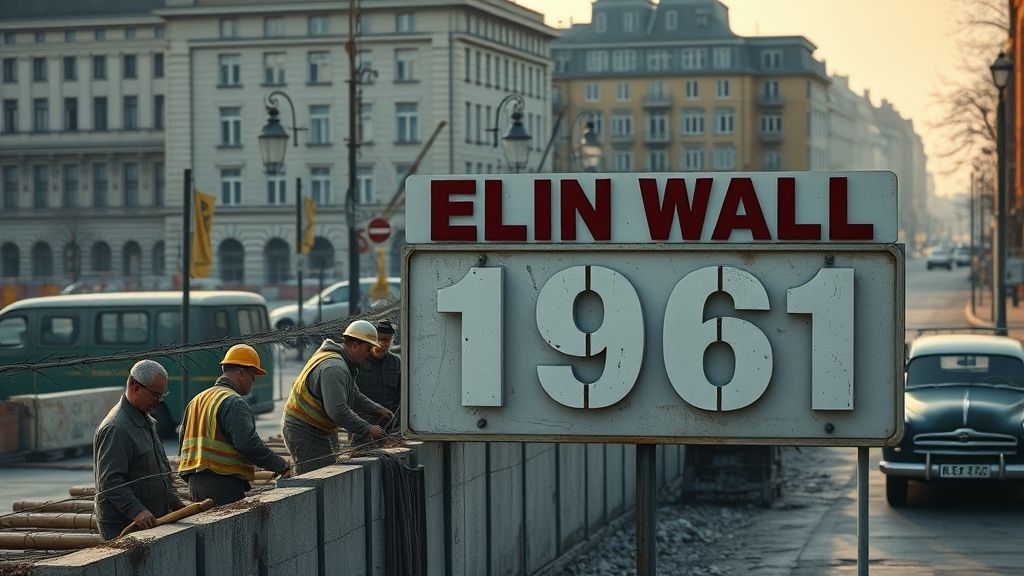
In the gray, mist-clad dawn of August 13, 1961, an extraordinary silence settled over East Berlin. At first, the city’s inhabitants sensed little more than an unusual bustle – whispered commands, vehicles rolling silently through the streets, young soldiers moving with hurried purpose. But soon, daybreak revealed a sight that would shatter millions of lives and become an enduring symbol of Cold War division: barbed wire fences appeared along the border between East and West Berlin. The construction of the Berlin Wall had begun.
Families woke to find their neighborhoods sliced by razor-sharp wire. Workers, students, and strangers noticed checkpoints erected overnight, severing the arteries of a city once intertwined in seamless urban and social fabric. This was no simple border reinforcement — it was the physical manifestation of an ideological confrontation that had been brewing since 1945, now crystallizing in concrete and steel. The Wall was not just a barrier; it was a declaration of a world divided.
2. The Shadow of the Iron Curtain: Post-War Germany and the Cold War Context
World War II’s cataclysmic end had left Germany in ruins, its capital a ghostly battleground split into occupation zones controlled by the victors: the United States, Britain, France, and the Soviet Union. Berlin, though deep inside Soviet-controlled East Germany, was similarly partitioned among the four powers. What was meant as a transitional arrangement quickly hardened into Cold War reality. The Soviet Union and the Western Allies, once partners in victory, became rivals in a global contest shaped by ideology, power, and mutual suspicion.
The famous Iron Curtain—a phrase coined by Winston Churchill—descended across Europe, splitting East from West, freedom from authoritarianism. Germany became the frontline of this confrontation. Democratic West Germany flourished materially under Marshall Plan aid, while East Germany, formally the German Democratic Republic (GDR), struggled with Stalinist control and economic hardship. East Germans increasingly sought to escape westward, altering the very demographic and political balance Berlin now represented.
3. The Rise of Tensions: From Refugees to Political Standoff
By 1961, the GDR was hemorrhaging population. Thousands were crossing daily through Berlin’s open border areas, fleeing repression and lack of opportunity. For East Germany, this exodus was catastrophic — the loss of skilled laborers and professionals threatened the viability of the state. For the West, Berlin remained a beacon of freedom, a cause célèbre for propaganda and diplomacy.
The East German leadership pleaded with Moscow to close the loophole Berlin represented. But sealing the border entirely—something only the Soviets could sanction—meant breaking agreements that gave the Western powers access and rights in the city. This delicate balance was about to be shattered. Tensions escalated in back-room negotiations, secret meetings, and phone calls between Nikita Khrushchev and the Western allies. The fear of direct military confrontation mixed with readiness for political brinkmanship.
4. The East German Government’s Dilemma: Stability or Suppression?
Walter Ulbricht, First Secretary of the Socialist Unity Party (SED) and leader of East Germany, faced a brutal choice. His government needed to stop the loss of citizens or risk collapse. But implementing stringent border controls would risk inciting rebellion or even Western intervention.
Ulbricht’s famous, chilling declaration months before the barrier’s rise—“Niemand hat die Absicht, eine Mauer zu errichten!” (“No one has the intention to build a wall!”)—was an ironic prelude to the very act that would define his regime. Behind raised hands of reassurance were months of secret preparations and orders for a rapid operation to stop the flow.
5. Behind Closed Doors: Soviet Influences and Khrushchev’s Calculations
For the Soviet leadership, the Berlin crisis was a test of superpower resolve. Khrushchev viewed Berlin as a bargaining chip in the wider Cold War chessboard. By sealing off East Germany, the Kremlin aimed to stabilize its satellite, bolster the socialist bloc, and force the West into negotiating the final status of the city—and, by extension, Germany.
But Khrushchev was acutely aware of the risks: a misstep could provoke a military response from NATO or escalate into nuclear confrontation. The decision involved balancing assertiveness against restraint, a complex geopolitical dance behind closed doors that culminated in the green light for Ulbricht’s plans.
6. Midnight Orders: The Secret Deployment of Border Troops
In the early hours of August 13, 1961, the order came down. Thousands of East German police and construction workers moved quietly but swiftly. Armed soldiers sealed off streets and alleyways, buildings near the border were evacuated or locked. Berliners awoke to razor wire fencing unfurling across their neighborhoods, separating friends and families before anyone fully comprehended the extent of the measures.
Street by street, block by block, barbed wire transformed into concrete walls, watchtowers, and guard posts. The operation was swift and efficient—designed to prevent a chaotic mass exodus, to close the border with minimal immediate bloodshed.
7. Dawn of the Wall: The Physical Erection Begins
Barbed wire was soon reinforced by concrete slabs, creating a barrier some twelve feet high. The initial roughness concealed a meticulous plan: the construction of a "Wall" that would eventually stretch over 155 kilometers encompassing West Berlin, fortified with armed patrols, minefields, and anti-vehicle trenches.
The iconic image took shape—grey, oppressive, unyielding. It was a concrete scar drawn across the city’s heart. For many in the West, the wall was a brutal symbol of captivity; for many in the East, a reminder of sacrifice for “socialist progress,” as official propaganda would claim.
8. Families Torn Apart: The Human Face of a Concrete Barrier
Perhaps the most heartrending consequence was the immediate fracturing of personal lives. Parents were separated from children, spouses cut off from each other. Streets where neighbors had mingled for decades became suddenly inaccessible. Stories emerged of frantic farewells, desperate escape attempts, and heartbreak—a grim testament to the human cost of geopolitical conflict.
One such story is that of Erika and Heinz, a couple who found themselves on opposite sides overnight. Erika, trapped in East Berlin, risked everything to throw small notes across gaps in the barrier, a thread of love and hope against the cold indifference of concrete.
9. The World Reacts: Shock, Silence, and Strategic Posturing
Global reaction ranged from outrage to cautious pragmatism. The United States condemned the act but avoided military intervention, fearing escalation. John F. Kennedy, newly elected president, reassured West Berliners of America’s commitment, famously stating “Ich bin ein Berliner” in 1963—a declaration that became synonymous with Western solidarity.
Meanwhile, the Soviet Bloc heralded the Wall as a necessary protective measure, a “shield” against Western aggression and espionage. The international community came to recognize the Wall as the intractable line dividing East and West for decades to come.
10. Checkpoints and Control: How the Wall Regulated Everyday Life
The Wall wasn’t simply a continuous stretch of concrete, but a system incorporating checkpoints, tunnels, and Grenze—the border patrol suppression forces. The famous Checkpoint Charlie became the scene of tense stand-offs between U.S. and Soviet tanks in October 1961, highlighting the ever-present danger lurking beneath everyday life.
East Berliners could no longer cross freely. Licenses for border crossing became rare and strictly controlled. The Wall was both physical and bureaucratic, tightly regulating a population’s every movement.
11. East-Berliners’ Resistance and Ingenuity in the Shadow of the Wall
Despite the harsh controls, East Berliners displayed remarkable resilience and creativity. From secret tunnels dug under the Wall to inventive disguises and daring leaps in hot-air balloons or makeshift zip lines, the human spirit challenged the barrier relentlessly.
Workers smuggled letters and goods, families found surreptitious ways to communicate, and an entire underground culture of opposition began to brew—proof that even the toughest walls cannot entirely suppress freedom’s yearning.
12. Western Allies’ Responses: Propaganda, Patience, and Power Plays
The Western powers balanced condemnation with realpolitik. Berlin was a flashpoint where nuclear war seemed possible, yet they pursued extended diplomatic efforts to avoid catastrophe. Radio Free Europe and other broadcasts became tools of psychological warfare, conveying hope and resistance to those trapped behind the Wall.
Economic aid and cultural support for West Berlin strengthened it as a showcase of democracy and economic success, a constant rebuke to the communist regime’s legitimacy.
13. The Wall’s Expansion: From Barbed Wire to Concrete Fortress
Over the years, the Wall evolved from its initial rough barriers into a formidable fortification. Wire fences were replaced by ten-foot-high concrete slabs topped with smooth pipe to prevent climbing. Watchtowers packed with armed guards surveilled every inch. A death strip cleared wide in front of the Wall gave border guards clear lines of sight.
The Wall became a monstrous monument to separation, a prison for millions, and a stark reminder of ideological conflict’s enduring consequences.
14. Psychological Borders: The Wall as a Symbol of Cold War Anxiety
More than a physical barrier, the Berlin Wall symbolized a fractured world order. It was a monument to fear, insecurity, and mistrust—an injury to the collective psyche of a generation. For millions across the globe, it embodied the struggle between freedom and oppression, democracy and autocracy, hope and despair.
Poets, artists, and politicians invoked the image of the Wall repeatedly, making it one of the most potent symbols of the 20th century.
15. Life under Surveillance: The GDR’s Security Apparatus Takes Hold
The Wall’s creation came hand in hand with the expansion of the Stasi—the East German secret police. Life in East Berlin became a continuous watchfulness. Neighbors monitored neighbors; informants proliferated. The promise of socialist utopia clashed with the harsh reality of suspicion and repression.
Daily life, from work to schooling, was permeated by this climate, reinforcing the divide beyond bricks and mortar.
16. Escape Attempts and Tragedies: Stories of Courage and Despair
Despite the deadly risks, countless East Berliners sought to escape. Over the Wall’s 28-year existence, at least 140 people perished trying to cross. Each name is a story of courage, desperation, and ultimate sacrifice.
The tale of Peter Fechter, shot and left to bleed on the “death strip” in 1962, became a global cause célèbre, exposing the brutal nature of the regime. These stories humanized a conflict often reduced to ideology and strategy.
17. The Wall’s Impact on German Identity and Memory
The Wall fractured not only geography but identity. East and West Germans developed distinct cultures, memories, and narratives. After 1989, uncovering the Wall’s legacy involved confronting pain, complicity, and hope. The Berlin Wall remains a site of remembrance, reconciliation, and reflection on human rights and freedoms.
18. Global Repercussions: The Berlin Wall in International Diplomacy
Berlin was a bellwether for Cold War relations. The Wall influenced U.S.-Soviet negotiations, NATO policies, and even China’s view of superpowers. It was both a flashpoint and a cautionary tale, shaping diplomatic strategies and fears of global conflict for nearly three decades.
19. The Iron Curtain's Legacy: From Division to Reunification
The Wall stood until November 9, 1989, when peaceful revolutions swept across Eastern Europe. Its fall marked not only the end of a physical barrier but the collapse of the ideological divisions that had ruled the continent for almost half a century. Germany’s reunification was a triumph of human will over division and despair.
20. Conclusion: A Monument to Division, A Testament to Human Will
The construction of the Berlin Wall on August 13, 1961, was a moment of profound rupture and profound symbolism. It forked destinies, shaped lives, and cast a long shadow over the 20th century. Yet, amid harshness and division, it also revealed the resilience, courage, and unyielding aspiration of people yearning for freedom.
The Wall’s story is a lesson etched in concrete and memory: that while walls may imprison bodies, they cannot imprison hope.
Conclusion
The Berlin Wall’s construction was a seismic event that changed history in irrevocable ways. It was a physical and emotional scar borne by a city—and a world—caught in Cold War tensions. Yet, beyond its bricks and wire lies a deeper human story of division and yearning, repression and resistance. The Wall embodied the ideological conflicts of its time but also the incredible forces of grace and courage amid adversity. To study its rise is to understand not only the mechanics of political power but the profound human cost—and ultimately, the triumph of freedom’s enduring spirit.
FAQs About the Berlin Wall Construction
Q1: Why was the Berlin Wall built?
The Wall was built primarily to stop the massive flow of East Germans fleeing to the West via Berlin, which threatened the East German economy and political stability.
Q2: Who ordered the construction of the Berlin Wall?
The East German government, led by Walter Ulbricht, ordered the construction with approval and support from Soviet leader Nikita Khrushchev.
Q3: How did the world react to the Wall's construction?
Reactions varied between Western condemnation, Eastern justification as a protective measure, and cautious diplomatic responses aimed at avoiding armed conflict.
Q4: How did the Wall affect ordinary Berliners?
It divided families, limited freedom of movement, and subjected many to state surveillance and repression, altering every aspect of daily life.
Q5: Were there any successful escapes from East to West Berlin?
Yes, numerous escapes occurred through tunnels, over walls, and with creative means, though many also ended tragically.
Q6: What role did the Berlin Wall play in Cold War geopolitics?
It became a potent symbol and frontline in the ideological and political tensions between the Soviet Union and Western powers.
Q7: When did the Berlin Wall fall, and why?
The Wall fell on November 9, 1989, due to a combination of political reforms, popular pressure, and the weakening of Soviet control over Eastern Europe.
Q8: What legacy does the Berlin Wall leave today?
It serves as a reminder of the human cost of division, the importance of freedom, and the triumph of peaceful resistance over oppression.