Table of Contents
- The Dawn of a New Era: October 22, 1962
- Setting the Stage: The Cold War’s Boiling Cauldron
- Cuba’s Revolution and the U.S. Response
- Soviet Ambitions and the Secret Deployment
- Discovery from the Sky: U-2 Reconnaissance Missions
- The White House in Crisis: Kennedy’s Emergency Meetings
- Public Announcement: The Nation Hears Kennedy’s Address
- The Naval Blockade: Enforcing the “Quarantine”
- Diplomatic High Wire: Hawkish Voices and Reasoned Counsel
- The World Holds Its Breath: Global Reactions and Tensions
- Back-Channel Negotiations: Urgent Messages Across the Globe
- The Turning Point: Khrushchev’s Letters and Concessions
- Avoiding Catastrophe: The Secret Deal and Missile Removal
- The Aftermath in Washington and Moscow
- Reflections on Near-Annihilation: Lessons for Humanity
- The Enduring Impact on U.S.-Soviet Relations
- The Crisis in Popular Memory and Cultural Legacy
- Military Doctrines Revisited: From Brinkmanship to Deterrence
- The Role of Intelligence and Information Control
- Cuba’s Place in Cold War History Post-Crisis
- The Crisis’s Effect on Nuclear Policy and Disarmament Talks
- Personal Stories: The Human Side of the Crisis
- Historical Debates and Interpretations Over Time
- Conclusion: The Fragility of Peace in a Nuclear Age
- FAQs – Exploring the Cuban Missile Crisis
- External Resource
- Internal Link
1. The Dawn of a New Era: October 22, 1962
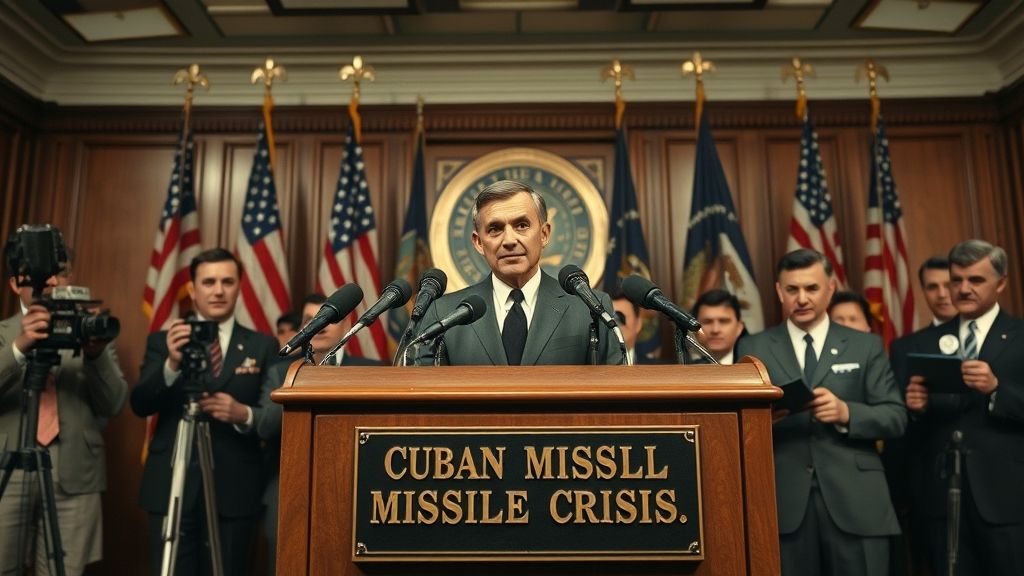
On the evening of October 22, 1962, in a packed room of the White House, the air was thick with tension as President John F. Kennedy prepared to address a nation oblivious to the perilive cliff it teetered on. The weight of secrecy lifted, exposing the frightening reality: Soviet nuclear missiles had been installed on Cuban soil, just 90 miles off the coast of Florida. The incandescent glow of television screens flickered across countless American living rooms, where millions listened to Kennedy’s calm yet resolute voice. He spoke of a peril that could engulf the world in “unthinkable catastrophe,” setting the stage for what would become the most harrowing 13 days of the 20th century.
This announcement was not merely a speech. It was a catalyst that transformed global politics, plunged two superpowers into a psychological duel, and sketched the outlines of modern nuclear diplomacy. The Cuban Missile Crisis was the closest brush humanity ever had with nuclear Armageddon. Yet in it lay rare human drama, profound mistakes, and heroic decisions that ultimately averted disaster.
2. Setting the Stage: The Cold War’s Boiling Cauldron
The tension between the United States and the Soviet Union had been simmering since the end of World War II, their uneasy alliance dissolved into mutual suspicion. The ideology of capitalism against communism fueled a global rivalry that raced into space, arms, and influence. By the early 1960s, the world was awash with nuclear weapons capable of obliterating entire cities instantaneously. The doctrine of Mutually Assured Destruction (MAD) kept both sides locked in stalemate, but also poised the world on a knife’s edge.
Against this backdrop, the tiny Caribbean island of Cuba, under the leadership of Fidel Castro, had shocked the western hemisphere by overthrowing a U.S.-backed dictatorship in 1959. This outcome rattled American policymakers, planting the seeds for confrontation. Cuba, allied with the USSR, became a pawn and then a critical chess piece in the grand game of Cold War geopolitics.
3. Cuba’s Revolution and the U.S. Response
Fidel Castro’s revolution was a lightning bolt, igniting hopes for many but triggering fears for American strategists. The Bay of Pigs invasion in April 1961, a failed U.S.-sponsored attempt to overthrow Castro, humiliated the Kennedy administration and emboldened Cuba’s leaders to deepen their Soviet ties. The island turned into a beacon of communist influence just next door to a superpower obsessed with containment.
Washington’s response grew increasingly aggressive, with covert operations and economic embargoes aimed at destabilizing the communist government. Cuba answered by fortifying its defenses, including secret agreements with Nikita Khrushchev’s Soviet Union to install medium and intermediate-range nuclear missiles to deter another American invasion.
4. Soviet Ambitions and the Secret Deployment
For Khrushchev, the deployment of missiles in Cuba was a strategic gambit designed to level the nuclear imbalance. The U.S. had stationed Jupiter missiles in Turkey, capable of striking the Soviet heartland; the Soviets sought a symmetrical threat. Moreover, the Cuban project was an ideological showpiece, illustrating the USSR’s determination to defend its communist ally in the Western Hemisphere.
Under the cover of darkness and extraordinary secrecy, Soviet ships loaded with missile components slipped into Havana’s port throughout 1962. Radar installations, missile sites, and bomb shelters were rapidly built, hidden beneath dense foliage. The dream of striking at the U.S. mainland with little warning was becoming a reality, unbeknownst to most Americans.
5. Discovery from the Sky: U-2 Reconnaissance Missions
Everything changed on October 14, 1962, when an American U-2 spy plane, piloted by Major Richard Heyser, snapped the first photographic evidence of Soviet missile installations in Cuba. The grainy black-and-white images sent shockwaves through the intelligence community. The White House moved swiftly to confirm and assess the threat.
Behind closed doors, advisors debated responses as the clock ticked. The images brought a stark realization: the Soviets had crossed a dangerous threshold, imperiling global balance and American security in one bold stroke.
6. The White House in Crisis: Kennedy’s Emergency Meetings
Kennedy convened an Executive Committee of the National Security Council—ExComm—to deliberate every possible action. The stakes could not have been higher: how to neutralize the threat without triggering nuclear war? Early suggestions ranged from surgical airstrikes on missile sites to an immediate invasion of Cuba; others warned of the catastrophic consequences.
In these tense sessions, advisors argued, facts were weighed, and temperament measured. Kennedy’s leadership shone as he sought a path between reckless aggression and passive retreat. The decision to impose a naval “quarantine” showcased brilliance in balancing firmness with restraint.
7. Public Announcement: The Nation Hears Kennedy’s Address
On the evening of October 22, with the nation watching, President Kennedy delivered a televised address revealing the missile sites in Cuba and announcing the U.S. response. It was a moment that fused fear and resolve. His words painstakingly conveyed the danger but also promised measured action, anticipating Soviet reactions.
“I have directed the Armed Forces of the United States to prepare for any eventuality,” he declared. Kennedy’s tone was grave, yet measured — a leader striving to rally a nation on the brink.
8. The Naval Blockade: Enforcing the “Quarantine”
Instead of calling it a “blockade,” a wartime term, Kennedy cleverly termed the U.S. naval operation a “quarantine” — strategically ambiguous yet forceful. American warships encircled Cuba, ready to intercept Soviet vessels suspected of carrying more missiles.
In international waters, this psychological tug-of-war manifested in tense naval encounters, with Soviet ships approaching but ultimately respecting the boundary. The quarantine was not just military; it was a test of wills, a subtle but potent form of power projection.
9. Diplomatic High Wire: Hawkish Voices and Reasoned Counsel
Inside the corridors of power, hawks clamored for immediate strikes, invoking the doctrine of strength and deterrence. Yet voices of caution—like Attorney General Robert Kennedy and UN Ambassador Adlai Stevenson—urged patience and diplomacy.
Soviet Premier Khrushchev, despite public bluster, was wary of triggering a nuclear conflict. His two controversial letters to the White House revealed a mix of toughness and willingness to negotiate. The crisis was a delicate dance of brinkmanship — each side probing the other’s red lines.
10. The World Holds Its Breath: Global Reactions and Tensions
News of the crisis rippled worldwide. Allied countries anxiously awaited developments, while non-aligned nations feared the consequences of superpower hostility. Paris, London, and capitals across Europe braced for potential fallout.
Meanwhile, U.S. citizens stocked fallout shelters, broadcast journalists chronicled each update, and families whispered fears of annihilation. The ever-visible shadow of nuclear war had never loomed larger.
11. Back-Channel Negotiations: Urgent Messages Across the Globe
Behind public threats and tough rhetoric, secret communications between Washington and Moscow unfolded feverishly. Robert Kennedy met personally with Soviet Ambassador Anatoly Dobrynin, exchanging carefully crafted messages and clarifying intentions.
These back-channels proved critical in preventing miscalculation. A remarkable moment in diplomacy emerged—human reason prevailing amid the abyss.
12. The Turning Point: Khrushchev’s Letters and Concessions
On October 26 and 27, Khrushchev sent two letters to Kennedy. The first offered to remove missiles if the U.S. promised not to invade Cuba. The second, more demanding, insisted on the withdrawal of American Jupiter missiles from Turkey.
Kennedy chose to respond to the first letter publicly and agreed quietly to the second, a compromise that preserved face for both leaders and set the stage for de-escalation.
13. Avoiding Catastrophe: The Secret Deal and Missile Removal
In a masterstroke of diplomacy, the Soviets began dismantling missile sites covertly, while the U.S. lifted its quarantine. The Jupiter missiles in Turkey were removed months later in a secret agreement, away from public eyes.
The world exhaled a tentative sigh of relief, though the shadow of nuclear threat remained. The Cuban Missile Crisis had ended — but its lessons echoed forever.
14. The Aftermath in Washington and Moscow
Kennedy’s political standing surged, but the crisis also exposed vulnerabilities in U.S. intelligence and strategy. Khrushchev suffered a blow to his authority, facing criticism at home for the perceived capitulation.
Both superpowers reevaluated their tactical doctrines, intelligence methods, and diplomatic channels to prevent similar crises from spiraling out of control.
15. Reflections on Near-Annihilation: Lessons for Humanity
The world had come perilously close to nuclear war. The Cuban Missile Crisis stands as a grim reminder of how human error, miscommunication, and brinkmanship nearly hurled the planet into apocalypse.
"To every man there comes a moment when he is figuratively tapped on the shoulder…" Kennedy had said — and that moment had come for global leadership.
16. The Enduring Impact on U.S.-Soviet Relations
Following the crisis, a period of détente emerged, including the establishment of the “Hotline” communication link to prevent future misunderstandings. It reshaped the Cold War, injecting a dose of caution and respect for the devastating power of nuclear weapons.
Yet, underlying rivalries persisted, coloring diplomacy until the eventual end of the Cold War decades later.
17. The Crisis in Popular Memory and Cultural Legacy
The Cuban Missile Crisis permeated books, films, documentaries, and public discourse. It became a symbol of Cold War anxieties and the precariousness of peace. Films like “Thirteen Days” and numerous memoirs have kept the event alive in collective memory.
This cultural imprint continues to educate and warn new generations.
18. Military Doctrines Revisited: From Brinkmanship to Deterrence
The crisis exposed the limits of brinkmanship — pushing the enemy to the edge of conflict was too dangerous when nuclear weapons were involved. It reaffirmed the doctrine of deterrence but also underscored the need for arms control and clear communication.
Military planners began integrating lessons that survived beyond mere strategy into policy.
19. The Role of Intelligence and Information Control
The importance—and pitfalls—of intelligence gathering was glaring. U-2 reconnaissance demonstrated the value of surveillance, yet failures in communication risked escalating tensions.
Information control, propaganda, and secrecy were tools wielded by both sides, shaping perceptions and decisions.
20. Cuba’s Place in Cold War History Post-Crisis
Despite the crisis’s resolution, Cuba remained a focal point of tension and defiance against U.S. power. The island’s resilience under Castro’s leadership symbolized the Cold War’s global ideological battles.
Cuba’s alliance with the USSR and its missile crisis role cemented its significance far beyond its size.
21. The Crisis’s Effect on Nuclear Policy and Disarmament Talks
The terrifying proximity to nuclear war galvanized efforts to control arms. The Limited Nuclear Test Ban Treaty of 1963 was one direct outcome, marking a foundation stone for future treaties.
The crisis became a driver for diplomacy aimed at reducing existential risks.
22. Personal Stories: The Human Side of the Crisis
Behind the scenes, stories abound of individuals bearing the weight of history—Kennedy’s cool resolve, Robert Kennedy’s negotiations, Vasili Arkhipov’s refusal to authorize nuclear torpedo launches, and everyday citizens preparing for the worst.
These human elements inject profound empathy into the historical narrative.
23. Historical Debates and Interpretations Over Time
Historians have debated causes, decision-making, and moral judgments ever since. Was Kennedy the poised hero or was it luck? Was Khrushchev reckless or a pragmatic strategist? What was Cuba’s agency in this drama?
These questions enrich our understanding of complexity in history.
24. Conclusion: The Fragility of Peace in a Nuclear Age
The Cuban Missile Crisis serves as a stark testament to humanity’s capacity for destruction and its equally astonishing capacity for restraint. The delicate balance maintained during those thirteen days reminds us that peace is never guaranteed, but achieved through vigilance, diplomacy, and courage.
We look back not just in relief, but with a renewed awareness of the price of failure—and the enduring imperative to choose dialogue over devastation.
Conclusion
The Cuban Missile Crisis, announced on that fateful October evening in 1962, was more than a geopolitical confrontation; it was a collision of ideologies, technologies, and human wills that nearly extinguished civilization. It revealed the pendulum upon which history swings—between war and peace, chaos and control. The courageous decisions, missteps, and negotiations during those thirteen days offer profound lessons for leaders and citizens alike: the perils of brinkmanship, the power of transparent communication, and the sacred value of peace.
As we reflect on this fraught chapter, we must remember that the crisis was neither inevitable nor the last warning. It was a moment when the world stared into the abyss and turned away. In that choice lies hope — a hope that we may learn, and that future generations may avoid the mistakes of the past.
FAQs
Q1: What triggered the Cuban Missile Crisis?
The crisis was triggered by the discovery of Soviet nuclear missiles being secretly installed in Cuba, which brought the threat of nuclear strike within striking distance of the U.S. mainland.
Q2: Why did the Soviet Union place missiles in Cuba?
The USSR aimed to balance U.S. missiles in Turkey, protect Cuba from invasion, and strengthen its global position during the Cold War.
Q3: How did the U.S. discover the missile sites?
American U-2 spy planes conducted reconnaissance flights over Cuba and captured photographic evidence of missile installations.
Q4: What were the main options considered by Kennedy’s administration?
Options ranged from diplomatic negotiations, a naval blockade (“quarantine”), air strikes, to a full-scale invasion.
Q5: How was nuclear war avoided during the crisis?
Through a combination of Kennedy’s measured response, diplomatic back-channels, concessions on both sides, and mutual recognition of the catastrophic risks.
Q6: What was the significance of the “quarantine” instead of “blockade”?
Calling it a quarantine avoided the legal impression of an act of war, thereby reducing the risk of immediate Soviet military retaliation.
Q7: How did the crisis affect subsequent U.S.-Soviet relations?
It led to improved communication, including the establishment of the Moscow-Washington hotline, and ushered in an era focused on arms control.
Q8: What is the Cuban Missile Crisis’s legacy today?
It remains a potent lesson on nuclear brinkmanship, the importance of diplomacy, and the ever-present dangers of global conflict.