Table of Contents
- The Dawn of a New Era: Africa’s Quest for Unity and Liberation
- Addis Ababa, 1963: A Gathering of Hope and Resolve
- Historical Roots: Colonialism’s Long Shadow over Africa
- Pan-Africanism: The Philosophical and Political Bedrock
- The Key Architects: Visionaries Who Shaped the OAU
- The Summit’s Opening: An Atmosphere Charged with Expectations
- Drafting a Charter: Ideals, Challenges, and Compromises
- Defining Objectives: Unity, Sovereignty, and Economic Cooperation
- The Role of Ethiopia: Emperor Haile Selassie’s Symbolic Leadership
- From Fragmentation to Solidarity: Overcoming Regional Divides
- Early Criticisms and Reservations: Fragility amid Optimism
- The OAU’s Position on Decolonization and Apartheid
- Symbolizing Pan-Africanism: The Flag, Anthem, and Emblem
- A New Political Force on the Global Stage: Reactions Worldwide
- The Organization’s Early Initiatives and Struggles
- OAU’s Legacy in Shaping African Diplomacy
- The Foundation’s Impact on Post-Colonial African States
- Lessons Learned: Limitations and Transformations over Time
- The Evolution of African Unity: OAU’s Transformation into the African Union
- Conclusion: A Continual Journey Toward Africa’s Collective Destiny
- FAQs: Understanding the Organization of African Unity
- External Resource: Wikipedia Link to the Organization of African Unity
- Internal Link: Visit History Sphere
The Dawn of a New Era: Africa’s Quest for Unity and Liberation
Sunlight drenched the vast skyline of Addis Ababa on May 25, 1963, but the true illumination came from the gathering souls of a continent long shackled by foreign chains, now joined in a common cause. The air buzzed with an electric mix of hope, apprehension, and fierce determination. Leaders from 32 independent African states assembled, a kaleidoscope of tongues, colors, and dreams, to crystallize a vision that had simmered for decades—a united Africa that could chart its own destiny. The birth of the Organization of African Unity (OAU) on that day was not merely an institutional formation but a profound declaration: Africa would no longer be a passive theatre of external powers but an active architect of its future.
Addis Ababa, 1963: A Gathering of Hope and Resolve
Amid the continent’s vast deserts, rainforests, and sprawling savannas, Addis Ababa, Ethiopia’s capital, bore witness to a remarkable historical moment—one that signaled an urgent call for solidarity at a time when colonial empires still gripped much of Africa. The OAU’s founding conference was more than a political meeting; it was a crucible of African identity, unity, and ambition. Dignitaries in crisp suits and majestic tribal robes converged, their eyes reflecting the weight of centuries of struggle and the shimmering promise of liberation.
Historical Roots: Colonialism’s Long Shadow over Africa
To understand the OAU's birth, one must grasp the profound scars left by centuries of European colonialism. The Scramble for Africa, formalized at the Berlin Conference of 1884-1885, had dismembered the continent into artificial borders, often ignoring ethnic realities and planting seeds of future conflict. By the mid-20th century, much of Africa remained under European dominion, with countries like Algeria resisting French rule and South Africa cementing the oppressive apartheid regime. The decolonization wave surged unevenly, and many African leaders saw unity as the only bulwark against neo-colonial interference and internal division.
Pan-Africanism: The Philosophical and Political Bedrock
At the heart of the OAU lay Pan-Africanism—a movement and ideology that originated as early as the late 19th century, pioneered by intellectuals like W.E.B. Du Bois and Marcus Garvey. Pan-Africanism called for solidarity among all people of African descent and championed the vision of political and economic unity. This was not a mere dream but a clarion call that had, by 1963, profoundly influenced African leaders like Kwame Nkrumah, Julius Nyerere, and Haile Selassie, who envisioned the continent transcending colonial legacies through shared purpose and mutual support.
The Key Architects: Visionaries Who Shaped the OAU
The architecture of the OAU was shaped by titanic personalities who brought their unique perspectives and ambitions. Emperor Haile Selassie of Ethiopia symbolized both continuity and liberation—a ruler of one of the few African nations never fully colonized, he was both a monarch and a pan-African advocate. Kwame Nkrumah, Ghana’s charismatic first president, pushed relentlessly for political federation and African socialism; meanwhile, leaders like Léopold Sédar Senghor of Senegal and Abdelaziz Bouteflika from Algeria balanced pragmatism and militancy, as their nations faced different colonial and post-colonial challenges.
The Summit’s Opening: An Atmosphere Charged with Expectations
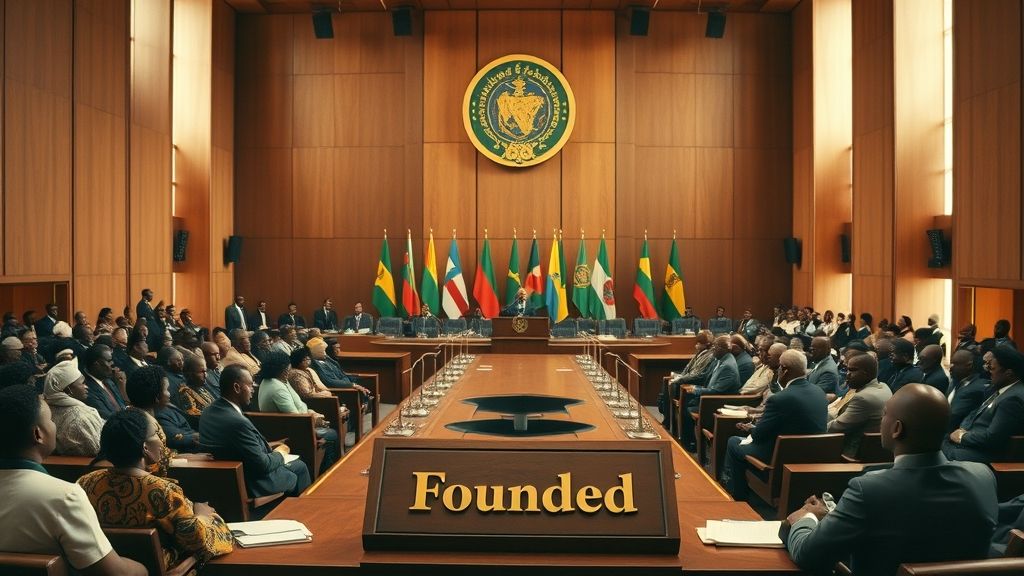
The conference opened in a hall filled with eager anticipation. Delegates spoke in passionate tongues, weaving narratives of suffering and hope into their speeches. The challenge was daunting: fostering unity among diverse political systems, economic conditions, languages, and cultures. There was a palpable tension between those who wanted immediate political federation and those who favored a looser alliance respecting national sovereignty. This opening was a historic gamble, marked by speeches that blended pride in African heritage with sober recognition of myriad contemporary obstacles.
Drafting a Charter: Ideals, Challenges, and Compromises
The drafting of the OAU Charter was a painstaking process demanding delicate negotiations and mutual concessions. The Charter set forth ambitious principles: respect for sovereignty and territorial integrity, non-interference in internal affairs, and the promotion of collective defense and economic cooperation. Yet, compromise skewed heavily towards a cautious respect for national borders — a direct concession to prevent internal conflicts, though it would later complicate the resolution of ethnic wars in the continent. The Charter also enshrined the determination to eradicate all forms of colonialism "by all means, positive or negative."
Defining Objectives: Unity, Sovereignty, and Economic Cooperation
The aims of the OAU were profound yet pragmatic. First, to rid the continent of colonialism—a domino effect of freshly independent countries encouraging those still under yokes of oppression. Second, to safeguard sovereignty and territorial integrity, an acknowledgement of the political realities Africa faced. Third, to foster economic development through collective self-reliance. Although these goals seemed clear-cut, they posed complex tensions. Would prioritizing sovereignty hinder regional integration? Could economic cooperation succeed without political federation? These questions haunted the organization’s infancy.
The Role of Ethiopia: Emperor Haile Selassie’s Symbolic Leadership
Ethiopia’s role was both strategic and symbolic in the OAU’s founding. Having never been colonized (save for a brief Italian occupation), it embodied African resilience and sovereignty. Emperor Haile Selassie’s presence lent moral weight and historic continuity to the gathering. Moreover, Addis Ababa was chosen as the organization’s headquarters, making Ethiopia the diplomatic heart of African unity. Haile Selassie’s eloquence and vision imbued the event with a profound aura; his appeals to dignity and freedom echoed beyond the conference walls, inspiring generations to come.
From Fragmentation to Solidarity: Overcoming Regional Divides
Africa’s diversity was its strength and challenge. Linguistic divisions among Anglophones, Francophones, Arabophone nations, and indigenous cultures threatened to fracture the African dream. Regional rivalry, religious differences, and varying colonial legacies risked derailing the spirit of unity. Yet, the OAU embodied a monumental effort to build solidarity above these divides. Delegates repeatedly invoked shared histories of oppression—slave trade, colonial exploitation—as threads uniting their separate narratives. This collective memory forged a tentative but resilient bond.
Early Criticisms and Reservations: Fragility amid Optimism
Despite the triumphant tones, doubts shadowed the OAU’s inception. Some critics warned the organization risked becoming a “talking shop” with limited practical impact. The strict respect for sovereignty sometimes paralyzed interventions needed to quell regional conflicts. Furthermore, economically, the continent’s reliance on former colonial powers remained a heavy chain. Internally, increasingly authoritarian regimes worried that the OAU might shield dictators rather than promote democracy. Yet the participants understood this was only the opening chapter—a fragile beginning with immense future promise.
The OAU’s Position on Decolonization and Apartheid
One of the OAU’s most resolute policies was combating colonialism in all its forms, particularly focused on the liberation movements in countries like Angola, Mozambique, Zimbabwe, and Namibia. It actively supported liberation fronts, endorsing armed struggle when deemed necessary, a stance that brought both international praise and criticism. Additionally, condemning apartheid in South Africa became a central pillar. The OAU’s unyielding pressure helped isolate the apartheid regime and provided moral and material support to anti-apartheid activists, underscoring the organization’s pivotal political role.
Symbolizing Pan-Africanism: The Flag, Anthem, and Emblem
Emblems matter in nation-building and identity crafting. The OAU adopted symbols deeply infused with Pan-African meaning: the emblem included a map of Africa surrounded by olive branches, signaling peace and solidarity. The Pan-African colors—green, gold, and red—featured prominently, echoing Ethiopia’s flag, itself a symbol of African liberation. These symbols were daily reminders that despite national differences, these nations were threads of a single continent yearning for respect, dignity, and progress.
A New Political Force on the Global Stage: Reactions Worldwide
Internationally, the birth of the OAU resonated profoundly. Western powers watched with wariness, fearing a united Africa might challenge neo-colonial economic interests or align more closely with the Soviet bloc during the Cold War. The Soviet Union and China saw the emergence as a potential ally against Western imperialism. The United Nations welcomed the OAU as a critical step in decolonization and international cooperation. This newfound collective Africa became an increasingly vocal bloc in global debates on sovereignty, development, and human rights.
The Organization’s Early Initiatives and Struggles
In its initial years, the OAU faced immense practical challenges: coordinating policies across diverse economies, mediating border disputes, managing political crises, and channeling support to liberation movements. Despite limited financial and institutional resources, it maintained a platform for dialogue and collective action. Its Council of Ministers and Assembly of Heads of State and Government served as forums where African interests could coalesce. However, the absence of a common army or sovereignty limited enforcement power, leading to mixed results in several conflicts.
OAU’s Legacy in Shaping African Diplomacy
Despite limitations, the OAU laid the groundwork for modern African diplomacy. It pioneered the concept that African problems required African solutions—promoting a culture of negotiation, respect for sovereignty, and shared responsibility. It cultivated decades of dialogue on human rights, development policies, and conflict resolution. The organization pressured global powers to respect African autonomy and challenged apartheid and minority white rule regimes. Its norms and practices seeded the foundation of the African Union, reflecting lessons learned and enduring aspirations.
The Foundation’s Impact on Post-Colonial African States
For newly independent nations, joining the OAU offered legitimacy, mutual support, and a forum to voice concerns. It nurtured a sense of belonging to a larger community beyond colonial divisions. The OAU’s support was crucial in sustaining liberation movements that later transformed into governments, while also giving technical advice on governance and development. Yet for some states, the OAU’s non-interference policy became a shield behind which undemocratic or repressive regimes hid—highlighting a dual-edged legacy.
Lessons Learned: Limitations and Transformations over Time
The OAU’s greatest accomplishment was its very existence and persistence amid adversity. However, its rigid stance on sovereignty often hindered intervention in conflicts such as the Nigerian Civil War or the Rwandan Genocide. Economic integration remained elusive, and corruption or inefficiencies sometimes weakened its authority. In response, the organization underwent reforms, recognizing the need for stronger institutions, enhanced respect for human rights, and integrated development strategies, culminating in the transformation into the African Union (AU) in 2002.
The Evolution of African Unity: OAU’s Transformation into the African Union
The formation of the African Union represented both a homage to and a transcending of the OAU’s legacy. Established in 2002, it introduced new mechanisms for peacekeeping, economic development, and political cooperation. The AU embodied a more assertive vision—allowing for intervention in cases of human rights abuses and striving for deeper regional integration and infrastructure development. This evolution reflected changing global dynamics and Africa’s aspirations to play a substantive role on the world stage beyond decolonization struggles.
Conclusion: A Continual Journey Toward Africa’s Collective Destiny
The Organization of African Unity was much more than a political institution birthed on a bright day in Addis Ababa. It was a symbol—of hope, resilience, and the arduous path toward self-determination. Despite its imperfections and crises, it succeeded in keeping the dream of African unity alive, asserting the continent's sovereignty and dignity. The journey it began continues, as Africa’s nations grapple still with the legacies of division and the promise of collective strength. Reflecting on the OAU’s founding is to celebrate the indomitable human spirit seeking freedom, justice, and solidarity—a story still unfolding.
FAQs
Q1: What were the main causes leading to the founding of the Organization of African Unity?
A1: The OAU was born out of the desire to unite newly independent African states against lingering colonial domination, oppression, and racial segregation systems like apartheid. It was also a response to ethnic fragmentation, economic underdevelopment, and the need for a platform to coordinate political and diplomatic efforts on the continent.
Q2: Which leaders played key roles in the establishment of the OAU?
A2: Emperor Haile Selassie of Ethiopia, Kwame Nkrumah of Ghana, and Léopold Sédar Senghor of Senegal were among the primary architects. Their leadership combined symbolism, political will, and intellectual vision that anchored the founding principles of the organization.
Q3: How did the OAU address the issue of colonialism and apartheid?
A3: The OAU actively condemned colonialism and apartheid, supporting liberation movements through moral and material assistance and insisting on all means, including armed struggle, to achieve freedom. It worked to isolate regimes that perpetuated racial segregation and oppression.
Q4: What were the main challenges faced by the OAU during its early years?
A4: Challenges included reconciling diverse political systems, managing border disputes, upholding sovereignty while promoting intervention, limited financial resources, and varying national interests that complicated coordinated action.
Q5: How did the OAU shape African diplomacy and international relations?
A5: It provided Africa with a unified voice in global affairs, promoting the vision that Africans should resolve their own issues. It influenced international opinion on decolonization, human rights, and countered neo-colonial pressures.
Q6: Why was the OAU eventually transformed into the African Union?
A6: The OAU’s structure was seen as insufficient for addressing emerging challenges such as internal conflicts, human rights violations, and economic fragmentation. The African Union introduced stronger mechanisms for enforcement, integration, and collective responsibility.
Q7: What symbolic significance did Ethiopia hold in the founding of the OAU?
A7: Ethiopia represented African sovereignty and resistance against colonization. Hosting the OAU’s headquarters and Emperor Haile Selassie’s leadership signified continuity with Africa’s independent heritage.
Q8: In what ways does the legacy of the OAU continue to influence Africa today?
A8: The OAU’s ideals of unity, sovereignty, and resistance to oppression remain foundational to continental policies. Its legacy informs the African Union’s agenda and inspires ongoing cooperation in political, social, and economic spheres.