Table of Contents
- A Night Shrouded in Shadows: The Indonesian 30 September Movement Unfolds
- Jakarta on the Edge: The Political Climate of Indonesia in the Mid-1960s
- The Seeds of Unrest: Ideologies and Factions in a Divided Nation
- The Role of the Indonesian Communist Party (PKI) and Its Ambitions
- President Sukarno: The Balancer Under Strain
- The 30 September Movement: Planning and Execution of the Coup Attempt
- Early Hours of Horror: Kidnappings and Assassinations in Jakarta
- General Nasution’s Narrow Escape and Its Implications
- The Role of Major General Suharto: From Contingent Commander to Decisive Leader
- The Army’s Counteroffensive and the Collapse of the Coup
- Mass Arrests and the Onset of Anti-Communist Purges
- The Silent Spectators: The Role of Civil Society and the Public Reaction
- Media and Propaganda: Crafting the Narrative of Betrayal
- International Echoes: Cold War Context and Reactions from the Global Powers
- From Chaos to Order? The Emergence of the New Indonesian Regime
- The Tragedy of Mass Killings: Scale, Stories, and Survivors
- The Political Death of Sukarno and the Rise of Suharto's New Order
- The Long Shadow: How 1965 Shaped Indonesian Society and Politics for Decades
- Historical Debates and Revisionism: Controversies over the 30 September Movement
- Memory and Silence: Indonesian Reflections on 1965 Today
- The Human Cost: Families Torn Apart and the Voices from the Shadows
- Lessons from the Past: Democracy, Power, and Repression in Modern Indonesia
- The 30 September Movement in Global Perspective
- Conclusion: Echoes of a Fateful Night
- FAQs: Unraveling the Mysteries of the 1965 Indonesian Coup Attempt
- External Resource
- Internal Link
1. A Night Shrouded in Shadows: The Indonesian 30 September Movement Unfolds
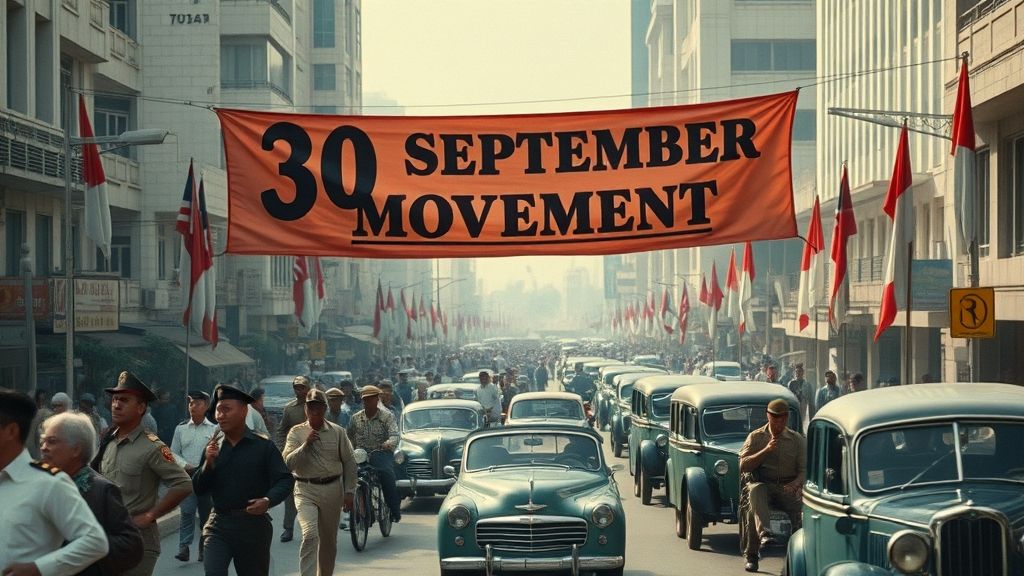
It was just past midnight on September 30, 1965, when Jakarta, the sprawling heart of Indonesia, was suddenly plunged into a nightmare. Gunshots shattered the silence, rifles rang out from military barracks, and the city’s elite generals were whisked away in darkness, never to be seen alive again. A mysterious group calling itself the “30 September Movement” declared they had seized power to prevent a plot against President Sukarno. But instead of a swift transition, the city plunged deeper into confusion and fear. People whispered in the streets, cities woke to rumors of betrayal and political revenge. It was a night that would change Indonesia forever—sending tremors through its fragile young democracy and igniting one of the 20th century’s most brutal political purges.
2. Jakarta on the Edge: The Political Climate of Indonesia in the Mid-1960s
Indonesia in 1965 was a nation bursting at the seams. Just two decades after declaring independence from Dutch colonial rule, it wrestled to unify its sprawling archipelago’s diverse peoples, religions, and ideologies. President Sukarno, charismatic and visionary, had guided Indonesia through its birth pangs with his doctrine of ‘Nasakom’—a delicate balance of Nationalism, Religion, and Communism. However, beneath this veneer of unity simmered intense political friction, fueled by competing factions vying for Indonesia’s future.
The military, deeply nationalist and wary of communist ideology, eyed the growing strength of the Indonesian Communist Party (PKI) with suspicion and fear. At the same time, Sukarno's leadership increasingly leaned toward leftist allies, alienating conservative and Islamic groups. The Cold War’s icy tentacles had wrapped themselves firmly around Indonesia’s fate, making this ideological tug-of-war all the more dangerous.
3. The Seeds of Unrest: Ideologies and Factions in a Divided Nation
In the 1960s, Indonesia’s political landscape was a patchwork of conflicting ambitions. The PKI, at the time Asia’s largest communist party outside China and the USSR, had amassed millions of members. Their influence touched labor unions, peasant organizations, and even parts of the military. Prime among their aims was securing a radical transformation of Indonesian society along socialist lines.
Opposing them was the army, fragmented but traditionally powerful, suspicious of the PKI’s rapid ascent. Figures like General Abdul Haris Nasution exemplified this concern, advocating a strong anti-communist stance. Meanwhile, Islamic parties and nationalist groups both competed and occasionally collaborated to check the PKI's power.
Sukarno’s vision of Nasakom was meant to bridge these divides, but hopes of equilibrium were fragile. By 1965, Indonesia was a powder keg of ideological tensions, ethnic fault lines, and competing loyalties.
4. The Role of the Indonesian Communist Party (PKI) and Its Ambitions
The PKI stood at the apex of power—and vulnerability—in early 1965. Its membership had ballooned to nearly three million, gaining unprecedented control over social institutions. The party’s leaders, including D.N. Aidit, saw Indonesia as ripe for a leftist revolution, but they also knew that open confrontation with the army could be disastrous.
Their strategy involved covert political maneuvering and strategic alliances with Sukarno, whom they saw as a protector of their movement. However, the PKI’s growing visibility provoked paranoia within military ranks. Fears proliferated that the party might attempt to seize power outright, a worry that loomed over every interaction in Jakarta’s corridors of power.
5. President Sukarno: The Balancer Under Strain
Sukarno, the architect of Indonesian independence and the symbol of national unity, had always walked a perilous line between power blocs. He invited communists into his inner circle, but equally relied on the military and Islamic leaders to sustain his vision.
By 1965, Sukarno’s health was waning, and his ability to enforce discipline within the fractious government diminished. Personal rivalries erupted, intelligence faltered, and suspicions hardened. Sukarno’s charisma could no longer mask the growing fractures within his rule.
6. The 30 September Movement: Planning and Execution of the Coup Attempt
What became known as the “30 September Movement” (Gerakan 30 September or G30S) was a clandestine operation whose origins remain shrouded in controversy and conflicting accounts. At approximately 2 a.m. on September 30, a faction within the military, including several lower-ranked officers, moved swiftly to arrest and execute six senior generals they accused of plotting a coup against Sukarno.
The motives behind the movement are still debated, but what is clear is its audacity: to seize control of Jakarta under the cloak of early morning darkness, with the declared goal to protect the president from a so-called “Council of Generals.” The operation involved kidnappings, house raids, and deadly ambushes at key army locations.
7. Early Hours of Horror: Kidnappings and Assassinations in Jakarta
Jakarta’s night air grew thick with tension as officers loyal to the movement rounded up prominent army leaders: General Ahmad Yani, General R. Suprapto, General Tahir, General M. T. Haryono, General S. Parman, and General Sutoyo. Under cover of night, in a series of brutal attacks, these men were executed and their bodies dumped in a well on the outskirts of the city.
General Nasution, their intended victim, narrowly escaped death. He was wounded but fled, his survival becoming a pivotal moment in the unfolding drama. Panic spread throughout the capital, while fanaticism and fear took root in every corner.
8. General Nasution’s Narrow Escape and Its Implications
The escape of General Nasution was nothing short of miraculous. Despite being wounded in the shoulder during an assault on his home, he managed to hide and eventually evade capture. His survival provided the army’s anti-communist faction with a rallying point and something tangible to contest the coup’s legitimacy.
Nasution’s testimony and ability to organize resistance within the army became crucial in the days that followed, setting the stage for a counter-coup that would alter Indonesia’s political destiny.
9. The Role of Major General Suharto: From Contingent Commander to Decisive Leader
At the time of the coup attempt, Major General Suharto commanded the Army Strategic Reserve Command (Kostrad), a powerful military contingent based in Jakarta. Initially uncertain, Suharto quickly took control of the situation by mobilizing troops to recapture key installations and arrest suspected conspirators.
Suharto’s calm efficiency contrasted sharply with the chaos engulfing the city. In less than a week, he had suppressed the movement and solidified his power base, ushering in a new era in Indonesian politics. His ascent from obscurity to power was rapid and would culminate in his presidency for over three decades.
10. The Army’s Counteroffensive and the Collapse of the Coup
The army loyal to Suharto enacted an organized and relentless campaign to crush the 30 September Movement. Within days, they suppressed the insurgent factions, arrested thousands, and reclaimed control of Jakarta’s military assets.
The swift suppression disoriented the PKI, which never fully mounted a defense. The failure of the coup attempt shattered the illusion that the PKI could challenge the military establishment openly.
11. Mass Arrests and the Onset of Anti-Communist Purges
What followed the failure of the coup was a wave of terror that swept across Indonesia. Military and paramilitary groups, backed tacitly or overtly by Suharto’s forces, launched mass arrests of suspected communists and sympathizers.
This precipitated one of the worst mass killings of the 20th century. Conservative estimates place the death toll between 500,000 and 1 million victims. Villages and towns turned battlegrounds of propaganda and repression, in a purge that targeted not only party members but ethnic Chinese minorities and intellectuals.
12. The Silent Spectators: The Role of Civil Society and the Public Reaction
Amidst the turmoil, ordinary Indonesians faced impossible choices. Reports indicate that many civilians either supported the army’s anti-communist purge out of fear or belief in the threat posed by the PKI, while others quietly resisted or mourned the victims in silence.
Religious and cultural groups often found themselves entangled in the violence, sometimes as perpetrators, sometimes as victims. The complexity and scale of public reaction reveal a society torn between hope for stability and grief for the human cost.
13. Media and Propaganda: Crafting the Narrative of Betrayal
From the onset, the victorious army orchestrated an intensive propaganda campaign. State media broadcast the narrative that the PKI had betrayed the nation in a treacherous coup attempt, framing Suharto and his allies as patriots saving Indonesia from communist subversion.
Films, newspapers, radio programs, and speeches painted a stark black-and-white picture: Good versus evil, order versus chaos. These narratives, entrenched in educational textbooks and popular culture, deeply shaped Indonesian collective memory for decades.
14. International Echoes: Cold War Context and Reactions from the Global Powers
The 1965 coup attempt and its aftermath played out against the thunderous backdrop of the Cold War’s global contest. Western powers, especially the United States and Britain, closely monitored Indonesia’s turmoil, deeply concerned about the island nation’s tilt toward communism under Sukarno.
Declassified documents later revealed that Western intelligence agencies tacitly supported the anti-communist purge, viewing Suharto’s rise as a bulwark against Soviet and Chinese influence. Meanwhile, China and the USSR condemned the suppression, but their ability to intervene was limited.
Indonesia thus became a frontline of Cold War geopolitics, with human lives caught between global ambitions.
15. From Chaos to Order? The Emergence of the New Indonesian Regime
By early 1966, Suharto had consolidated power, sidelining Sukarno through a gradual campaign that culminated in a formal transfer of authority in 1967. The new regime, known simply as the “New Order,” promised stability, economic growth, and a break from ideological extremism.
But the cost had been staggering: political freedoms crushed, opposition silenced, and a society haunted by violence. Suharto’s government would rule Indonesia with an iron fist until 1998, leaving a lasting imprint on the nation’s trajectory.
16. The Tragedy of Mass Killings: Scale, Stories, and Survivors
The purges following the failed coup remain one of the darkest chapters in modern history. Accounts from survivors tell of brutal executions, forced disappearances, and existential terror that engulfed entire communities.
Villages became mass graves, entire families decimated, and decades-long trauma etched into the Indonesian psyche. The sheer scale of the killings, carried out often without trial or due process, challenges comprehension and demands remembrance.
17. The Political Death of Sukarno and the Rise of Suharto's New Order
Sukarno’s sunset was as dramatic as his rise. Once exalted as the father of Indonesian independence, his influence waned swiftly under Suharto’s pressure. Denied real power, isolated from his supporters, Sukarno lived his final years in relative confinement, mourning a dream that had slipped away.
Suharto’s New Order heralded an authoritarian regime that prioritized economic development but sacrificed political pluralism and human rights. The legacy of 1965 haunted both men’s legends and Indonesia’s collective memory.
18. The Long Shadow: How 1965 Shaped Indonesian Society and Politics for Decades
The events of 1965 seeped into every facet of Indonesian life. Political discourse remained constrained, memories of the purges were suppressed, and societal divisions hardened. The PKI vanished from political life, while the military cemented its role as the nation’s dominant institution.
The trauma influenced literature, arts, and education, often through silence or euphemism. It would take decades—and a democratic transition—to begin confronting the full truth.
19. Historical Debates and Revisionism: Controversies over the 30 September Movement
To this day, historians, politicians, and survivors debate what truly transpired on September 30, 1965. Was the 30 September Movement a genuine coup by the PKI? Or was it a false flag operation engineered to justify a military takeover?
Conflicting testimonies, lack of transparent evidence, and politicized narratives entangle the event in controversy. Revisionist historians strive to shed light on forgotten victims and challenge official accounts, but the past remains contested.
20. Memory and Silence: Indonesian Reflections on 1965 Today
For decades, Indonesians navigated a complex relationship with the memory of 1965—across generations shaped by fear, denial, and trauma. Only recently, with political reform and greater freedom of expression, has the taboo around the purges begun to lift.
Documentaries, books, and survivors’ testimonies now emerge in the public space, inviting a reckoning. The nation grapples with how to honor victims, confront perpetrators, and heal wounds while avoiding political polarization.
21. The Human Cost: Families Torn Apart and the Voices from the Shadows
Beneath the political sweeping tides lie personal tragedies: children raised without parents, communities forever changed, and silence where stories should be told. Families of the victims have fought decades for recognition, justice, and closure.
Oral histories collected by human rights groups reveal resilience amid heartbreak. Their voices push beyond statistics, giving human shape to the anonymous suffering hidden in history’s shadows.
22. Lessons from the Past: Democracy, Power, and Repression in Modern Indonesia
The Indonesian 30 September Movement and its aftermath resonate far beyond the archipelago. They stand as stark reminders of the fragility of democracy, the dangers of ideological extremism, and the human cost of political repression.
Indonesia’s journey—from dictatorship to democracy—embodies these lessons. Its story challenges us to confront history honestly, guarding against repetition while forging a future built on justice.
23. The 30 September Movement in Global Perspective
While rooted in Indonesia’s unique context, the 1965 coup attempt echoes patterns seen globally during the Cold War: proxy conflicts, ideological purges, and the terrifying power of state violence. It serves as a case study in how international tensions can inflame domestic fault lines with devastating consequences.
Today, historians and political scientists study the event to understand not just Indonesian history but the dynamics of power, resistance, and memory in the modern world.
24. Conclusion: Echoes of a Fateful Night
The attempted coup of September 30, 1965, was not merely a failed military gambit—it was a cataclysm that uprooted Indonesia’s political and social fabric, leaving scars still visible half a century later. It was a night when ideals collided with blood, when ambitions toppled lives, and when history took a sharp turn down a darker path.
Yet amid this darkness, Indonesia’s continuing evolution shines as a testament to resilience and the unending quest for justice and truth. The shadows of 1965 persist, but so too does the hope that one day, the full story will be told—and healed.
FAQs: Unraveling the Mysteries of the 1965 Indonesian Coup Attempt
Q1: What exactly was the 30 September Movement?
It was a clandestine group within the Indonesian military that attempted a coup on the night of September 30, 1965, claiming to protect President Sukarno from a supposed “Council of Generals” planning a takeover. The movement abducted and killed several top generals but was quickly suppressed.
Q2: Who were the main actors behind the coup attempt?
Lower-ranking military officers linked to the Indonesian Communist Party (PKI) were primary participants, though the extent of PKI leadership involvement remains debated. Major General Suharto emerged as the leader who crushed the coup.
Q3: Why did the coup attempt fail?
The movement was poorly coordinated, failed to secure critical military and political assets, and underestimated opposition from Suharto and loyalist forces. The survival of General Nasution and rapid army mobilization turned the tide.
Q4: What were the consequences of the failed coup?
It precipitated mass anti-communist purges across Indonesia, resulting in up to a million deaths, the overthrow of Sukarno’s government, and the establishment of Suharto’s authoritarian New Order regime.
Q5: How did this event affect Indonesia’s place in the Cold War?
Indonesia shifted dramatically away from leftist and Soviet/Chinese influence towards a pro-Western, anti-communist stance. The event remains a pivotal moment highlighting Cold War dynamics in Southeast Asia.
Q6: Is the 30 September Movement universally accepted as a communist-led coup?
No, the event is highly contested. Some historians assert it was a communist plot, others argue it was manipulated or even fabricated by military forces to justify a crackdown.
Q7: How is the 1965 tragedy remembered in Indonesia today?
After decades of silence and state-controlled narratives, the topic is increasingly discussed openly, though it remains sensitive. Activists seek justice for victims, while official commemorations remain cautious and limited.
Q8: What lessons can modern societies learn from the 1965 Indonesian coup attempt?
The dangers of political polarization, the human cost of ideological purges, and the importance of safeguarding democratic institutions and human rights amid crises are key takeaways.