Table of Contents
- The Dawn of a Cultural Earthquake: Beijing, May 1966
- A Nation Poised on the Edge: China in the Mid-1960s
- Mao Zedong’s Gamble: Reigniting the Revolutionary Flame
- The Birth of the Red Guards: Youth as Revolutionaries
- The Purge of the “Four Olds”: Culture, Customs, and Minds Under Siege
- Intellectuals and Elites Caught in the Crossfire
- The Role of Propaganda: Words as Weapons of Change
- Factories, Farms, and Schools: A Society Turned Inside Out
- From Chaos to Control: The Party’s Internal Struggles
- The Violence Escalates: From Rhetoric to Bloodshed
- Women, Families, and Everyday Life: The Social Fabric Torn
- The Foreign Gaze: How the World Witnessed the Upheaval
- The End of the Cultural Revolution? A Fractured Legacy by 1969
- Economic Devastation and the Lost Generation
- Cultural Revolution’s Imprint on Modern China
- Memory and Reconciliation: How China Remembers the Turmoil
- Conclusion: The Human Cost of Revolution and the Lessons Learned
- FAQs: Understanding the Complexity of the Cultural Revolution
- External Resource
- Internal Link
The Dawn of a Cultural Earthquake: Beijing, May 1966
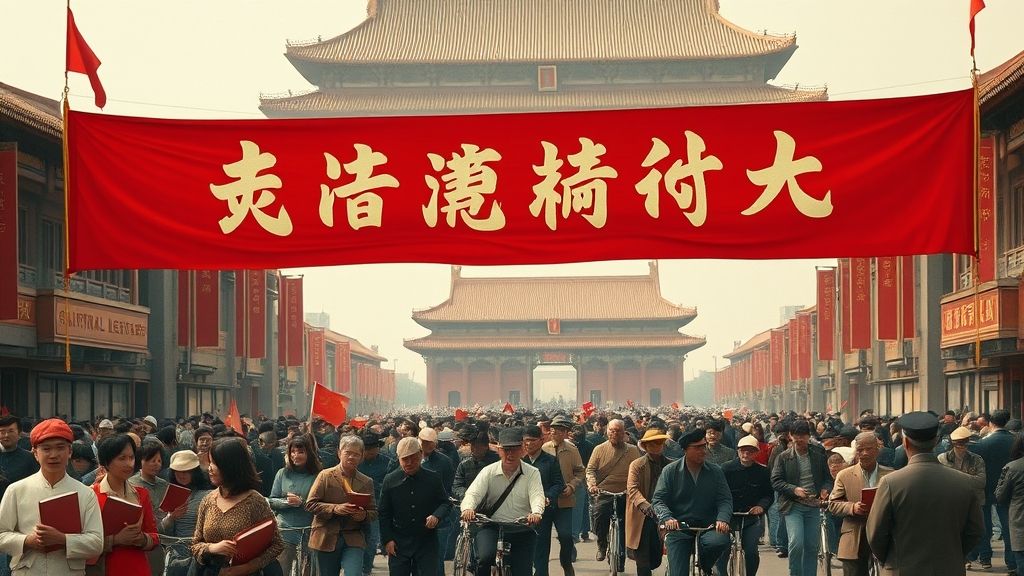
The air in Beijing was thick with tension and fervor. Streets once orderly and serene erupted into waves of chanting, banners rippling under a ruthlessly bright spring sky. It was May 1966, and the Cultural Revolution had just been launched—a cataclysmic campaign that would reshape China’s society in ways unimaginable. On the surface, fervent songs exalted Chairman Mao Zedong as the salvation of the revolution, yet beneath such uproar, fear, chaos, and uncertainty spread like wildfire.
The city’s university campuses, normally places of study and quiet debate, transformed overnight into theaters of ideological warfare. Youth clad in red armbands rallied under Mao’s banner, ready to “smash the old world” and build anew. For millions, this was a moment of revolutionary pride and promise; for many others, it marked the beginning of suffering, persecution, and loss. This convulsive outburst was to become one of the most profound social and political upheavals of the 20th century.
A Nation Poised on the Edge: China in the Mid-1960s
To grasp why the Cultural Revolution exploded from the regulatory confines of the Chinese Communist Party into a frenzied popular movement demands a journey into the complex, often turbulent context of mid-1960s China. Mao Zedong, the founding father of the People’s Republic of China, had already guided the nation through centuries of foreign domination and civil conflict. Yet by the mid-1960s, cracks began to show in his political edifice.
China’s Great Leap Forward (1958–1962), an ambitious but disastrously executed plan to rapidly industrialize the country, had ended in famine and millions of deaths. Mao’s prestige suffered, and the party’s more moderate voices gained sway. By 1966, Mao found himself distant from the bureaucratic elites who appeared to be steering China toward pragmatic modernization—away from continuous revolution.
For Mao, this was a dangerous drift. He feared the party was becoming a new ruling class, betraying communist ideals. The ideological battle lines hardened: Mao sought to reignite revolutionary zeal, eradicate what he saw as revisionism and capitalist thinking within the party, and mobilize the masses. Yet this time, he would unleash forces that went beyond top-down control.
Mao Zedong’s Gamble: Reigniting the Revolutionary Flame
Mao’s announcement of the Cultural Revolution was both a political maneuver and a deeply ideological crusade. In May 1966, the Central Committee issued the “Decision of the Central Committee of the Communist Party of China Concerning the Great Proletarian Cultural Revolution” — a document declaring the need to fight capitalist roaders within the party and reshape China’s culture to align with Socialist ideology.
But Mao’s goal was far from subtle party reform. He meant to unleash a wave of revolutionary fervor that would permeate every corner of society. “Without culture, there is no revolution,” Mao declared. His campaign was to root out the “Four Olds” — old customs, old culture, old habits, and old ideas — which were seen as anchors to a feudal past.
This was a gamble of extraordinary scale. An appeal to China’s youth, the most dynamic and idealistic generation since the Communist victory, Mao entrusted them to become the vanguard of the new revolution. The Red Guards were born—millions of young people who wielded Mao’s Little Red Book like a sacred text, empowered to identify and destroy enemies of the revolution.
The Birth of the Red Guards: Youth as Revolutionaries
What unfolded in the months after the Cultural Revolution was announced reads like the ignition of a social volcano. Student groups, galvanized by Mao’s call, formed the Red Guards—an armed youth militia infused with ideological fervor and naivety. They saw themselves as the new heroes of China’s historic mission, determined to purge society of corruption and reaction.
Schools and universities rapidly became arenas of struggle sessions and denunciations. Professors and intellectuals were humiliated, and sometimes beaten, as the youth sought to uncover hidden enemies of socialism. Red Guards attacked “bourgeois” teachers and destroyed books and art deemed incompatible with the revolution.
Yet with such empowerment came chaos. Rivalries among Red Guard factions, uneven interpretations of Maoist doctrine, and reckless zealotry meant that initially localized conflicts spiraled into nationwide turbulence. The movement, meant to safeguard the revolution, sometimes endangered it through violence and anarchy.
The Purge of the “Four Olds”: Culture, Customs, and Minds Under Siege
The targeting of the “Four Olds” was more than a campaign slogan—it was a cultural siege. Temples, religious relics, ancient artifacts, and classical literature became targets for destruction. Streets and place names deemed feudal or imperial were renamed, libraries and museums shuttered or vandalized.
This radical break from China’s historic cultural legacy sent shockwaves through not only elites but ordinary citizens. Parents found themselves torn between protecting their heritage and appeasing revolutionary sons and daughters. Traditional festivals, Confucian values, and family structures were scrutinized or denounced.
The campaign often triggered a profound identity crisis within China’s society, hungry for progress but unsettled by cultural erasure. Yet Mao’s charismatic authority and the sheer energy of the movement rendered dissent perilous.
Intellectuals and Elites Caught in the Crossfire
Among the most vulnerable targets were China’s intellectuals, who bore the full brunt of the revolution’s anger toward “class enemies.” Writers, professors, scientists, and artists were publicly humiliated, forced to perform self-criticisms, and sent to rural “re-education” camps.
An infamous example was the fate of the philosopher and economist Wu Han, whose play “Hai Rui Dismissed from Office” was criticized as a veiled attack on Mao’s policies. Wu Han’s downfall epitomized how cultural and political battle lines blurred, with personal safety contingent on ideological loyalty.
This persecution of intellectuals led to a staggering brain drain: thousands of talented professionals were removed from their roles just as China strived for scientific and technological advancement. The long-term cost in innovation and education was profound.
The Role of Propaganda: Words as Weapons of Change
Integral to the revolution’s momentum was an unprecedented wave of propaganda that saturated every aspect of life. Mao’s image appeared on posters in red and black; radio broadcasts and newspapers amplified revolutionary slogans incessantly.
The Little Red Book, officially titled “Quotations from Chairman Mao,” became a symbol of loyalty and an ideological compass. Reciting Mao’s sayings was not mere ritual but a marker of belonging to the new revolutionary order.
Mass rallies, parades, and struggle sessions were orchestrated to maintain a fever pitch of ideological enthusiasm. This propaganda not only molded public sentiment but also masked the growing violence and chaos behind revolutionary pageantry.
Factories, Farms, and Schools: A Society Turned Inside Out
The Cultural Revolution soon transcended urban centers, affecting factories and rural communes. In factories, managers were denounced and replaced by worker-peasant militias who enforced ideological conformity over efficiency. Production suffered as factional disputes and purges disrupted routine.
Rural areas faced similar upheaval. The drive to purge “capitalist” tendencies often led to forced labor and ideological education far from family homes, fracturing community and kinship structures.
Education itself was revolutionized—with schools shut down for months at a time, and curricula rewritten to emphasize manual labor and political theory over traditional academic learning. The “lost generation” of youth was deprived of normal schooling, leaving scars that would last decades.
From Chaos to Control: The Party’s Internal Struggles
While the Cultural Revolution detonated across the country, the Chinese Communist Party was anything but united. Behind the public displays of unity were fierce struggles for power. Mao’s closest allies, including Lin Biao and Jiang Qing, jockeyed for position amid shifting loyalties and shifting factional lines.
The military eventually stepped in to restore a degree of order, but not without its own political costs. The line between revolutionary zeal and anarchy blurred, and after initial enthusiasm, many party elites became wary, perhaps terrified, by what they had helped unleash.
This internal tumult would shape the direction of the Cultural Revolution until Mao’s death a decade later, with waves of purges, rehabilitations, and factional shifts.
The Violence Escalates: From Rhetoric to Bloodshed
What began as ideological struggle soon degenerated into widespread violence. Red Guard units clashed with each other and with those branded enemies of the revolution. Anecdotes of brutal beatings, public executions, and torture became tragically common.
In some regions, massacres occurred on a terrifying scale as local power vacuums erupted. Family members turned against each other; trust crumbled. The rule of law collapsed, replaced by revolutionary tribunals dispensing swift, often fatal, sentences.
The human cost was staggering: estimates of deaths due to purges, violence, and turmoil range in the millions. Yet the full scale remains contested, shrouded by official silence and fragmented testimonies.
Women, Families, and Everyday Life: The Social Fabric Torn
Amid the political firestorm, everyday life bore deep wounds. Women, too, were swept into revolutionary currents—some finding new roles in activism, others suffering verbal and physical assault in the purge of “traditional” femininity.
Marriage and family life were disrupted, with traditional norms challenged or entirely overturned. Children were encouraged to criticize their parents if they demonstrated “reactionary” tendencies. Generations found themselves alienated from each other, as loyalty to Mao superseded familial bonds.
This social upheaval left profound scars that stretched beyond the political, touching the very essence of community and personal identity.
The Foreign Gaze: How the World Witnessed the Upheaval
For the global community, the Cultural Revolution presented a bewildering, often disturbing spectacle. Foreign journalists, diplomats, and observers struggled to understand the tumult that engulfed the world’s most populous nation.
Reports ranged from sympathetic portrayals of youthful enthusiasm to horror at reported violence and disruption of China’s development. The Cultural Revolution complicated China’s international relations, while impacting Cold War dynamics as Mao steered a path independent of both the U.S. and Soviet blocs.
This period remains one of the most enigmatic chapters in modern international history, a blend of myth, propaganda, and harsh reality.
The End of the Cultural Revolution? A Fractured Legacy by 1969
By 1969, the initial frenzy of the Cultural Revolution had begun to subside. The party started regaining control, with the military suppressing Red Guard factions and reestablishing order. Mao remained powerful but appeared more cautious.
However, the wounds inflicted were deep and widespread. The Cultural Revolution had fundamentally altered China’s political culture, social relations, and economic trajectory.
It faded slowly from public life by the early 1970s but would be impossible to erase from collective memory.
Economic Devastation and the Lost Generation
The economic effects were catastrophic. Disrupted production, loss of skilled labor, and the paralysis of normal governance crippled growth. Education was halted for years, producing a generation that missed out on proper schooling and professional training.
This "lost generation" faced difficult futures, burdened by social stigma and gaps in expertise. The impacts echoed well beyond the decade, complicating China’s eventual modernization drive.
Cultural Revolution’s Imprint on Modern China
Despite its horror, the Cultural Revolution left an indelible imprint on China’s identity. It symbolized the dangers of ideological extremism, personality cults, and social cleansing.
Yet some reforms enacted during the period—such as increased participation of peasants and women in political life—would influence later policy debates. The narrative of revolutionary purity would be difficult to reconcile with China’s later pragmatic turn.
The Cultural Revolution remains a subject of debate, scholarly research, and evolving memory inside and outside China.
Memory and Reconciliation: How China Remembers the Turmoil
For decades, official discourse circumscribed discussion of the Cultural Revolution. Only in relatively recent years has a measure of public reflection begun, though still tightly controlled.
Victims and their descendants preserve painful memories, seeking recognition and justice. Museums, memoirs, and documentaries explore this fraught era, revealing stories of courage and tragedy.
The Cultural Revolution’s place in collective memory is complex—a painful chapter that challenges narratives of national glory and progress.
Conclusion: The Human Cost of Revolution and the Lessons Learned
The Cultural Revolution was not simply a political campaign— it was a human drama writ large. It was the eruption of hope and fanaticism, the destruction of culture, and the suffering of millions caught in the tumult.
As we look back, the period warns of the dangers inherent in concentrated power and unchecked ideology. It teaches the vital importance of pluralism, rule of law, and respect for human dignity.
Yet amid tragedy, stories of resilience, care, and survival shine through. The Cultural Revolution remains a living memory, a call for humanity amid history’s most unyielding seasons.
FAQs
Q1: What triggered Mao Zedong to launch the Cultural Revolution in 1966?
A1: Mao sought to reassert his control and preserve communist ideals, fearing the party was becoming bureaucratic and revisionist after the failures of the Great Leap Forward. The Cultural Revolution was a radical effort to mobilize youth and purge perceived enemies.
Q2: Who were the Red Guards and what role did they play?
A2: The Red Guards were mostly young students and youths who became Mao’s foot soldiers in the Cultural Revolution, carrying out attacks on intellectuals, destroying cultural relics, and enforcing ideological conformity.
Q3: What were the ‘Four Olds’, and why were they targeted?
A3: The ‘Four Olds’ referred to old customs, culture, habits, and ideas that the revolutionaries believed hindered China’s socialist rebirth. Destroying these was central to the Cultural Revolution’s agenda to remake society.
Q4: How did the Cultural Revolution affect Chinese intellectuals?
A4: Intellectuals faced persecution, public humiliation, imprisonment, or forced labor. Many lost their jobs or were sent to rural areas for “re-education,” significantly damaging China’s educational and scientific sectors.
Q5: What was the human and economic cost of the Cultural Revolution?
A5: It is estimated that millions died or suffered persecution. Economically, production fell, education was stalled, and a whole generation lost educational opportunities, delaying China’s development.
Q6: How is the Cultural Revolution remembered in China today?
A6: Officially, it is regarded as a "mistake" but remains a sensitive and generally taboo subject. Public memory is mixed with silence, cautious reflection, and personal testimonies, with discussion tightly controlled.
Q7: Did the Cultural Revolution have any positive outcomes?
A7: While overwhelmingly destructive, the Cultural Revolution encouraged political participation among peasants and women and challenged elitism, but these effects are overshadowed by its chaos and damage.
Q8: When did the Cultural Revolution officially end?
A8: The campaign gradually wound down by the early 1970s, with Mao's death in 1976 marking a definitive end, followed by denunciation of the movement in the late 1970s during China’s reform era.