Table of Contents
- A Nation on the Brink: July 6, 1967, Enugu’s Dawn
- The Roots of Calamity: Colonial Legacies and Ethnic Tensions
- The First Republic Fractures: Political Rivalries and Economic Rivalries
- The Igbo Identity and the Birth of Biafran Nationalism
- The Spark Ignites: The Declaration of Biafra’s Independence
- Enugu Under Siege: The War Breaks Out
- The Nigerian Federal Response: From Political Struggle to Military Confrontation
- The Human Face of War: Civilians Caught in the Crossfire
- International Eyes on Biafra: Cold War Dynamics and Global Diplomacy
- Propaganda and Perception: The Media War over Biafra
- Military Campaigns and Key Battles: The Struggle for Control
- The Blockade and Humanitarian Disaster: Starvation as a Weapon
- Voices of Suffering: Refugees, Orphans, and the Survivors
- Nigeria’s Unity Tested: Ethnic, Religious, and Regional Divisions
- The War’s End and Reintegration: 1970 and Beyond
- Legacy of the Biafran War: Memory, Reconciliation, and Justice
- The Biafran War in Contemporary Nigeria: Echoes and Resurgence
- Lessons from the Biafran Tragedy: Sovereignty, Self-Determination, and Humanitarianism
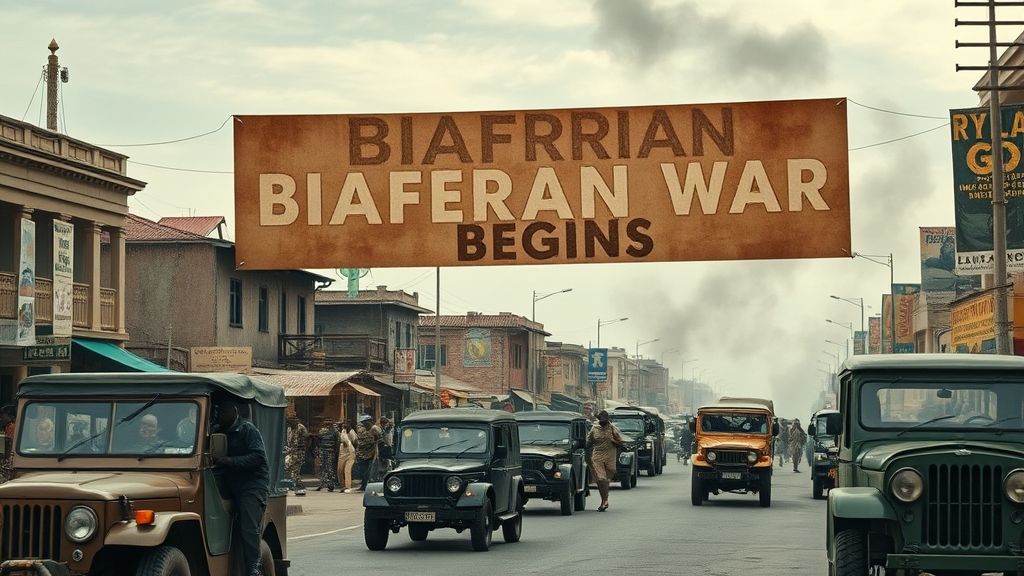
On the early morning of July 6, 1967, the city of Enugu, once a thriving colonial capital in southeastern Nigeria, breathed desperation and defiance. Flames flickered on the horizon, smoke curling into a sky heavy with fate. It was not just the smoke of burning buildings or the acrid residue of gunfire that hung in the air—it was the smoke of an imploding nation. The Biafran War, a brutal and heart-wrenching conflict that would engulf millions, had erupted in earnest. Long-simmering tensions exploded as Colonel Odumegwu Ojukwu, leader of the Eastern Region’s secessionist government, declared the Republic of Biafra independent from Nigeria. The war was no longer a distant threat; it was unrelenting and immediate, a tragedy seared deeply into the memory of Nigeria and the world.
1. A Nation on the Brink: July 6, 1967, Enugu’s Dawn
The streets of Enugu were thick with a sense of foreboding. Crowds gathered quietly, some in tears, others with clenched fists, as soldiers and citizens alike prepared for the inevitable. It was a city caught between hope and desperation—hope for a new nation where the Igbo people could find security and prosperity, desperation born from years of political betrayal and ethnic animosity. The declaration of Biafra’s independence was met with both cheers and cries, but the cost of this moment was already counting its victims. For Nigeria, a country barely seven years old, the dream of unity was fracturing spectacularly.
2. The Roots of Calamity: Colonial Legacies and Ethnic Tensions
To understand the Biafran War, one must first look back to the colonial era, when British administrators, in their pursuit of control, fashioned Nigeria as a patchwork of diverse ethnic groups forcibly united under a single colonial government. The dominant groups—the Hausa-Fulani in the north, the Yoruba in the west, and the Igbo in the east—were kept apart politically, economically, and socially. The British favored indirect rule in the north but adopted a more direct approach in the east and west, creating uneven development.
The patchwork of Nigeria after independence in 1960 was fragile. Lingering colonial divisions intersected with competition over resources, political power, and identity, sowing a deep distrust among ethnic groups. The discovery of oil in the Eastern Region added fuel to the smoldering fire of regional rivalry, as the revenue promised wealth and power that each group sought to claim exclusively.
3. The First Republic Fractures: Political Rivalries and Economic Rivalries
Nigeria’s First Republic (1960–1966) was marked by increasing instability. The coalition of ethnic alliances rapidly dissolved into bitter antagonisms. The political system was dominated by regional parties rooted in ethnic identities: the Northern People’s Congress (NPC), the Action Group (AG) in the west, and the National Council of Nigerian Citizens (NCNC) in the east.
In January 1966, a military coup led by mostly Igbo soldiers overthrew the civilian government. This event, seen by many Northerners as an Igbo attempt to dominate Nigeria, sparked a brutal counter-coup and waves of ethnic violence, especially targeting the Igbo community in the north. Hundreds of thousands of Igbo fled back to the Eastern Region, their ancestral homeland but now bracing for conflict.
4. The Igbo Identity and the Birth of Biafran Nationalism
The trauma of ethnic killings and the perceived betrayal by the Nigerian state shaped a rising nationalist consciousness among the Igbo leadership. Colonel Odumegwu Ojukwu, the military governor of the Eastern Region, emerged as the unwavering voice refusing to accept a return to insecurity and marginalization. For Ojukwu and many of his people, secession was an act of survival as much as political defiance.
The notion of Biafra – a historical term resurrected from the old Bight of Biafra – symbolized a homeland where the Igbo could govern themselves free from fear. But this vision also posed a direct challenge to Nigeria’s territorial integrity and unity.
5. The Spark Ignites: The Declaration of Biafra’s Independence
On May 30, 1967, with tensions reaching a boiling point, Ojukwu publicly declared the independence of Biafra. The federal government in Lagos, led by General Yakubu Gowon, rejected the secession outright. The Nigerian press and political leaders framed the move as rebellion.
What followed were weeks of escalating confrontation, culminating in full-scale war by early July. It was in Enugu, the symbolic capital of the Eastern Region, that the conflict erupted with devastating force. The first shots were fired. War had begun.
6. Enugu Under Siege: The War Breaks Out
Enugu, once a bustling city of trade and culture, became a frontline. Nigerian military jets bombed strategic positions while ground troops engaged fierce battles with Biafran forces. The fighting was intense, close, and personal; neighbors found themselves on opposing sides.
The fall of Enugu in October 1967 was a bitter blow to the Biafran cause, yet it signaled neither surrender nor peace. Instead, it hardened Biafran resolve to fight as a distinct nation under siege, determined not to collapse despite mounting odds.
7. The Nigerian Federal Response: From Political Struggle to Military Confrontation
General Gowon’s government initially pursued political solutions, proposing negotiations. But the stubbornness of secessionists pushed the Nigerian military toward a strategy of overwhelming force.
The federal troops were better equipped and vastly superior in numbers, but the war would drag on for nearly three years—not due to military stalemate only, but because of logistical challenges, international involvement, and the extraordinarily resilient will of Biafran fighters.
8. The Human Face of War: Civilians Caught in the Crossfire
The Biafran War was as much a tragedy for the people as it was a conflict between armies. Civilians bore the brunt through displacement, starvation, disease, and death. Families were torn apart, cultural heritages disrupted, and entire communities were erased.
The story of Biafra is, in many ways, the story of ordinary people caught in the gears of history—children orphaned, mothers grieving, communities razed.
9. International Eyes on Biafra: Cold War Dynamics and Global Diplomacy
The international community watched with a mixture of caution and apprehension. The United Kingdom and the Soviet Union backed the Nigerian federal government, motivated by geopolitical interests and colonial ties. France and several African states sympathized with Biafra, providing covert aid.
The conflict became a Cold War proxy to some extent, entangled in debates about sovereignty, self-determination, and interventionism.
10. Propaganda and Perception: The Media War over Biafra
The Biafran War was one of the first conflicts to be widely televised and documented. Journalists like Richard Dimbleby and organizations such as the Red Cross brought harrowing images of famine and suffering to the global stage.
Media narratives shaped international opinion, humanizing the Biafran plight but often oversimplifying the complex ethnic and political realities on the ground. Yet, the power of images of starving children mobilized the world’s humanitarian response.
11. Military Campaigns and Key Battles: The Struggle for Control
The war saw notable battles at places like Nsukka, Onitsha, and the River Niger crossings. Both sides displayed moments of brutality and desperation. Biafran forces, although outgunned, used guerilla tactics, exploiting their knowledge of the terrain.
The conflict revealed not only military failings on both sides but also the deep fractures within Nigeria's military and society.
12. The Blockade and Humanitarian Disaster: Starvation as a Weapon
One of the most tragic aspects was the Nigerian blockade that aimed to starve Biafra into submission. Food and medicine supplies dwindled; diseases such as kwashiorkor ravaged children. International relief efforts struggled against political obstacles and military interference.
Estimates suggest up to two million people died from starvation and disease, a stark echo of the darkest possible consequences of war.
13. Voices of Suffering: Refugees, Orphans, and the Survivors
Beyond numbers, the war left countless personal stories etched in memory. Survivors spoke of desperate treks to refugee camps, loss of family, and the slow, painful process of healing after the guns fell silent.
Orphans and displaced populations became faces of Biafra’s human cost—a poignant reminder of war’s unyielding toll.
14. Nigeria’s Unity Tested: Ethnic, Religious, and Regional Divisions
The war exposed Nigeria’s deep ethnic and regional fault lines. The North-South divide, the question of minorities within Biafra, and the role of religion complicated the conflict and its aftermath.
Post-war Nigeria faced the monumental task of rebuilding a nation scarred by betrayal and bloodshed while seeking a new vision of pluralism.
15. The War’s End and Reintegration: 1970 and Beyond
After nearly three years, Biafra officially surrendered in January 1970. The reintegration process was fraught with challenges—reconstruction, reconciliation, and addressing the trauma inflicted on millions.
Nigeria pursued a policy of “No Victor, No Vanquished,” but wounds remained open for decades.
16. Legacy of the Biafran War: Memory, Reconciliation, and Justice
The war’s legacy is complex. It shaped Nigeria’s political landscape, sparked debates on minority rights and federalism, and left cultural scars that endure in literature, art, and oral histories.
For some, Biafra is a symbol of resistance and a call for self-determination; for others, a painful reminder of the dangers of division.
17. The Biafran War in Contemporary Nigeria: Echoes and Resurgence
Even today, calls for the re-establishment of Biafra periodically arise, reflecting unresolved grievances. The conflict informs ongoing discussions about governance, ethnic identity, and the place of the Igbo in Nigeria’s future.
Security challenges and political movements keep the memory of Biafra alive in the Nigerian consciousness.
18. Lessons from the Biafran Tragedy: Sovereignty, Self-Determination, and Humanitarianism
The Biafran War presents enduring lessons about the delicate balance of national unity and ethnic self-determination. It highlights the devastating human cost when political disputes turn violent and the limitations of international intervention.
It also underscores the importance of addressing identity, equity, and justice in multiethnic nations—a warning echoing far beyond Nigeria’s borders.
Conclusion
The Biafran War remains a ghost that haunts the crossroads of African history and global conscience. It was far more than a military conflict; it was a crucible where the hopes and fears of a people collided with the brutal realities of power and survival. The flames that burned through Enugu in 1967 scorched not only buildings but the very soul of Nigeria—a nation forced to confront its fractured identity and painful contradictions.
Yet, amid the ashes, there is a testament to resilience. The survivors rebuilt lives, cultures evolved, and Nigerian society found ways—imperfect though they may be—to coalesce anew. The war’s memory challenges us even now to grapple with questions of belonging, justice, and humanity.
To remember Biafra is to honor those lost and to renew the vow that from tragedy, hope and understanding might emerge.
FAQs
1. What were the main causes of the Biafran War?
The war was primarily caused by ethnic tensions exacerbated by colonial legacies, political rivalries following Nigeria’s independence, and violent reprisals against the Igbopeople in northern Nigeria, which culminated in the Eastern Region’s secession.
2. Who was Odumegwu Ojukwu, and what was his role in the conflict?
Ojukwu was the military governor of Nigeria’s Eastern Region who led the secessionist movement and declared the Republic of Biafra. He became the symbolic and actual leader of Biafra throughout the war.
3. How did the international community respond to the Biafran War?
The response was divided: the Nigerian federal government received support from the UK and the USSR, while Biafra gained sympathy from France and humanitarian organizations. The war highlighted Cold War politics and raised debates about intervention.
4. What was the humanitarian impact of the war?
The conflict caused around two million deaths, mostly from starvation and disease due to a federal blockade. The war created hundreds of thousands of refugees and left many orphans and survivors with lasting trauma.
5. How did the war affect Nigeria’s post-war politics?
The aftermath forced Nigeria to adopt policies of reconciliation and reintegration but did not fully resolve ethnic tensions. The conflict influenced subsequent debates over federalism and governance.
6. Why is the memory of the Biafran War still significant today?
The war remains a powerful symbol of self-determination and ethnic identity for many Igbos, while also serving as a cautionary tale about nationalism, unity, and the horrors of civil war.
7. Were there any efforts to prevent the war before it broke out?
Several attempts at negotiation and political compromise were made, but mutual distrust and escalating violence made peaceful resolution impossible.
8. How is the Biafran War commemorated today?
Commemorations vary, including memorial services, literature, and public debates. The conflict remains an important part of Nigerian and African history taught in schools and discussed in political discourse.