Table of Contents
- The Dawn of June 10, 1967: An Exhausted City Hangs in the Balance
- Backdrop to War: The Tensions Brewing in the Middle East
- The Strategic Gamble: Military Preparations and Alliances
- The Opening Gambit: Blitzkrieg of the Six-Day War
- Jerusalem on the Brink: The Battle for a Sacred City
- The Role of Superpowers: The Cold War in the Desert
- From Sinai to the Golan Heights: Frontlines Expanding and Shifting
- June 10, 1967: The Long-Awaited Ceasefire Takes Hold
- Inside the Ceasefire: Negotiations, Pressures, and Fragile Peace
- The Aftermath: A Region Transformed Overnight
- Political Reverberations in Israel and the Arab States
- Human Stories Amid Silence: Civilians and Soldiers Reflect
- The Global Shift: How the Six-Day War Reshaped International Relations
- The Status of Jerusalem: Symbolism, Sovereignty, and Struggle
- Legacy of the Ceasefire: Seeds of Future Conflicts and Attempts at Peace
- Memory and Myth: How the War Lives On in Collective Consciousness
- Lessons from the 1967 Ceasefire: Diplomacy and Military Might
- Conclusion: The Ceasefire That Paused the Guns, Not the Disputes
- FAQs: Understanding the Six-Day War Ceasefire
- External Resource
- Internal Link
1. The Dawn of June 10, 1967: An Exhausted City Hangs in the Balance
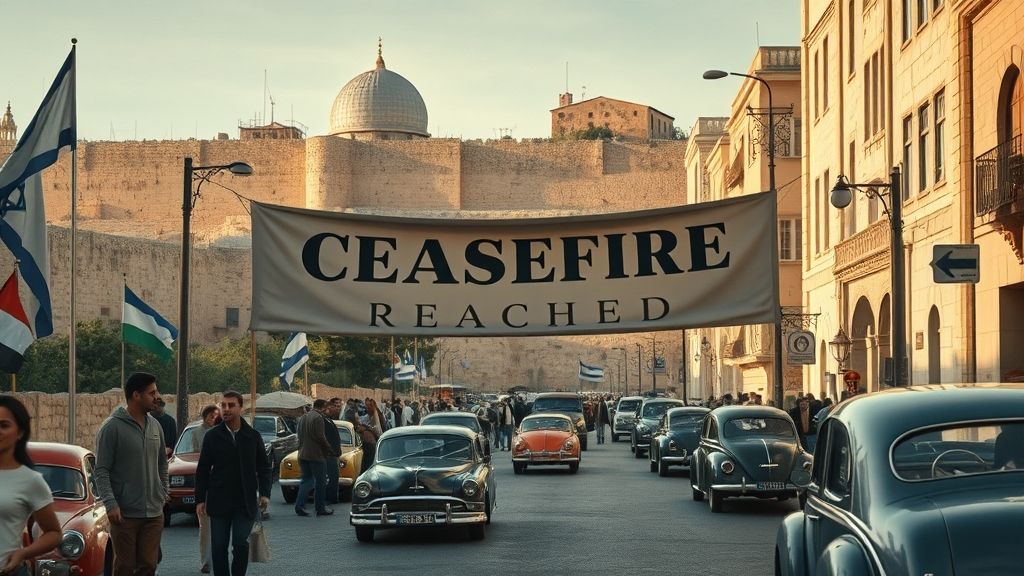
The morning light that crept over Jerusalem on June 10, 1967, filtered through a haze of dust, smoke, and the lingering echoes of gunfire. Streets once lively were eerily quiet, sidewalks empty or littered with the debris of fierce battles just days past. From the ancient stones of the Old City to the modern neighborhoods beyond, fear and hope wrestled in the hearts of its inhabitants. For six relentless days, the city had been a crucible—caught between weapons and prayers, between old rivalries and new realities shaped by tanks, jets, and armies sweeping across borders.
But on this day, a fragile calm began to settle—a ceasefire had been reached. It promised an end to the whirlwind that was the Six-Day War. Yet, as Jerusalem’s residents looked toward a tentative peace, few could imagine how the reverberations of those few days of combat would echo through decades, reshaping lives, boundaries, and the very soul of the region.
2. Backdrop to War: The Tensions Brewing in the Middle East
The 1967 Six-Day War was not born overnight. It was the thundercloud after years of gathering storm—a volatile mix of nationalism, colonial legacies, ideological divides, and territorial disputes.
Following the 1948 Arab-Israeli War and Israel’s declaration of independence, tensions simmered beneath the surface between Israel and its Arab neighbors—Egypt, Jordan, Syria, and Iraq most notably. The question of Palestinian refugees, borders left undefined from 1948, and rising Arab nationalism fueled mutual distrust. Egyptian President Gamal Abdel Nasser’s rise ushered in a wave of pan-Arabism and heightened rhetoric against Israel.
By May 1967, Nasser’s closure of the Straits of Tiran—the crucial maritime passage for Israeli shipping—and the mobilization of Egyptian forces in Sinai had escalated tensions to the breaking point. Syria and Jordan entered the fray with demands for Israel's withdrawal from contested borders. Underneath lay the Cold War’s shadow, with the United States and Soviet Union jockeying for influence.
As diplomatic efforts faltered, the stage was set for a conflict that would redraw maps faster than anyone could anticipate.
3. The Strategic Gamble: Military Preparations and Alliances
The Six-Day War was as much a product of military calculation as political brinkmanship. Israel, heavily outnumbered, had to deploy a strategy that promised quick, decisive victories to nullify the overwhelming numerical advantage of its adversaries.
Israeli intelligence, led by the Mossad and cunning commanders, anticipated the moves of their neighbors. The plan was audacious: a preemptive strike against Egyptian airfields, followed by rapid ground offenses to seize key terrain.
Meanwhile, Arab states coordinated on paper yet struggled with mistrust and differing objectives. Jordan’s King Hussein was wary but eventually joined the conflict under Egyptian pressure. Syria, holding the Golan Heights, sought to harass Israeli borders, while Iraq and Lebanon offered limited support.
This mosaic of alliances and ambitions created a complex backdrop where every decision had profound consequences.
4. The Opening Gambit: Blitzkrieg of the Six-Day War
On the morning of June 5, 1967, Israel launched Operation Focus—an air assault that stunned the world. In a matter of hours, Israeli jets decimated much of the Egyptian Air Force on the ground, achieving air superiority that would be decisive for the war.
The ground forces moved swiftly thereafter. In the Sinai Desert, Israeli troops outmaneuvered Egyptian divisions, exploiting gaps and supply weaknesses. Against Jordan’s forces in the West Bank, fierce urban and hilltop combat engulfed cities and villages alike.
The war unfolded like a high-stakes chess game, with rapid conscriptions, swift tank battles, and infantry clashes punctuating the tense rhythm. The surprise and speed of Israel’s advances created both exhilaration and desperation.
5. Jerusalem on the Brink: The Battle for a Sacred City
Jerusalem—holy to Judaism, Christianity, and Islam—stood at the epicenter of the conflict. Since 1948, the city had been divided: Israel controlled the western side, Jordan held the historic Old City and East Jerusalem.
As the war intensified, Israeli forces pressed forward with determination to reunify Jerusalem. The Old City's narrow alleys and centuries-old stones became battlegrounds, echoing with gunfire and prayers alike.
The moment when Israeli paratroopers reached the Western Wall—a sacred place of Jewish worship—was steeped in emotional significance. Soldiers wept openly, civilians celebrated cautiously, but the reality was stark: the city’s fate hung on a knife’s edge.
6. The Role of Superpowers: The Cold War in the Desert
The 1967 conflict unfolded against the backdrop of the global Cold War. The Soviet Union was a staunch supporter of many Arab regimes, supplying weapons, intelligence, and diplomatic backing. Moscow openly condemned Israeli actions, heightening global tensions.
On the other hand, the United States, under President Lyndon B. Johnson, saw Israel as an important strategic ally in a volatile region. Washington's support was nuanced—publicly calling for ceasefire and responsible behavior while quietly assisting Israel.
Both superpowers were cautious to prevent escalation beyond the regional conflict. Diplomatic channels buzzed alongside the roar of jet engines, with secret backdoor negotiations and warnings flying between capitals.
7. From Sinai to the Golan Heights: Frontlines Expanding and Shifting
While Jerusalem might have captured hearts and headlines, the conflict was sweeping across multiple frontlines.
In the south, Israeli forces surged through the Sinai Peninsula, chasing Egyptian troops back and capturing vital positions. This campaign demonstrated tactical brilliance, including the crossing of the Suez Canal by armored units.
In the north, the Golan Heights—dominated by Syrian artillery positions—became fiercely contested. Israeli brigades scrambled up the rocky slopes, enduring heavy fire to wrest control from entrenched Syrian forces.
The rapid territorial changes unsettled the balance of power, as Israel effectively tripled the size of territory under its control within days.
8. June 10, 1967: The Long-Awaited Ceasefire Takes Hold
By June 10, after six days of intense fighting marked by staggering casualties and shifting grounds, all sides were exhausted.
Early that day, a UN-brokered ceasefire was accepted, signaling a halt to active hostilities. Field commanders lowered their weapons, wary but relieved.
In Jerusalem, the streets quieted for the first time in nearly a week. Families tentatively emerged from shelters, soldiers ceased fire, and radios broadcast the fragility of peace.
Yet the ceasefire was more than a pause—it was a testament to the limits of war-weariness, international pressure, and pragmatism amid seeming intransigence.
9. Inside the Ceasefire: Negotiations, Pressures, and Fragile Peace
Ceasefires on paper often conceal simmering tensions. Behind the scenes, intense negotiations unfolded.
The United Nations Security Council demanded immediate cessation of hostilities and withdrawal of forces to pre-war lines, which Israel rejected, citing security concerns.
Diplomats scrambled to draft resolutions; superpowers pressed allies; regional leaders calculated next moves. Egyptian President Nasser’s image was damaged, forcing him to temper rhetoric without conceding defeat too plainly.
Israel found itself in control of newfound territories but confronted an unenviable diplomatic tightrope—holding gains that were strategic and symbolic, while avoiding wider conflict.
10. The Aftermath: A Region Transformed Overnight
The ceasefire signaled the end of fighting but marked the beginning of profound change.
Israel’s territorial gains reshaped the map: East Jerusalem and the West Bank came under Israeli control, as did the entire Sinai Peninsula and the Golan Heights. This expansion altered demographics, economies, and geopolitical realities.
The Arab world reeled from defeat, confronting questions of leadership, identity, and future strategy. Palestinian displacement intensified, seeding decades of unresolved conflict.
Internationally, the war demonstrated Israel’s military prowess and changed U.S. involvement in the Middle East.
11. Political Reverberations in Israel and the Arab States
Within Israel, the war sparked national euphoria but also debate on the moral and political implications of occupied territories. Prime Minister Levi Eshkol solidified his position, while opposition figures like Moshe Dayan rose in prominence.
In Egypt, Nasser’s credibility suffered yet he remained a key figure. Jordan’s King Hussein faced internal pressures and eventual loss of the West Bank spurred political shifts.
Syria grappled with defeat and the loss of the Golan Heights, pushing them toward future conflicts.
Region-wide, the war deepened divisions, radicalized some factions, and inspired others toward diplomacy.
12. Human Stories Amid Silence: Civilians and Soldiers Reflect
Beyond generals and politicians, the Six-Day War touched millions of lives. Soldiers who stormed into battle recounted moments of terror, camaraderie, and surreal beauty amid destruction.
Civilians in Jerusalem witnessed the scars of conflict etched into their city and soul. Families reunited, mourned, or fled. Religious communities viewed the war through lenses of liberation, loss, or fear.
These personal narratives remind us of war's human cost, often eclipsed by headline statistics.
13. The Global Shift: How the Six-Day War Reshaped International Relations
The ceasefire and the war itself reverberated far beyond the Middle East.
Western powers reassessed alliances and strategies. The Soviet Union’s influence waned in some Arab states; the U.S. deepened ties with Israel and reexamined its role as a Middle Eastern power broker.
The conflict exposed vulnerabilities in international diplomacy and foreshadowed decades of volatile intervention and peace efforts.
14. The Status of Jerusalem: Symbolism, Sovereignty, and Struggle
Perhaps no issue was more consequential than the fate of Jerusalem.
The city, sacred to billions, was reunified under Israeli control for the first time in nearly two decades. Israel declared the whole city its eternal capital, a move not recognized internationally.
Palestinians and the Arab world viewed this as occupation and injustice. The city's status fueled religious passion, political activism, and became a core obstacle in peace negotiations ever since.
15. Legacy of the Ceasefire: Seeds of Future Conflicts and Attempts at Peace
While the ceasefire ended fighting, it planted seeds of future turmoil.
Israel’s control of disputed land resulted in settlement policies, insurgencies, and periodic flare-ups. The Palestinian national movement gained urgency and international attention.
Subsequent wars—including the 1973 Yom Kippur War—and ongoing diplomatic efforts bear the imprint of 1967’s outcomes.
The ceasefire was not an ending, but a pivotal chapter in an unfinished story.
16. Memory and Myth: How the War Lives On in Collective Consciousness
The Six-Day War—and its ceasefire—have entered lore, memory, and narrative.
In Israel, 1967 remains a symbol of survival and divine favor, commemorated annually with reverence. Arab communities often recall it as a catastrophe and a call to resistance.
The event shaped literature, film, education, and political rhetoric. Memory itself became a battleground, informing identities and fueling disputes.
17. Lessons from the 1967 Ceasefire: Diplomacy and Military Might
What does the ceasefire teach us?
It illustrates the dual-edged nature of military conquest and diplomatic urgency. Swift victories cannot erase deep-rooted conflicts. International mediation, while essential, often contends with local realities and national pride.
The Six-Day War ceasefire is a reminder that peace is fragile, requiring constant nurture beyond the battlefield.
18. Conclusion: The Ceasefire That Paused the Guns, Not the Disputes
June 10, 1967, was a day when silence briefly reigned over battle-fatigued lands and fractured cities. The Six-Day War ceasefire spared further bloodshed—a momentary breath between storms.
Yet beneath that silence simmered unresolved grievances, territory contested, and peoples yearning for dignity and peace.
The ceasefire was a pause, not a cure—a testament to the complexity of conflict and the enduring hope for reconciliation in a land soaked with history and belief.
FAQs: Understanding the Six-Day War Ceasefire
Q1: What triggered the Six-Day War initially?
A1: The war was sparked by mounting tensions from territorial disputes, military buildups, and political rhetoric, culminating in Egypt closing the Straits of Tiran and massing troops in Sinai.
Q2: Why was the ceasefire reached on June 10, 1967?
A2: Exhaustion, international pressure from the UN and superpowers, and battlefield realities made all parties agree to halt active combat.
Q3: What territories changed hands due to the war and ceasefire?
A3: Israel captured the Sinai Peninsula, Gaza Strip, West Bank including East Jerusalem, and the Golan Heights.
Q4: How did the ceasefire impact the status of Jerusalem?
A4: Jerusalem was reunified under Israeli control, a highly contentious and symbolic outcome that remains disputed.
Q5: What was the role of the United Nations regarding the ceasefire?
A5: The UN brokered ceasefire resolutions, calling for cessation of hostilities and attempts at withdrawal to pre-war boundaries.
Q6: How did the ceasefire influence future Middle East peace efforts?
A6: It set the stage for ongoing conflict and peace negotiations, including the Camp David Accords and Oslo Process decades later.
Q7: Who were the key figures influencing the ceasefire agreement?
A7: Among them were Israeli Prime Minister Levi Eshkol, Egyptian President Gamal Abdel Nasser, Jordan’s King Hussein, UN diplomats, and great powers’ representatives.
Q8: What is the legacy of the Six-Day War ceasefire today?
A8: It remains a critical reference point in understanding Middle East geopolitics, conflict dynamics, and the quest for peace.