Table of Contents
- The Streets Ignite: May 3, 1968, Paris Awakens
- The Seeds of Discontent: Postwar France and Its Uneasy Calm
- Student Restlessness in the Sixties: The Spirit of Revolution in Youth
- The University of Nanterre: Where the Flame First Flickers
- Early Clashes: Police, Protesters, and the Spark of Violence
- The Expansion: From Students to Workers, A Nation on the Verge
- The Role of Media: How Radio and Press Amplified the Crisis
- Charles de Gaulle’s France: Authority under Threat
- The General Strike: Unprecedented Worker Solidarity
- Nuit des Barricades: Paris Reclaims Its Revolutionary Heritage
- Cultural Shifts and Artistic Responses to the May Upheaval
- Women in the Protests: Silent No More
- The Government’s Countermeasures: Negotiations and Repression
- The May Days in the Factories: The Working-Class Perspective
- Intellectuals and Thought Leaders: Voices from the Left
- The Global Impact: May ’68 Echoes Worldwide
- The Collapse of the Movement: Fragmentation and Fatigue
- The Aftermath: Political, Social, and Cultural Transformations
- May ’68 in Memory: Myths, Realities, and the Passage of Time
- Legacy of May 1968: The Enduring Spirit of Rebellion
1. The Streets Ignite: May 3, 1968, Paris Awakens
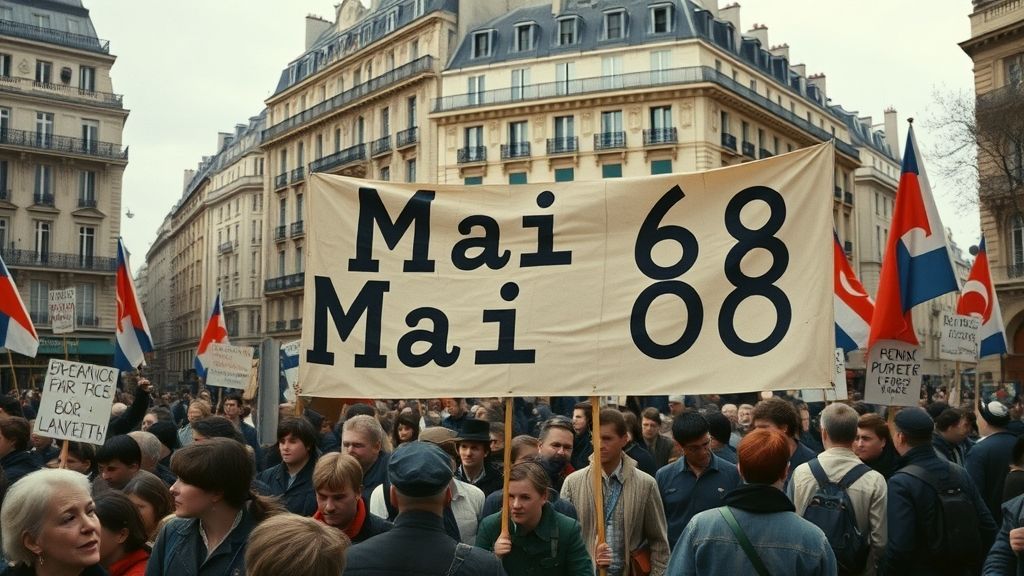
The dawn of May 3, 1968, broke over Paris with an uneasy quiet, but beneath that deceptive calm, an impassioned storm was swelling. On the sidewalks of the Latin Quarter, clusters of young men and women gathered furtively, their faces flushed with both the chilly spring air and fierce determination. The scent of unrest hung heavy in the air—smoke from earlier clashes, graffiti scrawled defiantly on university walls, and whispered discussions about revolution and reform.
This was no ordinary morning. It marked the ignition point when simmering grievances erupted into open conflict—student protests spiraled into national upheaval. Barricades rose, slogans shouted, tear gas lingered like a shadow. The city, the heart of France’s heritage and power, stood transformed—caught in a crucible of transformation stretching far beyond its cobbled streets.
To understand why Paris pulsed with this rebellious energy, one must unravel the tangled fabric of social, political, and generational tensions woven over the preceding decades. What began as a localized student protest would soon fragment the very foundation of French society. Fifty years later, the ghost of May ‘68 remains vivid—a symbol of youthful idealism, fierce confrontation, and the enduring quest for freedom.
2. The Seeds of Discontent: Postwar France and Its Uneasy Calm
The France of 1968 was a nation caught between triumph and turmoil. In the nearly two decades following World War II, “Les Trente Glorieuses” — thirty glorious years — witnessed impressive economic growth, modernization, and the construction of a welfare state. Yet, beneath this buoyant progress, discontent brewed. Traditional hierarchies clashed with emerging social mores, and the rapid urbanization alienated many.
Politically, Charles de Gaulle’s Fifth Republic, established in 1958, had restored a measure of stability following the chaos of the Fourth Republic. Yet de Gaulle’s vision of a strong, centralized state—and his own towering presence—began to chafe against a society increasingly hungry for change. The colonial wars in Algeria and Indochina, with their bitter divisions and traumatic legacies, haunted the French collective psyche.
Young people were coming of age in a society that prized conformity, discipline, and deference to authority. University life was hierarchical and stifling, labor conditions often rigid, and social mobility uneven. The “peaceful” façade of French society concealed a brewing rebelliousness, a generation yearning to redefine democracy, freedom, and justice in their own terms.
3. Student Restlessness in the Sixties: The Spirit of Revolution in Youth
The youth of 1968 France did not emerge in a vacuum. Across much of the Western world, a cultural revolution was underway—music, art, literature, and political activism merged to challenge established norms. The radical left, anti-imperialist movements, women's liberation, and civil rights struggles inspired a new vision of society that rejected consumerism, traditional hierarchies, and war.
French students, mostly young, idealistic, and poorly represented in political institutions, confronted universities that felt outdated, elitist, and disconnected from their lived realities. Struggles at institutions such as Sorbonne and Nanterre became test beds for wider social critiques.
French philosopher Henri Lefebvre’s theories on everyday life and space, and the influence of existentialists like Jean-Paul Sartre, gave intellectual heft to the growing unrest. Students called not merely for reform but for a transformation—a revolution against alienation and authoritarianism.
4. The University of Nanterre: Where the Flame First Flickers
In March 1968, the University of Nanterre, just outside Paris, became the epicenter of protest. Originally a modern and relatively liberal institution, Nanterre attracted a large number of politically engaged students. A dispute over campus regulations—such as curfews and restrictions on access to the women’s dormitories—soon escalated into broader demands for academic freedom and political expression.
Encouraged by radical groups like the Mouvement du 22 Mars, students occupied administrative buildings, organized sit-ins, and staged demonstrations. The university’s director, fearful of losing control, called the police, leading to violent confrontations that ignited further anger.
The authorities’ heavy-handed response only deepened resistance. By late April, Nanterre’s closure by police was interpreted as a direct attack on freedom itself. Students moved their protest to the Sorbonne in central Paris, swelling the ranks and visibility of the movement.
5. Early Clashes: Police, Protesters, and the Spark of Violence
The early days of May were a powder keg. On May 3, 1968, as thousands of students gathered in the Latin Quarter to resist the police closure of the Sorbonne, the confrontation turned violent. Batons cracked, tear gas filled the streets, and striking imagery of youths throwing stones against riot squads flooded the media.
What made these clashes so powerful was their symbolism. Paris had not witnessed street fighting on this scale since the 1930s, and the protesters skillfully evoked echoes of the Paris Commune and the French Revolution, raising barricades and chanting “Sous les pavés, la plage!” (“Beneath the pavement, the beach!”)—a slogan that captured the depth of their alienation and longing.
These violent outbreaks galvanized broader sectors of society. Workers, intellectuals, and artists began taking sides, as the movement expanded far beyond student circles. The city teetered on the edge of upheaval.
6. The Expansion: From Students to Workers, A Nation on the Verge
By mid-May, what started as a student rebellion broadened into an unprecedented social movement involving millions of French workers. Factories and public services paralyzed by strikes; transport grids immobilized; entire industries coming to a halt.
The General Confederation of Labour (CGT), France’s largest trade union, hesitated initially but rapidly gained momentum. Between May 13 and May 20, the nation witnessed the largest general strike in French history, with nearly 10 million workers refusing to work—a staggering figure that brought the country to a standstill.
This phase revealed the deep socio-economic fractures in French society. The struggles of urban working-class neighborhoods, the demands for better wages, improved working conditions, and greater participation in decision-making, resonated widely.
7. The Role of Media: How Radio and Press Amplified the Crisis
In 1968, the media landscape was very different from today. Television was still growing, but radio and newspapers remained the primary channels of information. The media’s portrayal of the protests oscillated between alarm and fascination.
On one hand, government-controlled outlets framed protesters as troublemakers or radicals threatening national order. On the other, alternative publications like “Salut les Copains” and underground newspapers gave voice to the revolutionaries, spreading slogans and ideals.
Radio became a crucial tool for coordination among protesters, while foreign reporters amplified the crisis internationally. The relentless media glare turned May ’68 into a spectacle; Paris was at the center of global attention.
8. Charles de Gaulle’s France: Authority under Threat
General de Gaulle, the towering figure of postwar France, was caught unprepared by the scale and spontaneity of the protests. His image as a decisive leader seemed brittle against the new reality of mass dissent.
Initially, de Gaulle appeared to underestimate the movement, retreating into silence. The government’s attempts at repression further alienated moderate voices. Some in the administration debated calling in the army to restore order, but de Gaulle’s reluctance to risk civil war showed his sensitivity to the stakes.
His decision to briefly disappear to Germany to consult with the military underscored his precarious position: the leader of a nation teetering between revolution and order.
9. The General Strike: Unprecedented Worker Solidarity
The mass strike that erupted midway through May represented a historic moment for the French labor movement. Thousands marched, barricaded the streets, and occupied factories.
But it was not just economic grievances fueling the strikes. Workers adopted political demands: calls for participatory democracy in workplaces, union rights, and social justice intertwined with the students’ calls for a freer society.
Negotiations between unions, government, and employers culminated in the Grenelle Agreements—offering wage increases and some reforms. Yet many workers felt the concessions insufficient, emboldening radical factions within the movement.
10. Nuit des Barricades: Paris Reclaims Its Revolutionary Heritage
The nights of May resembled scenes from revolutionary paintings. Barricades, cobbled together from park benches, cars, and cobblestones, sliced through narrow streets. Clashes with police erupted under the eerie glow of street lamps and burning rubbish piles.
Paris, city of revolutions—the 1789 storming of the Bastille, the 1848 uprising, the Paris Commune—reconnected with its own history. Many protesters consciously saw themselves as inheritors of this radical legacy.
The “Nuit des Barricades” in early May became a symbol of defiance, courage, and a refusal to submit to outdated structures.
11. Cultural Shifts and Artistic Responses to the May Upheaval
The cultural dimension of May ’68 is often overlooked but was profound. Writers, filmmakers, musicians, and artists joined the protests or expressed solidarity through their work.
The upheaval challenged traditional cultural norms—sexual liberation, anti-consumerism, critique of bourgeois values became dominant themes. Iconic musicians like Georges Moustaki and Serge Gainsbourg encapsulated mood and aspirations.
Cinema, too, took up the cause: directors such as Jean-Luc Godard, who briefly suspended commercial projects to participate politically, exemplified how art and politics blurred.
12. Women in the Protests: Silent No More
While often overshadowed in narratives dominated by male figures, women played critical and multifaceted roles in May ’68. From organizing demonstrations to articulating feminist demands, they challenged both state authority and patriarchal structures within the movement.
The explosion of traditional gender roles was part of the wider revolution—a precursor to the feminist movements of the 1970s in France and beyond. Women demanded autonomy, equality, and the end of repression against female sexuality.
May ’68, therefore, was not only a political and social upheaval but also a cultural rupture questioning the foundations of gender norms.
13. The Government’s Countermeasures: Negotiations and Repression
Facing paralysis, the government attempted a dual strategy: negotiation intertwined with repression. The Grenelle Agreements aimed to satisfy workers’ demands but fell short of pacifying radicals.
Police interventions continued, demonstrations were often violent, and several arrests were made. The administration feared a full-scale revolution and maneuvered carefully to avoid escalation.
Yet, repression often fueled further outrage, deepening the divides in French society.
14. The May Days in the Factories: The Working-Class Perspective
The working-class experience during May 1968 was not monolithic. In sprawling factories like Renault and Citroën, workers debated between cautious unionism and revolutionary zeal.
While some were primarily motivated by wage demands and job security, others were inspired by the vision of participatory democracy and social transformation.
Their strikes and occupations gave the movement mass force, but also exposed wartime class tensions and political fractures that complicated unity.
15. Intellectuals and Thought Leaders: Voices from the Left
May ’68 reverberated strongly among Paris’s intellectual circles. Figures like Jean-Paul Sartre, Simone de Beauvoir, and Michel Foucault joined, at least rhetorically, the chorus of dissent.
Sartre’s calls for direct action, his refusal to accept established authority, and his role as a moral beacon exemplified the intellectual engagement with the movement.
Yet, divisions appeared, with the Communist Party and other leftist factions debating the best approach and degree of support for the spontaneous uprising.
16. The Global Impact: May ’68 Echoes Worldwide
Though intensely French, May ’68 quickly inspired waves of protest around the globe. From the United States and Mexico to Czechoslovakia and Mexico City, the spirit of rebellion, defiance of authority, and radical critique of capitalism and imperialism found powerful expression.
The events resonated particularly with civil rights, antiwar, and feminist movements internationally, showing the interconnectedness of global struggles in the 1960s.
May ’68 thus became a key reference point for revolutionary energies worldwide.
17. The Collapse of the Movement: Fragmentation and Fatigue
Despite initial success, the movement faced fragmentation by late May and June 1968. Political differences, strategic disagreements, and exhaustion set in.
The government’s return to order, bolstered by the July legislative elections won decisively by de Gaulle’s party, signaled the limits of the uprising.
Many activists faced repression, others returned quietly to daily life, leaving a bittersweet legacy.
18. The Aftermath: Political, Social, and Cultural Transformations
Though the immediate revolutionary hopes were dashed, May ’68 left an indelible mark on France. Politically, it rejuvenated the Left and prompted social reforms. Workers gained better wages and conditions; the youth’s demands influenced education reform.
Culturally, it accelerated liberation movements, challenged conservative values, and reshaped French society’s contours.
Psychologically, the event ruptured complacency, inspiring subsequent generations to continue questioning authority.
19. May ’68 in Memory: Myths, Realities, and the Passage of Time
Over time, May ’68 acquired a mythic status, both glorified as the ultimate youth revolt and criticized as naive or self-indulgent.
Films, books, and commemorations continue to explore its contradictions—between idealism and reality, spontaneity and organization.
For many, it remains a symbol of possibility; for others, a cautionary tale.
20. Legacy of May 1968: The Enduring Spirit of Rebellion
More than fifty years on, the spirit of May 1968 continues to inspire. Whether in France’s vibrant social movements, or globally in struggles for justice, equality, and freedom, the echoes of that spring remain.
May ’68 reminds us that history is alive, shaped by those who dare to dream and dare to act, even when the odds seem insurmountable.
It also teaches us about the complexities of change—the fervor, the joy, the pain, and the necessity of both courage and compromise.
Conclusion
May 1968 was not merely a protest or a strike; it was a profound rupture, a moment when youth, workers, and intellectuals dared to remake society in the image of their hopes. The barricades were not just physical—they were barriers against conformity, repression, and injustice.
While the immediate political upheaval dissipated, the cultural and social transformations it sparked continue to reverberate. May ’68 challenges each generation to reckon with authority and envision a better world.
In the echo of the chants and the smoke of the barricades, the eternal quest for freedom, dignity, and human connection persists. That is the human heart of May 1968, that is its lasting legacy.
FAQs
Q1: What were the main causes of the May 1968 protests in Paris?
The protests were fueled by a combination of political dissatisfaction, societal conservatism, economic inequality, rigid university structures, and a global rise in youth activism challenging authority.
Q2: Who were the key actors involved in the May ’68 protests?
Students and young intellectuals initiated the movement, supported later by workers, trade unions, artists, and prominent leftist intellectuals like Jean-Paul Sartre.
Q3: How did Charles de Gaulle respond to the crisis?
De Gaulle initially appeared uncertain but ultimately used both negotiation and repression strategies; he briefly left the country to consult military leaders and called for new elections to restore authority.
Q4: What role did the workers and unions play during May ’68?
Workers staged the largest general strike in French history, demanding better wages and workplace democracy, greatly expanding the movement from students to a wider social upheaval.
Q5: How did May 1968 influence French society and politics afterward?
It led to significant cultural liberalization, reforms in education and labor rights, and revitalized left-wing politics, reshaping France’s social landscape.
Q6: Why is May 1968 still remembered and commemorated today?
It symbolizes the power of collective action, youthful idealism, and the ongoing struggle against authoritarianism; it remains a touchstone for social and political activism.
Q7: How did the media shape the perception of May ’68?
The media both sensationalized violence and provided a platform for dissenting voices, amplifying the movement's visibility nationally and internationally.
Q8: Were women prominently involved in the May ’68 protests?
Yes, women played crucial roles in organizing and articulating feminist demands, contributing to broader cultural and social transformations.