Table of Contents
- The Dawn of a New Era: Prague Springs to Life
- Seeds of Discontent: Czechoslovakia Before 1968
- Alexander Dubček: The Man of Velvet Promises
- The Political Climate of the Eastern Bloc: Breathing Under Soviet Shadow
- Early Whispers of Reform: Intellectuals and Dissidents Take a Stand
- April 1968: The Prague Spring Reforms Announced
- Reforming the State: Plans for “Socialism with a Human Face”
- The Role of Media and Freedom of Expression in the Spring
- Public Reaction: A Wave of Hope and Enthusiasm
- International Eyes on Prague: Western Optimism and Soviet Anxiety
- The Limits of Reform: Negotiations Within the Communist Party
- The Soviet Response: From Tolerance to Trepidation
- The Warsaw Pact’s Foreboding: Military Threat Looms
- August 1968: The Soviet-Led Invasion—The Crushing of a Dream
- The Aftermath: Political Repression and Reversed Reforms
- The Human Cost: Stories of Resistance and Resilience
- The Prague Spring in Cold War Memory and Legacy
- Echoes Beyond 1968: Influence on Future Reform Movements
- Cultural Imprint: Art, Literature, and the Spirit of Prague Spring
- The Global Significance: Lessons in Freedom and Oppression
- Conclusion: The Velvet Legacy of a Delicate Revolution
- FAQs: Understanding the Prague Spring
- External Resource
- Internal Link: Visit History Sphere
The Dawn of a New Era: Prague Springs to Life
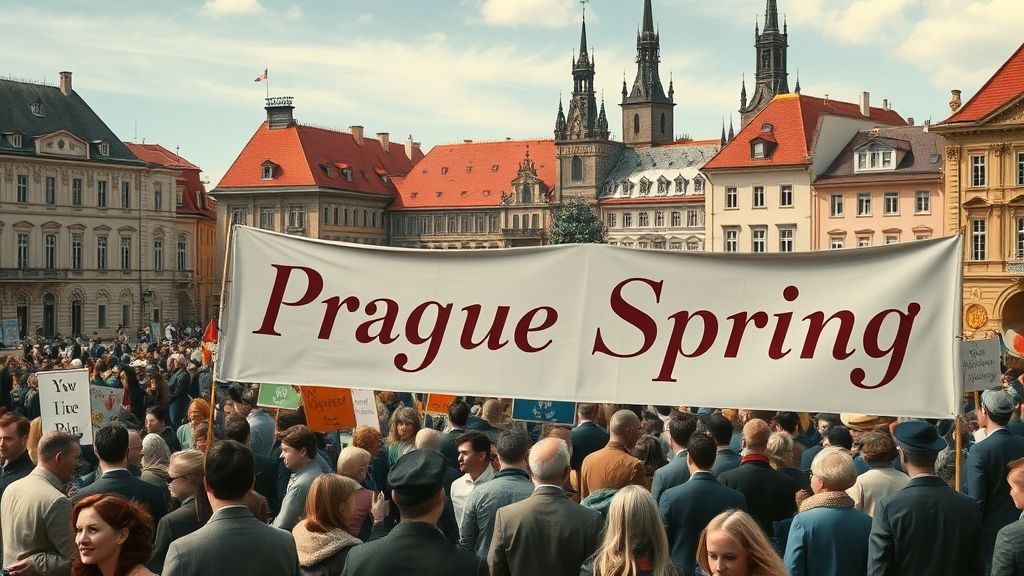
In the crisp, electric air of early April 1968, the city of Prague stirred with something unspoken yet palpable — a surge of hope woven into every whispered conversation, every cautious smile exchanged on bustling streets. The ancient city, with its Gothic spires and baroque facades, was awakening from a long political slumber. Lights glittered in café windows where intellectuals debated feverishly; youth poured into squares; workers gathered with tentative optimism. The Prague Spring was unfolding—an audacious experiment promising reform, freedom, and a "socialism with a human face."
The announcement of sweeping reforms that month marked a break in the suffocating post-war order. Yet beneath the excitement lurked an awareness of risk — that forces far beyond Czechoslovakia's borders could quash this fragile flowering. What was this moment in history? How did it bloom, and why did it wither so swiftly? To understand the Prague Spring is to immerse in a narrative of hope, courage, political tension, and the enduring quest for dignity amid oppression.
Seeds of Discontent: Czechoslovakia Before 1968
To grasp the significance of the Prague Spring reforms announced in April 1968, we must first rewind a decade and more. Post-World War II Czechoslovakia fell into the Soviet sphere, its fate intertwined with the iron grip of Stalinism. The 1948 Communist coup installed a regime marked by rigid control, suppression of dissent, and centralized economic planning. The country’s dynamic democratic traditions seemed smothered under ideological orthodoxy.
Yet the seeds of dissatisfaction had been quietly accumulating. The economy, shackled by inefficiency, stagnated; citizens chafed under censorship; intellectuals and artists found their voices stifled. Czechoslovakia, despite being a loyal member of the Soviet bloc, nursed an undercurrent of yearning—for freedom, for reform, for respect of human rights. The death of Stalin in 1953 and later Khrushchev’s "thaw" elsewhere raised expectations that change might be possible. But it was not until the 1960s that these hopes gained momentum.
Alexander Dubček: The Man of Velvet Promises
Into this tense atmosphere emerged Alexander Dubček, a Slovak communist party official known for his reformist leanings and reform-minded vision. His rise to First Secretary of the Communist Party of Czechoslovakia in January 1968 symbolized a rare chance for real change from within. Dubček promised a new direction—more openness, less repression, greater participation by the people.
Dubček’s charm did not lie in flamboyance but in the quiet determination of his rhetoric. He spoke of "socialism with a human face," bridging party loyalty with a vision of democracy and freedom. It was not an outright rejection of communism but an appeal to reform and modernization. His ascent galvanized a broad coalition of allies—artists, students, workers—who dared to entertain a Poland-style thaw but in bolder hues.
The Political Climate of the Eastern Bloc: Breathing Under Soviet Shadow
While Prague dreamed of reform, the geopolitical environment was fraught with tension. The Soviet Union, under Leonid Brezhnev, was wary of any challenge to its dominion over Eastern Europe. The Warsaw Pact nations, bound by military alliances and ideological discipline, offered little room for deviation.
The Cold War had hardened the East-West divide, and Soviet leadership perceived reforms in Czechoslovakia not just as domestic politics but as existential threats. Could such liberalization inspire other satellite states to break free? For Moscow, stability dictated harsh control. Thus, the Prague Spring unfolded amidst a geopolitical tinderbox, where local hopes clashed with international fears.
Early Whispers of Reform: Intellectuals and Dissidents Take a Stand
Long before official reform announcements, intellectuals, writers, and students had been voicing their frustrations. The Prague Spring owed much to these social undercurrents: publications that cautiously pushed boundaries, cultural gatherings that questioned rigid dogma, and political debates that reawakened civic consciousness.
Jan Palach's impassioned speeches, underground journals, and spirited university discussions transformed Prague into a hub of ferment. The regime’s attempts at suppression only fueled the fire. By early 1968, it was clear that the old ways no longer satisfied; the people demanded change, including fundamental freedoms of speech, press, and association.
April 1968: The Prague Spring Reforms Announced
April 1968 was a defining month. The official announcement of reforms by Dubček’s new government was both thrilling and daunting. The program outlined sweeping changes: abolishing censorship, enhancing citizens’ rights, decentralizing economic control, and rehabilitating victims of past purges.
This was not mere symbolic rhetoric—it was a bold blueprint to remake society on democratic-socialist principles. The reforms promised a vibrant public sphere, free elections within the Communist framework, open discussion of political and economic shortcomings, and labor unions' empowerment.
Reforming the State: Plans for “Socialism with a Human Face”
"Socialism with a human face" became the rallying cry of the Prague Spring. It embodied the attempt to reconcile Marxist ideals with human dignity and liberty. The reforms sought to transform Czechoslovakia into a model of democratic socialism, more responsive to citizens’ needs than the Soviet-style command economy and single-party rigidity dominant elsewhere.
Dubček and his allies envisioned political pluralism limited within the party, an independent judiciary, and a decentralized media landscape. Economic reforms aimed at increasing productivity through market mechanisms and worker participation. It was a tremendous gamble—redefining socialism rather than abandoning it.
The Role of Media and Freedom of Expression in the Spring
Perhaps the most vivid symbol of the Prague Spring was the blossoming media freedom. Newspapers and magazines flourished as censorship relaxed; previously forbidden subjects appeared openly in print. Radio and television began broadcasting debates and critiques of the regime.
This explosion of expression ignited public enthusiasm but also alarmed the party hardliners and the Kremlin. The vibrant public discourse fueled hopes for broader political change—potentially beyond the control of any single party. The media became the pulse of the revolution, chronicling dreams and fears alike.
Public Reaction: A Wave of Hope and Enthusiasm
The people’s response to the reforms was extraordinary. Crowds gathered in Wenceslas Square, artists painted provocative murals, workers held assemblies discussing the future, and street signs bore slogans of hope and renewal. The Prague Spring inspired a nationwide enthusiasm rarely seen under Communist regimes.
Yet, not everyone was convinced; conservative party members and Soviet officials warned that such rapid changes could spiral out of control. Nevertheless, for many citizens, April 1968 felt like a historic liberation from decades of fear and repression—a chance to reclaim their lives.
International Eyes on Prague: Western Optimism and Soviet Anxiety
News of Prague Spring reforms rippled beyond Czechoslovakia’s borders. Western media portrayed Dubček as a hero of democratic socialism and a beacon of hope behind the Iron Curtain. Intellectuals worldwide celebrated his vision, believing that the Cold War might thaw further.
Conversely, Moscow reacted with increasing alarm. The leadership feared that Czechoslovakia’s experiment might weaken Warsaw Pact unity and embolden other member states. Balancing diplomacy and threats, the Soviet Union oscillated between cautious dialogue and preparations for intervention.
The Limits of Reform: Negotiations Within the Communist Party
Despite public zeal, the Prague Spring’s reforms faced significant internal resistance from hardliner factions within the Czechoslovak Communist Party. The governance apparatus, accustomed to centralized authority, was slow to adjust. Behind closed doors, debates grew bitter over the pace and extent of reforms.
Dubček navigated a treacherous path—seeking to keep the party united while responding to popular demands. Yet the underlying tension between revolutionary ambition and political reality was ever-present, underscoring the fragility of the moment.
The Soviet Response: From Tolerance to Trepidation
The Soviet Union’s initial cautious tolerance shifted rapidly into trepidation by spring’s end. Brezhnev, prioritizing Soviet control, demanded curbs on reforms, fearing ideological contagion across Eastern Europe. Diplomatic notes, warnings, and pressures escalated from May onward.
Moscow insisted on preserving the status quo; any deviation was deemed counter-revolutionary. Faced with recalcitrant Czechoslovak leadership, Soviet patience wore thin. The crescendo of tensions hinted at an impending, possibly violent, resolution.
The Warsaw Pact’s Foreboding: Military Threat Looms
As political warnings failed to bring compliance, the Warsaw Pact countries—Soviet Union, East Germany, Poland, Hungary, and Bulgaria—prepared a military intervention. The looming specter of tanks and troops cast a shadow over Prague’s aspirations.
The military buildup was not a secret. Rumors of an invasion spread, but many hoped that force would not be used. For those living the experiment, the possibility of a brutal crackdown seemed almost surreal—yet the tension was unbearable.
August 1968: The Soviet-Led Invasion—The Crushing of a Dream
On the night of August 20-21, waves of Warsaw Pact troops and tanks rolled into Prague. The operation, swift and overwhelming, crushed the Prague Spring. Dubček and other reformers were arrested or forced into submission.
Citizens greeted tanks with flowers, but resistance was quickly subdued. The joyous optimism of only months before gave way to shock, despair, and mourning. The dream of "socialism with a human face" was violently stifled, replaced by tightened authoritarian rule.
The Aftermath: Political Repression and Reversed Reforms
In the wake of the invasion, purges and repression swept through Czechoslovakia. The reforms were dismantled, free press clamped down, and dissidents silenced. Dubček was replaced by a hardliner, Gustáv Husák, signalling a "normalization" period of restored Soviet control.
The Prague Spring’s memory was suppressed domestically, but it lived on quietly in exile circles and underground movements. The invasion made clear to all the costs of resisting Soviet dominance in Eastern Europe.
The Human Cost: Stories of Resistance and Resilience
Beyond political events lay innumerable personal stories—journalists jailed, students exiled, families torn apart. Yet courage endured. Acts of small resistance—a banned book circulated in secret, a whispered poem, a hidden gathering—spoke of a human spirit unbroken.
Jan Palach’s later self-immolation was a tragic testament to the despair and ongoing struggle for freedom. The Prague Spring inspired a generation to believe in human dignity despite overwhelming oppression.
The Prague Spring in Cold War Memory and Legacy
In Cold War history, the Prague Spring remains a defining episode—a symbol of hope cut short, reform crushed by force. It revealed the limits of Soviet tolerance and highlighted the cracks in the communist monolith.
For decades, it shaped dissident movements, influenced policy debates, and was a touchstone for human rights advocacy. Its memory challenges us to remember the difficult path toward freedom and the cost it exacts.
Echoes Beyond 1968: Influence on Future Reform Movements
The Prague Spring foreshadowed later upheavals—Solidarity in Poland, the Gorbachev era reforms, and eventually the Velvet Revolution of 1989. Its lessons echoed in history as proof that authoritarian regimes could be challenged, even if suppressed temporarily.
Activists worldwide drew inspiration from Czechoslovakia’s brief moment of liberation, holding on to the idea that change, however difficult, was possible.
Cultural Imprint: Art, Literature, and the Spirit of Prague Spring
The return of artistic freedom during the Prague Spring generated a burst of creative energy—films, literature, music—that challenged dogma and celebrated individual expression. This cultural renaissance enriched Czech identity and became part of the nation’s soul.
Artists like Václav Havel emerged from this milieu, later becoming leading figures in Czechoslovakia’s democratic transition. The Spring was as much a cultural awakening as a political one.
The Global Significance: Lessons in Freedom and Oppression
The Prague Spring exposed the contentious dialectic between the desire for freedom and the reality of power politics. It was a stark reminder of the suppression many faced in the Cold War world and the courage required to resist.
Its global significance endures as a cautionary tale and an inspiration. The delicate balance between reform and repression continues to resonate in struggles for democracy worldwide.
Conclusion
The Prague Spring of 1968 was a fleeting yet luminous chapter in 20th-century history—a moment when dreams of liberty and justice blossomed amid the iron grip of a totalitarian regime. It was a testament to the human yearning for dignity, the courage to envision a better society, and the tragic costs when such visions threaten entrenched power.
Though brutally suppressed, the ideas sown in those spring months nourished the spirit of resistance for decades. The legacy of the Prague Spring remains a beacon—reminding us that even in the darkest moments, hope can take root, and the human face of socialism, or any ideology, must always remember the people it serves.
FAQs
Q1: What were the main causes behind the Prague Spring reforms?
A: The causes included economic stagnation, political repression, intellectual ferment, and growing dissatisfaction with Soviet-style communism. Citizens and leaders wanted to create a more humane, democratic socialism.
Q2: Who was Alexander Dubček and what role did he play?
A: Dubček was the reformist leader of the Czechoslovak Communist Party who introduced the Prague Spring reforms promising "socialism with a human face," combining Communist principles with political liberalization.
Q3: How did the Soviet Union react to the Prague Spring?
A: Initially cautious, the Soviet Union became increasingly alarmed, seeing the reforms as a threat to Eastern Bloc unity, culminating in a military invasion in August 1968 to suppress the movement.
Q4: What were the key reforms announced in April 1968?
A: Reforms included abolishing censorship, enhancing civil freedoms, decentralizing economic planning, allowing limited political pluralism, and empowering workers and trade unions.
Q5: What was the international reaction to the Prague Spring?
A: Western countries expressed support and optimism for reform in the Eastern Bloc, while the Soviet Union and its allies viewed it as a dangerous challenge to their control.
Q6: What happened after the Soviet-led invasion?
A: Reforms were reversed, political repression intensified, and "normalization" policies restored strict Communist control. Many reformers were arrested or sidelined.
Q7: How is the Prague Spring remembered today?
A: It is remembered as a symbol of hope, courage, and tragic loss, inspiring later democratic movements in Czechoslovakia and worldwide.
Q8: Did the Prague Spring have any lasting cultural impact?
A: Yes, it sparked a cultural renaissance influencing literature, theatre, and art, and nurturing leaders like Václav Havel who later steered Czechoslovakia to democracy.