Table of Contents
- The Calm Before the Storm: Czechoslovakia in Early 1968
- Seeds of Reform: The Prague Spring Awakens
- Alexander Dubček: The Man Behind the Velvet Vision
- Hopes and Fears: The Czechoslovak People Embrace Change
- The Brezhnev Doctrine Looms: Soviet Concerns Intensify
- August 20, 1968: The Night of Silent Tanks
- Dawn of Invasion: Warsaw Pact Troops Enter Prague
- The Shock and Silence: How Prague Reacted to the Occupation
- Acts of Defiance: Nonviolent Resistance Amidst Occupation
- International Response: Between Condemnation and Realpolitik
- Leaders Under Pressure: Political Maneuvers Behind Closed Doors
- The Crushing of Reform: The Imposition of “Normalization”
- Life Under Occupation: The Everyday Reality in Czechoslovakia
- Cultural and Intellectual Resistance: Keeping the Spirit Alive
- The Cold War Context: The Invasion’s Global Ripple Effects
- The Shape of Soviet Hegemony: Brezhnev Doctrine Institutionalized
- Voices from the Past: Personal Accounts and Memoirs
- The Long Shadow: How 1968 Shaped Post-Communist Czechoslovakia
- Memory and Reconciliation: Commemorating the August Invasion
- Lessons in Freedom: The Legacy of the Prague Spring Today
1. The Calm Before the Storm: Czechoslovakia in Early 1968
On a warm spring morning in Prague, the city hummed with a nervous energy, the kind that precedes momentous change. The air, heavy with the scent of blooming chestnut trees, carried whispers of something extraordinary about to unfold. It was 1968, and the iron grip of Soviet-style communism that had dominated Eastern Europe for decades was subtly loosening—at least, in this small country nestled in the heart of Europe. For many Czechoslovaks, the year promised hope, transformation, and a breath of freedom after years of stagnation.
But, beneath the facade of cautious optimism, tension crackled like static electricity. The Soviet Union and its Warsaw Pact allies were watching with growing unease. What was blossoming in Prague threatened the carefully constructed order across the Eastern Bloc. The fate of a nation—and perhaps that of Cold War geopolitics—would hinge on the dramatic events of August 1968.
2. Seeds of Reform: The Prague Spring Awakens
Czechoslovakia in the mid-1960s was suffocating under the weight of rigid Stalinist policies and economic inefficiency. The death of Stalin in 1953 and the subsequent thaw allowed some Eastern Bloc countries to consider reform cautiously. Yet, Czechoslovakia remained trapped in a system resistant to change. Economic stagnation, censorship, and political repression had left many frustrated.
The Prague Spring was the embodiment of new ideas. It was a movement that sought “socialism with a human face.” New leadership within the Communist Party, led by Alexander Dubček, aimed to introduce freedom of expression, loosen press restrictions, reduce state control, and revitalize the economy—all while remaining loyal to the Warsaw Pact.
Dubček’s ascension in January 1968 marked a turning point. His vision ignited enthusiasm, not only within Prague's intellectual circles but also among the working class. Cafés buzzed with discussions about political pluralism, cultural renaissance, and national sovereignty. What seemed unlikely a few years prior now appeared within reach.
3. Alexander Dubček: The Man Behind the Velvet Vision
Dubček was no ordinary communist. Born in 1921 to Slovak peasant parents, he had climbed the party ranks through dedication but was also known for his moderation and pragmatism. His charisma and commitment to reform resonated deeply with a populace craving change without revolution.
Though Dubček would never abandon socialism entirely, he envisioned a system where the people’s voices mattered more—a radical idea for the Eastern Bloc. His reforms promised to end censorship, allow freedom for artistic expression, and give workers more say in their factories. To him, socialism wasn’t an iron cage but a garden to be tended carefully.
Yet no matter how genuine his intentions, the Soviet leadership viewed Dubček with suspicion. To Moscow, allowing one satellite state to experiment with liberalization risked unraveling the entire communist empire. What began as hope would soon be crushed by heavy, foreign steel.
4. Hopes and Fears: The Czechoslovak People Embrace Change
In the early months of 1968, Prague buzzed with excitement. Newspapers that once parroted Moscow’s line began publishing editorials critical of bureaucracy and corruption. Writers, artists, and students openly debated the future on street corners and university halls.
For ordinary citizens, the promise of reforms felt like a new dawn. Families dared to dream about traveling abroad, better consumer goods, and the possibility of electing local leaders. Shops offered goods previously withheld; cultural festivals flourished.
Yet, beneath this optimism lay palpable anxiety. The Soviet Union had not commented openly but maintained a fleet of tanks along its western borders. Rumors swirled of reprisals should Prague’s experiments continue. Were these reforms sustainable? Were they a step too far?
5. The Brezhnev Doctrine Looms: Soviet Concerns Intensify
By mid-1968, Soviet unease crystallized into resolve. Leonid Brezhnev, the General Secretary of the Communist Party of the Soviet Union, grew increasingly worried that Czechoslovakia’s liberalization would embolden opposition forces and destabilize the Warsaw Pact.
The Soviet leadership drafted the infamous Brezhnev Doctrine: the principle that the USSR had the right to intervene in any socialist country if socialism was threatened. It was a clear declaration that reform was not to be tolerated if it deviated from Moscow’s rigid vision.
In July and early August, a series of meetings among Warsaw Pact leadership hastened the decision to intervene militarily. They feared that a "Czechoslovakian Spring" might produce a domino effect—Poland, Hungary, East Germany could all demand reforms as well. That possibility could not be tolerated.
6. August 20, 1968: The Night of Silent Tanks
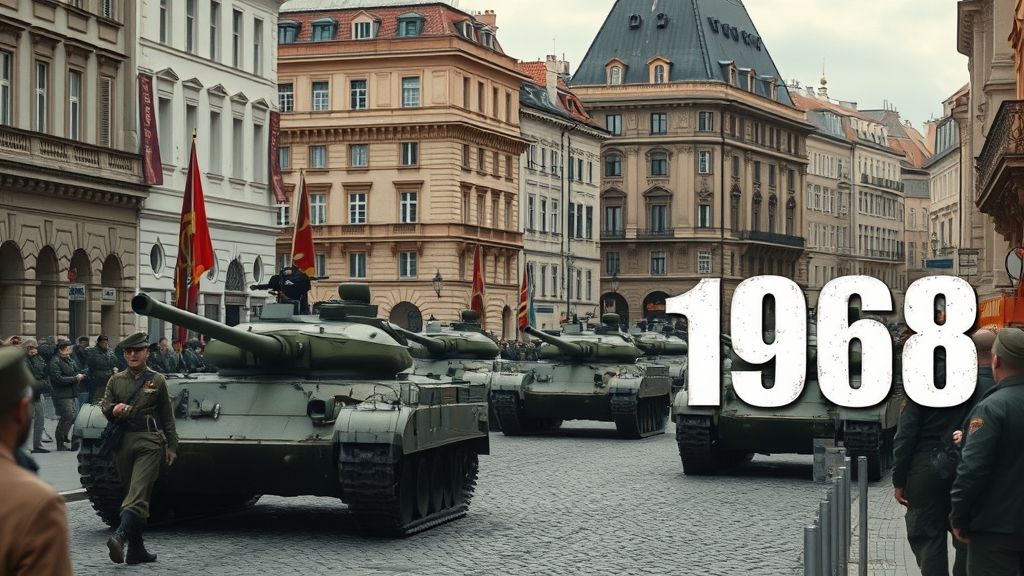
As night swallowed the city on August 20, 1968, the streets of Prague looked deceptively calm. Few suspected that the Warsaw Pact had mobilized over 200,000 troops and nearly 2,000 tanks, preparing to extinguish the Prague Spring in a brutal display of repression.
In the dead of night, without warning, thousands of soldiers silently rolled across the Czechoslovak borders from the USSR, East Germany, Poland, Hungary, and Bulgaria. The sounds of engines and clanking armor shattered the silence as foreign troops encircled Prague—establishing control with overwhelming force.
The operation was swift and shocking. Airwaves were jammed; communication lines cut. Dubček and his government were arrested and taken to Moscow. Overnight, the progressive flame flickered out beneath the weight of occupying soldiers.
7. Dawn of Invasion: Warsaw Pact Troops Enter Prague
By morning, the true scale of the invasion became impossible to ignore. The skyline bristled with tanks, soldiers in stern helmets patrolled major streets, and checkpoints mushroomed throughout the city. Bridges were monitored, protests crushed with batons and arrests.
The city, which only weeks before had danced with hope, now bore a chilling atmosphere of fear and powerlessness. Yet, despite this, the people’s resolve did not break immediately. Mothers shielded children, students organized peaceful demonstrations, and workers continued their jobs under watchful eyes.
But the invasion was not merely a military operation; it was a message to the entire Eastern Bloc. Dissent would not be tolerated.
8. The Shock and Silence: How Prague Reacted to the Occupation
Emotionally, the invasion stunned Prague. A collective numbness settled over the city, with disbelief rapidly turning into sorrow and anger. Newspapers that once celebrated reform now printed heavily censored accounts, and radio stations broadcast the official version from Moscow.
Conversations turned hushed and fearful. Many citizens chose silence over potential repercussions; others whispered of martyrdom and sacrifice. The reality that a neighbor’s tanks were suppressing Czechoslovakia’s autonomy echoed in quiet corners and family parlors.
Yet, even in defeat, a spirit of resilience took hold. The Prague Spring’s ideals had not vanished entirely but burrowed deep into the hearts of hundreds of thousands.
9. Acts of Defiance: Nonviolent Resistance Amidst Occupation
The invasion did not extinguish the human spirit. Acts of defiance, though small and often desperate, manifested across the city. Citizens waved flags defiantly, displayed banned literature secretly, and organized underground meetings.
One poignant detail: students in Wenceslas Square laid flowers on tanks, greeted soldiers not with hatred but with solemn dignity. Factory workers staged slowdowns. Artists and intellectuals penned secret manifestos: the pen, they believed, was mightier than any gun.
Sports stadiums became venues for silent protests. Ordinary people found subtle ways to resist—quiet rebellion that kept the embers of freedom burning against the storm of repression.
10. International Response: Between Condemnation and Realpolitik
News of the invasion rippled across the globe almost immediately. Western leaders condemned the Soviet-led crackdown as a cowardly betrayal of socialist ideals. The United States, embroiled in Vietnam and wary of direct confrontation with the USSR, issued formal protests but stopped short of intervention.
In the communist world, reactions were mixed. China condemned the invasion vehemently, deepening the Sino-Soviet split. Other Warsaw Pact nations largely fell silent or defended the operation under pressure.
For many in the West, the event reinforced the image of the Soviet Union as an imperialistic oppressor. Yet the Cold War’s chessboard dictated caution—no country wanted to precipitate a wider conflict.
11. Leaders Under Pressure: Political Maneuvers Behind Closed Doors
Behind the scenes, the invasion marked a humiliating moment for Dubček and his allies. Forced to negotiate in Moscow under duress, Dubček reluctantly agreed to roll back reforms, a bitter pill swallowed to prevent outright Soviet replacement.
Meanwhile, dissenting Czechoslovak politicians aligned with Moscow were installed to guarantee compliance. The invasion discredited reformists within the Communist Party, ushering in an era known as “Normalization” — a return to rigid Soviet-style governance.
Internationally, Brezhnev emerged as the man who had preserved the communist bloc’s unity but at a deep cost to legitimacy.
12. The Crushing of Reform: The Imposition of “Normalization”
Normalization was a systematic reversal of Prague Spring policies. Censorship returned, independent media were shuttered, and political dissenters were purged or harassed into exile. Dubček himself was removed from office in 1969, replaced by Gustáv Husák, a hardliner loyal to Moscow.
The economic reforms were scrapped, and a return to planned economy policies imposed. The population faced renewed restrictions, with a gloom settling over everyday life.
Though outwardly restored, Czechoslovakia remained a simmering cauldron of discontent beneath its controlled surface.
13. Life Under Occupation: The Everyday Reality in Czechoslovakia
For the average citizen, life became a daily balance between survival and quiet resistance. State surveillance intensified, with secret police infiltrating communities. Fear of denunciation curtailed public expression.
Yet families continued, children attended schools where propaganda was lifted directly from Soviet manuals, and cultural life was carefully carefully scripted to align with party ideology.
At times, humor and satire cracked the façade. Underground literature circulated, and coded jokes became subtle weapons against oppression.
14. Cultural and Intellectual Resistance: Keeping the Spirit Alive
Despite repression, a thriving undercurrent of cultural resistance persisted. In offices and cafés, samizdat publications circulated clandestinely. Playwrights and filmmakers embedded veiled criticisms within their art, speaking to those willing to listen.
Opera houses and theatres became sanctuaries for coded messages. The spirit of the Prague Spring inspired a generation that would later fuel the Velvet Revolution two decades hence.
One cannot underestimate the power of the arts as a beacon of hope when words were otherwise silenced.
15. The Cold War Context: The Invasion’s Global Ripple Effects
The Warsaw Pact invasion reshaped Cold War dynamics. It exposed fractures within communist alliances and hardened Western skepticism about détente talks with the USSR.
It also sent a chilling message to reformers elsewhere in the bloc: freedom would be tolerated only if it served Soviet interests. The Brezhnev Doctrine became the new iron law, a “live and let live” policy replaced by “live and obey.”
Global attention remained focused on the increasingly fragile balance between East and West, arms race escalation, and ideological standoffs far from Prague’s cobblestone streets.
16. The Shape of Soviet Hegemony: Brezhnev Doctrine Institutionalized
The bureaucratic codification of the Brezhnev Doctrine granted the Soviet Union the right—and duty—to crush reforms threatening socialism, effectively legalizing military intervention to preserve Soviet dominance.
For nearly two decades, this doctrine dictated policies across Eastern Europe. It functioned as a tool of control but also deeply undermined the credibility of the communist project, exposing its authoritarian core.
The legacy of this doctrine would linger well beyond 1968, shaping the fates of satellite states in unmistakable ways.
17. Voices from the Past: Personal Accounts and Memoirs
To understand the invasion’s human cost, personal testimonies offer invaluable insight. Jan Palach, a Czech student, famously self-immolated in January 1969 to protest the repression, embodying the anguish felt by many.
Memoirs from soldiers, journalists, and dissidents reveal the complexity of emotions later—disillusionment, anger, fear, but also moments of courage and solidarity.
Such accounts transform abstract history into lived experience, reminding us that behind tanks and treaties are real lives forever altered.
18. The Long Shadow: How 1968 Shaped Post-Communist Czechoslovakia
Though silenced, the Prague Spring’s ideals never disappeared. Throughout the 1970s and 80s, underground movements kept the dream alive. These persistent undercurrents contributed significantly to the peaceful Velvet Revolution of 1989, which toppled communist rule.
The memory of August 1968 remained a rallying cry for freedom, dignity, and national sovereignty. It shaped Czechoslovak identity and informed democratic aspirations.
History had bowed to force, but the spirit of reform was indomitable.
19. Memory and Reconciliation: Commemorating the August Invasion
In post-communist Czech and Slovak Republics, commemorations of the invasion have become solemn reminders of resilience. Monuments, museums, and annual ceremonies honor those who resisted.
These moments of remembrance recognize the trauma and celebrate the courage that endured. They also serve as warning: freedom must always be safeguarded against tyranny.
The legacy of 1968 remains alive in the collective consciousness, a testament to the human longing for liberty.
20. Lessons in Freedom: The Legacy of the Prague Spring Today
Fifty years later and beyond, the Prague Spring and its violent suppression offer profound lessons about power, ideology, and human rights. The invasion underscores the dangers of absolute control and the sacrifices demanded when people dare to envision a better society.
Today, as the world grapples with new authoritarian temptations, the spirit of 1968 reminds us that freedom is not a given but a constant struggle—carried forward by the courage of those who believe in a more humane future.
Conclusion
The Warsaw Pact invasion of Czechoslovakia in August 1968 remains one of the most acute moments of the Cold War and a stark reminder of the price paid for aspirations of freedom. It was the violent extinction of a hope that dared to bloom amidst repression—a hope that nonetheless refused to die.
Alexander Dubček’s dream of “socialism with a human face” revealed the profound human desire not only for political reform but for dignity, culture, and voice. Though crushed under foreign boots and ideological rigidity, that dream endured in underground resistance, in the hearts of ordinary citizens, and ultimately, in the peaceful revolutions that followed two decades later.
History shows us that the path to liberty is perilous and often contested by brute force. Yet, it is also illuminated by the resilience of human spirit—a beacon that no tank, no invasion, no doctrine can wholly extinguish.
The story of August 1968 is a story of loss, hope, and ultimately, the enduring power of freedom.
FAQs
Q1: What exactly was the Prague Spring?
A1: The Prague Spring was a period of political liberalization and reform in Czechoslovakia during early 1968, led by Alexander Dubček. It intended to create “socialism with a human face” by introducing freedoms of speech, press, and economic decentralization while remaining within the communist bloc.
Q2: Why did the Warsaw Pact countries invade Czechoslovakia?
A2: The Soviet Union and its Warsaw Pact allies invaded to stop the reforms in Czechoslovakia, fearing that these changes would destabilize the Eastern Bloc and encourage similar uprisings elsewhere. The invasion was justified under the Brezhnev Doctrine.
Q3: Who was Alexander Dubček?
A3: Alexander Dubček was the First Secretary of the Czechoslovak Communist Party in 1968. He was the leader of the Prague Spring reforms, advocating moderate socialism and greater freedoms, before being removed from power after the invasion.
Q4: What was the international reaction to the invasion?
A4: Western countries condemned the invasion but were reluctant to intervene militarily due to Cold War tensions. China strongly criticized the USSR, worsening Sino-Soviet relations. The invasion deepened Cold War divisions globally.
Q5: What were the consequences of the invasion for Czechoslovakia?
A5: The invasion resulted in the suppression of reforms, installation of a hardline communist regime, increased censorship, political repression, and a period called “Normalization,” in which Moscow’s control was reaffirmed.
Q6: How did the Czechoslovak people resist the occupation?
A6: Resistance was mostly nonviolent—peaceful protests, cultural dissent, underground publications, symbolic acts like laying flowers on tanks, and continued hope for eventual freedom.
Q7: How is the 1968 invasion remembered today?
A7: It is commemorated as a tragic but heroic chapter in Czech and Slovak history, symbolizing the fight for freedom and the resilience against oppression. Monuments, museums, and public ceremonies honor the victims and resistors.
Q8: Did the Prague Spring influence later events in Eastern Europe?
A8: Yes. The Prague Spring inspired dissidents and reform movements across the Eastern Bloc and contributed to the eventual collapse of communism in Eastern Europe, culminating in peaceful revolutions like the Velvet Revolution of 1989.