Table of Contents
- The Cairo Agreement of November 1969: Setting the Stage for a New Chapter
- Shadows over the Middle East: The Palestinian Question before 1969
- Beirut’s Tumult and the PLO’s Rising Ambitions
- Egypt’s Strategic Role: Nasser’s Vision and Regional Dynamics
- The Negotiations Begin: Bringing Parties to the Table
- The Delegates of a Fragile Peace: Key Figures in the Agreement
- The Agreement Unveiled: Provisions and Promises Explained
- Armed Presence Guaranteed: Palestinian Militancy’s New Legitimacy
- Beirut’s Changing Landscape: From Refugees to Armed Actors
- The Immediate Impact: Militarization and Lebanese Sovereignty
- Political Repercussions within Lebanon: Alliances and Fissures
- Regional Consequences: Arab World Reactions and Israeli Responses
- Between War and Diplomacy: The Cairo Agreement’s Role in the Escalation
- The Agreement’s Fragility: Seeds of Future Conflicts
- Palestinian Identity and Autonomy: A Transformative Moment
- Lebanese Civil War and the Echoes of 1969
- The Cairo Agreement in Historical Memory
- Lessons and Legacies: What Cairo 1969 Tells Us Today
1. The Cairo Agreement of November 1969: Setting the Stage for a New Chapter
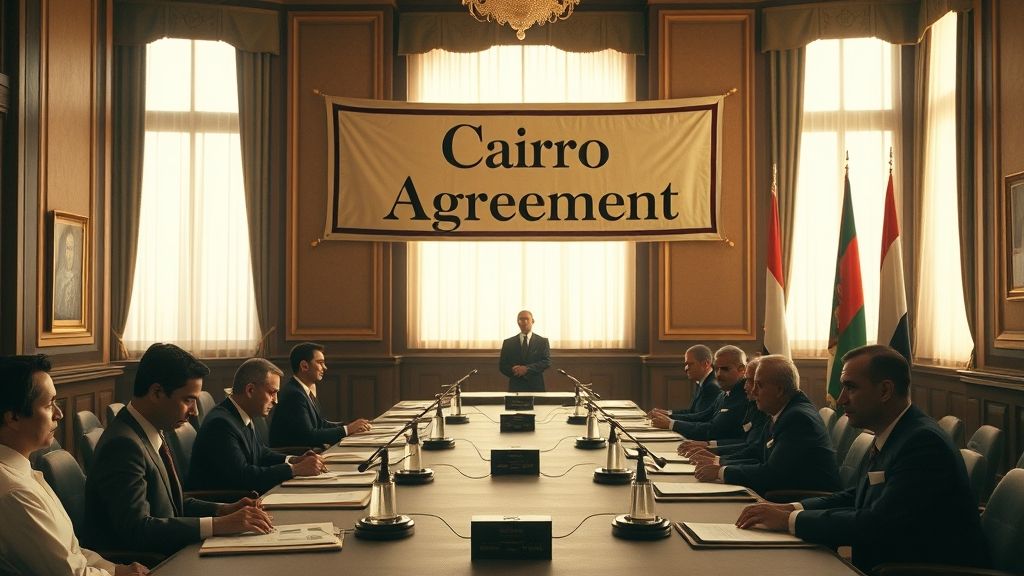
The smell of dust and smoke lingered in the warm Egyptian air that afternoon of November 2, 1969, as delegations from Lebanon and the Palestine Liberation Organization (PLO) took their seats in a modest conference hall in Cairo. The stakes were monumental, the hopes fragile but palpable. Here, amid the echoes of decades of conflict and displacement, they sought to carve out a fragile framework — a legal and political recognition of Palestinian armed presence on Lebanese soil.
The Cairo Agreement was born not from peace, but from an uneasy necessity forged in the crucible of shifting allegiances, military realities, and a desperate quest for survival and sovereignty. It was a document layered with concession and assertion, reflecting a deeply complex struggle over identity, territory, and authority.
The atmosphere was thick with tension but also with a cautious optimism. Delegates knew the power of words inked that day — promises that would shape not only Lebanon’s future but also the entire Middle East’s turbulent history for years to come.
2. Shadows over the Middle East: The Palestinian Question before 1969
The mid-20th century Middle East was a mosaic of fractured hopes and unfulfilled promises. Since the 1948 Arab-Israeli war, waves of Palestinian refugees had spilled into neighboring countries, with Lebanon hosting a significant and growing population. The Palestine Liberation Organization had been founded in 1964 with the aim to represent Palestinian interests, but by the late 1960s, it had transformed into an increasingly militant and organizationally complex force.
Palestinian fedayeen (fighters) operated mainly out of Jordan and Lebanon, launching raids against Israeli targets, and in return, their refugees’ host countries struggled to maintain sovereignty and stability. Lebanon, a sectarian patchwork society, was particularly sensitive to the complex balance of power between its religious communities and the influx of armed Palestinians threatened that delicate order.
The Six-Day War of 1967 was a devastating blow to Arab nationalism, intensifying Palestinian militancy and pushing the PLO to assert greater autonomy and military presence within Lebanon. Lebanon’s uneasy tolerance of Palestinian guerrillas was a powder keg waiting to explode.
3. Beirut’s Tumult and the PLO’s Rising Ambitions
By 1969, Beirut’s southern suburbs had become a bustling yet volatile enclave of Palestinian refugees and fighters. The camps, long temporary sanctuaries, had turned into mini-cities, governed more by the PLO’s rules than Lebanon’s state authority.
The Lebanese government’s control over the camps was effectively ceded to the PLO. The organization sought to establish training facilities, carry out operations against Israel, and foster a collective Palestinian national identity rooted in armed struggle.
Yet this growing militarization created tensions with Lebanon’s government and Christian militias. The Palestinian presence challenged Lebanon’s sovereignty and exacerbated sectarian fears, laying groundwork for future conflict.
4. Egypt’s Strategic Role: Nasser’s Vision and Regional Dynamics
Egypt, under President Gamal Abdel Nasser, was the preeminent Arab power striving for unity against Israel and Western influence. By hosting the talks leading to the Cairo Agreement, Cairo sought to assert leadership, mediate intra-Arab disputes, and channel the Palestinian cause into a framework that would stabilize Lebanon and intensify pressure on Israel.
Nasser’s approach balanced between encouraging Palestinian militarization and preserving Arab unity. Egypt’s involvement lent the agreement additional legitimacy and shaped its contents, aimed at balancing Lebanese sovereignty with Palestinian armed presence.
5. The Negotiations Begin: Bringing Parties to the Table
Negotiations were arduous and fraught with mutual suspicion. Lebanese representatives feared erosion of state authority, worried about enabling an armed faction within their borders. Palestinian delegates demanded freedom and recognition to continue their struggle.
Throughout the days leading to November 2, intense talks navigated between demands and red lines. Cairo was not just a venue but a crucible where Arab nationalism, state sovereignty, and guerrilla warfare intersected with poignant urgency.
6. The Delegates of a Fragile Peace: Key Figures in the Agreement
Among the Lebanese negotiators stood Saeb Salam, a seasoned politician known for his delicate balancing act between Lebanon’s sectarian communities. Representing the Palestinians was the charismatic Yasser Arafat, whose reputation as a committed and pragmatic leader grew steadily.
Egyptian mediators, led by Foreign Minister Mahmoud Riad, steered the talks with a firm hand, drawing historical legitimacy from Cairo’s status as the cradle of Arab nationalism.
Each player brought personal histories, national ambitions, and ideological commitments to the negotiation table, infusing these talks with a profoundly human dimension.
7. The Agreement Unveiled: Provisions and Promises Explained
At the heart of the Cairo Agreement was a groundbreaking clause: the Lebanese government recognized the right of Palestinian refugees to carry weapons and operate armed groups inside designated refugee camps.
The state agreed not to intervene militarily in the camps, effectively ceding law enforcement to the PLO. Palestinian fighters gained the right to use Lebanese territory as a base for operations against Israel.
However, in return, the PLO promised to respect Lebanon’s sovereignty in other parts of the country and to coordinate with Lebanese authorities, although these promises proved difficult to enforce.
8. Armed Presence Guaranteed: Palestinian Militancy’s New Legitimacy
The Cairo Agreement marked a watershed moment — it was the first formal acknowledgment of the PLO as a quasi-state within Lebanon, granting legitimacy to Palestinian armed groups’ presence.
For the Palestinian resistance, this was a diplomatic victory, granting them a rear base crucial for their operations and survival. For Lebanon, it was a double-edged sword: the attempt to manage a powerful non-state actor but simultaneously planting the seeds of future instability.
9. Beirut’s Changing Landscape: From Refugees to Armed Actors
Palestinian refugee camps, once places of exile and impoverishment, morphed into militarized zones — fortress-like enclaves intimately linked to the broader Arab-Israeli conflict.
This transformation altered local demographics, security patterns, and daily life. The presence of armed fighters influenced not only political decisions but also social relations between Palestinians and Lebanese communities, often fueling mistrust and hostility.
10. The Immediate Impact: Militarization and Lebanese Sovereignty
The Lebanese state’s relinquishment of the right to police the refugee camps created a governance vacuum. Lebanese army units were largely barred from entering the camps, which operated under PLO law.
This shift complicated Lebanon’s internal security and contributed to a precarious balance marked by armed factions operating with relative impunity.
11. Political Repercussions within Lebanon: Alliances and Fissures
The Cairo Agreement exacerbated Lebanon’s sectarian tensions. Muslim factions and Palestinians often found common cause, while Christian militias perceived the arrangement as a direct threat to Lebanese sovereignty and national identity.
Political alliances grew more polarized, setting the stage for the Lebanese Civil War some years later. The agreement thus played an indirect but significant role in destabilizing Lebanese politics.
12. Regional Consequences: Arab World Reactions and Israeli Responses
Across the Arab world, reactions were mixed. Many supported the agreement as a necessary accommodation to the Palestinian cause. Israel, however, decried it as a dangerous escalation, as the PLO now had a sanctioned base for attacks.
This development intensified the cycle of violence and retaliation. Israeli military responses and internal Arab debates during the 1970s must be viewed in light of the Cairo Agreement’s implications.
13. Between War and Diplomacy: The Cairo Agreement’s Role in the Escalation
Though intended as a mechanism for stability, the agreement inadvertently legitimized armed struggle on Lebanese soil, fueling an arms race between militias and fragmenting state power.
It became a stepping stone that led Lebanon into decades of violent conflict, resisting simple categorization as peacekeeping or war-making.
14. The Agreement’s Fragility: Seeds of Future Conflicts
The Cairo Agreement was more a paper of convenience than a lasting treaty. Its vagueness and contradictions left room for interpretation and exploitation.
Over time, rival Lebanese factions, growing Palestinian militancy, and external pressures strained the agreement’s limits, culminating in its breakdown during the Lebanese Civil War of 1975-1990.
15. Palestinian Identity and Autonomy: A Transformative Moment
For Palestinians, the agreement enhanced their organizational identity, transforming their refugee status into a form of political autonomy.
It strengthened Yasser Arafat’s leadership and the PLO’s institutional growth, setting the stage for their international recognition as the legitimate representative of the Palestinian people.
16. Lebanese Civil War and the Echoes of 1969
The war that ravaged Lebanon for 15 years bore the imprint of the Cairo Agreement’s legacy. The unresolved tensions within Lebanese sectarian politics and Palestinian militancy erupted into open conflict.
The fragile balance achieved in Cairo unraveled amid competing nationalisms, foreign interventions, and deep social divisions.
17. The Cairo Agreement in Historical Memory
To this day, the Cairo Agreement remains a contested chapter. Some see it as a pragmatic necessity that allowed Palestinians to maintain resistance; others regard it as a fatal compromise that undermined Lebanese sovereignty.
Its legacy is kept alive in Lebanese and Palestinian narratives, historical studies, and political discourse across the Middle East.
18. Lessons and Legacies: What Cairo 1969 Tells Us Today
Looking back, the Cairo Agreement offers a poignant lesson about the complexities of state sovereignty, refugee rights, and armed resistance.
It reveals how fragile political arrangements, born of urgent necessity, can entangle nations in prolonged conflict — a reminder that peace requires more than paper but a steady commitment to justice, dialogue, and mutual recognition.
Conclusion
The Cairo Agreement of November 1969 stands as a remarkable yet ambivalent milestone in Middle Eastern history. Born from the urgent need to address the Palestinian presence in Lebanon, it simultaneously fostered recognition and conflict, solidarity and division.
This agreement transformed both Palestinian resistance and Lebanon’s national fate, illustrating the intricate interplay between refuge and rebellion, state sovereignty and sub-state militancy. While it intended to stabilize a volatile situation, it instead paved the way for decades of fracturing and warfare, the reverberations of which echo even now.
Yet, beyond the political calculus and military maneuvers, the story of the Cairo Agreement is ultimately human — of displaced communities seeking dignity, political leaders grappling with impossible choices, and a region caught in the crossroads of history, identity, and survival.
Understanding this chapter helps us grasp the endurance of conflict, the power of negotiated recognition, and the fragile hope for peace in a land long haunted by struggle.
FAQs
Q1: What was the main purpose of the Cairo Agreement in 1969?
The agreement primarily aimed to formalize and regulate the presence of the Palestine Liberation Organization (PLO) and its armed groups on Lebanese territory, especially within refugee camps, granting them the right to bear arms and operate militarily against Israel from Lebanon.
Q2: Why did Lebanon agree to the presence of armed Palestinian groups within its borders?
Lebanon was under significant pressure due to the growing Palestinian militant presence. The government sought to officially regulate this reality rather than engage in open conflict, hoping to maintain a degree of control while appeasing Arab allies and managing internal sectarian tensions.
Q3: How did the Cairo Agreement affect Lebanon’s national sovereignty?
By effectively ceding security control over Palestinian refugee camps to the PLO, Lebanon compromised parts of its sovereignty, creating enclaves where state authority was limited or non-existent, contributing to internal instability.
Q4: Who were the key figures involved in the negotiation of the Cairo Agreement?
Prominent figures included Lebanese Prime Minister Saeb Salam, PLO leader Yasser Arafat, and Egyptian mediators led by Foreign Minister Mahmoud Riad, with President Gamal Abdel Nasser playing a crucial indirect role through Cairo’s hosting.
Q5: What were the regional implications of the agreement?
The agreement heightened tensions in the Middle East, as it legitimized armed Palestinian resistance within Lebanon, provoking Israeli military responses and influencing Arab politics, thereby contributing to the escalation of conflict in the following decade.
Q6: Did the Cairo Agreement prevent conflict in Lebanon?
No, it did not prevent conflict; instead, it is often considered to have contributed indirectly to the Lebanese Civil War by exacerbating sectarian tensions and undermining state authority.
Q7: How is the Cairo Agreement viewed today by Palestinians and Lebanese?
For Palestinians, it is seen as a crucial step toward political and military recognition; for many Lebanese, particularly Christian communities, it remains a symbol of lost sovereignty and the beginning of prolonged instability.
Q8: Where can one learn more about the Cairo Agreement?
A detailed overview is available on Wikipedia and various histories of the Palestine Liberation Organization and the Lebanese Civil War.