Table of Contents
- The Dawn of July 20, 1974: A Sudden Invasion into Kyrenia
- Cyprus Before the Storm: A Nation Divided
- The Greek Junta and the Coup d’État: Catalyst to Conflict
- Turkey’s Strategic Calculus: Justifications and Ambitions
- The Amphibious Landing: Kyrenia in Flames
- The Battle for Kyrenia: Chaos, Courage, and Collapse
- The Displaced and the Divided: Human Tragedy Emerges
- International Reactions: Cold War Powers Weigh In
- The Aftermath: Partition and a Frozen Conflict
- The Rise of the Turkish Republic of Northern Cyprus
- Impact on Greek-Turkish Relations: From Brotherhood to Hostility
- The Role of the United Nations: Peacekeeping and Stalemate
- Cypriot Society in Turmoil: Refugees, Families, and Memories
- Cultural and Economic Consequences for Cyprus
- The Legacy of 1974 in Modern Cyprus: A Divided Island Today
- Reconciliation Efforts and the Search for Peace
- The 1974 Invasion in Popular Culture and Memory
- Lessons from Kyrenia: Sovereignty, Security, and Survival
- The Turkish Military Perspective: Operations and Objectives
- Long-Term Geopolitical Implications in the Eastern Mediterranean
- Voices from the Ground: Eyewitnesses and Soldiers
- Cyprus at the Crossroads: Between East and West
- The Continuing Quest for Justice and Resolution
- The Turkish Invasion’s Place in Global Cold War History
1. The Dawn of July 20, 1974: A Sudden Invasion into Kyrenia
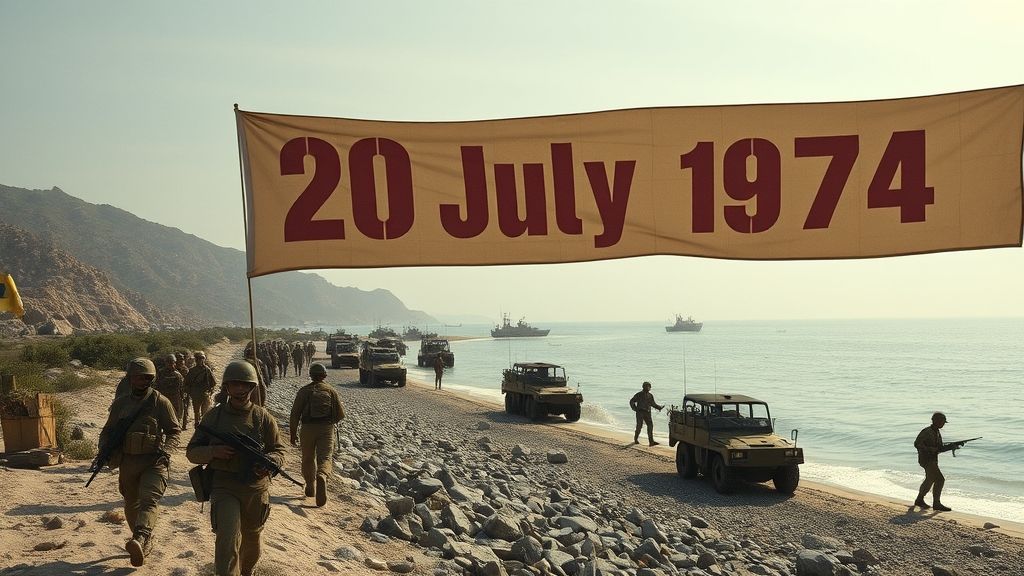
The sun had barely risen over the Mediterranean when the serene seaside town of Kyrenia, Cyprus, was shattered by the thunderous roar of Turkish warships and aircraft. Within hours, the docks swarmed with soldiers in olive drab uniforms, determined and resolute, landing on a shore that moments before still buzzed with quiet civilian life. The carefree ambiance, of children playing near boats and fishmongers shouting their wares, was irrevocably broken.
This was no ordinary morning. July 20, 1974, marked the beginning of a military intervention that tore apart the multiethnic fabric of Cyprus and altered the course of history in the Eastern Mediterranean. Turkish forces had launched their long-anticipated operation to seize the northern coast of Cyprus, starting with Kyrenia, aiming to protect the Turkish Cypriot minority and assert Turkish sovereignty claims. For many Cypriots, it was the terrifying dawn of war, uprooting lives and sowing division that would last for decades.
2. Cyprus Before the Storm: A Nation Divided
Understanding the events of 1974 requires a journey into the island's troubled prelude. Cyprus, an island of rich history and strategic importance, was home to two main communities: Greek Cypriots, comprising about 78%, and Turkish Cypriots, around 18%. Although neighbors, their histories and identities were sharply distinct, fused with deep-rooted mistrust.
Under British colonial rule until 1960, the island’s independence came with constitutional guarantees balancing power between the two communities. Yet, this fragile arrangement barely concealed simmering tensions—Greek Cypriots largely desired enosis, meaning union with Greece, while Turkish Cypriots feared marginalization and pushed for taksim, partition.
This volatile mix yielded a series of crises in the 1960s, punctuated by intercommunal violence and UN peacekeeping missions. Efforts at reconciliation repeatedly faltered, setting the stage for the explosive events of 1974.
3. The Greek Junta and the Coup d’État: Catalyst to Conflict
Behind the scenes of Cyprus’s turmoil loomed the shadow of the Greek military junta, a brutal regime that ruled Athens since 1967. Seeing Cyprus as an extension of its Hellenic mission, the junta sought to orchestrate a union with Greece by any means necessary.
On July 15, 1974, the coup d’état unfolded with lightning precision. Backed and directed by Athens, Cypriot National Guard units overthrew President Archbishop Makarios III and installed the hardline nationalist Nikos Sampson. The island's fragile peace shattered.
This sudden upheaval sent shockwaves through Ankara. The Turkish government, invoking its rights as a guarantor power under the 1960 Treaty of Guarantee, declared military intervention was necessary to restore order and protect Turkish Cypriots.
4. Turkey’s Strategic Calculus: Justifications and Ambitions
Turkey’s decision to invade Cyprus was a calculated risk born from historical fear and national pride. The ruling military government in Ankara framed the operation as a "peace operation," a humanitarian mission to safeguard Turkish Cypriots from the perceived threats unleashed by the Greek-sponsored coup.
Beyond protection, Turkey sought to assert its influence in the Eastern Mediterranean and counterbalance Greek ambitions. The island’s strategic position—at the crossroads of Europe, Asia, and the Middle East—made it too vital to leave vulnerable.
Yet, among Turkish leaders, opinions varied. Some advocated restraint, worried about international backlash; others saw this as a supreme opportunity to correct what they perceived as historical injustices. In the early dawn hours of July 20, the decision was made.
5. The Amphibious Landing: Kyrenia in Flames
The Turkish invasion commenced at 5:30 a.m. with an amphibious landing near Kyrenia's harbor. More than 3,000 Turkish troops stormed the city by sea, supported by naval gunfire and air cover. The element of surprise was key.
The initial assault overwhelmed the local Cypriot defenders, who were underprepared and disorganized. Civilians watched helplessly as artillery shells and gunfire erupted around their homes. Streets once filled with laughter became scenes of chaos and terror.
Kyrenia’s narrow alleys and ancient castle became focal points of fighting. Despite intense resistance from Greek Cypriot forces, Turkish troops secured the city by nightfall, marking a critical foothold for further operations inland.
6. The Battle for Kyrenia: Chaos, Courage, and Collapse
The battle was both brutal and bewildering. Combatants on both sides faced confusion, shortages of ammunition, and conflicting orders. Civilians were caught in crossfire or rounded up for protection.
Among the defenders were soldiers and volunteers determined to repel the invasion. Tales of heroism abound: a Greek Cypriot officer rallying troops amidst bombing raids; a family sheltering neighbors in their basement amid shelling. Yet, these acts of bravery could not stem the overwhelming tide.
The collapse of defenses in Kyrenia sent shockwaves across Cyprus, as Turkish forces consolidated control. This moment sealed the fate of the northern coast.
7. The Displaced and the Divided: Human Tragedy Emerges
The invasion precipitated one of the most tragic humanitarian crises in Cyprus’s history. As Turkish troops advanced, approximately 180,000 Greek Cypriots fled their homes in the north, becoming refugees overnight.
Families were separated, neighbors turned enemies, and a new island of two realities was carved. Likewise, thousands of Turkish Cypriots moved into the Turkish-occupied territories, often forced from their homes in the south.
Testimonies from refugees evoke heartbreak—a grandmother clutching photographs as she fled, children lost in the confusion, entire villages emptied. The physical division was mirrored by deep emotional scars.
8. International Reactions: Cold War Powers Weigh In
The world watched anxiously. The crisis in Cyprus unfolded against the backdrop of the Cold War, where Greece was a NATO ally, and Turkey’s strategic importance was paramount.
Washington, London, and Moscow condemned the violence but were reluctant to intervene forcefully. The United Nations quickly called for ceasefires and dispatched peacekeepers, but political solutions were elusive.
The United States, balancing alliances and geopolitical interests, opted for double-dealing: sanctions were threatened yet mostly muted. This ambivalence frustrated Cypriots, who felt abandoned to the whims of greater powers.
9. The Aftermath: Partition and a Frozen Conflict
By mid-August 1974, Turkish forces had pushed beyond Kyrenia to control roughly 37% of Cyprus’s territory, effectively partitioning the island. The Green Line—a demilitarized buffer zone patrolled by the UN—divided the south and north, a division that persists today.
The Republic of Cyprus retained governance over the south, dominated by Greek Cypriots. The north became a Turkish military zone, later proclaimed as the Turkish Republic of Northern Cyprus in 1983, recognized only by Turkey.
This partition institutionalized division, embedding conflict into Cyprus’s identity and international relations.
10. The Rise of the Turkish Republic of Northern Cyprus
In the years that followed, the Turkish-occupied north evolved into a de facto state. Political institutions, a new administration, and social infrastructures were built, though under heavy Turkish influence.
The Turkish Republic of Northern Cyprus (TRNC) declared independence in 1983, but remains unrecognized globally except by Ankara. Its economy and culture were shaped by migration, Turkish settlers, and isolation.
The TRNC became a focal point for ongoing disputes, peace negotiations, and divergent political narratives regarding sovereignty and security.
11. Impact on Greek-Turkish Relations: From Brotherhood to Hostility
The events in Cyprus transformed what had once been a complex but cooperative Greek-Turkish relationship into animosity tempered by occasional dialogue.
Military clashes around Cyprus hardened nationalist sentiments. Diplomatic ties were severed multiple times, and mutual distrust deepened.
The island became a permanent bone of contention, influencing bilateral relations, NATO dynamics, and regional stability.
12. The Role of the United Nations: Peacekeeping and Stalemate
Since 1964, the UN Peacekeeping Force in Cyprus (UNFICYP) had sought to maintain calm. Post-invasion, the force expanded its mandate along the buffer zone.
Despite decades of presence, UN efforts have yielded little permanent resolution. Ceasefires have held, but political dialogue remains deadlocked.
The UN missions symbolize hope, frustration, and international commitment amid enduring conflict.
13. Cypriot Society in Turmoil: Refugees, Families, and Memories
The division left deep fissures in Cypriot society. Refugees faced difficulties rebuilding lives; properties were lost or confiscated; cultural sites damaged.
Generations grew up with stories of loss and longing. Memorials, displaced persons’ associations, and community networks sought to preserve memory and identity.
Yet, the psychological wounds endure, complicating reconciliation and coexistence.
14. Cultural and Economic Consequences for Cyprus
The occupation devastated Cyprus’s economy, especially its tourism and agriculture in the north. Infrastructure was damaged; investments stalled.
Culturally, heritage sites faced neglect or politicization. The coexistence once symbolized by villages changed, as separation entrenched ethnic distinctions.
The division also forced missing potential collaboration and economic integration on the island.
15. The Legacy of 1974 in Modern Cyprus: A Divided Island Today
Nearly five decades later, the consequences of July 20, 1974, are embedded in Cyprus’s political landscape. The island remains divided, with peace talks repeatedly faltering.
Yet, recent years have also seen tentative openings—crossings between north and south, mixed communities, cultural exchanges, and efforts at dialogue.
Cyprus today is a mosaic of resilience, memory, and a cautious hope for unity.
16. Reconciliation Efforts and the Search for Peace
Multiple rounds of negotiations under UN auspices have sought to bridge the divide, proposing federal solutions and power-sharing.
Civil society initiatives promote trust-building, education, and cooperation.
While political leaders remain wary, the younger generations increasingly envision a future less burdened by division.
17. The 1974 Invasion in Popular Culture and Memory
The invasion inspired extensive literature, art, and film, capturing its tragedy and complexity.
In both Greek and Turkish Cypriot communities, memory of 1974 is central to identity and politics.
Monuments stand solemnly, while narratives differ, reflecting the contested nature of history.
18. Lessons from Kyrenia: Sovereignty, Security, and Survival
The Turkish landing in Kyrenia teaches harsh lessons about ethnic nationalism, international law, and the fragility of peace.
It highlights the limits of treaties and guarantees, and the human cost of geopolitical games.
Yet, it also reveals the courage of ordinary people caught in extraordinary times.
19. The Turkish Military Perspective: Operations and Objectives
From the Turkish Army’s view, the invasion was a meticulously planned intervention aimed at protecting a threatened minority and preserving regional balance.
Detailed military reports praise operational success but acknowledge difficulties.
Understanding this perspective is crucial for a balanced historical assessment.
20. Long-Term Geopolitical Implications in the Eastern Mediterranean
The Cyprus conflict affects broader regional dynamics—NATO cohesion, energy exploration, and alliances in the Eastern Mediterranean.
It remains a flashpoint in Greek-Turkish relations and incursions by external powers.
Lessons from 1974 resonate in contemporary geopolitics.
21. Voices from the Ground: Eyewitnesses and Soldiers
Personal testimonies humanize the invasion—stories of fear, loss, heroism, and survival.
Interviews reveal the complexity beyond military maneuvers: families torn apart, friendships tested, ordinary people caught in extraordinary events.
These voices ensure the history is lived, not just recorded.
22. Cyprus at the Crossroads: Between East and West
Cyprus stands as a unique meeting point of cultures, religions, and political spheres.
The invasion forced a redefinition of its place between Europe, the Middle East, and the Mediterranean basin.
Its ongoing division mirrors larger themes of nationalism, identity, and integration.
23. The Continuing Quest for Justice and Resolution
Efforts continue in courts and international forums to address property claims, human rights, and accountability.
Cyprus remains one of the longest unresolved conflicts in the world.
The search for justice intertwines with the quest for peace.
24. The Turkish Invasion’s Place in Global Cold War History
Finally, the 1974 intervention is a critical episode in Cold War history—where local conflicts intertwined with global rivalries.
It tested alliances, shaped superpower policies, and revealed the complexities of proxy conflicts.
Its reverberations are felt well beyond the island.
Conclusion
The Turkish landing at Kyrenia on July 20, 1974, was more than a military operation—it was a pivotal moment that fractured a nation and reshaped regional history. Through smoke and shellfire, the island of Cyprus was cleaved, families scattered, and dreams of unity deferred. Yet beneath the scars lies a testament to resilience, an island where the hope for reconciliation still flickers amid division.
History teaches us that sovereignty is not merely a matter of borders but of trust, understanding, and shared humanity. As Cyprus strives toward healing, the lessons of Kyrenia remind us that peace born from violence is fragile, but the human spirit’s yearning for home, harmony, and justice endures.
FAQs
1. What triggered the Turkish invasion of Cyprus on July 20, 1974?
The invasion was triggered primarily by a coup d’état on July 15, 1974, by Greek Cypriot nationalists backed by the Greek military junta, aiming to annex Cyprus to Greece. Turkey intervened to protect Turkish Cypriots and restore constitutional order.
2. What role did the Greek military junta play in the Cyprus crisis?
The junta orchestrated the coup that ousted President Makarios, exacerbating ethnic tensions and provoking Turkey’s military intervention.
3. How did the invasion affect the civilian population of Cyprus?
It caused massive displacement, with roughly 180,000 Greek Cypriots fleeing the north and thousands of Turkish Cypriots relocating north, creating enduring refugee crises.
4. What was the international community’s response to the invasion?
The UN responded with peacekeeping and calls for ceasefires, while major powers offered diplomatic condemnations but limited intervention, balancing Cold War alliances.
5. What is the current status of Cyprus following the events of 1974?
Cyprus remains divided between the Republic of Cyprus in the south and the Turkish-controlled north, recognized only by Turkey; peace negotiations continue intermittently.
6. How is the 1974 invasion remembered today in Cyprus?
It is remembered as a tragic wound, with differing narratives in Greek and Turkish communities; remembrance is central to cultural identity and politics.
7. What are the main obstacles to resolving the Cyprus dispute?
Key obstacles include mistrust between communities, property claims, security guarantees, political structures, and external influences.
8. What lessons does the Turkish landing on Kyrenia offer for international politics?
It underscores the volatility of ethnic nationalism, the limits of international treaties, and the complex interplay of geopolitical interests in regional conflicts.