Table of Contents
- The Spark Ignites: April 13, 1975, Beirut Explodes
- A City on the Brink: Beirut’s Fractured Identity
- Lebanon’s Confessional Mosaic: A Powder Keg of Faiths and Loyalties
- The Regional Chessboard: Geo-Political Stakes in Lebanon
- Palestinian Presence and the PLO’s Role
- The Historical Roots of Sectarian Tensions
- The Lebanese Front and the Leftist Alliance Emergence
- The First Gunfire: Ain el-Rummaneh Incident
- Beirut’s Streets Turn Battlefield: Clashes and Chaos
- The Role of Militias: From Phalanges to Amal
- Foreign Powers Enmesh: Syria, Israel, and the Cold War Context
- The Human Cost: Displacement, Casualties, and Trauma
- International Reaction and Diplomatic Failures
- The War’s Spread and Fragmentation of Authority
- Attempts at Peace: Taif Accord’s Long Road Ahead
- The War of Memories: Collective Trauma and Narratives
- Echoes of the Civil War in Modern Lebanon
- The Cultural Portrayal of the Conflict
- Political and Social Consequences of the War
- Lebanon’s Reconstruction and the Fragile Peace
- The Lebanese Civil War’s Place in Middle Eastern History
- Lessons Learned and Warnings for the Future
The Spark Ignites: April 13, 1975, Beirut Explodes
Amid the shimmering Mediterranean coastline, where golden sunlight kisses the ancient cityscape of Beirut, the morning air was deceptively calm on April 13, 1975. Yet, beneath this serene facade, long-simmering tensions pulled tighter like a ratchet, ready to snap. That fateful day, two opposing factions clashed in the neighborhood of Ain el-Rummaneh, a Christian enclave within the Lebanese capital. What began as a street confrontation spiraled mercilessly into gunfire and bloodshed, plunging a nation already stretched by political crisis into a bitter civil war that would ravage Lebanon for fifteen long years.
The opening shots fired near a church and a bus belonging to Palestinians shattered the fragile peace. A procession commemorating the Christian right-wing leader Pierre Gemayel transformed into an inferno of violence. Witnesses described the air thick with the sharp ring of bullets and cries echoing off narrow streets. This violent eruption was not an isolated incident but the culmination of years of sectarian mistrust, geopolitical rivalries, and the failure of a fragile political system—one that had long balanced on the edge of collapse.
The Lebanese Civil War, triggered by this explosive confrontation, was to become one of the most complex and tragic conflicts of the late 20th century. It fractured society, drew in neighboring powers, and forever altered the fabric of Lebanon and the wider Middle East.
A City on the Brink: Beirut’s Fractured Identity
Beirut, once known as the "Paris of the Middle East," was a cosmopolitan city where diverse communities coexisted but rarely fully integrated. The city’s streets bore witness to centuries of cultural exchange — Phoenician ruins mingled with Ottoman bazaars, Christian churches neighboried by Muslim mosques, and synagogues tucked into narrow lanes. Yet beneath this rich mosaic lay deep divisions that politics had only magnified.
Income disparities, uneven state resource distribution, and competing national visions fueled frustration among Lebanon’s multifaceted society. The post-independence power-sharing arrangement, known as the National Pact of 1943, had institutionalized sectarianism by distributing political offices across religious communities, further entrenching identities and rivalries. By the early 1970s, this confessional model had become less effective at managing demographic and political upheavals.
Beirut itself was divided—its neighborhoods microcosms of the larger national tensions. East Beirut, the Christian stronghold, was politically and economically dominant. West Beirut, predominantly Muslim and leftist in orientation, increasingly challenged the status quo. Along the city’s fault lines, tension was palpable and impossible to contain.
Lebanon’s Confessional Mosaic: A Powder Keg of Faiths and Loyalties
Lebanon’s population was not monolithic but an intricate tapestry of religious communities: Maronite Christians, Sunni Muslims, Shiite Muslims, Druze, Greek Orthodox, Armenians, and smaller sects. Each formed communities bound not only by faith but by political and social alliances.
This religious pluralism was both a source of rich cultural heritage and latent conflict. The Maronite Christians, long tied to French colonial influence and Western identity, held sway over political power and economic control. Sunni Muslims prided themselves on their mercantile heritage and ties to the Arab nationalist camps, while Shiite Muslims, often marginalized and impoverished, nurtured a growing sense of grievance.
The Druze, a minority community with a warrior tradition, played a pivotal balancing act. Over time, these divisions translated into political rivalry, with each sect fielding militias and forging external alliances. This confessional system created a fragility akin to a house of cards—seemingly stable, but vulnerable to collapse under pressure.
The Regional Chessboard: Geo-Political Stakes in Lebanon
Lebanon in the 1970s did not exist in a vacuum. The Middle East was the arena of Cold War rivalries, Arab nationalist fervor, and nascent Islamic movements. Beyond Lebanon’s borders, powerful neighbors watched with keen interest.
Syria, under Hafez al-Assad, sought to maintain influence by acting as Lebanon’s arbiter, sometimes promoting stability, other times fanning the flames of conflict. Israel viewed Lebanon as a launchpad for Palestinian militants and a threat to its northern border. The Palestinian Liberation Organization (PLO), expelled from Jordan in 1970, had established a semi-autonomous base in Lebanon, deepening the complexity of local-national dynamics.
Pan-Arab ideologies, socialism, communism, and traditionalism clashed within Lebanon, as did the competing desires of global powers including the United States and the Soviet Union, who saw Lebanon as a strategic chess piece amid Cold War alignments.
Palestinian Presence and the PLO’s Role
One cannot understand the eruption of the Lebanese Civil War without acknowledging the pivotal role of the Palestinian armed presence. After the Black September clashes in Jordan in 1970, the PLO relocated much of its operations to Lebanon, using the southern border regions as a launching point for attacks on Israel.
The PLO’s presence polarized Lebanese politics. Many Christians saw the Palestinian armed groups as an existential threat, a disruptor of Lebanon’s delicate communal equilibrium. On the other hand, many Muslim Lebanese sympathized with the Palestinians’ cause, linking it to their own struggles for political equality and social justice.
This external dimension deeply intertwined with internal grievances and colonial legacies, sharpening sectarian and ideological contradictions.
The Historical Roots of Sectarian Tensions
Sectarian friction in Lebanon traces back centuries but hardened during the Ottoman era and under the French mandate. The French had favored the Maronite majority, sowing seeds of division by instituting a confessional political system that privileged Christians. Yet demographic changes, including Muslim population growth and shifting economic power, upset this balance.
Statelessness among various communities, competition over land and resources, and conflicting aspirations regarding Lebanon’s identity — Western or Arab — created a volatile cocktail. The 1958 Lebanese crisis had already exposed these underlying cracks, but no lasting reforms followed.
The 1970s were marked by a growing polarization between “right-wing” Christian militias seeking to preserve their primacy, and “left-wing” and Muslim groups agitating for change.
The Lebanese Front and the Leftist Alliance Emergence
By 1975, two major political-military coalitions had crystallized. The Lebanese Front, led by the Maronite Christian establishment, including Pierre Gemayel’s Phalange Party, sought to defend Christian dominance. They formed militias with close ties to Western interests and often operated under the banner of protecting Lebanon’s sovereignty.
Opposing them was a Leftist-Muslim alliance, comprising Palestinian factions, Sunni and Shiite militias, and various left-wing parties inspired by Arab nationalism and socialism. This bloc called for reforms to democratize political representation and reduce sectarian privilege.
These two camps were armed and prepared, but limited in their ability to compromise—a grim prelude to civil war.
The First Gunfire: Ain el-Rummaneh Incident
On April 13, 1975, a bus carrying Palestinian militants drove through Ain el-Rummaneh to disrupt a Christian procession. Shots were exchanged, killing several people, including young Christian activists. In retaliation, Christian militias attacked a Palestinian bus, marking the first mass casualties of what would become a full-scale war.
This event shattered the tenuous calm. Rumors and fear rippled through Beirut’s communities. The violence spread from these initial skirmishes like wildfire, engulfing the city and countryside in firefights, checkpoints, and counterattacks.
Residents fled their homes, once-neighborly streets hardened into front lines, and Lebanon’s famed hospitality gave way to suspicion and survivalism.
Beirut’s Streets Turn Battlefield: Clashes and Chaos
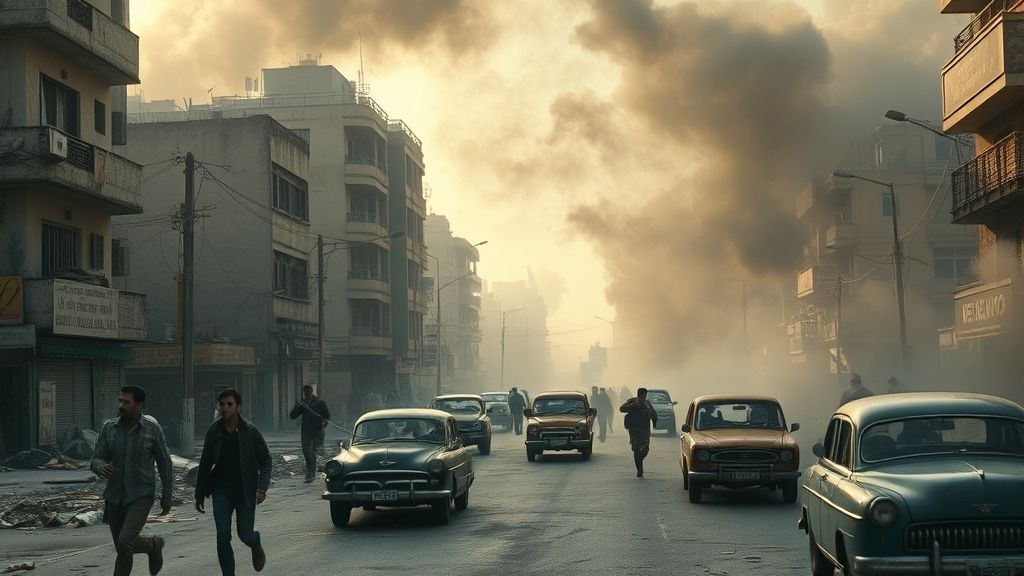
Following Ain el-Rummaneh, Lebanon’s capital fractured. Neighborhoods that had coexisted for centuries turned hostile. Snipers perched on rooftops, militia roadblocks cropped up, and daily life became a mortal gamble.
Civilians bore the brunt of atrocities as sectarian militias engaged in brutal campaigns of massacres, kidnappings, and intimidation. No area was spared: West Beirut witnessed confrontations between leftist and Palestinian militias, East Beirut between Christian forces and their rivals. Lebanese army fragmentation meant security dissolved.
The city’s economy ground to a halt, its markets emptied, streets scarred by rubble and blood. Yet the fighting was more than a local civil conflict—it bore the imprint of regional powers and ideologies.
The Role of Militias: From Phalanges to Amal
Militias multiplied as Lebanon slid deeper into chaos. The Phalange Party’s Kataeb militia symbolized Christian resistance; the Lebanese Forces would later unify various Christian factions under a militarized banner.
Opposite them, Shiite groups like Amal and later Hezbollah arose from marginalized communities, initially focusing on defending Shiite areas and contesting political exclusion.
Palestinian armed factions performed both offensive and defensive roles, while Druze militias under leader Kamal Jumblatt strove for their own regional autonomy.
Militias were not mere combatants; they were political actors, social service providers, and community protectors—yet also the source of much violence and fragmentation.
Foreign Powers Enmesh: Syria, Israel, and the Cold War Context
Syria entered Lebanon under the guise of peacekeeping but quickly pursued its own agenda, supporting certain factions, suppressing others, and extending Assad’s influence.
Israel conducted cross-border raids and later invaded Lebanon in 1978 and decisively in 1982, purportedly to crush the PLO but inadvertently exacerbating divisions.
The United States, the Soviet Union, and France played roles behind the scenes, supplying arms, shaping alliances, and using Lebanon as a proxy battlefield in the Cold War.
This external involvement complicated peace efforts and prolonged the war’s agony.
The Human Cost: Displacement, Casualties, and Trauma
The war shattered countless lives. Estimates suggest over 120,000 people died, nearly a million were wounded, and half the population—some 800,000—became internal or external refugees.
Families were uprooted. Neighborhoods were ethnically cleansed as sectarian militias sought to carve out homogeneous enclaves. Trauma became a national epidemic, with generations scarred by loss, violence, and distrust.
Cities once vibrant turned ghostly; Lebanon’s infrastructure was decimated; schools and hospitals became frontline victims. The human story of the war is etched in the eyes of survivors and the silent streets of Beirut.
International Reaction and Diplomatic Failures
Despite widespread violence, international reaction remained muted or ineffective. The United Nations deployed peacekeeping forces in 1978 with limited mandate and success.
Arab League summits often resulted in rhetoric without resolution; Western powers prioritized strategic interests over humanitarian concerns.
Diplomatic attempts—ceasefires, negotiations—repeatedly faltered amid shifting alliances and broken trust. The war’s complexity defied easy solutions.
The War’s Spread and Fragmentation of Authority
As years passed, Lebanon’s central government dissolved into impotence. Warlords governed territories like fiefdoms. Beirut became a divided capital, with sectarian enclaves controlled by militias.
Infrastructure decayed, lawlessness prevailed, and the economy collapsed. Lebanon’s sovereignty was fractured—dominated by outside powers and local militias.
The war evolved from a political conflict into a prolonged, multi-faceted struggle involving shifting lines, alliances, and cycles of violence.
Attempts at Peace: Taif Accord’s Long Road Ahead
In 1989, after 14 years of carnage, the Taif Agreement brokered under Saudi auspices aimed to end the war, rebalancing political power and calling for militia disarmament.
Though the accord ended open warfare, implementation was partial and fraught with challenges. Syria’s influence persisted, and political sectarianism remained entrenched.
Yet, the Taif Accord marked a fragile beginning for Lebanon’s slow return to relative stability and reconstruction.
The War of Memories: Collective Trauma and Narratives
Lebanon’s civil war is not only a past event but a continuing societal dialogue. Different communities have competing narratives—some stress victimhood, others resistance, reconciliation or grievances.
Monuments and commemorations often reflect sectarian perspectives, making national unity elusive.
The war’s memory is contested terrain, influencing politics, arts, literature, and collective identity.
Echoes of the Civil War in Modern Lebanon
The war’s shadow looms over contemporary Lebanon—from political paralysis to recurrent violence and economic crisis.
Sectarianism remains embedded in governance, and political actors often invoke wartime legitimacy.
The refugee crisis, diaspora dynamics, and regional conflicts echo wartime divisions.
Yet fledgling civil society movements and calls for reform also draw lessons from this painful history.
The Cultural Portrayal of the Conflict
Lebanese writers, filmmakers, and artists have grappled with the war’s complexity and tragedy. Works like Maroun Baghdadi’s films or Elias Khoury’s novels provide intimate insights into the human condition during wartime.
The arts serve as a bridge across divides, documenting suffering, memory, and resilience with piercing humanity.
Political and Social Consequences of the War
The war shattered old political orders, created new power dynamics, and altered social relations.
It accelerated Shiite political mobilization, weakened the traditional Maronite establishment, and left lasting scars on national cohesion.
Militias transformed into political parties; sectarian patronage networks solidified; the Lebanese state remained fragile and vulnerable.
Lebanon’s Reconstruction and the Fragile Peace
Post-war reconstruction efforts rebuilt property and infrastructure, with international aid and investments.
Yet physical rebuilding could not immediately heal societal fractures or political dysfunction.
Lebanon’s peace remains precarious, challenged by internal and external tensions, economic upheaval, and governance challenges.
The Lebanese Civil War’s Place in Middle Eastern History
Lebanon’s civil war stands as a vivid example of how sectarianism, external interference, and failed political systems can spiral into prolonged conflict.
It exposed the dangers of proxy wars, the limits of power-sharing systems, and the profound human cost of division.
Its legacy informs understanding of Middle Eastern conflicts, and global studies on civil wars.
Lessons Learned and Warnings for the Future
From Lebanon’s civil war emerges a stark reminder: fragile states require inclusive governance, social justice, and cautious external involvement.
Sectarian divisions, if institutionalized politically, risk becoming fault lines for violence.
The war’s history speaks to all societies embroiled in identity struggles about reconciliation, peace, and shared futures.
Conclusion
The eruption of the Lebanese Civil War on April 13, 1975, was not a sudden rupture but a slow-burning inferno sparked by decades of tension, conflict, and unmet aspirations. It transformed Beirut from a city of vibrant coexistence into a battlefield of sectarian rivalries and external ambitions, leaving scars that Lebanon still grapples with today.
Yet amid destruction and despair, Lebanon’s story is also one of resilience, complex human narratives, and enduring hopes for peace. The civil war’s lessons transcend time and borders, reminding us of the delicate nature of plural societies and the urgent need for dialogue, justice, and empathy.
As Lebanon continues to navigate its fragmented legacy, the echoes of April 1975 remind us: peace is not merely the absence of war but the presence of justice and shared humanity.
FAQs
Q1: What triggered the Lebanese Civil War in 1975?
A1: The immediate trigger was a violent clash on April 13, 1975, in Beirut’s Ain el-Rummaneh district—between Christian militias and Palestinian factions—within the context of deep sectarian, political, and social tensions.
Q2: What were the main factions involved in the war?
A2: Key factions included the Christian Lebanese Front (Phalanges, Lebanese Forces), Muslim-leftist coalitions, Palestinian Liberation Organization groups, and Shiite militias like Amal, plus external actors such as Syria and Israel.
Q3: How did foreign powers influence the conflict?
A3: Syria and Israel militarily intervened; the US, USSR, and France supported proxies; Syria acted as a dominant regional power; Israel launched invasions. Each sought to advance strategic interests.
Q4: What was the human impact of the war on Lebanon?
A4: Over 120,000 deaths, widespread displacement, destruction of infrastructure, deep societal trauma, and important demographic changes reshaped Lebanon’s population and cities.
Q5: How did the war end?
A5: The war formally ended with the 1989 Taif Agreement, which restructured Lebanese politics and laid groundwork for militia disarmament, though challenges remain.
Q6: What legacy did the civil war leave on Lebanese society?
A6: It entrenched sectarian divisions in governance, altered political power balances, influenced cultural memory, and complicated national reconciliation.
Q7: Why is the war still relevant to Lebanon today?
A7: Sectarianism persists in politics, economic and political crises reflect unresolved tensions, and the war’s memory shapes identity and political discourse.
Q8: How has Lebanese culture reflected the civil war?
A8: Through literature, cinema, and art—offering personal and collective reflections on trauma, memory, and hopes for unity.