Table of Contents
- Dawn over Saigon: The Final Day of the Vietnam War
- The Long Shadow of Conflict: Origins of the Vietnam War
- Colonial Legacies and the Seeds of Division
- The Domino Effect: Rising Cold War Tensions in Southeast Asia
- Building Up to the Fall: The Final Years of the Republic of Vietnam
- The North Vietnamese Spring Offensive of 1975: A Tide Unstoppable
- Within Saigon’s Walls: Fear, Hope, and Uncertainty
- Operation Frequent Wind: The Last Evacuation
- The Iconic Images: Helicopters, Crowds, and Desperation
- The Moment the Flags Fell: Viet Cong Capture of Saigon
- The City Transformed: Saigon Becomes Ho Chi Minh City
- Human Stories Amidst the Ruins: Refugees, Families, Soldiers
- Aftermath and Reconciliation: The New Vietnam Emerges
- Global Repercussions: Shifting Geopolitics after the Fall
- Memories and Controversies: How the War and Its End Are Remembered
- Lessons from Saigon: War, Peace, and the Price of Conflict
Dawn over Saigon: The Final Day of the Vietnam War
On the morning of April 30, 1975, the air in Saigon was thick not with sunlight but with dread. The once-bustling capital city of South Vietnam was gripped by an oppressive silence punctuated only by hurried footsteps, whispered prayers, and the distant roar of military vehicles. In offices, homes, and streets, people knew something irreversible was upon them – the culmination of a war that had spanned two decades, scarring a nation and reshaping the world’s political map.
The last vestiges of American military personnel vanished into helicopters ascending from rooftops. Families clung to one another, refugees scrambled to find any passage to safety, and the Northern Vietnamese army, confident and relentless, closed in. Saigon was about to fall — and with it, an era would end, marking both a tragedy and a transformation. This was not just a military defeat; it was the closing of an epic chapter lived by millions, a bitter testament to the costs of ideology, intervention, and conflict.
The Long Shadow of Conflict: Origins of the Vietnam War
To comprehend the fall of Saigon, one must journey back to the roots of the Vietnam War. This conflict was not born in 1965 when the first major American troop deployments arrived, nor simply from Cold War geopolitics. It simmered for decades within a land historically torn between foreign domination and fierce independence.
Vietnam had for centuries endured waves of colonial rule, principally by France. The French Indochina colony was a crucible of cultural clashes, economic exploitation, and nationalist ferment. Vietnamese patriots — intellectuals, peasants, and revolutionaries alike — sought liberation. Among them emerged Ho Chi Minh, a figure who would define the struggle for decades to come, blending communist ideology with fervent nationalism.
After Japan’s World War II occupation and subsequent defeat, the French sought to reassert control, sparking the First Indochina War. The Vietnamese, led by Ho Chi Minh’s Viet Minh, resisted with determination. The pivotal defeat of the French at Dien Bien Phu in 1954 shattered colonial dominance and set the stage for a divided Vietnam — a communist North and a capitalist South — each claiming legitimacy, each supported by their Cold War patrons.
Colonial Legacies and the Seeds of Division
The 1954 Geneva Accords drew an invisible line at the 17th parallel, creating two Vietnams but promising elections which never occurred. The United States, terrified of the "domino effect" of communist expansion, threw its weight behind the South Vietnamese regime led initially by Ngo Dinh Diem. His government, authoritarian and deeply unpopular, struggled with corruption, religious tensions, and the insurgent Viet Cong.
This division sowed the seeds for internal strife that escalated into full-blown civil war, drawing in global superpowers. The South’s regime increasingly depended on US military and economic support. By the early 1960s, the war transformed — no longer a mere insurgency but a sprawling conflict wrapped in the Cold War’s ideological garb.
The Domino Effect: Rising Cold War Tensions in Southeast Asia
The Vietnam War was a brutal theater within the broader Cold War. American leaders perceived Vietnam as the frontline to stop the spread of communism in Asia, fearing that a communist victory would lead to successive collapses in Thailand, Malaysia, Indonesia, and beyond. This so-called “domino theory” galvanized public support initially, though over time, as casualties mounted and progress stalled, American public opinion grew fractured.
The Soviet Union and China supplied weapons and advisers to the North, heightening the conflict’s intensity and prolonging its agony. Meanwhile, South Vietnam became entrenched in a struggle marked by guerrilla warfare, aerial bombing campaigns, and the infamous use of chemical agents like Agent Orange.
Building Up to the Fall: The Final Years of the Republic of Vietnam
By the early 1970s, the conflict had reached a bloody stalemate. The Paris Peace Accords of 1973 led to the withdrawal of most US troops, but fighting between North and South Vietnam continued. The South Vietnamese government, propped up by American aid, was increasingly fragile, riddled with corruption and lacking popular legitimacy.
Meanwhile, Hanoi, backed by Soviet and Chinese arms, planned its next phase. The North Vietnamese leadership, led by General Võ Nguyên Giáp and Party leaders, prepared a massive offensive. The stage was set for a decisive campaign that would shatter the South’s resistance.
The North Vietnamese Spring Offensive of 1975: A Tide Unstoppable
In March 1975, North Vietnamese forces launched their Spring Offensive, a sweeping military campaign characterized by rapid advances and stunning victories. The South Vietnamese army, crippled by low morale, dwindling resources, and internal chaos, was overwhelmed. Cities fell one by one: Ban Me Thuot, Hue, Da Nang — each defeat weakening the government’s grip.
Saigon, once considered impregnable, found itself under existential threat. Panic spread within political and military ranks. President Nguyễn Văn Thiệu resigned in late April, passing the baton to Vice President Trần Văn Hương, then quickly to Dương Văn Minh, who inherited a city on the brink.
Within Saigon’s Walls: Fear, Hope, and Uncertainty
Inside Saigon, the atmosphere was surreal. Some tried to maintain normalcy — cafes were still open, children attended school, the city buzzed with uneasy energy. Others frantically packed belongings, sought contacts, or waited desperately for evacuation.
The American embassy coordinated one final evacuation plan. Citizens, embassy personnel, and at-risk Vietnamese scrambled for spots on helicopters flying out. Stories emerged of neighbors torn apart, families left behind, of heartbreaking farewells.
Yet amidst despair, there was also resilience. Many vowed to stay, believing in their nation’s survival no matter the cost.
Operation Frequent Wind: The Last Evacuation
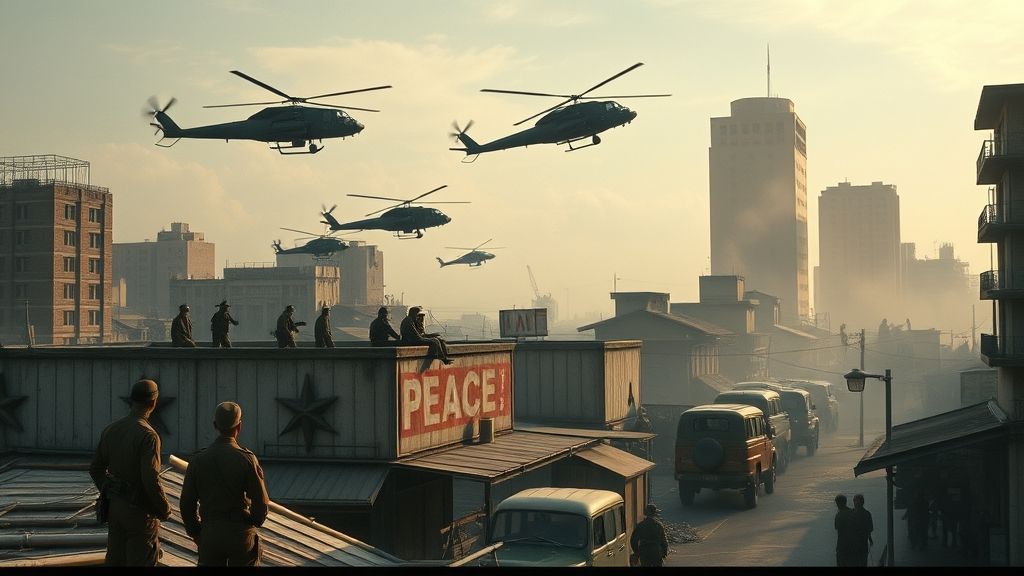
On April 29–30, Operation Frequent Wind became the largest helicopter evacuation in US history. Helicopters buzzed continuously above Saigon, ferrying out thousands in a frantic exodus. The spectacle was chaotic — people climbed onto rooftops and even onto the skids of helicopters, desperate to escape.
The images from this operation became iconic: crowded helicopters lifting off the U.S. Embassy’s roof, pilots navigating to safety while jets flew overhead, searching for enemy forces.
Though the operation saved many, thousands more were left behind or faced imprisonment in the aftermath.
The Iconic Images: Helicopters, Crowds, and Desperation
Photographs from April 1975 captured the world’s attention — a young woman clutching a stuffed animal as she boards a helicopter, a pilot urging crowds to move back, masses pressing toward evacuation points. They symbolize the human tragedy and complexity of war’s end.
One such image, taken by Hubert van Es, shows a helicopter atop an embassy building with a sprawling cityscape beneath — a visual representation of a world turned upside down.
These images haunt us, reminding future generations of the cost of conflict.
The Moment the Flags Fell: Viet Cong Capture of Saigon
At approximately 11:30 AM on April 30th, the tanks of the People’s Army of Vietnam crashed through the gates of the Presidential Palace. The South Vietnamese flag was taken down, replaced by the red flag with a gold star. The Fall of Saigon was official.
President Dương Văn Minh formally surrendered, and the war was declared over. For the victors, it was a glorious homecoming after years of struggle. For others, a time of mourning and uncertainty.
The City Transformed: Saigon Becomes Ho Chi Minh City
In the months following the fall, Saigon underwent profound political and cultural transformation. It was renamed Ho Chi Minh City, honoring the North’s legendary leader. The communist government began comprehensive reforms, reeducation camps were established for former South Vietnamese military personnel and officials.
The city’s identity shifted, but so did its scars. Former casinos became government offices; neighborhoods changed as former opponents tried to coexist under a new regime.
Human Stories Amidst the Ruins: Refugees, Families, Soldiers
The fall of Saigon was not just a military or political event; it was a human drama of loss and survival. Hundreds of thousands fled by boat or land, embarking on perilous journeys as "boat people." Families separated by ideology, imprisonment, or death sought reunion.
Soldiers who fought on both sides faced psychological and physical wounds. Many South Vietnamese officers, fearing persecution, lived in exile. The war’s shadow extended far beyond Vietnam’s borders.
Aftermath and Reconciliation: The New Vietnam Emerges
In the decades after 1975, Vietnam slowly opened itself to the world with economic reforms known as Đổi Mới in 1986, transitioning towards a market-oriented economy while retaining one-party rule. Relations with the United States improved, culminating in normalized diplomatic ties in the 1990s.
Generations born after the war grew up amid rapid modernization and reconciliation efforts, yet memories linger. Museums and memorials in Vietnam and abroad preserve the legacy, fostering dialogue on peace and remembrance.
Global Repercussions: Shifting Geopolitics after the Fall
The end of the Vietnam War sent shockwaves through global politics. The United States faced a crisis of confidence and a reevaluation of its interventionist policies. The Cold War’s dynamics shifted as China and the Soviet Union jostled for influence in Southeast Asia.
Regional partners had to adapt to the new reality of a unified communist Vietnam, influencing conflicts such as Cambodia’s Khmer Rouge regime and the Sino-Vietnamese War of 1979.
Memories and Controversies: How the War and Its End Are Remembered
The Vietnam War and the Fall of Saigon remain subjects of contested memory. In the United States, the war prompted deep soul-searching about military power, ethical responsibility, and national identity. Among Vietnamese communities in exile, Saigon’s fall is commemorated as a day of mourning and loss.
Meanwhile, within Vietnam, official narratives emphasize liberation and reunification, yet private memories often recount hardship and suffering. The war’s legacy continues to shape generations, art, literature, and political discourse.
Lessons from Saigon: War, Peace, and the Price of Conflict
The Fall of Saigon stands as a potent reminder of the human cost of war, the limits of power, and the complexities of ideological conflict. It teaches us about the resilience of people amid upheaval and the dangers of foreign intervention without clear ends.
As history moves forward, the events of 1975 urge reflection on compassion, diplomacy, and the profound need for peace.
Conclusion
The fall of Saigon on that damp April morning was not merely a military defeat or the conclusion of a distant war. It was a profound moment of human drama etched into the hearts of millions — those who witnessed the helicopters lifting off in desperation and those who marched victorious into a transformed city. Behind the flags, the tanks, and the official histories, there are countless stories of hope, loss, fear, and courage.
Today, as Ho Chi Minh City pulses with vibrant life and Vietnam’s place on the world stage grows, the shadows of 1975 remind us that peace is hard-won and fragile. The saga of Saigon’s fall is a timeless narrative — of pride and pain, of closure and new beginnings, and ultimately, of the enduring human spirit in the face of history’s most relentless tides.
FAQs
1. What exactly caused the Fall of Saigon in 1975?
The fall was the culmination of a long conflict fueled by ideological divisions, colonial legacies, and global Cold War rivalries. The immediate cause was a swift and decisive North Vietnamese offensive coupled with the withdrawal of American support and the weakening of South Vietnamese military and political structures.
2. Who were the key figures involved in the Fall of Saigon?
Notable figures include North Vietnamese leaders such as General Võ Nguyên Giáp, South Vietnamese Presidents Nguyễn Văn Thiệu and Dương Văn Minh, and US officials overseeing the evacuation such as Ambassador Graham Martin.
3. How did Operation Frequent Wind impact the evacuation?
Operation Frequent Wind was the helicopter evacuation that saved thousands of Americans and Vietnamese allies in the final hours, though the operation was chaotic and underscored the desperation of the moment.
4. What happened to South Vietnamese refugees after the war?
Hundreds of thousands fled Vietnam in dangerous journeys, becoming “boat people.” Many resettled in countries like the United States, Australia, and Canada, building new lives while maintaining cultural ties.
5. How did the fall affect Vietnam politically and socially?
Vietnam was reunified under communist rule, with political purges, reeducation camps, and significant social transformation. Decades later, economic reforms and increased openness reshaped the society further.
6. What is the legacy of the Fall of Saigon in American history?
The event symbolized the limits of American power and led to widespread reevaluation of US foreign policy, particularly regarding military intervention.
7. Are there still divisions in how the war and the fall are remembered today?
Yes, there remain sharp differences in collective memory between Vietnamese at home, diaspora communities, and others, reflecting varied experiences and perspectives.
8. How has Saigon changed since 1975?
Now Ho Chi Minh City, it has evolved into a booming metropolis blending modernity with remnants of its turbulent past, a symbol of Vietnam’s resilience and renewal.