Table of Contents
- The Night of Hope: December 6, 1978, Madrid
- Spain on the Brink: A Nation Scarred by Dictatorship
- The Ghosts of Franco: Legacy and Resistance
- Seeds of Change: The Transition to Democracy
- The Architects of the Constitution: Political Titans in Dialogue
- Crafting the Carta Magna: From Debate to Consensus
- The Role of the Monarch: King Juan Carlos and His Crucial Stand
- The Regional Puzzle: Autonomy and National Identity
- The Political Spectrum: From Communists to Conservatives
- Public Sentiment: The Citizens’ Role and Expectations
- The Referendum Campaign: Challenges and Triumphs
- Voters at the Polls: December 6, 1978, Unfolded
- The Democratic Constitution: Pillars and Principles
- A New Dawn: International Reactions to Spain’s Democratic Leap
- Trials Ahead: Implementing Democracy in a Divided Land
- The Constitution’s Enduring Legacy in Spanish Society
- The Echoes of 1978 in Modern Spain
- Lessons Learned: Democracy as a Continuous Journey
- Conclusion: The Spirit of December 6, A Beacon for Generations
- Frequently Asked Questions about Spain’s 1978 Constitution
- External Resource
- Internal Link
1. The Night of Hope: December 6, 1978, Madrid
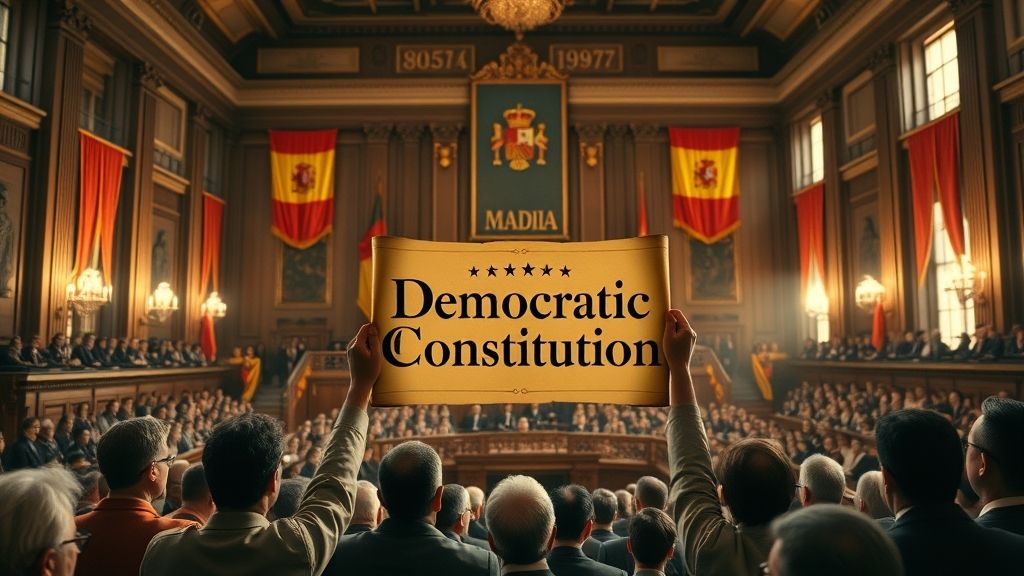
Madrid on the evening of December 6, 1978, was a city holding its breath. The cold winter air was charged with an unprecedented sense of anticipation. Citizens from all walks of life poured into plazas and cafés, clutching their ballots, whispering to neighbors about an uncertain future. No one could quite predict what the dawn would bring — but all knew what was at stake: a new path for Spain, a chance to heal decades-old wounds, and a final farewell to the shadow of dictatorship. When the democratic constitution was approved by a resounding majority, it was more than a legal text—it was a collective leap into freedom. The applause that echoed in Madrid’s streets was not just for the victory of democracy, but for the promise of a new Spain reborn.
2. Spain on the Brink: A Nation Scarred by Dictatorship
To truly grasp the monumental importance of December 6, 1978, one must navigate the turbulent waters of Spain’s 20th-century history. The civil war of the 1930s, which tore families and communities apart, had left a deep scar. Soon after, General Francisco Franco seized power, establishing a rigid, authoritarian regime that would last nearly four decades. The Franco dictatorship suppressed political dissent, abolished freedoms, and promoted a singular, uniform identity that marginalized regional languages and cultures.
Spain, isolated internationally and trapped in a stifling socio-political silence, saw little hope for change. Every expression of opposition was met with brutality and imprisonment, forcing dissent underground or into exile. For millions, the vision of democracy seemed distant, almost unimaginable. Yet beneath the surface, the seeds of resistance quietly germinated, nurtured by a desire for justice and the human yearning for dignity.
3. The Ghosts of Franco: Legacy and Resistance
Franco’s death in 1975 did not immediately dissolve the long shadows cast by his regime. The military, conservative factions, and entrenched power structures remained wary, if not hostile, to rapid reform. Many Spaniards feared chaos or a replay of civil conflict. Memories of violence loomed large, and wounds remained raw. Nevertheless, emerging voices—politicians, intellectuals, workers, and youth—began to coalesce around the dream of democracy.
The resistance took many forms: from clandestine meetings of opposition leaders to massive protests and strikes. Simultaneously, secret negotiations began in corridors of power, as reformists within Franco’s own party sought a controlled transition to prevent anarchy. The challenge was immense: how to dismantle a dictatorship without bloodshed or collapse.
4. Seeds of Change: The Transition to Democracy
Known as the Transición, Spain’s peaceful transition to democracy is one of the most studied political transformations in modern history. It combined pragmatism, courage, and extraordinary statesmanship. In 1977, the first democratic elections in over forty years were held, setting the stage for a new constitutional framework. The newly elected Cortes Generales (the Spanish Parliament) had the enormous task of writing a constitution that could reconcile a fractured past and diverse political visions.
This period was marked by delicate balancing acts. Reformers needed to convince former Francoists to accept change without denouncing them so harshly as to provoke rebellion. Meanwhile, radical left-wing factions and regional nationalists pushed hard for deeper reforms. The challenge lay in creating a political system inclusive and stable enough to endure.
5. The Architects of the Constitution: Political Titans in Dialogue
Behind the scenes of the constitutional process were towering figures. Adolfo Suárez, the former Francoist who became Prime Minister, emerged as a pragmatic leader walking a tightrope between old and new Spain. Alongside him were other indispensable actors: Santiago Carrillo, leader of the Communist Party; Manuel Fraga, a former Francoist with a reformist streak; and the young socialist Felipe González.
These men and many others spent months in closed-door negotiations, arguing fiercely but with a shared understanding: this was the moment to craft a consensus that would spare Spain from civil strife and open a democratic future. Their debates stretched over sensitive issues—the role of the monarchy, church-state relations, civil liberties, and the distribution of powers between central and regional governments.
6. Crafting the Carta Magna: From Debate to Consensus
Writing the Constitution was a colossal task, requiring the harmonization of competing narratives and aspirations. The drafters faced the delicate question of Spain’s territorial organization. Regions like Catalonia and the Basque Country, which had long histories of autonomy and strong nationalist feelings, demanded recognition. The Constitution’s solution was novel for its time: it created a system of autonomous communities, allowing self-governance within the framework of the Spanish state.
The text also addressed fundamental rights—a comprehensive catalogue of freedoms designed to prevent any return to authoritarianism. Freedom of speech, assembly, political association, and equality before the law were enshrined as inviolable. Yet, the Constitution preserved the monarchy as a symbol of unity and continuity, a decision that would prove crucial in anchoring the fledgling democracy.
7. The Role of the Monarch: King Juan Carlos and His Crucial Stand
King Juan Carlos I was a pivotal figure in Spain’s democratic transition, embodying both the country’s complex history and its hopeful future. At first seen with skepticism by many who associated the monarchy with Franco’s regime, Juan Carlos surprised observers by embracing reform. His discreet but firm support for democracy, famously demonstrated during the attempted coup of 1981, cemented his legacy.
During the constitution’s drafting and ratification, Juan Carlos was more than a silent figurehead. His presence provided reassurance to conservatives and moderates alike, signaling that change would be gradual but irreversible. This royal backing was instrumental in guiding Spain through uncertain political waters.
8. The Regional Puzzle: Autonomy and National Identity
Spain’s remarkable ethnic, linguistic, and cultural diversity posed a formidable obstacle during constitutional debates. Catalonia, the Basque Country, and Galicia had distinct identities and had been suppressed under Franco’s regime. The new Constitution acknowledged the right to autonomy for these regions, allowing them to maintain their language and culture, and to establish their own parliaments.
This innovative approach was not without controversy. Nationalists demanded even greater sovereignty while Spanish centralists feared a balkanization of the country. The Constitution struck a delicate compromise, laying the groundwork for ongoing debates about Spain’s territorial integrity—a conflict that remains alive to this day.
9. The Political Spectrum: From Communists to Conservatives
The Constitution’s creation validated a new pluralism in Spanish politics. The legalization of the Communist Party signaled an unprecedented openness, given its prior outlawing under Franco. The Socialist Workers’ Party (PSOE) grew in influence, while the center-right People's Alliance (which evolved into the Popular Party) provided a more conservative counterbalance.
This broad spectrum represented the many Spaniards who had been dispossessed of political voice for decades. The ability of these diverse parties to cooperate—sometimes frictionally—but ultimately collegially was a testament to the conciliatory spirit that suffused the Transición.
10. Public Sentiment: The Citizens’ Role and Expectations
For ordinary Spaniards, the 1978 Constitution was not just a political document but a symbol of liberation. Years of censorship and repression had stifled public expression, but the voting referendum empowered millions to shape their nation’s future.
Despite some skepticism and fears of instability, turnout was remarkably high, with around 67% backing the new Constitution. For the first time in generations, people could openly celebrate democracy, speak freely, and envision a society where human rights were protected.
11. The Referendum Campaign: Challenges and Triumphs
The referendum campaign was an extraordinary exercise in civic engagement. Political parties organized rallies, debates, and grassroots canvassing across cities and villages. Challenges persisted: the lingering influence of Francoists urged a “No” vote, radicals on the far left viewed the document as insufficient, and some nationalist groups held back support.
Yet, the eventual overwhelming approval was a testament to the widespread desire to move forward. Newspapers ran headlines like “¡Sí a la Libertad!” (“Yes to Freedom!”), capturing a national mood of cautious optimism mixed with pride.
12. Voters at the Polls: December 6, 1978, Unfolded
On that decisive December day, millions of Spaniards queued patiently at polling stations nationwide. The air was electric with anticipation but also tinged with solemnity. For many, this vote represented the culmination of years of hardship and the beginning of a long-awaited dawn.
When the results came in, it was clear: over 87% of those who voted had said “Yes.” Cities erupted in celebrations, flags waved from balconies, and strangers embraced in the streets. This was, undeniably, a turning point—the collective confirmation that Spain was ready to embrace democracy.
13. The Democratic Constitution: Pillars and Principles
Spain’s 1978 Constitution rests on several foundational pillars: the sovereignty of the people, the rule of law, the separation of powers, and the protection of fundamental rights. It established a parliamentary monarchy, where the King acts within constitutional limits, and set up democratic institutions including independent judiciary and periodic elections.
Its artful recognition of Spain's plural identities through autonomous communities was revolutionary. The document also guaranteed freedom of expression, assembly, and religion, laying the cornerstone for a pluralistic, democratic society.
14. A New Dawn: International Reactions to Spain’s Democratic Leap
The global community greeted Spain’s constitutional approval with admiration and relief. After decades of isolationism and dictatorship, Spain was now ready to engage as a modern democratic partner in Europe. Western powers, especially the United States and member states of the European Economic Community (now European Union), hailed the transition as a model of peaceful reform.
The constitution paved Spain’s way to join NATO and the European Community, integrating it into the Western democratic fold and boosting its economy and international stature.
15. Trials Ahead: Implementing Democracy in a Divided Land
Approval of the Constitution was far from the end of the journey. The early 1980s saw Spain grappling with political violence, especially from separatist groups like ETA, social unrest, and challenges in consolidating democratic institutions.
Economic problems and pressures to modernize weighed heavily. Nonetheless, the resilient structures created in 1978 provided a framework for stability and gradual reform, enabling Spain to weather crises without reverting to authoritarianism.
16. The Constitution’s Enduring Legacy in Spanish Society
More than four decades later, the 1978 Constitution remains the backbone of Spain's democratic system. It has been amended sparingly, showing its robustness. Its principles continue to guide debates on civil rights, regional autonomy, and governance.
For many Spaniards, the constitution symbolizes a pact of mutual respect and democratic legitimacy—a benchmark against which political actors are measured.
17. The Echoes of 1978 in Modern Spain
Contemporary Spain still wrestles with questions first raised during the constitution's drafting—regional sovereignty demands, political corruption, and the pace of democratic reforms. Yet the spirit of dialogue and compromise embedded in the 1978 process offers tools for reconciliation.
Movements from Catalonia’s independence push to debates on social justice all trace their roots to the constitutional order that sought to manage diversity with unity.
18. Lessons Learned: Democracy as a Continuous Journey
Spain’s story since 1978 illustrates that democracy is not a static achievement but a continuous process requiring vigilance, dialogue, and adaptation. The journey from dictatorship to democratic constitution teaches that compromise among adversaries can forge durable peace.
The constitution’s success owes as much to the values it enshrined as to the willingness of Spaniards to embrace a collective future despite their past divisions.
Conclusion
December 6, 1978, marks a moment of profound transformation—a collective step taken by a nation emerging from darkness into light. The approval of Spain’s democratic Constitution represents not merely a set of legal provisions but the triumph of hope, courage, and shared commitment. Through compromise across ideological divides, Spain chose peace over conflict, democracy over repression, and pluralism over uniformity.
This moment resonates beyond the borders of Spain, serving as an inspiring testament to the human capacity for reconciliation and renewal. As Spain continues to evolve, the principles laid down that night illuminate the path forward, reminding us that democracy, though fragile, is enduring when nurtured with respect and courage.
FAQs
Q1: What were the main causes leading to the approval of the 1978 Constitution in Spain?
A1: The death of Franco in 1975 created an opportunity for political reform. Prolonged repression under dictatorship, economic stagnation, and the rise of opposition groups pushed Spain towards a negotiated transition to democracy, culminating in the Constitution.
Q2: Who were the key figures involved in creating Spain’s 1978 Constitution?
A2: Prominent figures included Prime Minister Adolfo Suárez, Communist leader Santiago Carrillo, Socialist Felipe González, conservative Manuel Fraga, and King Juan Carlos I, among others, who negotiated to build consensus.
Q3: How did the Constitution address Spain’s regional diversity?
A3: It introduced the system of autonomous communities, allowing regions like Catalonia, the Basque Country, and Galicia to preserve their languages, culture, and self-government rights within Spain.
Q4: What role did King Juan Carlos I play in the democratic transition?
A4: He acted as a unifying symbol and staunch supporter of democracy, notably opposing the 1981 coup attempt, thus reinforcing the constitutional order.
Q5: What were the international reactions to Spain’s new democratic constitution?
A5: Democratic nations and institutions widely welcomed Spain’s transition, which paved the way for Spain’s integration into NATO, the European Economic Community, and improved diplomatic relations.
Q6: What challenges did Spain face after the Constitution was approved?
A6: Spain confronted political violence, separatist movements, economic difficulties, and the ongoing task of consolidating democratic institutions.
Q7: How is the 1978 Constitution viewed today in Spain?
A7: It is seen as the foundational legal document supporting democracy, human rights, and regional autonomy, though debates about reform or reinterpretation continue.
Q8: Why is Spain’s transition considered a model for peaceful democratization?
A8: Because it avoided violent conflict through dialogue, compromise, and inclusion of diverse political forces, balancing change with continuity.