Table of Contents
- The Dawn of a New Era: Tehran on the Eve of Departure
- The Shah's Reign: A Troubled Dynasty
- Seeds of Discontent: Political and Social Upheaval
- The Rise of Ayatollah Khomeini: From Exile to Revered Leader
- Iran’s Economic Boom and Inequality: Persia’s Double-Edged Sword
- The Political Repression and the SAVAK’s Shadow
- Religious Resurgence and the Mobilization of the Masses
- Western Influence and the Oil Factor: A Tangled Web
- The Month of January 1979: A Nation on the Brink
- January 16, 1979: The Shah’s Final Flight
- The Emotional Farewell: Public Reactions Across Tehran
- The Power Vacuum: Revolutionary Fervor Ignites the Streets
- The Shah in Exile: A Life Displaced and Haunted
- The Fall of a Monarchy: End of an Era, Birth of the Islamic Republic
- The Global Shockwave: Repercussions in World Politics
- Iranian Diaspora: Memories of Loss and New Beginnings
- Myths and Realities of the Shah’s Departure
- The Shah’s Departure in Historical Perspective
- The Transformation of Tehran: City of the Revolution
- The Legacy of January 16, 1979, in Contemporary Iran
- Conclusion: A Departure That Changed the Course of History
- FAQs: Understanding the Shah’s Departure and Its Aftermath
- External Resource: Comprehensive Overview and Further Reading
- Internal Link: Visit History Sphere for More Engaging Articles
The Dawn of a New Era: Tehran on the Eve of Departure
The brisk January morning of 1979 dawned over Tehran with an unusual stillness, as if the capital city itself was holding its breath. Streets that had once echoed with the triumphant footsteps of Imperial guards seemed to shudder under the weight of an unseen force. The snow-capped Alborz mountains encircling the city were silent witnesses to the palpable tension that gripped the metropolis. Here, in the heart of ancient Persia, a 2,500-year-old monarchy was about to make its fateful exit. On January 16, Mohammad Reza Shah Pahlavi, the emblematic figure of Iran’s modernizing ambitions and authoritarian rule, boarded a plane that would take him into exile — a departure that would reshape the very essence of Iran and reverberate across the world.
This pivotal moment was no mere political exile; it was the dramatic dénouement of decades of growing unrest, hope, and despair. The Shah’s departure heralded the end of a dynasty and the birth pangs of the Islamic Republic, a transformation marked by profound contradictions and complex human stories. As we step into this narrative, we delve deeper into the forces that propelled this event, the drama that unfolded, and the indelible consequences on Iran and beyond.
The Shah's Reign: A Troubled Dynasty
Mohammad Reza Pahlavi ascended the Peacock Throne in 1941 after his father, Reza Shah, was forced into exile by British and Soviet forces. The young Shah inherited a nation teetering between tradition and transformation, between feudal tribalism and the promises of modernity. For nearly four decades, the Shah sought to be the architect of a modern Iran — blending Western-style modernization with a centralized, monarchical power.
His reign was marked by ambitious reforms: the White Revolution, launched in 1963, aimed to redistribute land, expand education, and empower women. Yet, this vision often clashed violently with entrenched social structures and religious authorities. The Shah’s efforts to cement his rule involved building a pervasive intelligence service, SAVAK, infamous for harsh repression of political dissent.
Thus, the Shah’s Iran was a mosaic of paradoxes — a country rich in oil and resources but rife with inequality; a modernizing state yet politically repressive; a Western ally but culturally conflicted. The seeds of discontent germinated steadily under this veneer of grandeur.
Seeds of Discontent: Political and Social Upheaval
Despite economic growth spurred by surging oil revenues in the 1970s, wealth and power remained concentrated among a privileged elite. Rural farmers, urban workers, and religious conservatives were often left marginalized, fueling widespread dissatisfaction. Political dissent was ruthlessly crushed, leaving no legal avenues for opposition.
Moreover, rapid modernization unleashed social disorientation. Traditional religious values were perceived to be under threat, igniting a cultural backlash. The rise of left-wing movements further complicated the landscape, with Marxist and nationalist voices finding resonance among students and intellectuals.
The political landscape was a powder keg of grievances — corruption, human rights abuses, foreign interference, and cultural alienation combined to create a potent revolutionary climate.
The Rise of Ayatollah Khomeini: From Exile to Revered Leader
Among the growing opposition figures, Ayatollah Ruhollah Khomeini emerged as the singular voice of resistance. Exiled since 1964 due to his criticism of the Shah’s regime and its secular policies, Khomeini’s messages smuggled into Iran became a rallying cry for those opposing the Shah.
His blend of political Islam and calls for social justice galvanized disparate groups — religious conservatives, clerics, students, and workers — uniting them under a shared vision of an Islamic government. The Shah underestimated Khomeini's influence, dismissing the cleric’s ability to mobilize the masses.
Khomeini’s return would become emblematic of the revolution itself, but for now, in early 1979, his doctrines fan the flames of dissent from afar.
Iran’s Economic Boom and Inequality: Persia’s Double-Edged Sword
By the late 1970s, Iran was riding an economic high fueled by the oil booms of the 1970s. Urbanization surged as millions moved to Tehran and other cities in search of opportunity. Skyscrapers, highways, and modern amenities sprouted alongside crumbling bazaars and ghettos.
Yet this prosperity masked stark disparities. While Tehran's upper class enjoyed luxury and international flair, large swaths of the population lived in poverty and destitution. The gap between rich and poor was aggravated by inflation, unemployment, and housing shortages.
This economic divide widened societal fractures, turning many against the Shah who was seen as a profligate spender on grandeur and Western trappings, indifferent to the plight of ordinary Iranians.
The Political Repression and the SAVAK’s Shadow
The myth of economic success was perpetuated under a cloud of fear. The Shah’s secret police, SAVAK, was infamous for its brutal tactics — surveillance, arbitrary arrests, torture, and extrajudicial killings were rampant. The regime’s intolerance for opposition silenced political debate and fomented underground resistance.
Yet, repression often backfired — instead of quelling dissent, it stoked hatred and paranoia. Families were shattered, and entire communities radicalized. The regime’s reliance on coercion rather than consent deepened the alienation of the populace.
This brutality, juxtaposed with the Shah’s cosmopolitan image abroad, intensified criticism both within Iran and from the international community.
Religious Resurgence and the Mobilization of the Masses
In the face of political vacuum and cultural dislocation, religion became a powerful vehicle for popular mobilization. Mosques transformed from spiritual spaces to political hubs, where sermons sparked protests, strikes, and civil disobedience.
The clergy, marginalized since Reza Shah’s attempts to curtail their influence, regained ascendancy. Khomeini’s calls for an Islamic state resonated profoundly, particularly among rural and urban poor communities who found hope in a religious vision of justice and dignity.
Mass gatherings, particularly during Ashura commemorations, became moments of collective defiance, weaving faith with resistance.
Western Influence and the Oil Factor: A Tangled Web
Iran’s vast oil reserves had long attracted Western powers hungry for energy security. From the mid-20th century, British, and later American, companies dominated Iran’s oil sector, enriching elites and fueling geopolitical interests.
The Shah’s close relationship with the United States provided military aid and political backing, but also fueled nationalist resentment. Many Iranians saw the monarchy as a Western puppet, compromising Iran’s sovereignty.
This perception was a critical factor in the revolutionary fervor — a desire not only to overthrow the Shah but to expel foreign influence. The global context of Cold War rivalry further complicated efforts to stabilize Iran.
The Month of January 1979: A Nation on the Brink
January 1979 was a month charged with mounting confrontation. Protests cascaded through Tehran and other cities, government forces found themselves increasingly unable to maintain order, and the Shah’s inner circle grew fractious.
Political negotiations attempted, yet failed to stem the tide. The Shah’s health, already poor due to cancer, deteriorated, making governance more erratic. Soldiers and police often sympathized with protesters or hesitated to use force.
International pressure mounted as the prospect of a revolutionary regime unsettled allies and adversaries alike.
January 16, 1979: The Shah’s Final Flight
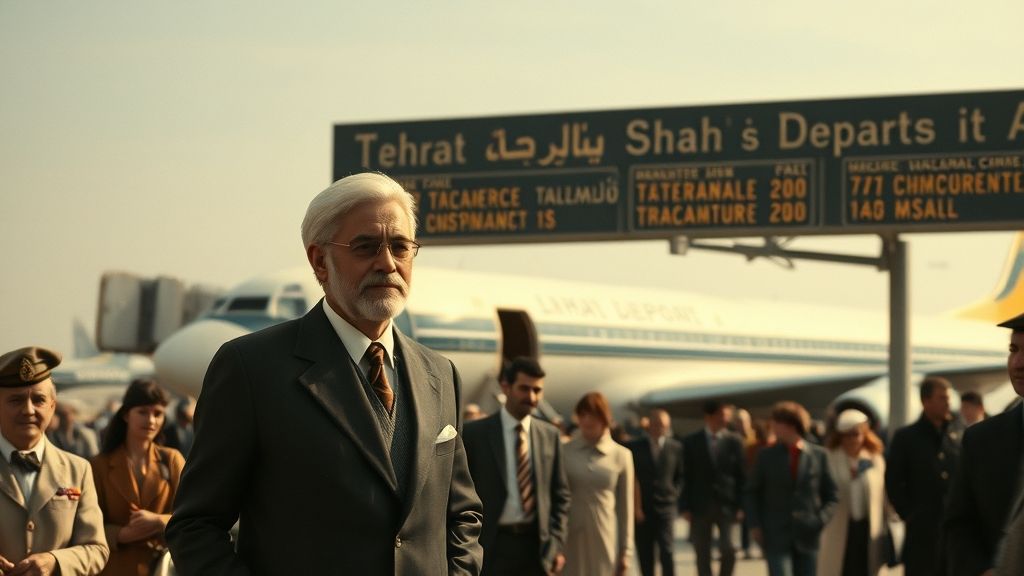
On January 16, under the cloak of early morning darkness, the Shah slipped away from Tehran’s palace, boarding a Royal Air Force Boeing 707. His destination was uncertain — Egypt, Morocco, or ultimately the United States — but one fact was clear: his rule in Iran was finished.
The departure was shrouded with a mixture of secrecy and spectacle — military aircraft flanked the plane; television stations broadcast the news with awe and fear. For many Iranians, the moment was surreal — the monarch who had seemed invincible was gone.
Yet for others, anxiety lingered. What would replace the monarchy? Would chaos ensue?
The Emotional Farewell: Public Reactions Across Tehran
The streets of Tehran reacted with a mixture of jubilation, relief, confusion, and grief. Crowds swelled, chanting slogans of victory for revolution and prayers for a new Iran. Yet others mourned a lost era, fearing retribution, instability, and loss.
Families gathered around radios and television sets, trying to make sense of a seismic change. The city — a complex tapestry of old bazaars, modern apartments, and sacred shrines — echoed with voices debating the future.
In homes, cafes, and mosques, Iranians grappled with hope and trepidation — a nation caught between past and future.
The Power Vacuum: Revolutionary Fervor Ignites the Streets
With the Shah’s departure, no clear authority remained. Revolutionary councils formed hastily, security forces dissolved. The provisional government under Prime Minister Shapour Bakhtiar struggled to assert control amidst an unstoppable wave of opposition.
The streets were alive with revolutionary committees, young demonstrators, and clerical leaders coordinating the dismantling of the monarchy’s structures. Tehran became both a battleground and a crucible of change.
What began as hope for reform soon transformed into a radical redefinition of Iran’s identity — an Islamic republic rooted in Shia theocracy and populist mobilization.
The Shah in Exile: A Life Displaced and Haunted
The Shah’s life in exile was marked by wandering and decline. He found refuge in Egypt, Morocco, the Bahamas, and the United States, where he sought medical treatment. Yet exile was a bitter existence — isolated from the land he once ruled, shunned by many former allies and haunted by memories of power lost.
The once-mighty monarch became a symbol of fallen imperial ambition and failed modernization. His health deteriorated rapidly, and he died in Egypt in 1980.
The personal tragedy of the Shah mirrored the upheavals engulfing Iran, a poignant reminder of impermanence.
The Fall of a Monarchy: End of an Era, Birth of the Islamic Republic
The Shah’s departure was not the end but rather the beginning of Iran’s revolutionary transformation. Within weeks, Ayatollah Khomeini returned to Tehran triumphantly, greeted by millions.
By April 1979, a referendum abolished the monarchy and declared the Islamic Republic, fundamentally altering the nation’s political, social, and cultural landscape. The new regime redefined Iran’s laws, governance, and international relations, often through harsh and revolutionary means.
The Pahlavi dynasty, which symbolized Iran’s 20th-century modernization, was officially over.
The Global Shockwave: Repercussions in World Politics
The fall of the Shah sent shockwaves far beyond Iran’s borders. The geopolitical balance in the Middle East shifted dramatically, alarmed Western powers recalibrated their strategies. The US lost a crucial ally and faced an emboldened, anti-Western regime.
The revolution inspired Islamist movements worldwide and intensified Cold War rivalries. The Iranian hostage crisis later in 1979 shattered US-Iranian relations for decades.
This upheaval reshaped the modern world order, highlighting the complex intersections of ideology, faith, and power.
Iranian Diaspora: Memories of Loss and New Beginnings
Millions of Iranians fled the upheaval, seeking refuge in Europe, the United States, and beyond. The diaspora communities became vibrant hubs of culture, activism, and memory — preserving nostalgia for a vanished Iran and articulating critiques of the Islamic Republic.
These communities embody the personal human costs of revolution — exile, fragmented identities, and the painful balancing of heritage and assimilation.
The Shah’s departure was not only a political event; it catalyzed countless life stories of displacement and hope.
Myths and Realities of the Shah’s Departure
Over the decades, narratives about the Shah’s exit have been shaped and reshaped — from heroic tales of liberation to conspiracy theories implicating global powers. The truth, nestled amid propaganda and memory, reveals a complex interplay of internal revolt and external pressure.
Was the Shah abandoned by his allies, or did he choose exile voluntarily? Did the West betray him or pragmatically accept change? These questions still resonate in Iranian discourse.
Understanding these myths helps unpack the deeper truths of historical experience.
The Shah’s Departure in Historical Perspective
Viewed through a historical lens, the Shah’s departure stands as a pivotal moment in 20th-century history — emblematic of the clashes between autocracy and popular sovereignty, tradition and modernity, East and West.
It exemplifies how deeply-rooted grievances can culminate in revolutionary rupture, influencing countless subsequent events in the region.
The narrative of January 16, 1979, continues to teach lessons about leadership, legitimacy, and the forces of history.
The Transformation of Tehran: City of the Revolution
Tehran itself transformed — from a city of palaces and oil wealth into the epicenter of revolutionary zeal. The urban landscape shifted as monuments were dismantled and slogans about justice and faith adorned walls.
The city’s social fabric was rewoven, as ordinary citizens became actors in a profound political drama. The memory of the Shah faded gradually while new visions of Iran emerged robustly.
Tehran’s story encapsulates the broader Iranian saga — a city forever changed by revolution.
The Legacy of January 16, 1979, in Contemporary Iran
Today, the Shah’s departure remains deeply etched in Iran’s collective memory, serving as both a warning and a symbol. It underscores the fragility of imposed modernization without consent and the potency of mass mobilization rooted in faith and identity.
Contemporary Iranian politics, with its tensions between reform and conservatism, nationalism and religious authority, still echo the unresolved issues of 1979.
The Shah’s exit inaugurated a new chapter, one still unfolding in the heart of Persian civilization.
Conclusion
The flight of Mohammad Reza Shah on January 16, 1979, was much more than the departure of a ruler — it was a seismic shift in the soul of a nation. Tehran, once thrumming under the firm hand of imperial power, became the stage for a revolution that reshaped not only Iran’s destiny but reverberated across global politics.
This moment captured the entangled threads of ambition, faith, repression, hope, and transformation. Millions witnessed the collapse of an empire and the dawn of a new order whose echoes are still felt today.
Understanding this event requires us to look beyond the headlines and slogans — to feel the hopes and fears of those who lived it. It compels us to appreciate how history is never a simple tale of cause and effect, but a human story — fraught, layered, and profoundly alive.
January 16, 1979, is an emblem of that truth: the fragile, formidable power of people to remake their world.
FAQs
Q1: What were the main causes that led to the Shah's departure in 1979?
A: The Shah’s departure resulted from prolonged political repression, social inequality, rapid modernization clashing with traditional values, economic disparities, and the rising influence of religious opposition led by Ayatollah Khomeini. Widespread protests and loss of support within security forces accelerated his exit.
Q2: Who was Mohammad Reza Shah Pahlavi, and what characterized his rule?
A: Mohammad Reza Shah was the last monarch of Iran’s Pahlavi dynasty. His reign (1941-1979) combined ambitious western-style modernization efforts with authoritarian rule, supported by the SAVAK secret police. His policies created both economic progress and deep societal divisions.
Q3: How did Ayatollah Khomeini influence the events leading to the Shah’s exile?
A: Exiled since 1964, Khomeini became the spiritual and ideological leader of the opposition through religious sermons and political statements spread inside Iran. His vision of an Islamic government united diverse groups against the Shah and provided a rallying point for the revolution.
Q4: What were the immediate consequences of the Shah leaving Iran?
A: The Shah’s departure left a power vacuum, allowing revolutionary forces to take control. Ayatollah Khomeini returned triumphantly from exile, leading to the establishment of the Islamic Republic following a national referendum that abolished the monarchy.
Q5: How did the international community react to the Shah’s departure?
A: Global powers, especially the United States and the Soviet Union, reacted with concern and uncertainty. The fall of a US ally alarmed Western countries, reshaping Middle East geopolitics and contributing to Cold War tensions.
Q6: What was the role of the Iranian people during the final days of the Shah’s rule?
A: Millions of Iranians mobilized in massive protests, strikes, and civil disobedience, often organized through mosques and revolutionary committees. Both secular and religious groups demanded the fall of the monarchy, playing a decisive role in its collapse.
Q7: What is the legacy of the Shah’s departure in modern Iran?
A: The departure symbolizes the end of monarchical rule and the rise of the theocratic Islamic Republic. It highlights enduring themes such as the struggle for sovereignty, the role of religion in governance, and the clash between modernity and tradition.
Q8: How did the Shah’s departure affect Iranian diaspora communities?
A: Millions fled Iran, creating vibrant diaspora communities worldwide. These communities hold complex memories of pre-revolution Iran and continue to influence debates on identity, politics, and culture related to Iran.