Table of Contents
- The Dawn of a New Era: Cold War Shadows over Vienna
- The Road to SALT II: Origins and Stakes in the Arms Race
- The Players: Carter, Brezhnev, and the Cold War Chessboard
- Vienna, 1979: The City Becomes a Diplomatic Battleground
- The Anatomy of the Negotiations: From Helsinki to Vienna
- The Stakes of Strategic Arms Limitation: Mutual Assured Destruction and Paranoia
- Cold Rooms and Hot Words: Behind the Closed Doors of SALT II Talks
- The Signature Day: June 18, 1979—Ceremonies and Symbolism
- The Content of SALT II: Agreements, Limits, and Loopholes
- Domestic Reactions: Washington’s Hurdles and Soviet Calculations
- The Global Ripple: How SALT II Reframed International Security
- An Oath Under Strain: The Afghanistan Invasion and SALT II’s Tripwire
- Public Perceptions and Media Narratives: Hope vs. Skepticism
- The Slow Demise: Why SALT II Never Ratified Fully
- The Legacy of SALT II: From Treaty to Template
- Arms Control After SALT II: Paving the Path to START and Beyond
- Reflections on Trust and Mistrust: Cold War Lessons from SALT II
- Anecdotes and Human Moments: Diplomats, Spies, and Secretaries
- Measuring Restraint in an Age of Fear: The Moral Calculus of Arms Limitation
- SALT II in Historical Memory: Interpretation and Debate Today
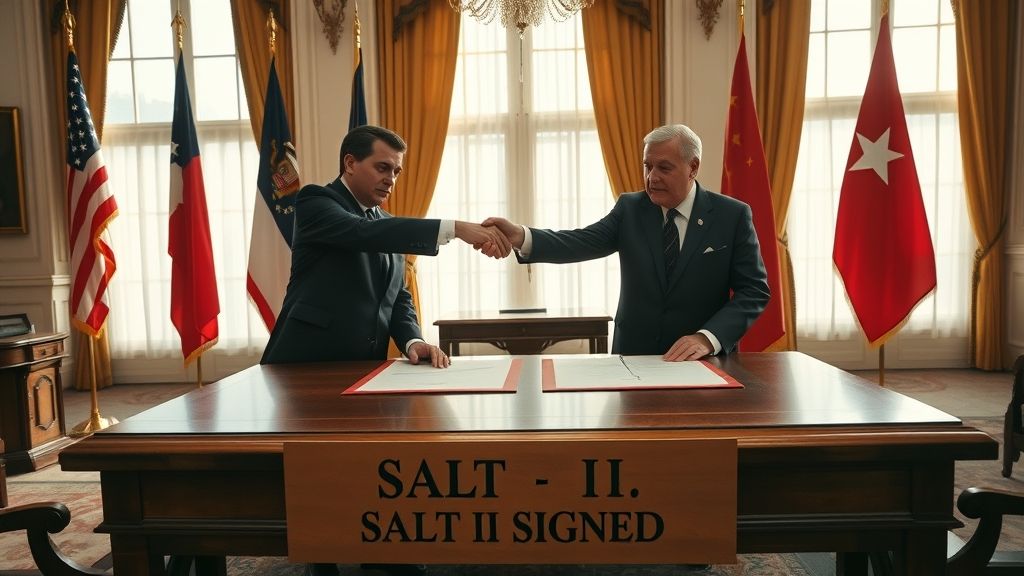
On a crisp June morning in 1979, the ornate halls of the Hofburg Palace in Vienna buzzed with a potent mix of hope and tension. Under the gilded ceilings where empires once negotiated their destinies, two men—U.S. President Jimmy Carter and Soviet General Secretary Leonid Brezhnev—cemented a complex, fragile agreement: the second Strategic Arms Limitation Treaty, or SALT II. The handshakes and smiles caught by the world’s cameras masked a deeper, more precarious reality. For decades, the superpowers had engaged in an escalating shadow war of missile silos and submarine-launched nuclear arsenals. But on this June day, amid the baroque splendor of Vienna, they attempted a truce—not in battlefields—but in words, numbers, and trust.
It was an emotional moment, one brimming with cautious optimism. Yet, as the ink dried on the treaty, a storm of geopolitical upheavals awaited, threatening to render SALT II more symbolic than functional. This is an exploration of that historic day, its intricate backdrop, the characters involved, and the legacies etched in the delicate balance of terror that the treaty both tried to contain and inadvertently exposed.
1. The Dawn of a New Era: Cold War Shadows over Vienna
The late 1970s were a paradox in international relations. Though nuclear war still loomed as a dark threat, an uncertain détente had warmed diplomatic relations between the United States and Soviet Union from the iced peaks of the early Cold War. Vienna, once a crossroads where East met West during the Cold War’s infancy, became a fitting place to attempt to stem the tide of nuclear proliferation.
The city’s very architecture—baroque and imperial—whispered of old power struggles and negotiations. This transitional period reflected a decades-long grind, where armament cycles clashed with moments of mutual restraint. SALT II was the centerpiece of this uneasy balance.
2. The Road to SALT II: Origins and Stakes in the Arms Race
The origin story of SALT II roots itself in the nuclear arms escalation post-World War II. The 1968 Nuclear Non-Proliferation Treaty had curtailed the spread of nuclear weapons but left the two superpowers locked in an escalating duel of intercontinental ballistic missiles (ICBMs) and multiple independently targetable reentry vehicles (MIRVs).
Following SALT I—a treaty signed in 1972 that set initial limits on missile numbers—the need for a second round of negotiations became imperative. The technological arms race was accelerating; both sides developed new missile types, bombers, and submarine capabilities. The cost, politically and economically, was astronomical. Leaders faced a strategic dilemma: how to maintain credible deterrence without plunging humanity into doom.
3. The Players: Carter, Brezhnev, and the Cold War Chessboard
Jimmy Carter, a man shaped by his Southern Baptist upbringing and commitment to human rights, viewed arms control as a path not only to security but also to moral leadership. His presidency was marked by this vision, striving for peace amid a world of stark divisions.
Opposing him was Leonid Brezhnev, a Soviet elder statesman whose authority came from decades navigating Stalinist purges and Khrushchev’s reforms. Brezhnev’s Soviet Union was formidable, but increasingly burdened by economic stagnation and the costs of Cold War rivalry.
Each leader carried heavy domestic pressures and international expectations. Behind their poised public personas lay an unspoken understanding: failure was not an option, yet success was fraught with uncertainty.
4. Vienna, 1979: The City Becomes a Diplomatic Battleground
Vienna’s historical neutrality made it an ideal host for these tense negotiations. Months before the signature, the city’s hotels, embassies, and cafes hummed with diplomats, intelligence operatives, and journalists. The shadow of the Iron Curtain hung palpably over the Danube.
Local Austrians witnessed the world’s greatest powers engage in what looked like a grand diplomatic ballet: closed-door talks riddled with long silences, stubborn debates over warhead counts, and exchanges of carefully parsed information.
The city itself became a character in this drama—a reminder that great historical moments often unfold in places rich with the echoes of past conflicts and tentative hopes for peace.
5. The Anatomy of the Negotiations: From Helsinki to Vienna
The SALT II negotiations were the culmination of years of intermittent talks that began soon after SALT I’s signature. The Helsinki Accords of 1975 had preceded these talks, attempting to bind East and West with commitments to respect sovereignty and human rights.
During the SALT II bargaining, delegations grappled with thorny issues: how to count existing warheads, how to verify compliance without fully transparent inspection, and how to account for emerging technologies like mobile missile launchers and improved submarine capabilities.
Days of intense dialogue gave way to breakthroughs and impasses. Personal chemistry among the chief negotiators—Ambassador Gerard Smith for the U.S. and Vladimir Semyonov for the USSR—played a subtle but decisive role.
6. The Stakes of Strategic Arms Limitation: Mutual Assured Destruction and Paranoia
At the heart of SALT II lay the grim doctrine of Mutual Assured Destruction (MAD)—the idea that neither superpower would risk nuclear war because it guaranteed total annihilation.
Yet, this fragile peace rested on suspicion: monitoring the build-up of nuclear weapons required trust in intelligence and verification methods. Any misstep might trigger a catastrophic chain reaction of escalation.
Thus, limiting and capping offensive nuclear weapons was not only a policy choice but a psychological shield within a world constantly shadowed by existential dread.
7. Cold Rooms and Hot Words: Behind the Closed Doors of SALT II Talks
The atmosphere of the SALT II talks reflected the larger Cold War’s paradoxes—civilized diplomacy wrapped over fierce ideological combat. Negotiators met in austere conference rooms, debating arcane clauses over ballistic missile throw-weight and multiple warhead systems.
Tensions flared at times. Each side accused the other of secret program escalation or document obfuscation. Yet, moments of levity and mutual recognition occasionally pierced the veil of suspicion—a shared understanding that failure might mean catastrophe beyond imagined scale.
8. The Signature Day: June 18, 1979—Ceremonies and Symbolism
When Carter and Brezhnev signed SALT II on June 18, the day was heavy with symbolism. The cameras captured gestures of cautious camaraderie, and press releases lauded a new chapter of peace and cooperation.
But journalists and diplomats alike knew this was much more complex than a photo-op. Ambivalence, distrust, and internal political calculations shadowed the handshake.
For many observers, this was both a triumph of diplomacy and a fragile step on a narrow bridge over the abyss.
9. The Content of SALT II: Agreements, Limits, and Loopholes
SALT II was not a simple accord. It established ceilings on the number of strategic nuclear delivery vehicles, banned new types of missile systems, and sought to impose constraints on the qualitative and quantitative development of forces.
But the treaty left certain subjects ambiguous: verification relied on national technical means like satellites rather than intrusive inspections; loopholes existed concerning tactical nuclear weapons and new technology.
These ambiguities would later be points of contention and exploitation.
10. Domestic Reactions: Washington’s Hurdles and Soviet Calculations
While SALT II was hailed as a diplomatic breakthrough, it faced a rocky domestic landscape—particularly in the U.S. Congress, where skeptics doubted Soviet intentions and feared strategic disadvantage.
Conservative critics labeled the treaty as too lenient, while some liberals worried it would legitimize the arms race. The Soviet leadership, meanwhile, balanced the treaty against internal economic pressures and growing international commitments.
This internal political tug-of-war foreshadowed the difficulties SALT II would face in ratification.
11. The Global Ripple: How SALT II Reframed International Security
SALT II, beyond the superpowers, sent ripples worldwide. Allies debated the implications for NATO’s strategy. Non-aligned countries viewed the treaty as an example of great power negotiation that largely excluded them from decision-making.
It also set a tone for arms control as an achievable, albeit complex, route to peace—a departure from all-out military competition.
12. An Oath Under Strain: The Afghanistan Invasion and SALT II’s Tripwire
Just months after SALT II's signature, the Soviet invasion of Afghanistan in December 1979 slammed cold water on détente. The U.S. viewed the Soviet action as a breach of faith, prompting President Carter to withdraw SALT II from Senate consideration.
This geopolitical rupture underscored how fragile arms control was in the face of broader strategic conflicts.
13. Public Perceptions and Media Narratives: Hope vs. Skepticism
Media coverage in the West was a tale of hope marred by realism. Headlines celebrated progress but questioned enforceability. Opinion polls showed American public divided—while many welcomed arms control, fears of Soviet duplicity persisted.
In the USSR, state-controlled media framed SALT II as a victory for peace, though internally the costs of the arms race and war in Afghanistan weighed heavily.
14. The Slow Demise: Why SALT II Never Ratified Fully
Despite signature and round-the-clock diplomatic effort, SALT II never achieved full ratification. The Afghanistan war, renewed distrust, and changing political dynamics in the U.S.—including the arrival of Ronald Reagan—sealed its fate.
However, both superpowers generally adhered to its terms loosely, demonstrating the treaty’s partial success as a framework of restraint.
15. The Legacy of SALT II: From Treaty to Template
SALT II left a complex legacy: a mixture of achievement and failure, symbol and substance.
Future treaties, notably START (Strategic Arms Reduction Treaty), drew on SALT II’s groundwork, improving verification techniques and confidence-building measures.
SALT II illuminated both the promise and peril of arms limitation in a brittle peace.
16. Arms Control After SALT II: Paving the Path to START and Beyond
The 1980s arms race intensified, but SALT II’s lessons informed later diplomacy. START, alongside the INF Treaty of the late 1980s, embodied progress, integrating more intrusive inspection protocols.
Despite Cold War tensions, this trajectory demonstrated that even amidst rivalry, dialogue—and limits—were possible.
17. Reflections on Trust and Mistrust: Cold War Lessons from SALT II
SALT II teaches that arms control is as much about psychology as about policy. Trust is not easily built but can be calibrated through persistent dialogue.
The treaty reveals how weapons symbolize deeper fears and ambitions and how managing them requires patience, vision, and humility.
18. Anecdotes and Human Moments: Diplomats, Spies, and Secretaries
Behind the grand narratives were countless personal stories: a Soviet interpreter translating late into night; an American spy nervously monitoring compliance; a stenographer chronicling every tense pause.
Such human fragments show that history is made not only by leaders but also by the unseen cogs keeping the machines of peace in motion.
19. Measuring Restraint in an Age of Fear: The Moral Calculus of Arms Limitation
How to limit instruments designed for ultimate destruction?
SALT II represented an attempt to balance necessity and morality, acknowledging the grim reality while striving to impose human limits on technological terror.
It raises enduring questions about security, power, and conscience.
20. SALT II in Historical Memory: Interpretation and Debate Today
Decades later, SALT II invites reconsideration. Was it a missed opportunity or a vital step toward nuclear stability?
In modern discussions on arms control—whether toward new treaties or nuclear proliferation—the lessons of Vienna 1979 resonate, reminding us that dialogue amid discord remains indispensable.
Conclusion
The signing of SALT II in Vienna was more than a treaty ceremony; it was a poignant moment when two of history’s greatest adversaries chose words over war, seeking to rewrite the future in an age teetering on the brink of annihilation. Though never fully ratified, SALT II embodied hope, fear, and the immense difficulty of taming the nuclear beast. It stands as a testament to the human capacity for diplomacy amid existential peril and a lasting symbol of the Cold War’s complex dance between cooperation and conflict.
In the end, SALT II reminds us that peace is not merely the absence of violence but the patient, often fragile architecture of trust, negotiation, and shared humanity—a lesson that remains urgent in any era shadowed by weapons of unimaginable power.
FAQs
1. What was the primary goal of SALT II?
SALT II aimed to limit and control the number and capabilities of strategic nuclear weapons held by the U.S. and USSR to reduce the risk of nuclear war.
2. Why was SALT II never ratified by the U.S. Senate?
The Soviet invasion of Afghanistan and rising Cold War tensions led the U.S. Senate to withhold ratification, fearing Soviet aggression and mistrust.
3. Who were the main negotiators behind SALT II?
U.S. Ambassador Gerard Smith and Soviet Ambassador Vladimir Semyonov led the negotiation, with overarching leadership from President Carter and General Secretary Brezhnev.
4. How did SALT II affect global nuclear arms control efforts?
Though not ratified, SALT II’s limits and frameworks influenced subsequent treaties such as START, setting important precedents for verification and negotiation.
5. What role did Vienna play in Cold War diplomacy?
Vienna’s neutral position made it a key meeting point for East-West talks, symbolizing a city where ideological adversaries could meet face-to-face.
6. What was the impact of SALT II on the Cold War’s trajectory?
SALT II temporarily fostered détente but its collapse amid renewed hostilities highlighted the fragility of arms control in a tense geopolitical landscape.
7. Did SALT II address all types of nuclear weapons?
No, SALT II focused mainly on strategic offensive arms but left tactical nuclear weapons and some new technologies less regulated.
8. How is SALT II remembered in historical scholarship today?
Historians see SALT II as a complex milestone—an ambitious, if flawed, attempt to tame nuclear rivalry that offers enduring lessons about diplomacy under pressure.