Table of Contents
- A Night That Changed Poland Forever: The Eve of Martial Law
- Poland in the Early 1980s: A Nation on the Brink
- The Rise of Solidarity: Voices of Dissent and Hope
- General Wojciech Jaruzelski: The Man Behind the Decree
- December 13, 1981: Midnight’s Darkest Hour
- The Sudden Lockdown: Military Presence Sweeps Warsaw
- Arrests and Repression: The Targeting of Opposition Leaders
- Everyday Life Under Martial Law: A Nation Under Siege
- The Role of the Media: Silence, Propaganda, and Underground Resistance
- International Reactions: From Shadows of the Cold War
- The Catholic Church: Sanctuary and Silent Resistance
- Economic Paralysis: Shortages, Black Market, and Decline
- The Underground Press and Radio Free Europe: Voices Beyond the Iron Curtain
- Acts of Defiance: Strikes, Underground Meetings, and Courageous Persistence
- The Human Cost: Families Torn Apart, Lives Lost, and Imprisoned Spirits
- The Fall of Martial Law: 1983’s Gradual Easing and Official End in 1983
- Legacy of Martial Law: The Road to Democracy and Memory in Poland
- Reflections on Freedom: Lessons from a Nation’s Darkest Hours
- Conclusion: An Enduring Witness to Courage and Resilience
- FAQs: Understanding Martial Law in Poland
- External Resource
- Internal Link
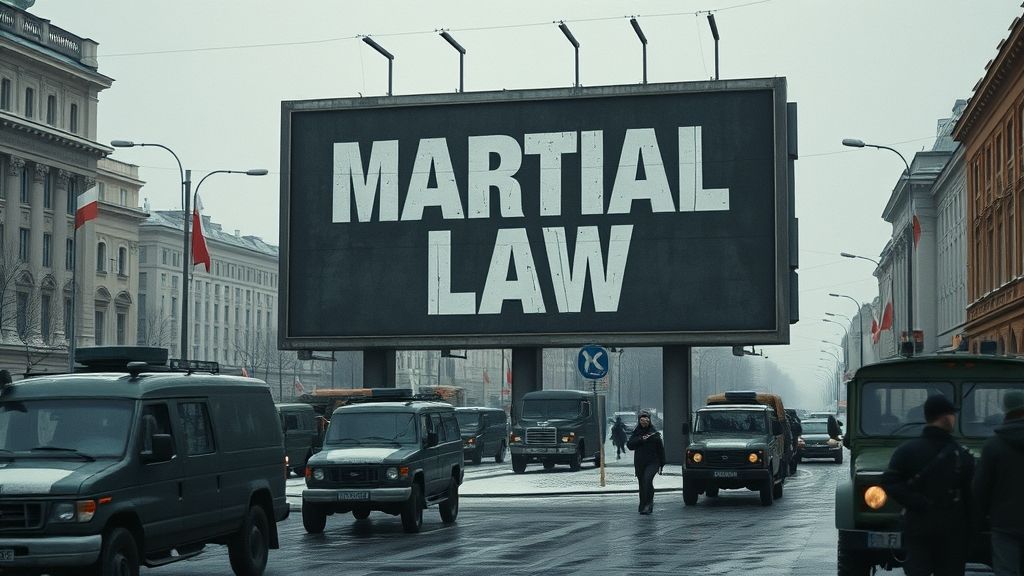
On the night of December 13, 1981, an eerie silence fell over Warsaw, pierced only by the muted rumble of tanks rolling through shadowed streets. The lamps flickered uncertainly as thousands of soldiers took up positions, encircling city squares, government buildings, and working-class neighborhoods alike. Families shuttered their windows in hurried fear. Over the intercoms came the ominous order: Martial Law declared. This was not a distant political maneuver but a seismic rupture that shattered everyday life in Poland—and echoed far beyond its borders. It was a night when hope and fear wrestled visibly on the streets, when a nation’s dreams were frozen beneath the boot of military rule.
This story is not just a chronicle of repression; it is a deeply human saga of courage, loss, and unyielding spirit amid oppression. To understand Martial Law in Poland is to peer into the heart of Cold War tensions, the quest for freedom, and the complex dance of power in one of Eastern Europe’s most tumultuous moments.
Poland in the Early 1980s: A Nation on the Brink
By the dawn of the 1980s, Poland was a land choking under economic malaise, political stagnation, and rising social discontent. The shadows of Soviet domination stretched long, suffocating political pluralism and economic initiative. Yet, beneath this surface, a growing wave of resistance brewed—a resistance that had crystallized in the summer of 1980 with the birth of the Solidarity movement.
Massive strikes at the Lenin Shipyard in Gdańsk ignited a national awakening. Workers, intellectuals, and clergy alike found common cause against decades of authoritarianism. This movement, centered around the charismatic Lech Wałęsa, embodied a new hope: that socialism could be reformed—not discarded, but transformed to respect human dignity and rights.
However, the Communist Party, pressured intensely from its Soviet patrons, viewed Solidarity not as a partner but as a perilous challenge. Economic hardships deepened in 1981 with rationing, inflation, and chronic shortages, fraying the social contract further. The Kremlin’s watchful eye grew more anxious, fearing contagion of rebellion across the Eastern Bloc.
The Rise of Solidarity: Voices of Dissent and Hope
Solidarity was unlike any opposition movement before it in the Eastern Bloc. Its scale was unprecedented: millions of Poles registered as members, creating a civic mass that transcended class and ideology. The Catholic Church offered moral sustenance and organizational shelter, imbuing the movement with a profound spiritual gravitas. The charismatic presence of Pope John Paul II, himself Polish and elected in 1978, lent further strength.
Yet Solidarity’s rise was as complex as it was inspiring. Internally diverse, its members ranged from moderate reformists to ardent revolutionaries. For the Communist leadership, this growing unity posed a dilemma: concession would mean erosion of control; repression risked violent crackdown and international condemnation.
General Wojciech Jaruzelski: The Man Behind the Decree
General Wojciech Jaruzelski was no stranger to Poland’s political labyrinth. A career soldier and Communist loyalist, he rose through the ranks to become head of the Polish United Workers' Party. Jaruzelski—complex, pragmatic, and controversial—believed that radical measures were necessary to preserve national stability.
Behind his steely exterior, Jaruzelski wrestled with an impossible choice: to impose martial law and risk bloodshed and international horror, or to allow growing unrest to spiral into a catastrophic Soviet invasion akin to Hungary or Czechoslovakia in earlier decades. In his infamous 1982 interview, he claimed the imposition of martial law was a “lesser evil” in the face of looming foreign intervention—a justification that remains debated among historians.
December 13, 1981: Midnight’s Darkest Hour
As the clock neared midnight on December 13, Warsaw’s streets emptied under the eerie glow of military vehicles. Suddenly, a curfew was in effect. Communication lines were severed. Borders sealed. The government broadcast a chilling message: Martial Law was declared. The army and police detained over 10,000 opposition activists overnight, including Wałęsa.
For many Poles, the timing was crushing—just weeks before Christmas, the spirit of family and celebration was replaced by fear, confusion, and uncertainty. Soldiers patrolled neighborhoods. Private homes were subject to random searches. Citizens spoke in hushed tones. "It felt like the air itself had thickened," one Warsaw resident later recalled.
The Sudden Lockdown: Military Presence Sweeps Warsaw
The city transformed overnight. Tanks rolled down the once-bustling boulevards; checkpoints sprang up at every corner. Authorities shut down universities, factories, and media outlets. The police wielded curfews with brutal efficiency. Resistance was met with tear gas, batons, and imprisonment.
This military lockdown was not only a physical domination but a psychological warfare tactic meant to paralyze the society. However, what the regime underestimated was the indomitable human spirit galvanized underground by shared suffering.
Arrests and Repression: The Targeting of Opposition Leaders
Solidarity’s leadership was systematically rounded up. In the shadows of secret police interrogations, leaders were isolated, tortured, and imprisoned. Yet even behind bars, figures like Lech Wałęsa became symbols of resistance, their quiet dignity inspiring the masses.
Countless unnamed individuals disappeared into labor camps or forced exile. Families mourned in silence, and the network of informants sowed suspicion within communities. It was a dark time where trust was scarce and fear proliferated.
Everyday Life Under Martial Law: A Nation Under Siege
For the average Pole, daily existence was a trial. Food shortages worsened. Milk and bread were rationed. Blackouts became routine as energy resources dwindled. Public gatherings were banned, and schools operated under strict ideological control.
Yet beneath the surface, life’s rhythms continued—underground meetings, secret prayers, whispered conversations kindled hope. The human need for connection and freedom survived behind the facade of control.
The Role of the Media: Silence, Propaganda, and Underground Resistance
State-run media parroted official propaganda—portraying martial law as a necessary defense against chaos and foreign subversion. Television and radio spewed slogans about patriotism and unity while censorship strangled debate.
In defiance, clandestine underground presses sprang up. The “bibuła,” secret leaflets and newsletters, distributed illegal news and calls for resistance. Radio Free Europe, broadcasting from Munich, became a lifeline, piercing the information blockade and fueling morale.
International Reactions: From Shadows of the Cold War
Across the Iron Curtain, the world watched with a mix of horror and strategic calculation. Western governments denounced the crackdown, imposing economic sanctions and diplomatic pressure. Yet geopolitical realities kept NATO from direct intervention.
The Soviet Union supported Jaruzelski’s move, seeing it as a bulwark against destabilization. Meanwhile, Polish émigrés rallied globally to raise awareness and support. The event deepened Cold War tensions, drawing a stark line between freedom and repression.
The Catholic Church: Sanctuary and Silent Resistance
The Polish Catholic Church played a crucial, nuanced role during Martial Law. It became a beacon of hope and spiritual resistance, offering sanctuary in churches and providing covert support to the oppressed.
Pope John Paul II’s messages inspired quiet defiance, reminding Poles of their inherent dignity and the promise of justice. Bishops and priests documented abuses and negotiated for prisoners’ welfare, walking a delicate tightrope under vigilant surveillance.
Economic Paralysis: Shortages, Black Market, and Decline
Martial Law exacerbated an already fragile economy. Factories operated at reduced capacity. Trade slowed. Inflation soared. The black market flourished as ordinary citizens sought essential goods beyond official channels.
This economic malaise deepened dissatisfaction but also highlighted the inefficiencies and inherent contradictions of the Communist system—setting the stage for future reforms.
The Underground Press and Radio Free Europe: Voices Beyond the Iron Curtain
The determination to communicate across barriers manifested in the bold operation of underground presses distributing forbidden ideas and truthful reporting. Radio Free Europe, listened to secretly by millions at night, shattered the regime’s narrative monopoly.
These clandestine networks nurtured the spirit of resistance, connecting isolated pockets of opposition into a national movement that refused to be silenced.
Acts of Defiance: Strikes, Underground Meetings, and Courageous Persistence
Despite repression, acts of rebellion persisted. Workers staged limited strikes, students met secretly, and families protected banned literature. The candlelight vigils, whispered protests, and symbolic gestures communicated a message loud and clear: Martial Law could suppress bodies, but not the soul.
The Human Cost: Families Torn Apart, Lives Lost, and Imprisoned Spirits
The toll was devastating. Thousands imprisoned, families fragmented, dreams deferred. Psychological scars ran deep. For many, this period was a pause in normal life; for others, a permanent rupture.
The stories of personal sacrifice, from mothers enduring anguish for imprisoned children to union leaders enduring harsh interrogations, reveal the profound human dimension behind political headlines.
The Fall of Martial Law: 1983’s Gradual Easing and Official End in 1983
By late 1982 and into 1983, mounting internal and external pressures nudged the regime to relax controls. Martial Law was “lifted” in July 1983—though many repressive structures lingered.
The process sowed seeds for eventual political transformation, culminating in negotiations and semi-free elections in 1989, which marked the collapse of Communist rule.
Legacy of Martial Law: The Road to Democracy and Memory in Poland
Martial Law remains etched in Poland’s collective memory as a period of suffering and heroism. It shaped the nation’s identity and informed its democratic values.
Memorials, literature, and films continue to explore this fraught period to ensure lessons endure—reminding future generations of the price freedom demands and the strength found in unity.
Reflections on Freedom: Lessons from a Nation’s Darkest Hours
The story of Poland’s Martial Law teaches that oppression may temporarily silence citizens, but cannot extinguish the yearning for dignity and justice. It invites reflection on the resilience of societies under duress and the moral complexity faced by leaders and peoples alike.
Conclusion
Martial Law declared in Poland on December 13, 1981, was a defining rupture in 20th-century history—a stark clash between authoritarian control and an unstoppable quest for freedom. It was a crucible that tested Polish society, challenging its faith, solidarity, and courage.
Yet, the night of tanks and curfews did not mark the end of hope. Instead, it forged a resilient spirit that ultimately dismantled an empire of oppression. Today, Poland stands as a testament to the enduring human capacity to resist tyranny and reclaim dignity.
The dark days of Martial Law remain a somber reminder—and a source of inspiration—a narrative of struggle whose echoes still pulse in the Warsaw winter air.
FAQs
Q1: What led the Polish government to impose Martial Law in 1981?
A1: Martial Law was imposed due to escalating socio-economic crisis, growing unrest fueled by the Solidarity movement, fears of Soviet invasion, and the regime’s desire to maintain control.
Q2: Who was General Wojciech Jaruzelski and why did he declare Martial Law?
A2: Jaruzelski was Poland’s Communist leader and army general who declared Martial Law to suppress dissent, asserting it was a “lesser evil” to prevent Soviet military intervention.
Q3: How did Martial Law affect everyday life in Poland?
A3: Life was heavily restricted—curfews, military patrols, arrests, censorship, and severe shortages disrupted normal existence, but underground resistance persisted.
Q4: What role did the Catholic Church play during this period?
A4: The Church served as moral support and sanctuary, opposing repression quietly and sustaining hope through spiritual leadership, especially under the guidance of Pope John Paul II.
Q5: How did the international community react to Martial Law in Poland?
A5: Western nations condemned the crackdown, imposed sanctions, and offered moral support to dissidents, while the Soviet Union backed the regime’s actions.
Q6: When and how did Martial Law end?
A6: Martial Law was officially lifted in July 1983 after internal and external pressures lessened, although repression lingered until the political transformations of 1989.
Q7: What is the historical legacy of Martial Law in Poland today?
A7: It remains a symbol of resilience and the high cost of freedom, shaping Poland's democratic identity and commemorated through memorials and cultural memory.
Q8: How did Solidarity survive under Martial Law?
A8: Through underground networks, secret meetings, clandestine printing presses, and international support, the movement persisted despite repression.