Table of Contents
- The Night of Shadows and Fire: October 25, 1983
- A Tropical Island Caught in the Cold War Crossfire
- Grenada Before the Storm: The Rise of Bishop and the New Jewel Movement
- The Tumultuous Road to Revolution: From Hope to Isolation
- The Eastern Caribbean Tensions and the Regional Response
- Operation Urgent Fury: Planning the Unplanned
- The Invasion Begins: Midnight Assault on St. George’s
- The Battle for Pearls Airport: Gateway to Control
- The Role of American, Caribbean, and Allied Forces
- Civilian Life in the Crossfire: Fear, Confusion, and Survival
- The Media Frenzy: Broadcasting the Conflict to a Global Audience
- The Soviet and Cuban Shadows Behind the Scenes
- The Death of Maurice Bishop: A Turning Point in the Conflict
- International Reactions: Allies, Adversaries, and the United Nations
- Aftermath: Military Victory and Political Resurrection
- The Grenada Invasion’s Ripple Effect on U.S. Foreign Policy
- Lessons Learned and Military Innovations Spawned
- Grenada Today: Remembering the Invasion and Its Legacy
- Voices from the Island: Personal Recollections and Testimonies
- Conclusion: The Complex Tapestry of Power, Ideology, and Freedom
- FAQs: Understanding the Grenada Invasion
- External Resource: Wikipedia Link
- Internal Link: Visit History Sphere
1. The Night of Shadows and Fire: October 25, 1983
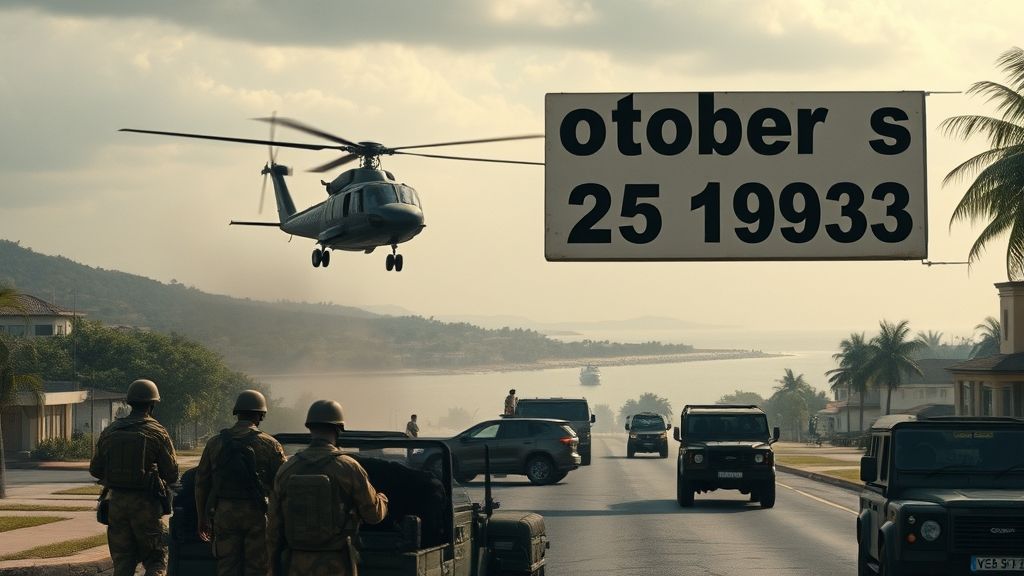
It was just past midnight when the calm Caribbean night broke into a symphony of thunderous explosions and frantic radio commands. Jets roared overhead, their searchlights slicing through the humid darkness like blades. On the ground in St. George’s, the capital of Grenada, soldiers dashed through the twilight, their boots pounding on the cobblestone streets, while civilians awakened startled by the gunfire peered from shattered windows. The air was heavy with smoke and tension, scenting a clash that would etch its mark on the annals of history.
This was the beginning of Operation Urgent Fury—the United States-led invasion of Grenada. What some called a rescue mission, others branded a blatant imperial overreach. The invasion was brief but intense, a lightning strike aimed at a tiny island with outsized geopolitical importance in the throes of the Cold War. The events of October 25, 1983, did not merely redraw borders or shift political power; they exposed a turbulent world grappling with the aftermath of revolution, ideology, and superpower rivalry.
2. A Tropical Island Caught in the Cold War Crossfire
While Grenada was only 212 square kilometers of emerald hills and tropical beaches, its strategic location and recent political upheavals rendered it a key battleground in the ideological ping-pong match between the United States and the Soviet Union. The Caribbean in the early 1980s was a powder keg, with revolutions, coups, and shifting allegiances coloring every archipelago and mainland coast.
For Washington, the specter of communism spreading in the Western Hemisphere—just miles from the U.S. mainland—was an intolerable threat. The memory of Cuba’s embrace of communism in 1959 and the failed Bay of Pigs invasion haunted policymakers. Grenada, governed by a Marxist-Leninist government under Maurice Bishop, had deepened ties with Cuba and received support from the USSR, fueling American anxieties and mounting calls for intervention from regional neighbors.
3. Grenada Before the Storm: The Rise of Bishop and the New Jewel Movement
The story began in the late 1970s with Maurice Bishop, a charismatic leader and revolutionary thinker. An academic-turned-politician, Bishop's New Jewel Movement (NJM) promised a new vision for Grenada: emancipation from colonial legacies, economic independence, and social justice for the marginalized majority.
In March 1979, the NJM successfully orchestrated a bloodless coup, toppling the government of Eric Gairy, whose rule was marred by corruption and repression. Bishop’s rise was initially met with widespread enthusiasm. His government implemented sweeping reforms: literacy campaigns, healthcare expansion, and infrastructure projects, including a controversial plan for a large international airport designed to boost Grenada’s tourism and economy.
4. The Tumultuous Road to Revolution: From Hope to Isolation
Despite local hopes, Bishop’s government soon encountered internal conflicts and mounting external pressure. The Cold War’s invisible hand tightened—Grenada’s close ties with Cuba and the Eastern bloc unsettled Western powers. Internally, cracks appeared within the NJM’s leadership.
By 1983, tensions escalated dramatically. Deputy Prime Minister Bernard Coard led a faction accusing Bishop of authoritarianism and mismanagement. On October 13, 1983, Coard’s faction detained Bishop and several allies. Days later, Bishop and others were executed under murky circumstances—a brutal turning point that shattered the island’s hopes for peaceful socialism and plunged it into political chaos.
5. The Eastern Caribbean Tensions and the Regional Response
Grenada's instability roused consternation in neighboring Caribbean states, notably those within the Organization of Eastern Caribbean States (OECS). Prime Minister Eugenia Charles of Dominica voiced harsh criticism of the new regime and appealed to the United States and Western allies for assistance.
Aware that Grenada’s instability threatened regional security, the Caribbean nations authorized intervention "to restore order and democracy." This request, combined with mounting American fears of a Cuban-Soviet foothold near their shores, provided the legal and moral rationale for Washington to act decisively.
6. Operation Urgent Fury: Planning the Unplanned
The U.S. military had been monitoring Grenada for weeks but was caught somewhat off guard by the rapid political developments. Operation Urgent Fury was hastily orchestrated under President Ronald Reagan’s administration—a 7,000-strong force composed of U.S. Army Rangers, Marines, Navy SEALs, and Air Force units, supplemented by troops from Caribbean countries.
The objective was clear yet formidable: secure the safety of American medical students on the island, dismantle the Communist government, and restore a pro-Western regime. However, the operation was complicated by poor intelligence, coordination challenges between military branches, and logistical hurdles posed by Grenada’s uneven terrain and tropical climate.
7. The Invasion Begins: Midnight Assault on St. George’s
At 2 a.m. on October 25, 1983, the invasion commenced with air strikes and amphibious landings. Paratroopers descended in the darkness amid bursts of gunfire, aiming to disorient Grenadian forces loyal to Coard's regime.
The initial assault was chaotic yet determined. Coastal defenses were neutralized swiftly, but resistance intensified in pockets of the capital. Civilians, many unaware of the political complexities, found themselves trapped in a fog of conflict. Buildings echoed with the clatter of machine guns, and the streets ran with fear and uncertainty.
8. The Battle for Pearls Airport: Gateway to Control
One of the most strategic objectives was securing Pearls Airport, near St. George’s. The airport was vital both for controlling movement and for international access.
Cuban construction workers—some of whom had taken up arms in support of Grenada's military forces—put up fierce resistance. The intense combat here resulted in several casualties and underscored the international aspects of the invasion. By dawn, American forces seized the airport, signaling a major turning point in the campaign.
9. The Role of American, Caribbean, and Allied Forces
While U.S. troops formed the bulk of the invasion force, soldiers from Jamaica, Barbados, and other Caribbean neighbors played important, if smaller, roles. Their participation symbolized regional solidarity against perceived communist expansion.
The invasion also involved special operations forces, intelligence units, and logistical support teams working under immense pressure. However, fault lines emerged—communication breakdowns and conflicting priorities between branches initially hampered effectiveness, prompting significant after-action reforms in U.S. military doctrine.
10. Civilian Life in the Crossfire: Fear, Confusion, and Survival
Amid fighting, Grenadian citizens grappled with fear and uncertainty. Many had little knowledge of the ideological battles playing out on their doorstep, only the desperate need to protect their families and homes.
Hospitals overflowed with wounded, schools shut their doors, and once-bustling markets stood empty. Stories of kindness and bravery surfaced—neighbors shielding the vulnerable, makeshift aid stations popping up—revealing the resilience of a people caught in a formidable geopolitical struggle.
11. The Media Frenzy: Broadcasting the Conflict to a Global Audience
In 1983, live news coverage was ascending; the invasion was broadcast in near real-time to millions around the world. Television crews embedded with troops, radio commentators relayed updates, and newspaper editors scrambled to explain what some saw as a justifiable rescue mission and others as unwarranted intervention.
The media narrative was complex—a mix of patriotism, skepticism, and ideological debate. The invasion became a lens through which Cold War anxieties were projected and contested.
12. The Soviet and Cuban Shadows Behind the Scenes
The Soviet Union and Cuba, allies to Bishop’s government, watched the invasion with alarm but limited capacity to respond effectively. Cuban military advisors and engineers—numbering around 600—were on the island, many captured or killed during the conflict.
Moscow condemned the invasion as an illegal act of U.S. imperialism, but its global distractions—the Soviet war in Afghanistan, internal political strains—meant no direct confrontation ensued. The episode nonetheless highlighted the global reach of superpower proxies in local conflicts.
13. The Death of Maurice Bishop: A Turning Point in the Conflict
Maurice Bishop, once the island’s hopeful revolutionary leader, met a tragic end weeks before the invasion. His execution by a hardline faction gravely undermined Grenada’s internal stability and international standing.
Bishop’s demise transformed the political landscape—what started as a hopeful experiment in indigenous socialism descended into factional violence, providing the pretext for intervention. His death remains a haunting reminder of the dangers revolutionaries face from within their ranks.
14. International Reactions: Allies, Adversaries, and the United Nations
The invasion elicited a spectrum of responses. The Commonwealth and the United Nations voiced concern over the violation of sovereignty, with the UN General Assembly condemning the act.
Western governments, conversely, generally supported or tacitly accepted the intervention as a necessary step to curb communist influence and restore democracy. The invasion therefore illuminated the contested notions of sovereignty and humanitarian intervention in Cold War geopolitics.
15. Aftermath: Military Victory and Political Resurrection
Within weeks, American and allied forces had secured the island. A new government was installed, elections promised, and American troops withdrew by December 1983.
The intervention was declared a success by the Reagan administration: American medical students were safe, and a communist regime was dismantled. Yet the territory faced immense rebuilding challenges, from physical infrastructure to political reconciliation.
16. The Grenada Invasion’s Ripple Effect on U.S. Foreign Policy
Operation Urgent Fury influenced U.S. military planning and foreign policy. It underscored the utility and risks of rapid intervention and highlighted the need for joint-service operational coordination.
Politically, it sent a clear message to the Soviet Union and its allies: the United States would decisively act to block communist expansion in its hemisphere. The invasion also reinvigorated debates about American military engagement and interventionist policy during the Reagan era.
17. Lessons Learned and Military Innovations Spawned
The operational difficulties encountered during the invasion—fragmented command structures, intelligence failures, and logistical hurdles—prompted a sweeping overhaul of U.S. special operations and joint military doctrines.
The lessons learned in Grenada paved the way for the Goldwater-Nichols Act reforms and the strengthening of the U.S. Special Operations Command, shaping American military responses for decades.
18. Grenada Today: Remembering the Invasion and Its Legacy
Nearly four decades later, Grenadians live with the dual legacy of revolution and invasion. The island is peaceful, seeking economic growth through tourism and education, hosting a memorial to Bishop and other victims.
Annual commemorations reflect both pride in independence and sorrow for the losses, underscoring the complex interplay of local aspirations and global geopolitics.
19. Voices from the Island: Personal Recollections and Testimonies
Testimonies from Grenadian civilians, soldiers, and American troops reveal the human dimension often obscured by strategic narratives. Memories of fear, loss, hope, and resilience weave a rich tapestry of lived experience.
One Grenadian woman recalled, “We were caught between giants, unsure if they were our saviors or new oppressors.” This ambivalence captures the enduring emotional legacy of Operation Urgent Fury.
20. Conclusion: The Complex Tapestry of Power, Ideology, and Freedom
The invasion of Grenada in 1983 remains a compelling chapter in Cold War history—a small island at the nexus of great power struggles, ideological clash, and human drama. It challenges simplistic narratives of good versus evil and forces us to grapple with the morality of intervention, the fragility of revolution, and the price of freedom.
In reflecting on those tense October nights, the swirling smoke over St. George’s, and the voices silenced and freed alike, we confront the profound complexity of history—a testament to human hope, folly, and resilience.
Conclusion
Operation Urgent Fury was more than a fleeting military engagement; it was a prism refracting the anxieties of a divided world and the intricacies of small-nation sovereignty amidst global power plays. It forced a reckoning with how superpowers exercise influence and the costs borne by ordinary people caught in their wake.
While the invasion restored a degree of stability to Grenada, it also left scars—political, social, and psychological—that resonate generations beyond 1983. Its enduring legacy is a sobering example of how ideals collide with realpolitik, and how history’s tides sweep nations toward uncertain futures.
FAQs
Q1: What triggered the U.S. invasion of Grenada in 1983?
A1: The immediate triggers were the internal coup against Prime Minister Maurice Bishop, his subsequent execution, and the perceived threat to American medical students on the island. The broader context included Cold War fears of Soviet and Cuban influence in the Caribbean.
Q2: Who was Maurice Bishop and why was his death significant?
A2: Maurice Bishop was the charismatic revolutionary leader of Grenada’s New Jewel Movement. His execution by a rival faction destabilized the government and provided justification for U.S.-led intervention.
Q3: What was Operation Urgent Fury?
A3: It was the codename for the 1983 U.S.-led invasion of Grenada aimed at restoring order, protecting American citizens, and ousting the Marxist government.
Q4: How did Caribbean nations react to the invasion?
A4: Several Eastern Caribbean nations supported the intervention, viewing the instability as a regional threat and requesting assistance from the U.S.
Q5: What role did the Soviet Union and Cuba play during the invasion?
A5: Cuba had military advisors and engineers supporting Grenada, some of whom fought alongside Grenadian forces. The Soviet Union condemned the invasion diplomatically but did not intervene militarily.
Q6: What were the main military challenges faced by U.S. forces?
A6: Issues included poor inter-service coordination, limited intelligence on enemy forces, difficult terrain, and logistical constraints.
Q7: How has the invasion affected Grenada’s future?
A7: The invasion led to the restoration of a pro-Western government, but also left lasting political and social scars, influencing Grenada’s subsequent development and identity.
Q8: Why is the Grenada invasion still relevant today?
A8: It exemplifies Cold War dynamics, complexities of foreign intervention, and the enduring questions of sovereignty, security, and ethical warfare.