Table of Contents
- The Calm Before the Storm: Amritsar in Early 1984
- Roots of Tension: The Sikh Quest for Identity and Autonomy
- Sant Jarnail Singh Bhindranwale: The Rising Leader and Symbol
- The Golden Temple: Sacred Sanctuary and Political Stronghold
- The Indian Government’s Growing Anxiety and Response
- Operation Blue Star: The Decision to Storm the Holy Shrine
- June 3-6, 1984: The Siege of the Golden Temple Begins
- The Battle Within the Holy Precincts: Chaos, Courage, and Carnage
- The Human Cost: Casualties, Civilians, and Aftermath Inside the Shrine
- Bodies and Broken Spirits: The Immediate Fallout in Amritsar
- Political Reverberations: Indira Gandhi’s Calculated Gamble
- The Assassination of Indira Gandhi: Retribution and Rift
- The 1984 Anti-Sikh Riots: A Nation Unraveling in Violence
- Memory and Mourning: Sikh Diaspora and Global Resonance
- Operation Blue Star in Historical Perspective: Legacy and Lessons
- The Quest for Justice and Reconciliation in Post-1984 India
- Revisiting Blue Star: Narratives from Survivors and Witnesses
- Blue Star and Indian Democracy: Balancing Security and Rights
- Symbolism of the Golden Temple: Beyond Walls and Conflicts
- Conclusion: The Indelible Scars and the Path Forward
- Frequently Asked Questions (FAQs)
- External Resource
- Internal Link
The Calm Before the Storm: Amritsar in Early 1984
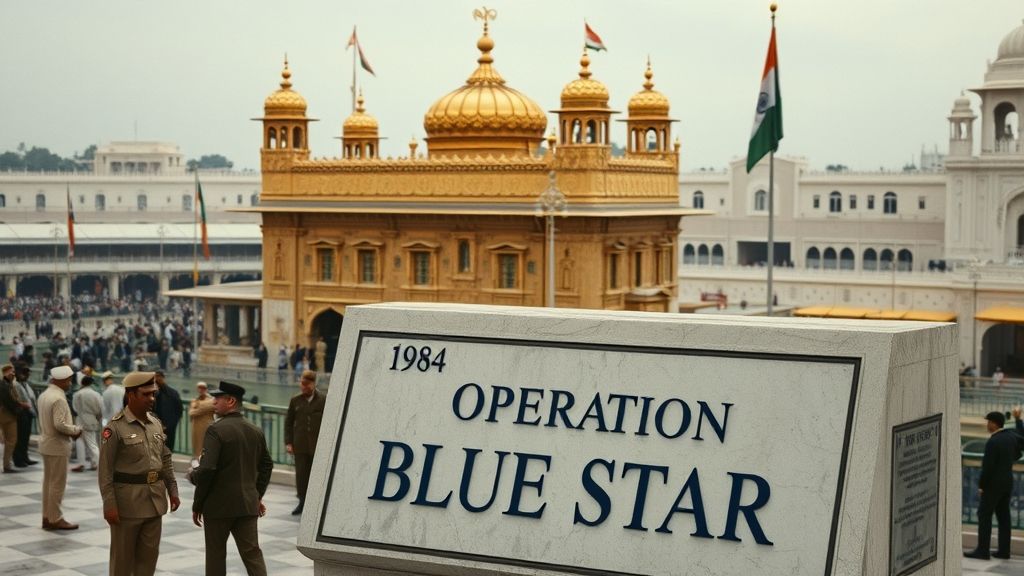
The city of Amritsar in early 1984 was steeped in an uneasy quiet. The golden glow of the Harmandir Sahib—the Golden Temple—reflected in the sacred pool, a beacon of spiritual solace for millions of Sikhs worldwide. Yet, beneath this serene veneer simmered years of tension, mistrust, and whispered warnings. Pilgrims continued to murmur prayers, oblivious or willfully blind to the storm gathering at the gates of their holiest shrine. The scent of incense mingled with the undercurrents of restlessness, and Amritsar stood precariously at the crossroads of faith and fury.
The very heart of Sikhism—the Golden Temple—had become an arena where faith intersected brutally with politics. As protesters wrapped themselves in saffron cloth, brandished weapons, and fortified the sanctuary, the Indian state was preparing a response that would soon shatter the city’s fragile peace and reverberate through history.
Roots of Tension: The Sikh Quest for Identity and Autonomy
To understand Operation Blue Star is to trace back decades of complex history—a story that intertwines religious identity, post-colonial politics, and regional aspirations. The Sikh community had long nurtured grievances about political marginalization following India’s independence in 1947. Many Sikhs felt the promises of autonomy under the Punjabi Suba movement were left unfulfilled. Their distinct linguistic and cultural identity sought a political voice within the Indian union, but fierce opposition from other states and factions made this path fraught.
By the late 1970s and early 1980s, the demand for a separate Sikh state—“Khalistan”—began gaining momentum, voiced by militants and political leaders alike. The Border Security Force infiltrated villages and cities, attempting to stem the rising tide of dissent. Yet, the sense of alienation and persecution deepened, fueled by memories of past injustices and contemporary crackdowns.
Sant Jarnail Singh Bhindranwale: The Rising Leader and Symbol
In the midst of these turbulent times, a charismatic and controversial figure emerged—Sant Jarnail Singh Bhindranwale. Originally a religious preacher advocating for Sikh revivalism and purity, Bhindranwale increasingly became entwined with the political unrest. To his followers, he was a defender of Sikh rights, a fiery voice against corruption and secular affronts to their faith. To the government and many in India’s broader society, he was a dangerous militant fomenting discord.
Bhindranwale’s escalating calls for Sikh autonomy and his defiant stance against the state escalated tensions. The mounting standoff was epitomized by his determined presence inside the Golden Temple complex, where he and his armed supporters built fortifications, turning the sacred site into a fortress.
The Golden Temple: Sacred Sanctuary and Political Stronghold
For centuries, the Golden Temple stood as an emblem of Sikh spirituality, resilience, and community. Unlike other places of worship, its architecture and ethos embodied the Sikh principle of openness—welcoming all castes, religions, and creeds. But by 1984, the temple complex was no longer merely a religious site; it had become a symbol of Sikh defiance and conflicting sovereignties.
The sanctity of the complex was juxtaposed fiercely against its transformation into a hub for militants. Over time, tunnels and bunkers were constructed beneath the marble floors, weapons caches hidden in its halls. The sacred pool shimmered, its serene surface belying the unrest below.
The Indian Government’s Growing Anxiety and Response
Prime Minister Indira Gandhi’s government grappled with the escalating crisis. After failed negotiations and rising violence, the administration decided on a decisive show of strength. Operation Blue Star—the code name for a military assault on the Golden Temple—was conceived as a swift action to quell militancy and restore order.
The stakes were enormous. For a government that prided itself on democratic ideals yet faced the specter of insurgency, the military operation was both an ultimatum and a gamble. The risk of desecrating a sacred site and inflaming communal passions was calculated, yet the alternative—continued violence and separatism—was deemed intolerable.
Operation Blue Star: The Decision to Storm the Holy Shrine
On June 3, 1984, the Indian Army, led by General Kuldip Singh Brar, launched the operation. Thousands of troops encircled Amritsar, while inside the Golden Temple, militants braced for what was to come. The army planned a meticulously coordinated attack involving infantry, tanks, and artillery. Even the political leadership understood the operation's historic and emotional magnitude, issuing clear commands: to minimize damage to the sanctum and preserve the sacredness of the complex, while eliminating militant resistance.
But such precision collided with harsh realities—heavily armed militants, entrenchments, and labyrinthine tunnels made the campaign a grim battle cloaked in hallowed grounds.
June 3-6, 1984: The Siege of the Golden Temple Begins
The attack began under the cover of darkness, with commandos moving swiftly, yet the sacred plaza echoed with gunfire and explosions. For three brutal days, fierce combat unfolded. Soldiers advanced through corridors once filled with prayers, breaking through barricades, exchanging fire with militants embedded deeply within the shrine.
The use of tank fire against the Akal Takht—the political seat within the complex—marked both a tactical decision and a symbolic rupture. Smoke and dust blurred golden domes; prayers and cries mingled in the suffocating haze.
Witnesses later recounted the surreal clash of violence and faith. Civilians trapped in the shrine became unwilling hostages, caught between soldiers’ bullets and militants’ resolve.
The Battle Within the Holy Precincts: Chaos, Courage, and Carnage
Amidst the chaos emerged stories of valor and despair. Soldiers recount engaging in close quarters combat, navigating narrow spaces illuminated only by sporadic gunfire. Militants fought tenaciously, unwilling to yield the spiritual bastion to the state. Some militants perished, others surrendered or fled through hidden exits.
Tragically, many innocent pilgrims—men, women, children—were caught in the crossfire. Hospitals overflowed, and news of the bloodshed spilled beyond the temple's marble walls, shocking the nation and the world.
The sanctity of the Golden Temple was betrayed, and the spiritual fabric of Sikhism bruised in exchange for a fraught political victory.
The Human Cost: Casualties, Civilians, and Aftermath Inside the Shrine
Precise figures remain contested, but estimates suggest hundreds died—militants, soldiers, and civilians alike. The desecration of the Akal Takht, the deaths of prominent Sikh figures, and the destruction within the temple cast a long shadow.
Survivors recall the chilling silence after ceasefire: empty corridors echoing with grief, families searching for lost loved ones, and pilgrims laying flowers amidst ruins. The Golden Temple emerged physically scarred and emotionally shattered.
Bodies and Broken Spirits: The Immediate Fallout in Amritsar
News of the operation sent shockwaves beyond the shrine. Amritsar's streets, a city that had felt the immediate earthquake of gunfire replaced by an oppressive silence, suddenly became the epicenter of an unfolding tragedy. The city’s Sikhs mourned collectively, their pain fueling anger and confusion.
Political leaders debated, the media churned headlines, and diplomats expressed concern. Blue Star had subdued the militants, but at what cost?
Political Reverberations: Indira Gandhi’s Calculated Gamble
For Prime Minister Indira Gandhi, the operation was intended to reassert state authority and silence separatist voices. Yet, it profoundly altered India’s socio-political landscape. The attack alienated millions of Sikhs who saw their holiest site violated by the army.
Though temporarily quelling militancy, it galvanized Sikh nationalism and sowed seeds for further violence. The government lost crucial support among a significant demographic, setting the stage for a tragic political cycle.
The Assassination of Indira Gandhi: Retribution and Rift
On October 31, 1984, just months after Operation Blue Star, Indira Gandhi was assassinated by her own Sikh bodyguards—a grim echo of the conflict she had unleashed. Her death plunged India into chaos, triggering horrors that would stain the nation’s conscience.
Her assassination was a tragic reminder of the fracturing caused by Blue Star, a cycle of violence birthing yet more violence.
The 1984 Anti-Sikh Riots: A Nation Unraveling in Violence
Within days of Gandhi’s assassination, India witnessed one of its darkest chapters—the anti-Sikh riots. Thousands of Sikhs were massacred, homes burned, families torn apart in coordinated attacks that many alleged were orchestrated by political actors.
The riots left deep scars on the Sikh community, driving a wedge between Sikh citizens and the Indian state. The cries for justice from survivors remain a haunting echo in India’s democratic narrative.
Memory and Mourning: Sikh Diaspora and Global Resonance
The impact of Blue Star and the subsequent violence spilled across continents. Sikh communities worldwide rallied in grief and protest, their petitions echoing through Western democracies.
Diaspora Sikhs preserved memory through art, literature, and public demonstrations, ensuring the events of 1984 remained in global consciousness. Blue Star became more than a local tragedy; it was a symbol of sacrifice, struggle, and the fight for dignity.
Operation Blue Star in Historical Perspective: Legacy and Lessons
Decades later, Blue Star continues to provoke debate among historians, politicians, and Sikhs alike. It poses difficult questions about the limits of state power, the sanctity of religious spaces, and the costs of internal conflict.
The operation serves as a stark lesson on how identity, politics, and faith, when intertwined with violence, can fracture a nation’s soul.
The Quest for Justice and Reconciliation in Post-1984 India
Even now, India grapples with accountability for the violence that surrounded Blue Star's aftermath. Efforts at reconciliation have been halting and fraught. Commissions and courts have struggled to address survivors' demands fully.
The wounds of 1984 remain raw for many, underscoring the urgent need for dialogue and healing to mend the ruptured bonds between state and community.
Revisiting Blue Star: Narratives from Survivors and Witnesses
First-hand accounts reveal a kaleidoscope of experiences—soldiers’ remorse, civilians’ horror, militants’ conviction, and pilgrims’ heartbreak. These voices humanize the conflict beyond political rhetoric, reminding us of the human lives enmeshed in history's relentless wheel.
They speak of courage and despair, of faith tested and communities ruptured, preserving the memory of those days in living testimony.
Blue Star and Indian Democracy: Balancing Security and Rights
Operation Blue Star challenges the very fabric of democracy—how to balance the imperative of national security with protecting religious freedoms and human rights.
The Indian state’s decision to use military force inside a religious sanctuary sparked debate on governance, minority rights, and the nature of secularism in a diverse society.
Symbolism of the Golden Temple: Beyond Walls and Conflicts
The Golden Temple, in its gilded glory, symbolizes more than religion. It embodies tolerance, resilience, and the Sikh ideal of justice and equality.
In its storms and scarring, the temple stands as a testament to faith’s endurance—even when besieged. It calls humanity to ponder on sacredness beyond physical structures.
Conclusion: The Indelible Scars and the Path Forward
Operation Blue Star was a fulcrum upon which the fate of Sikh-Indian relations pivoted violently. Amid the shards of faith and politics, lessons about empathy, dialogue, and respect emerge.
History offers no easy absolution, only a mirror reflecting painful truths and the hope that understanding might pave a peaceful path forward.
Frequently Asked Questions (FAQs)
1. What was Operation Blue Star and why was it conducted?
Operation Blue Star was a military assault launched by the Indian government in June 1984 to remove armed militants, led by Sant Jarnail Singh Bhindranwale, who had fortified themselves inside the Golden Temple complex in Amritsar. The government aimed to quell rising separatist militancy threatening national unity.
2. Who was Sant Jarnail Singh Bhindranwale?
Bhindranwale was a charismatic Sikh leader who initially advocated for religious revival but later became associated with militant activism demanding greater Sikh autonomy. He became symbolic of the rising tension between the Sikh community and the Indian state.
3. What were the human and cultural costs of Operation Blue Star?
The operation resulted in significant casualties among militants, pilgrims, and soldiers, with the Golden Temple suffering structural damage. It deeply hurt Sikh sentiments worldwide, contributing to long-term communal strife and violence.
4. How did the Indian government justify the military action inside a religious site?
The government argued that the operation was necessary to restore law and order and prevent separatist violence threatening India’s integrity. They hoped to minimize damage but faced criticism for the desecration and bloodshed.
5. What was the political fallout of Operation Blue Star?
The attack alienated many Sikhs, leading to Indira Gandhi’s assassination later in 1984 by Sikh bodyguards, and subsequent anti-Sikh riots killed thousands. It marked a turning point in Indian politics and Sikh-state relations.
6. How is Operation Blue Star remembered in India and globally?
It remains a deeply polarizing event—seen by some as a necessary security measure and by others as a tragic assault on faith. Globally, especially among the Sikh diaspora, it is commemorated as a moment of sacrifice and sorrow.
7. What lessons does Operation Blue Star offer about managing religious and political conflicts?
It highlights the perils of militarized responses to identity-based movements and underlines the importance of dialogue, respect for sacredness, and political accommodation to prevent escalation.
8. Has there been justice and reconciliation for the victims?
Efforts have been mixed and often criticized as inadequate. Many survivors and families continue to seek full accountability and recognition, underscoring an ongoing challenge in India’s democratic framework.