Table of Contents
- The Dawn of a New Era: February 25, 1986
- Shadows Over Manila: The Rise of Martial Law and Marcos’ Regime
- The People’s Burden: Economic Strife and Social Unrest
- Defiance Beckons: The Spark of the Assassination of Benigno Aquino Jr.
- The Role of the Church: Cardinal Sin and the Moral Compass of the Nation
- Media Under Siege: The Battle for Truth Amidst Propaganda
- The Unlikely Heroes: Ordinary Citizens and the Birth of a Movement
- February 22–24: The Military Defection and the Tide Turned
- The Heartbeat of EDSA: Masses Gather on the Avenue
- Face to Face with Tyranny: The Stand-off Between People and Soldiers
- Courage in the Skies: The Role of Fidel V. Ramos and Juan Ponce Enrile
- The World Watches: International Reactions to the Revolution
- The Fall of a Dictator: Ferdinand Marcos Flees the Philippines
- Corazon Aquino’s Rise: Symbol of Hope and Renewal
- Aftermath: Rebuilding a Nation from the Ashes of Authoritarianism
- The Power of Nonviolent Resistance in Modern History
- Echoes in Today’s Philippines: The Revolution’s Legacy
- Lessons Learned: Democracy’s Fragility and the People’s Strength
- Remembering EDSA: Commemorations and National Memory
- Conclusion: The Triumph of Spirit and the Birth of a New Philippine Republic
- FAQs: Unpacking the People Power Revolution
- External Resource: Deep Dive into the People Power Revolution
- Internal Link: Explore More at History Sphere
The Dawn of a New Era: February 25, 1986
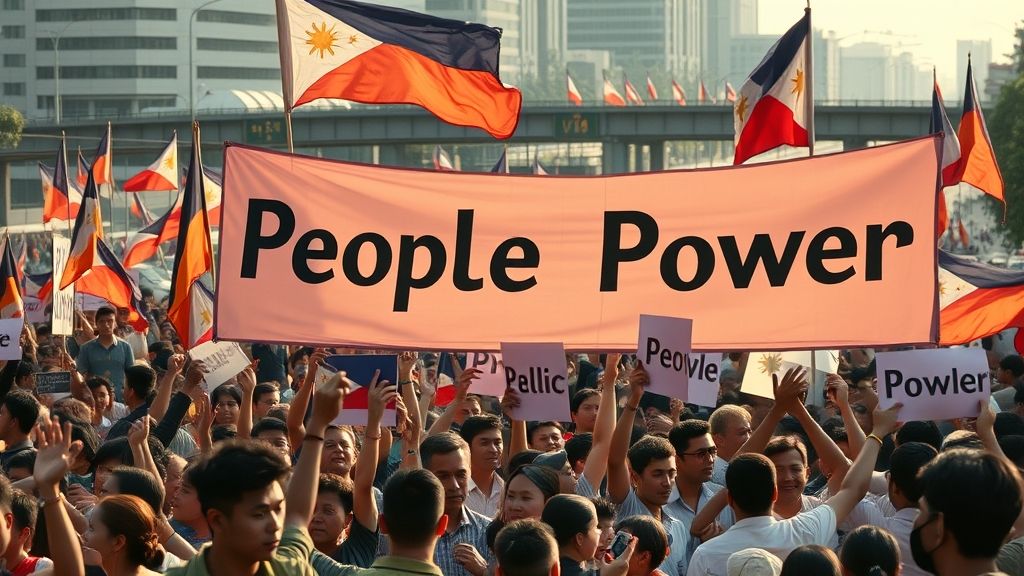
The sun rose cautiously over Manila, its warm light filtering through the humid Philippine air, touching the faces of millions who had waited—some for decades—for a new dawn. On this day, the mighty ebb of authoritarian rule was about to break, swept away by the roar of a peaceful crowd whose resolve could not be drowned by bullets or tyranny. The streets along Epifanio de los Santos Avenue—known affectionately and forever after as EDSA—overflowed with a tide of humanity dedicated to reclaiming their nation’s soul. This was no ordinary protest; it was a crescendo of hope, defiance, and unity that would irrevocably alter the course of Philippine history. The People Power Revolution, as it would come to be called, was not simply a revolt; it was a peaceful uprising that demonstrated the indomitable power of collective will.
Shadows Over Manila: The Rise of Martial Law and Marcos’ Regime
To understand the seismic shift of 1986, one must traverse the dark corridors of Martial Law under Ferdinand Marcos. Declared in 1972, Martial Law was ostensibly a move to quell communist insurgencies and social disorder. However, it quickly morphed into a stranglehold on civil liberties, an era marked by widespread human rights abuses, media censorship, and political repression. Marcos declared himself president-for-life, wielding power with an iron fist behind a veneer of legality.
The Philippines, rich in culture and spirit, was shackled under an increasingly fragile regime propped up by patronage, corruption, and fear. The promise of development turned hollow as crony capitalism flourished and democracy faded into a distant memory. The thick haze of oppression was palpable in every corner of Manila’s crowded streets and rural villages alike.
The People’s Burden: Economic Strife and Social Unrest
Beneath the surface of authoritarian control, the Filipino people bore the burden of staggering economic inequality. The Marcos administration plunged the nation into crushing debt, while the elite amassed wealth. Inflation soared, unemployment tightened its grip, and poverty became an inescapable cycle for many.
The social fabric began to fray. Students, workers, religious groups, and civic organizations started to coalesce, united by a shared frustration. The people, once silenced, began to murmur dissent. The seeds of revolution were sown in the fertile soil of suffering—and resilience.
Defiance Beckons: The Spark of the Assassination of Benigno Aquino Jr.
No event catalyzed the awakening more than the brutal assassination of Benigno “Ninoy” Aquino Jr., a prominent opposition leader. His return from exile in August 1983 ended in the cold blood of Manila’s airport—a moment that sent shockwaves through the nation. Aquino’s death was a shattering blow, but paradoxically, it ignited the flame of resistance.
Aquino embodied the struggle for democratic freedoms and was a beacon for those who dared to dream of change. His martyrdom transformed grief into galvanizing energy, inspiring a fractured nation to unite. The final years of Marcos’ regime would be defined by the growing chorus of those demanding justice, transparency, and renewal.
The Role of the Church: Cardinal Sin and the Moral Compass of the Nation
In the Philippines, faith has always been a cornerstone of cultural identity. During the revolution, the Catholic Church, led by the influential Cardinal Jaime Sin, played a critical role in shaping the movement’s character. Sin’s midnight call to Catholics to gather at EDSA was a pivotal moment that galvanized the faithful to join the peaceful protests.
The Church provided sanctuary not only physically, offering churches as safe spaces amid military threats, but spiritually, providing moral legitimacy to the uprising. This intertwining of faith and politics reflected how deeply the revolution was rooted in the collective conscience of the Filipino people.
Media Under Siege: The Battle for Truth Amidst Propaganda
Under Marcos’ regime, mainstream media was muzzled or co-opted to propagate state narratives. But the rise of alternative media, clandestine radio stations, and brave journalists kept the flame of truth alive. The controversial television coverage of the events on EDSA, including international media spotlighting the peaceful demonstrators and military defection, shifted the narrative beyond the government’s control.
This battle for truth was instrumental in swaying public opinion, both locally and abroad, turning the tide in favor of the protestors and undermining the legitimacy of the dictator’s rule.
The Unlikely Heroes: Ordinary Citizens and the Birth of a Movement
Perhaps what is most remarkable about the People Power Revolution was the protagonism of ordinary Filipinos—students, housewives, jeepney drivers, professionals. The movement was not orchestrated by military might or elite strategists but by a sea of citizens who refused to be complicit in oppression.
Stories abound: nurses who tended to wounded protestors, grandmothers who offered food and prayers, young children waving flags—all symbols of a nation galvanized by hope and courage. These everyday heroes forged an unbreakable front whose combined voice shook a regime to its core.
February 22–24: The Military Defection and the Tide Turned
A turning point came when key military leaders, most notably Defense Minister Juan Ponce Enrile and Vice Chief of Staff Fidel V. Ramos, defected from Marcos. Their dramatic move signaled cracks within the regime and emboldened the protestors.
The two generals took refuge in Camp Crame and Camp Aguinaldo, and from those strongholds, coordinated a call to civilians to protect them from a potential violent crackdown. This military mutiny was the spark lighting a powder keg of public enthusiasm and fear—fear that well-founded could have unleashed a bloody civil conflict.
The Heartbeat of EDSA: Masses Gather on the Avenue
From dawn till dusk, EDSA became a sprawling congregation of humanity. The strip of road turned into a living river of colors, chants, prayers, and tears. The commitment to non-violence was palpable, a conscious choice that defined the revolution. Protesters carried rosaries, flowers, and the national flag, offering candies to soldiers as a gesture of peace.
This massive peaceful demonstration was a phenomenon that transcended political calculation—it was a collective act of faith in democracy’s promise and the power of the people. The atmosphere was electric, infused with both joyous solidarity and tense anticipation.
Face to Face with Tyranny: The Stand-off Between People and Soldiers
One of the most iconic moments came when enraged troops faced an unarmed crowd. The tanks and rifles pointed across the streets seemed destined to open fire, but the humanity of the situation prevailed. Mothers and nuns placed themselves between soldiers and civilians; a young woman famously held a crucifix in front of a tank, a photograph that symbolized the revolution’s spirit.
Without firing a single bullet, the revolutionaries defied the omnipotence of the state machinery. This standoff remains a testament to the power of peaceful resistance over brute force.
Courage in the Skies: The Role of Fidel V. Ramos and Juan Ponce Enrile
The defection of Ramos and Enrile was not an impulsive act but a calculated gamble hinged on popular support. These leaders risked everything—lives and careers—to stand against Marcos. Their decision fractured the military’s loyalties and provided legitimacy to the protestors’ calls for change.
Their boldness turned the tide and symbolized the fracture of the once monolithic pillar of Marcos’ power. Their story is one of transformation and unexpected alliance between military authority and people’s power.
The World Watches: International Reactions to the Revolution
The People Power Revolution unfolded on a global stage. International observers, media outlets, and foreign governments followed events with bated breath. The United States, which had been a longstanding Marcos ally, shifted its stance as the protests gained momentum. Diplomatic pressure mounted, and the world’s eyes focused on Manila as a beacon of peaceful democratic uprising.
This moment influenced other revolutions worldwide, serving as a template for how civil resistance could triumph without bloodshed in an era marked by Cold War tensions.
The Fall of a Dictator: Ferdinand Marcos Flees the Philippines
On February 25, 1986, the untenable became undeniable. The regime crumbled as Marcos and his family fled to Hawaii, leaving behind a country hungry for renewal. Their departure marked the end of two decades of dictatorship and the beginning of a fragile but promising democratic experiment.
His exit was not just a political event but a catharsis for millions who had endured years of repression. It was a victory not only for the Filipino people but for the universal aspirations toward liberty and justice.
Corazon Aquino’s Rise: Symbol of Hope and Renewal
Corazon Aquino, the widow of Ninoy Aquino, emerged as the unifying figure of the revolution. Her ascendancy symbolized a rejection of tyranny and an embrace of democratic ideals. Despite lacking political experience, her moral authority and connection to the people made her presidency a symbol of national healing.
Her administration faced immense challenges but carried forward the promise of democratic restoration, human rights, and reconciliation. Aquino became a living embodiment of the power of faith, resilience, and peaceful change.
Aftermath: Rebuilding a Nation from the Ashes of Authoritarianism
The post-Marcos Philippines was a nation tasked with the monumental challenge of rebuilding. The new government dismantled oppressive structures, restored the constitution, and sought to address the social and economic disparities that fueled unrest.
The revolution’s success also inspired constitutional reforms, the strengthening of institutions, and efforts to engage civil society more deeply in governance. Yet, the legacies of corruption and inequality lingered, reminding all that democracy demands vigilance and continual nurturing.
The Power of Nonviolent Resistance in Modern History
The triumph at EDSA became a touchstone for nonviolent protest worldwide. It demonstrated how peaceful, collective action could dismantle entrenched power structures without the devastation of civil war or military coups.
This revolution reaffirmed the potency of civil society, moral conviction, and unity, influencing movements in Eastern Europe, Africa, and beyond. It remains a foundational case study on how ordinary citizens can rewrite their destiny sans violence.
Echoes in Today’s Philippines: The Revolution’s Legacy
Decades later, the spirit of the People Power Revolution still resonates throughout the Philippines. Civic engagement, democratic participation, and struggles for transparency remain vibrant, even as new challenges arise.
The revolution’s lessons remind Filipinos and the world that democracy is a living process, dependent on each generation’s commitment. Today’s political discourse, media freedoms, and mass mobilizations bear the indelible imprint of 1986.
Lessons Learned: Democracy’s Fragility and the People’s Strength
The People Power Revolution taught invaluable lessons about the fragility of democracy and the necessity of vigilance. The transition from dictatorship to democracy is fraught with perils, dependent upon institutions, leadership, and an informed citizenry.
Yet, it also demonstrated the limitless strength unlocked when people unite peacefully for a just cause. The Philippines’ experience serves as a beacon and warning—a reminder that freedom is hard-won and must be fiercely protected.
Remembering EDSA: Commemorations and National Memory
Every February 25, the Philippines pauses to remember the revolution that changed its course. The anniversary at EDSA is marked with prayer vigils, cultural events, and reflections on the costs and triumphs of peaceful resistance.
Memorials and museums preserve the stories of ordinary heroes and the extraordinary choices they made. This collective memory continues to inspire and educate new generations about the power of unity and the price of freedom.
Conclusion
The People Power Revolution stands as a monumental testament to the power of peaceful resistance, collective courage, and unwavering hope. What began as a desperate struggle against tyranny became a global symbol of how ordinary people can reclaim their destiny with nothing but faith, solidarity, and an unyielding commitment to justice.
Today, as the Philippines continues to grapple with the challenges of democracy, the echoes of 1986 remind us all: the true power lies within the people’s voice, and history belongs to those who dare to dream—and act—for a better tomorrow.
FAQs
Q1: What triggered the People Power Revolution in 1986?
The assassination of opposition leader Benigno Aquino Jr. in 1983 ignited widespread outrage and galvanized diverse social groups into resistance against Ferdinand Marcos’ authoritarian regime.
Q2: Who were the key figures in the revolution?
Key personalities include Corazon Aquino, Cardinal Jaime Sin, Defense Minister Juan Ponce Enrile, Vice Chief of Staff Fidel V. Ramos, and countless ordinary citizens who took to the streets.
Q3: Why was the Church important during the revolution?
The Catholic Church, under Cardinal Sin, provided moral authority, sanctuary, and mobilization efforts, framing the struggle as both a political and spiritual quest for justice.
Q4: How did the military respond to the uprising?
Significant defections by military leaders Enrile and Ramos weakened Marcos’ hold on power and encouraged civilians to join the peaceful protests, avoiding violent confrontation.
Q5: What made the revolution unique compared to other uprisings?
Its commitment to nonviolence and massive peaceful participation led to the ousting of a dictator without major bloodshed, a rare and inspiring victory in global history.
Q6: What were the immediate consequences of the revolution?
Marcos fled the country, Corazon Aquino assumed the presidency, and the Philippines began a challenging process of democratic restoration and institutional reform.
Q7: How is the revolution remembered today?
Every year, Filipinos commemorate February 25 with ceremonies and educational programs that honor the lives lost and celebrate the enduring spirit of democracy.
Q8: Did the revolution influence other movements worldwide?
Yes, it inspired nonviolent resistance movements globally, demonstrating the efficacy of peaceful mass mobilizations in overthrowing oppressive regimes.