Table of Contents
- A Frosty Washington Morning, December 8, 1987: The World Holds Its Breath
- The Cold War's Nuclear Shadow: Roots of the INF Treaty
- Superpowers in Standoff: Reagan, Gorbachev, and the Winds of Change
- Escalation and Fear: The Euromissile Crisis and Brinkmanship
- The Detente That Wasn't: Prelude to Negotiation
- From Reykjavik to Washington: The Long Road to Agreement
- Signing the INF Treaty: A Moment Frozen in Time
- Terms of the Treaty: What Was Agreed Upon?
- The Global Political Impact: From Hostility to Hope
- Technological and Military Implications: A New Era of Arms Control
- Public Reactions: From Relief to Skepticism
- The INF Treaty and European Security: Allies in Uneasy Peace
- Behind the Scenes: Negotiators, Advisors, and the Intrigue
- Verification and Trust: The Breakthrough of On-Site Inspections
- Challenges and Critics: Doubts in a Divided World
- The INF Treaty’s Role in Ending the Cold War
- Legacy and Echoes: Arms Control After the INF
- The Treaty’s Unraveling and Final Collapse
- Lessons from the INF Treaty for Contemporary Geopolitics
- Conclusion: When Diplomacy Forged a Fragile Peace
- FAQs: Understanding the INF Treaty’s Past, Present, and Future
- External Resource: INF Treaty on Wikipedia
- Internal Link: Visit History Sphere
1. A Frosty Washington Morning, December 8, 1987: The World Holds Its Breath
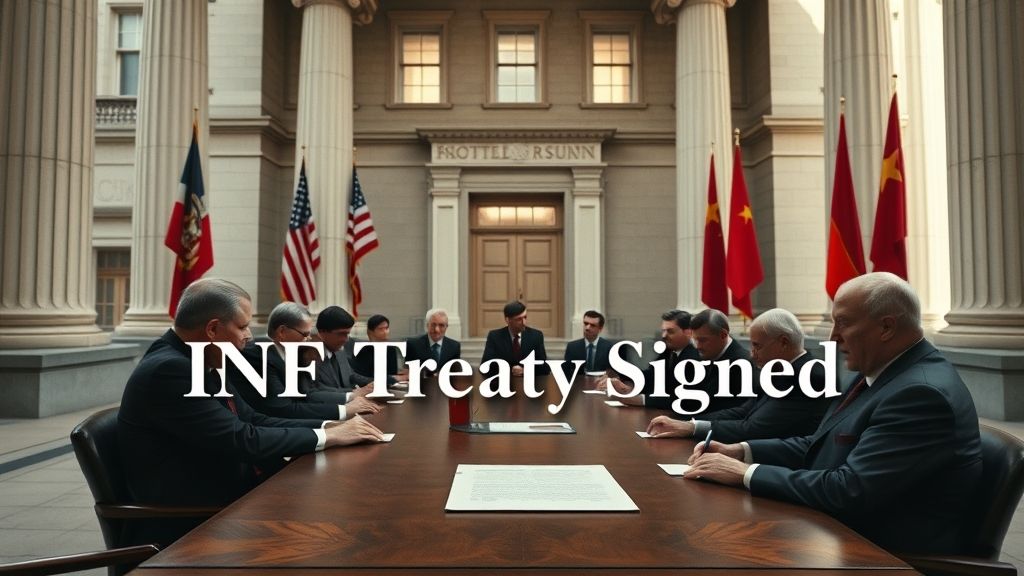
The winter air was crisp, almost biting, as dignitaries gathered inside the grand East Room of the White House. The radiant glow of chandeliers contrasted sharply with the underlying tension pressing the room to silence. Journalists, diplomats, and onlookers witnessed a scene few could have imagined a decade prior: two archrivals, the United States and the Soviet Union, ready to sign an accord that promised to reduce one of the deadliest arsenals the world had ever known. The Intermediate-Range Nuclear Forces (INF) Treaty was not just a legal document but a beacon of hope slicing through the icy gloom of the Cold War.
President Ronald Reagan and General Secretary Mikhail Gorbachev, figures synonymous with decades of ideological confrontation, stepped forward to sign the treaty as photographers captured the historic moment. There was a palpable sense of cautious optimism — a desire to begin dismantling the deadly dance of nuclear brinkmanship that had held humanity hostage for so long. The ink on the treaty, as it dried on that December day, symbolized not mere words, but a fragile step toward a less perilous future.
2. The Cold War's Nuclear Shadow: Roots of the INF Treaty
The Cold War, stretching from the end of World War II to the late 1980s, was defined not only by ideological rivalry but by the terrifying specter of nuclear annihilation. Between the United States and the Soviet Union, the arms race escalated relentlessly. Each step forward in missile technology, each increase in warhead numbers, fed mutual insecurity and perpetual fear.
Intermediate-range nuclear missiles—those with ranges between 500 and 5,500 kilometers—became a particularly contentious issue. These weapons threatened the heart of Europe, where NATO and Warsaw Pact countries found themselves living under the constant threat of sudden, devastating strikes.
The origins of the INF Treaty lie in this perilous context. Both superpowers amassed missiles that could reach deep into enemy territories, but the presence of these weapons in European bases multiplied the stakes, increasing the sense of urgency for arms control.
3. Superpowers in Standoff: Reagan, Gorbachev, and the Winds of Change
The 1980s marked a unique juncture in Cold War dynamics. Ronald Reagan, a staunch anti-communist and advocate of military buildup, initially escalated tensions with aggressive rhetoric branding the Soviet Union as the “evil empire.” Yet, beneath his hawkish image lurked a pragmatic streak, a willingness to engage in meaningful dialogue if it could prevent nuclear catastrophe.
Mikhail Gorbachev’s ascent in 1985 introduced a new ethos. His policies of glasnost (openness) and perestroika (restructuring) signaled a thaw, an openness to reform within the Soviet Union and a diplomatic willingness to reduce arms as a first step toward broader change. Together, these two men embodied the paradox of confrontation and cooperation.
Their personal rapport, built through a series of summits and exchanges, carved the essential foundation for the INF Treaty—but getting there involved years of distrust, negotiation, and brinkmanship.
4. Escalation and Fear: The Euromissile Crisis and Brinkmanship
The 1970s and early 1980s saw a surge in Soviet SS-20 intermediate-range missile deployments in Eastern Europe, prompting NATO to respond with the deployment of Pershing II and cruise missiles in Western Europe. This buildup ignited a crisis — known as the Euromissile Crisis — which brought the world uncomfortably close to war.
European publics erupted in protest, fearing their homelands would serve as nuclear battlegrounds. Cities like Bonn, London, and Rome witnessed massive demonstrations. Politicians were pressed to balance alliance commitments against popular fears of annihilation. Strategic doctrines on both sides grew more aggressive, and the risk of miscalculation heightened with every new missile placed.
This period proved a painful yet crucial backdrop, underscoring the necessity of a treaty that would eliminate this category of nuclear weapons altogether.
5. The Detente That Wasn't: Prelude to Negotiation
Prior efforts at détente in the 1970s had yielded some agreements—SALT I and II talks aimed at limiting strategic arms—but had stopped short of addressing the growing threat posed by intermediate-range weapons. Mutual suspicion and geopolitical flashpoints, from Afghanistan to Central America, kept the superpowers locked in cyclical cold war posture.
Yet as the 1980s progressed, the economic toll of the arms race and the human desire for peace converged with leadership changes to open cracks in the seemingly impenetrable Cold War armor. Secret talks, back channels, and a growing recognition of shared risk began to sow the seeds of the INF Treaty talks.
6. From Reykjavik to Washington: The Long Road to Agreement
The 1986 Reykjavík Summit between Reagan and Gorbachev was a watershed moment. While no agreement was concluded there, the summit revealed an extraordinary convergence of ideas, showing both leaders willing to consider radical steps in arms reduction—including the complete abolition of nuclear weapons.
Though discussions faltered over missile defense systems, the summit laid groundwork for the INF Treaty through renewed negotiation efforts. Subsequent meetings focused on specifics, trust-building measures, and verification protocols, reflecting lessons learned from past failed agreements.
Months of detailed talks culminated in the technical and political framework that would be signed in Washington in December 1987.
7. Signing the INF Treaty: A Moment Frozen in Time
December 8, 1987, marked an emotional crescendo. Underneath the polished grandeur of the White House, Reagan and Gorbachev signed the treaty, officially committing both nations to eliminate all land-based ballistic and cruise missiles with ranges between 500 and 5,500 kilometers, along with their launchers.
The ceremony was broadcast globally, symbolizing a powerful message: even the deepest rivalries can give way to dialogue and disarmament. The signing was met with cautious applause worldwide, signaling relief but also recognition of the huge challenges ahead in implementation.
8. Terms of the Treaty: What Was Agreed Upon?
At its core, the INF Treaty mandated the elimination of an entire class of nuclear weapons—something unprecedented. The treaty required the destruction of 2,692 missiles—1,846 Soviet and 846 American—over a three-year period.
It stipulated strict verification measures, including unprecedented on-site inspections, mandatory notifications of missile production, and destruction procedures. The treaty also covered cruise and ballistic missiles equally, closing loopholes that had plagued earlier agreements.
Critically, this marked the first time the superpowers agreed to allow comprehensive reciprocal inspections on their soil—a radical act of transparency that would pave the way for trust-building measures.
9. The Global Political Impact: From Hostility to Hope
The treaty’s ramifications transcended mere arms control. It reconfigured the geopolitical landscape, signaling the possibility of cooperative security between adversaries. European leaders hailed it as a vital step toward reducing the nuclear threat on their soil.
For the United States, the treaty was both a diplomatic success and a strategic shift, aiming to stabilize an unstable region and reduce the dangers of miscalculation. The Soviet Union, grappling with internal reforms and economic strain, gained a symbolic victory that boosted Gorbachev’s reformist agenda.
Moreover, the INF Treaty energized global non-proliferation efforts and inspired other arms control initiatives, marking a sunset on the Cold War’s darkest period.
10. Technological and Military Implications: A New Era of Arms Control
By eliminating entire missile systems, the treaty forced both nations to rethink military doctrines previously reliant on rapid, mobile nuclear response units. It also shifted focus toward strategic, longer-range weapons and introduced the value of negotiation over unilateral buildup.
As dismantling programs began, engineers and technicians faced the challenge of disposing of warheads and launching systems safely, paving the way for new protocols in arms elimination. The treaty also spurred advances in monitoring technology, satellite surveillance, and verification techniques that remain standards today.
11. Public Reactions: From Relief to Skepticism
Across many Western and Eastern capitals, the INF Treaty sparked celebrations among citizens weary of nuclear fear. Protest marches in Europe, once marked by anxiety and tension, embraced cautious optimism that the world could step back from the nuclear abyss.
Yet skepticism persisted. Hardliners criticized the treaty for compromising security, while some activists decried it as insufficient. Debates raged in media and parliaments about the treaty’s enforceability and whether the peace it promised was stable or fragile.
Still, the general mood tilted toward hope—a precious, precarious feeling that reshaped public discourse on war and peace.
12. The INF Treaty and European Security: Allies in Uneasy Peace
Europe, caught directly in the missile crossfire, saw the INF Treaty as a pivotal moment. NATO allies sought reassurance that U.S. commitment remained strong, even while missiles were being eliminated. The Soviet Union’s willingness to negotiate was met with cautious acceptance, but deep mistrust lingered.
The treaty helped ease military tensions, reduced forward-deployed nuclear numbers, and alleviated fears of a sudden strike. Yet it did not erase geopolitical rivalries or debates about national defense doctrines, issues that would persist well into the post-Cold War era.
13. Behind the Scenes: Negotiators, Advisors, and the Intrigue
The treaty was not the product of the two leaders’ signatures alone. Teams of dedicated diplomats, military experts, legal scholars, and translators worked relentlessly to navigate minefields of technical detail and political complexity.
Negotiators such as Paul Nitze and Yuli Kvitsinsky became key figures, embodying decades of experience and dogged determination. Back-channel conversations, carefully timed leaks, and strategic compromises behind closed doors revealed a human story of perseverance and cautious optimism beneath the grand political theater.
14. Verification and Trust: The Breakthrough of On-Site Inspections
Perhaps the treaty’s most groundbreaking feature was the establishment of on-site verification inspections—trusted inspectors could physically examine missile sites on either side. This was revolutionary.
Previous agreements had relied primarily on satellite imagery and national intelligence, tools that had intrinsic limits and fostered mutual suspicion. The INF verification regime introduced transparency as a safety valve, critical to both sides’ willingness to proceed.
This innovation set precedents for future arms control treaties, reinforcing that trust must be earned through concrete, verifiable actions.
15. Challenges and Critics: Doubts in a Divided World
Despite the optimism, the INF Treaty faced significant challenges. Political opposition, technological evasion attempts, and differing interpretations led to periods of tension. Some feared that verification would fail or that the treaty favored one side.
The rise of new geopolitical tensions, rogue states, and technological advances in missile systems also chipped away at the treaty's authority over time. Nonetheless, the treaty endured through multiple political storms, testifying to the resilience of arms control frameworks.
16. The INF Treaty’s Role in Ending the Cold War
While not the sole factor, the INF Treaty played a crucial role in the peaceful conclusion of the Cold War. It embodied a broader shift from confrontation to negotiation, showing that even the most entrenched enemies could find common ground.
The treaty paved the way for subsequent arms control agreements, helped reduce European tensions, and fostered a global climate more conducive to peaceful coexistence. It was an emblem of hope in a turbulent era.
17. Legacy and Echoes: Arms Control After the INF
The treaty’s legacy lasts well beyond its original terms. It inspired the Strategic Arms Reduction Treaty (START) and influenced global non-proliferation efforts. It raised public awareness about the dangers of nuclear weapons and the potential for diplomacy to avert catastrophe.
Today, many elements of the INF’s verification regime serve as foundations for new arms control ventures, proving that even amid shifting politics, principles of mutual security endure.
18. The Treaty’s Unraveling and Final Collapse
Despite years of success, the INF Treaty began to unravel in the 2010s. Accusations, particularly from the United States, claimed that Russia was violating the treaty by deploying new intermediate-range missiles. Moscow denied these charges, counteraccusing Washington of destabilizing actions.
In 2019, both countries withdrew from the treaty, marking an ominous end to an era of arms control. The collapse reignited fears of a new arms race and raised urgent questions about the future of global nuclear security.
19. Lessons from the INF Treaty for Contemporary Geopolitics
The INF Treaty’s story offers crucial lessons for today’s complex world. It demonstrates the power of dialogue amid deep mistrust, the necessity of verification in building confidence, and the fragility of peace that must be vigilantly maintained.
As new technological challenges arise—hypersonic weapons, cyber warfare, emerging nuclear states—these lessons resonate, emphasizing diplomacy’s irreplaceable role in preventing conflict.
20. Conclusion: When Diplomacy Forged a Fragile Peace
The INF Treaty was more than an agreement; it was a moment when humanity chose to step back from the abyss. Signed beneath the glow of December chandeliers, it illuminated the power of courage, negotiation, and mutual understanding.
Though the treaty ultimately collapsed, its spirit endures as a testament to the possibility of peace. It reminds us that history’s darkest chapters can be rewritten when leaders dare to trust, and when the world demands more than fear.
Conclusion
The 1987 INF Treaty stands as a landmark achievement in the annals of modern diplomacy and arms control. It encapsulated a moment when superpower rivalry bowed—however briefly—to the shared interests of survival and peace. This treaty was not just about missiles; it was about humanity’s collective will to break free from the shackles of fear and to envision a world where diplomacy could triumph over destruction.
Yet, its eventual demise also serves as a stark warning. The gains of peace are not irreversible but demand constant vigilance, adaptation, and commitment. The echoes of the INF Treaty still reverberate, challenging current and future leaders to rise beyond confrontation and safeguard a world where the nightmare of nuclear war remains only a memory, not a fate.
FAQs
Q1: What prompted the signing of the INF Treaty in 1987?
The escalation of intermediate-range missiles in Europe during the Euromissile Crisis, combined with leadership willingness for détente and the high economic and human-costs of the arms race, prompted the two superpowers to negotiate the treaty.
Q2: Who were the main figures behind the INF Treaty?
U.S. President Ronald Reagan and Soviet General Secretary Mikhail Gorbachev were the key political figures, supported by negotiators such as Paul Nitze (U.S.) and Yuli Kvitsinsky (Soviet Union).
Q3: What did the INF Treaty specifically prohibit?
It banned all ground-launched ballistic and cruise missiles with ranges between 500 and 5,500 kilometers, requiring destruction of existing weapons and launchers.
Q4: How did the treaty change the nature of arms control?
It introduced unprecedented verification measures, including on-site inspections, building trust through transparency—a breakthrough in Cold War diplomacy.
Q5: Why did the INF Treaty collapse in 2019?
The U.S. accused Russia of violating the treaty by deploying prohibited missile systems, while Russia denied the allegations, leading both sides to withdraw.
Q6: What is the legacy of the INF Treaty today?
The treaty laid groundwork for subsequent arms control agreements, showed the potential of diplomacy, and created verification standards still influential in current disarmament efforts.
Q7: How did the treaty affect European security?
By eliminating missiles targeted at Europe, it reduced immediate nuclear threats on the continent and eased tensions between NATO and Warsaw Pact countries.
Q8: Did the INF Treaty end the Cold War?
No, but it was a significant step that helped reduce tensions and fostered dialogue leading to a peaceful conclusion of the Cold War.