Table of Contents
- The Dawn of a Long-Sought Peace: Geneva, April 14, 1988
- Afghanistan in the 1980s: A Nation Torn Apart
- The Soviet Invasion: Origins and Escalation
- Global Stakes and Cold War Rivalries
- The Mujahideen Resistance: Heroes and Complexities
- The Human Cost: Refugees, Casualties, and a Broken Society
- Early Attempts at Negotiation: The Road to Geneva
- Key Players Arrive: From Washington to Moscow to Kabul
- The Anatomy of the Geneva Accords: Provisions and Promises
- The Secret Talks and Public Declarations
- The Role of Pakistan and the United States
- The Soviet Withdrawal: A Moment of Reckoning
- Reactions Inside Afghanistan: Hope, Skepticism, Tensions
- Aftermath in the Region: Pakistan, Iran, and Beyond
- The United Nations’ Involvement and Peacekeeping Efforts
- The Failure of Peace? Renewed Civil War and Fragmentation
- The Legacy of the Geneva Accords in Afghanistan’s Turbulent History
- Lessons from Geneva: Diplomacy in the Shadow of War
- Voices from the Ground: Personal Stories and Testimonials
- The Geneva Accords’ Impact on International Law and Refugees
- Remembering April 14, 1988: Commemoration and Memory
- Conclusion: A Fragile Promise in the Mountainous Heart of Asia
- FAQs on the Geneva Accords and Afghanistan
- External Resource
- Internal Link
The Dawn of a Long-Sought Peace: Geneva, April 14, 1988
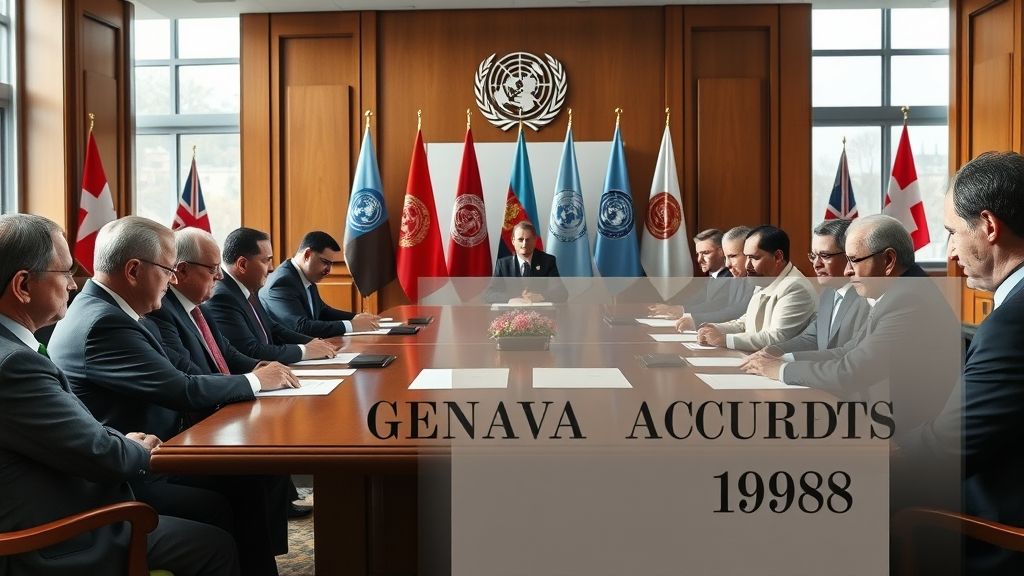
In the chill of a crisp Swiss spring morning, as dawn painted the snow-capped Alps with a faint golden light, a fragile hope took form in the neutral city of Geneva. On April 14, 1988, the world’s attention quietly converged on a solemn chamber where representatives from Afghanistan, Pakistan, the Soviet Union, and the United States inked a set of agreements that promised an end to one of the most brutal proxy wars of the Cold War era. The Geneva Accords on Afghanistan were presented as a beacon of diplomacy in an otherwise bleak landscape scarred by a decade of conflict, destruction, and human suffering. But beneath the formal signatures and diplomatic language lay layers of complexity, contradictions, and the seeds of future turmoil.
Geneva, a city known for its tranquil international diplomacy, had rarely been the stage for peace talks of such profound consequence. Yet here were actors deeply entrenched in a conflict that had reshaped global power dynamics and devastated an entire nation. The signing marked not an end, but a pivotal turning point—an uneasy truce forged by exhaustion, geopolitical interests, and battered hopes for a stable Afghan future.
Afghanistan in the 1980s: A Nation Torn Apart
To understand the weight of the Geneva Accords, one must first witness the turmoil that had engulfed Afghanistan throughout the 1980s. The near-decade-long Soviet invasion, launched in December 1979, had transformed Afghanistan from a mostly agrarian society into a hardened battlefield. Cities were bombed, villages razed, and a generation of Afghans was brutalized by a foreign occupation and a ferocious insurgency.
Afghanistan in the 1980s was not a single story of invaders and resistance but a fragmented mosaic of ethnic groups, tribes, ideologies, and political alliances. The communist government, installed and backed by Moscow, struggled to maintain control amidst deep-rooted tribal dissent and a fierce Islamist rebellion that drew on a powerful well of religious conviction and foreign support. The country’s mountainous terrain became a natural fortress, providing Mujahideen fighters sanctuaries and complicating the Soviet military’s efforts.
Words like “proxy war” and “Cold War battlefield” often reduce the conflict to abstractions, but for those who lived through it, it was an agonizing saga of betrayals, alliances, hope, and despair.
The Soviet Invasion: Origins and Escalation
The Soviet Union’s military intervention was initially rationalized as a support mission to a communist regime under threat from insurgent forces. Yet, the roots went deeper, tied to the Brezhnev Doctrine’s resolve not to lose influence in a key strategic region. The invasion aimed to stabilize Afghanistan politically, but instead triggered widespread resistance.
Over the following years, more than 100,000 Soviet troops were deployed, turning the country into a quagmire. The prolonged conflict drained Soviet resources, morale, and global prestige. Their military strategy, often harsh and indiscriminate, alienated the local population further and hardened resistance. The Soviets found themselves embroiled in a drawn-out war without a clear exit strategy, echoing the Vietnam War’s stalemate.
Global Stakes and Cold War Rivalries
The Afghan conflict was not confined to its borders. It became a proxy arena for Cold War rivalries, with the United States and its allies funneling support to the Mujahideen, while the Soviet Union supplied the Afghan government troops. Pakistan, in particular, under General Zia-ul-Haq, became a critical conduit, providing training, arms, and sanctuary for Afghan fighters.
This international dimension added layers of complexity to negotiations. For the US, backing the Mujahideen was part of a broader strategy of containing Soviet influence. For Pakistan, Afghanistan was a vital buffer and ally in its own strategic calculations. The USSR, on the defensive, sought a diplomatic means to withdraw honorably without leaving the communist government vulnerable to collapse.
The Mujahideen Resistance: Heroes and Complexities
The Mujahideen fighters—Islamic guerrilla groups united by the goal of expelling Soviet forces—became iconic resistance heroes in the West and the Muslim world. Their religious fervor combined with nationalism galvanized disparate factions. Yet these groups were far from a monolith. Rivalries, ideological differences, and ethnic divisions complicated their unity.
Figures like Ahmad Shah Massoud, Gulbuddin Hekmatyar, and others played both heroic and controversial roles. Foreign fighters and funding flooded in, transforming the conflict into a global jihadist magnet, setting the stage for future extremism. Still, for many Afghans, the Mujahideen symbolized resistance, dignity, and the hope for self-determination.
The Human Cost: Refugees, Casualties, and a Broken Society
By 1988, the humanitarian toll was staggering. Over 1.5 million Afghan civilians estimated dead or wounded. More than 6 million refugees had fled mainly into Pakistan and Iran, creating massive refugee camps and destabilizing the region. Children were orphaned or forced into combat. Traditional societal structures were disrupted, education crippled, and economies shattered.
This suffering became a central moral and political issue. The Geneva Accords were not just a diplomatic document but a potential lifeline to millions caught in the crossfire.
Early Attempts at Negotiation: The Road to Geneva
Before the Geneva Accords, numerous attempts to mediate and negotiate peace had faltered. Regional tensions, distrust among parties, and conflicting objectives stalled progress. The United Nations played a discreet but persistent role, proposing frameworks and hosting discussions.
The breakthrough came with a gradual recognition that military victory was impossible, and that a negotiated settlement was essential for Soviet withdrawal and regional stability. The complexity of the talks reflected the intricate web of local, regional, and global concerns.
Key Players Arrive: From Washington to Moscow to Kabul
The negotiating table was set with prominent figures who carried heavy diplomatic weight. From the Soviet side came representatives intent on salvaging Soviet prestige while extricating their forces. The United States delegation balanced its anti-communist stance with the need for a diplomatic exit.
Afghan government delegations faced the impossible task of protecting their fragile regime. Pakistan, as a principal regional player and supporter of the Mujahideen, exerted pressure but also sought to avoid escalation.
Each character brought their own agendas, fears, and hopes, shaping a delicate dance of diplomacy.
The Anatomy of the Geneva Accords: Provisions and Promises
The accords, in their careful wording, outlined the parameters for the Soviet withdrawal, non-interference from foreign powers, and the principle of non-intervention in Afghan internal affairs. They called for respect for Afghanistan’s sovereignty and the voluntary return of refugees.
Importantly, the agreements did not include the Mujahideen as direct signatories, reflecting the complicated internal dynamics. The accords were essentially a pact between states, leaving the Afghan people’s fate uncertain.
The Secret Talks and Public Declarations
Behind closed doors, intense negotiations featured compromises, disagreements, and strategic posturing. Publicly, the accords were hailed as a victory for peace and diplomacy. Yet, beneath this optimistic facade, doubts simmered about implementation, enforcement, and the sincerity of all parties.
The secrecy mirrored the sensitivity of the matter: too much exposure risked derailing progress or provoking internal opposition.
The Role of Pakistan and the United States
Pakistan’s role was indispensable. Its support for Mujahideen factions placed it in an ambiguous position—both sponsor and mediator. The Geneva framework required Islamabad to guarantee no interference after Soviet withdrawal—a condition fraught with challenges.
The United States, under the Reagan administration, cautiously endorsed the accords while maintaining covert support to resistance forces, underscoring the ambiguity that would shadow future peace prospects.
The Soviet Withdrawal: A Moment of Reckoning
Perhaps the most tangible outcome of the accords was the planned phased Soviet military pull-out, completed by February 1989. This massive logistical undertaking symbolized the USSR’s retreat from a conflict that had drained both resources and morale.
For Soviet soldiers and commanders alike, the withdrawal was a bittersweet return home from a war many saw as futile. It also heralded the beginning of a new and uncertain phase for Afghanistan.
Reactions Inside Afghanistan: Hope, Skepticism, Tensions
Within Afghanistan, reactions were mixed. The government hoped to consolidate power but faced a resilient and increasingly empowered insurgency. Civilians were caught between the two sides, wary of further violence but yearning for peace.
Skepticism about the accords’ ability to deliver stability was widespread—as was the fear that the withdrawal might spark an even bloodier civil war.
Aftermath in the Region: Pakistan, Iran, and Beyond
Neighboring countries watched closely. Pakistan anticipated gains but worried about spillover instability. Iran, with its own interests in Afghanistan’s Shia minorities, maneuvered diplomatically and militarily.
The broader region faced the blowback of decades-long conflict: refugee crises, the rise of militancy, and shifting alliances that would shape the 1990s geopolitical landscape.
The United Nations’ Involvement and Peacekeeping Efforts
The UN’s role, while limited in military capacity, was crucial in mediating the accords and organizing monitoring mechanisms. The United Nations Good Offices Mission in Afghanistan and Pakistan (UNGOMAP) was established to oversee compliance, though its effectiveness was often questioned.
This early effort laid groundwork for future international peace missions in conflict zones.
The Failure of Peace? Renewed Civil War and Fragmentation
Despite the hopeful promises, the Geneva Accords failed to bring lasting peace. After the Soviet withdrawal, Afghanistan descended into a vicious civil war as Mujahideen factions vied for power, leaving a fractured country vulnerable to further foreign intervention.
The accords’ inability to integrate opposing factions or enforce disarmament revealed the limitations of diplomacy divorced from ground realities.
The Legacy of the Geneva Accords in Afghanistan’s Turbulent History
In hindsight, the Geneva Accords stand as a complex symbol—both a diplomatic achievement and a cautionary tale. They represent the limits of international agreements in resolving deep internal conflicts, especially when key stakeholders remain excluded.
Yet, they also mark the first formal step toward ending foreign military occupation, a moment of diplomatic breakthrough amidst decades of chaos.
Lessons from Geneva: Diplomacy in the Shadow of War
The Geneva experience offers valuable insights about negotiation under duress, the importance of inclusive dialogue, and the challenges of peacebuilding in proxy conflicts. It underscores the delicate balance between geopolitical interests and the will of local populations.
These lessons resonate in contemporary conflict resolution efforts worldwide.
Voices from the Ground: Personal Stories and Testimonials
Afghan refugees, Soviet veterans, diplomats, and local officials have all shared memories of the events surrounding the accords. Stories of hunger, fear, cautious optimism, and heartbreak lend a deeply human perspective often missing from official records.
One Soviet officer recalled, “We left with heavy hearts, knowing we had not won, but knowing we had to leave.” An Afghan woman refugee spoke of hope yet despair, “We wished for peace, but the guns never stopped.”
The Geneva Accords’ Impact on International Law and Refugees
The accords highlighted obligations toward refugees and non-interference, influencing later international humanitarian law. They drew attention to the plight of millions displaced and set precedents for how the international community might respond.
But the persistent instability also exposed the limitations of legal frameworks in conflict zones.
Remembering April 14, 1988: Commemoration and Memory
Every year, Afghan communities, diaspora groups, and historians reflect on the accords’ anniversary. It is a day mixed with reflection on the cost of conflict and the elusive quest for peace.
Memorials in Geneva and Kabul remind the world of the fragile promises signed amid towering Alps and distant mountains.
Conclusion: A Fragile Promise in the Mountainous Heart of Asia
The Geneva Accords of April 14, 1988, encapsulated a moment suspended in hope and uncertainty. They signified the weary acknowledgment of war’s futility and a diplomatic attempt to craft a path forward. Yet the turbulence that followed revealed how peace is more than treaties—it is the patient weaving together of trust, justice, and reconciliation.
For Afghanistan, a land of rugged resilience and enduring spirit, the accords were a chapter in a long, tragic, and ongoing saga where the mountain winds carried both the echoes of conflict and the whisper of peace still to come.
FAQs on the Geneva Accords and Afghanistan
Q1: What triggered the negotiation of the Geneva Accords in 1988?
A1: After nearly a decade of Soviet military intervention and an unwinnable war, combined with growing international pressure and humanitarian concerns, the main parties saw a diplomatic resolution as necessary. The USSR sought an honorable withdrawal, while the US and Pakistan wanted to manage the conflict’s aftermath to contain Soviet influence.
Q2: Who were the signatories of the Geneva Accords?
A2: The accords were signed by representatives of Afghanistan, Pakistan, the Soviet Union, and the United States. Notably, the Afghan Mujahideen factions were not direct signatories, which affected the accords’ implementation.
Q3: Did the Geneva Accords end the Afghan war immediately?
A3: No. While the accords led to the Soviet withdrawal in 1989, they did not end the internal conflict in Afghanistan, which soon escalated into a devastating civil war among rival factions.
Q4: What role did Pakistan play in the Geneva negotiations?
A4: Pakistan was a critical regional player, hosting Mujahideen fighters and supplying aid. It participated in negotiations to ensure its interests and regional stability, although its support for resistance groups complicated post-accord peace efforts.
Q5: How did the people of Afghanistan react to the Geneva Accords?
A5: Reactions were mixed—some hoped for peace and stability, while many were skeptical due to continued violence and exclusion of insurgent groups from negotiations. Civilians bore the brunt of ongoing conflict despite diplomatic promises.
Q6: What was the United Nations’ involvement in the Geneva Accords?
A6: The UN facilitated the negotiation process and established monitoring mechanisms like UNGOMAP to oversee compliance and encourage refugee repatriation, though with limited enforcement power.
Q7: Why did the Geneva Accords fail to bring lasting peace?
A7: The key reasons include the exclusion of major insurgent factions from the agreement, ongoing geopolitical rivalries, lack of effective enforcement, and deep internal divisions within Afghanistan.
Q8: What is the lasting legacy of the Geneva Accords?
A8: The accords symbolize a landmark diplomatic effort to end a proxy war and bring about peace by peaceful means, but also highlight the complexities of resolving conflicts where multiple internal and external actors are involved.