Table of Contents
- Introduction
- The World in 1944
- Why Bretton Woods Was Needed
- The Players and Delegates
- Key Objectives of the Conference
- Formation of the IMF
- Creation of the World Bank
- The U.S. Dollar as Global Anchor
- Controversies and Negotiation Battles
- The Gold Exchange Standard
- Long-Term Economic Vision
- Bretton Woods’ Impact on Global Trade
- Criticism and Limitations
- Decline and Collapse of the System
- Legacy and Influence Today
- Conclusion
- External Resource
- Internal Link
1. Introduction
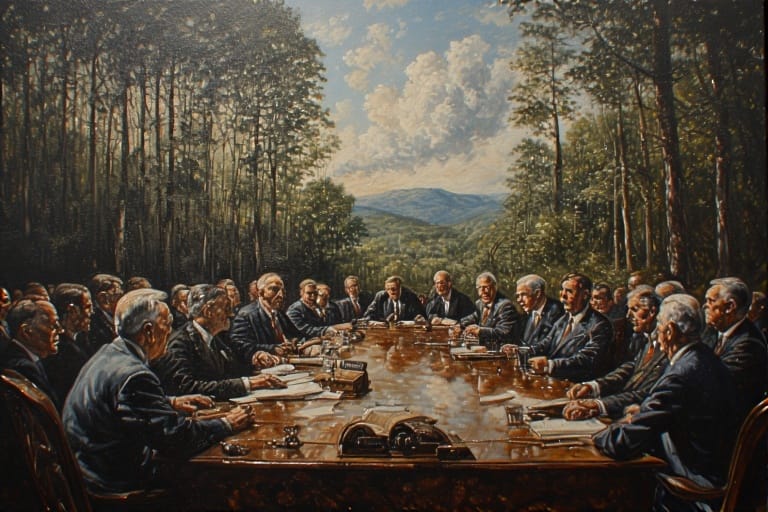
On July 1, 1944, in the quiet town of Bretton Woods, New Hampshire, 730 delegates from 44 Allied nations gathered for an ambitious goal: to reshape the international monetary system after the devastation of World War II. Over the next three weeks, they forged a blueprint for global economic stability that would influence the world for generations.
2. The World in 1944
✔️ Europe ravaged by war
✔️ Economies unstable and currencies volatile
✔️ The U.S. emerging as the dominant financial power
A new financial order was urgently needed to prevent future conflict.
3. Why Bretton Woods Was Needed
✔️ Avoid another Great Depression
✔️ Prevent currency devaluations and protectionism
✔️ Facilitate international trade and reconstruction
The conference aimed to promote cooperation, not competition.
4. The Players and Delegates
✔️ John Maynard Keynes (UK)
✔️ Harry Dexter White (USA)
✔️ Representatives from 42 other nations
These minds debated and clashed, but shared a vision of a better economic future.
5. Key Objectives of the Conference
✔️ Establish a stable international monetary system
✔️ Create institutions to oversee financial flows
✔️ Prevent future financial crises
They wanted to build guardrails for global capitalism.
6. Formation of the IMF
✔️ International Monetary Fund founded to provide short-term lending
✔️ Promote exchange rate stability
✔️ Assist countries with balance of payment issues
The IMF became a watchdog of global currencies.
7. Creation of the World Bank
✔️ Originally called the International Bank for Reconstruction and Development
✔️ Provide loans for rebuilding infrastructure
✔️ Focus on long-term development
The World Bank was born to help rebuild and modernize war-torn nations.
8. The U.S. Dollar as Global Anchor
✔️ Dollar pegged to gold
✔️ Other currencies pegged to the dollar
✔️ U.S. held most of the world’s gold reserves
This made the dollar the central pillar of post-war finance.
9. Controversies and Negotiation Battles
✔️ Keynes favored an international currency (“bancor”)
✔️ U.S. pushed for dollar dominance
✔️ Compromises shaped final agreements
Diplomacy and pragmatism ruled the day.
10. The Gold Exchange Standard
✔️ Currencies pegged to the dollar
✔️ Dollar convertible to gold at $35/oz
✔️ Provided confidence and predictability
This system lasted for nearly 30 years before collapsing.
11. Long-Term Economic Vision
✔️ Encourage trade and development
✔️ Reduce economic inequality between nations
✔️ Foster cooperation instead of conflict
Bretton Woods wasn’t just about banks—it was about building a peaceful world.
12. Bretton Woods’ Impact on Global Trade
✔️ Lowered barriers to trade
✔️ Stabilized currencies
✔️ Boosted post-war recovery
It helped rebuild shattered economies and connect markets.
13. Criticism and Limitations
✔️ System overly reliant on the U.S. economy
✔️ Excluded Soviet bloc countries
✔️ Developing nations had limited influence
Still, it provided structure in a chaotic time.
14. Decline and Collapse of the System
✔️ U.S. deficits and inflation eroded confidence
✔️ In 1971, Nixon ended dollar convertibility to gold
✔️ Floating exchange rates replaced the fixed system
By 1973, Bretton Woods was officially over.
15. Legacy and Influence Today
✔️ IMF and World Bank still operate globally
✔️ Inspired future economic frameworks
✔️ Guided rebuilding of Europe and Japan
Its DNA lives on in modern international financial architecture.
16. Conclusion
The Bretton Woods Conference was more than a summit—it was a turning point in global economic history. In a world shattered by war, nations came together to design a system based on cooperation, rules, and shared prosperity. While the original framework has changed, the institutions it birthed remain central to managing the complexities of the global economy.
17. External Resource
🌐 Wikipedia: Bretton Woods Conference